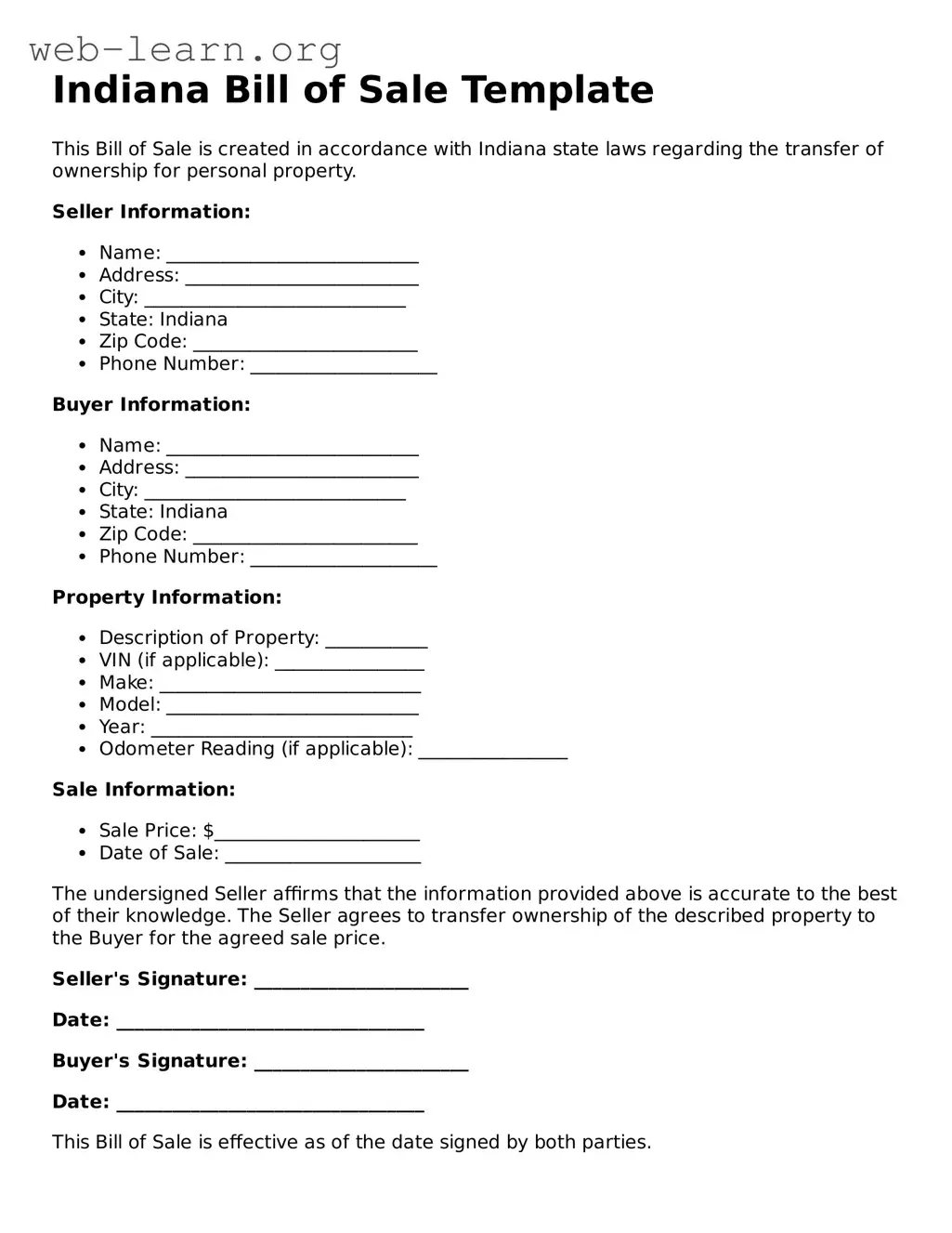
The Indiana Bill of Sale form serves as a crucial document in the transfer of ownership for various types of personal property, including vehicles, boats, and other goods. This form provides essential information that both the seller and buyer need to ensure a smooth transaction. Key elements typically included are the names and addresses of both parties, a detailed description of the item being sold, and the purchase price. Additionally, the form may outline any warranties or conditions related to the sale, ensuring that both parties are clear on their rights and responsibilities. Signatures from both the seller and buyer are often required to validate the transaction, making the Bill of Sale a legally binding agreement. In Indiana, having a properly completed Bill of Sale can help protect both parties in case of disputes and serves as a record of the transaction for future reference.
Indiana Bill of Sale Template
This Bill of Sale is created in accordance with Indiana state laws regarding the transfer of ownership for personal property.
Seller Information:
Buyer Information:
Property Information:
Sale Information:
The undersigned Seller affirms that the information provided above is accurate to the best of their knowledge. The Seller agrees to transfer ownership of the described property to the Buyer for the agreed sale price.
Seller's Signature: _______________________
Date: _________________________________
Buyer's Signature: _______________________
Date: _________________________________
This Bill of Sale is effective as of the date signed by both parties.
| Fact Name | Description |
|---|---|
| Purpose | The Indiana Bill of Sale form is used to document the transfer of ownership of personal property from one party to another. |
| Governing Law | This form is governed by Indiana Code Title 26, Article 1, which outlines the laws regarding the sale of goods and personal property. |
| Required Information | The form typically requires details such as the names and addresses of the buyer and seller, a description of the item being sold, and the sale price. |
| Notarization | While notarization is not mandatory for all transactions, it is recommended for added legal protection and to verify the identities of the parties involved. |
| Usage | This form is commonly used for the sale of vehicles, boats, and other significant personal property items in Indiana. |
Once you have the Indiana Bill of Sale form ready, you can begin filling it out with the necessary information. Ensure that all details are accurate to avoid any issues later on.
What is an Indiana Bill of Sale?
An Indiana Bill of Sale is a legal document that serves as proof of the transfer of ownership of personal property from one party to another. This form is commonly used for transactions involving vehicles, boats, and other tangible items. It outlines the details of the sale, including the description of the item, the sale price, and the names and addresses of both the buyer and seller.
Is a Bill of Sale required in Indiana?
While a Bill of Sale is not legally required for all transactions in Indiana, it is highly recommended. Having a Bill of Sale provides both the buyer and seller with a record of the transaction, which can be useful for tax purposes, registration, and in case of disputes. For vehicle sales, the Indiana Bureau of Motor Vehicles (BMV) requires a Bill of Sale for certain transactions.
What information should be included in the Bill of Sale?
A comprehensive Bill of Sale should include the following information:
Do I need to have the Bill of Sale notarized?
In Indiana, notarization is not required for a Bill of Sale to be valid. However, having the document notarized can add an extra layer of security and authenticity. This may be particularly important in transactions involving significant amounts of money or valuable items.
Can I use a generic Bill of Sale template?
Yes, you can use a generic Bill of Sale template, but it is essential to ensure that it meets Indiana's legal requirements. Templates can be found online, but they should be customized to reflect the specifics of your transaction. It is advisable to verify that the template includes all necessary information and complies with state laws.
What should I do after completing the Bill of Sale?
After completing the Bill of Sale, both the buyer and seller should retain a copy for their records. The seller should also provide the buyer with any additional documentation related to the item, such as titles or registration papers, if applicable. For vehicle sales, the buyer will need the Bill of Sale when registering the vehicle with the Indiana BMV.
What if the item sold is defective or not as described?
In Indiana, the Bill of Sale can include specific clauses regarding the condition of the item. If the item is sold "as is," the seller may not be held responsible for defects. However, if the seller made specific representations about the item that are proven false, they could be liable for misrepresentation. It is important to clearly outline any conditions or warranties in the Bill of Sale.
Can I cancel a Bill of Sale?
Once a Bill of Sale is signed and the transaction is completed, it generally cannot be canceled unilaterally. However, if both parties agree to void the transaction, they can create a mutual release agreement. This agreement should be documented in writing to avoid any future disputes.
Where can I find an Indiana Bill of Sale form?
Indiana Bill of Sale forms can be obtained from various sources. They are available at local government offices, online legal form websites, and through legal stationery stores. Ensure that the form you choose is specific to Indiana and tailored to your particular type of transaction.
Filling out the Indiana Bill of Sale form can seem straightforward, but many individuals encounter common pitfalls that can lead to complications down the line. Understanding these mistakes can help ensure that the transaction is valid and legally binding.
One frequent error is failing to provide complete information about the buyer and seller. Both parties must include their full names, addresses, and contact information. Omitting any of these details can create confusion and may even jeopardize the validity of the sale.
Another common mistake is neglecting to accurately describe the item being sold. The Bill of Sale should include a detailed description, such as the make, model, year, and Vehicle Identification Number (VIN) for vehicles. Without this information, it becomes difficult to identify the item, which can lead to disputes later on.
Many people also forget to include the sale price. It’s essential to state the agreed-upon amount clearly. Leaving this blank or writing an ambiguous figure can cause problems if either party disputes the terms of the sale.
Additionally, some individuals do not date the Bill of Sale. A date is crucial as it establishes when the transaction took place. Without a date, it can be challenging to prove when ownership changed hands, which is especially important for legal and tax purposes.
Not signing the document is another common oversight. Both the buyer and seller must sign the Bill of Sale for it to be valid. A signature signifies that both parties agree to the terms outlined in the document. Without signatures, the form may be considered incomplete.
People often forget to check the form for any errors after filling it out. Simple mistakes, such as typos or incorrect information, can lead to significant issues. Taking a moment to review the document before submission can save a lot of trouble later.
Another mistake is not keeping a copy of the Bill of Sale. Once the transaction is complete, both parties should retain a copy for their records. This documentation can be vital for future reference, especially if any disputes arise.
Some individuals also overlook the need for witnesses or notarization, depending on the nature of the sale. While not always required, having a witness or notarizing the document can provide additional protection and legitimacy to the transaction.
Lastly, people sometimes fail to understand the implications of the Bill of Sale. It is not just a receipt; it transfers ownership and can affect taxes and liabilities. Understanding the full scope of what the document entails is crucial for both the buyer and seller.
When completing a transaction in Indiana, especially for the sale of a vehicle or personal property, several additional documents may be necessary. These documents help ensure that the sale is valid and protect both the buyer and seller. Here’s a list of some commonly used forms alongside the Indiana Bill of Sale.
Using these documents in conjunction with the Indiana Bill of Sale helps to create a clear and legally binding transaction. Always ensure that all forms are completed accurately to protect your interests in the sale.
The Bill of Sale is an important document in various transactions, particularly when it comes to the transfer of ownership of goods. Several other documents serve similar purposes, providing proof of ownership or detailing the terms of a transaction. Here are eight documents that share similarities with the Bill of Sale:
Understanding these documents and their similarities to the Bill of Sale can help individuals navigate transactions more effectively. Each serves a unique purpose while contributing to the overall clarity and legality of ownership transfers.
When filling out the Indiana Bill of Sale form, it is important to approach the task with care. This document serves as a record of the transaction between a buyer and a seller. Below are some essential dos and don'ts to consider during this process.
By following these guidelines, you can ensure that your Bill of Sale is properly filled out, protecting both parties involved in the transaction.
When it comes to the Indiana Bill of Sale form, there are several misconceptions that can lead to confusion. Let’s clear up some of these misunderstandings.
Many people think a Bill of Sale is only necessary for selling cars. In reality, it can be used for any item of value, such as boats, furniture, or electronics.
While notarization isn’t always required, having a notary can add an extra layer of protection and authenticity to the transaction.
A receipt is simply proof of purchase, while a Bill of Sale serves as a legal document outlining the terms of the sale.
Both the buyer and seller should sign the Bill of Sale to ensure that both parties agree to the terms of the sale.
When properly filled out and signed, a Bill of Sale is a legally binding document that can be used in court if disputes arise.
Even if you’re giving an item as a gift, having a Bill of Sale can help clarify ownership and avoid future disputes.
Businesses can also use a Bill of Sale when selling items to customers. It’s useful for both private and commercial transactions.
Each state has its own rules and requirements for a Bill of Sale, so it’s important to use the correct form for Indiana.
A Bill of Sale should include specific details about the item, such as its condition, serial number, and sale price, to avoid misunderstandings.
While it’s best to get it right the first time, if both parties agree, changes can be made to the Bill of Sale before the transaction is finalized.
Understanding these misconceptions can help you navigate the process of buying or selling items in Indiana with confidence. Always take the time to ensure that your Bill of Sale is complete and accurate.
When filling out and using the Indiana Bill of Sale form, it is essential to understand several key points to ensure a smooth transaction. Below are important takeaways to consider:
Understanding these key points will help facilitate a successful transaction when using the Indiana Bill of Sale form.
Auto Bill of Sale Colorado - A Bill of Sale can be modified to include additional terms or conditions as needed.
Proof of Ownership Car - Both parties should review the Bill of Sale carefully before signing to ensure accuracy.
How to Sell a Car in Hawaii - The document can provide peace of mind for both the buyer and seller.
Connecticut Dmv Bill of Sale - A Bill of Sale can be an effective way to keep track of personal property sales over time.