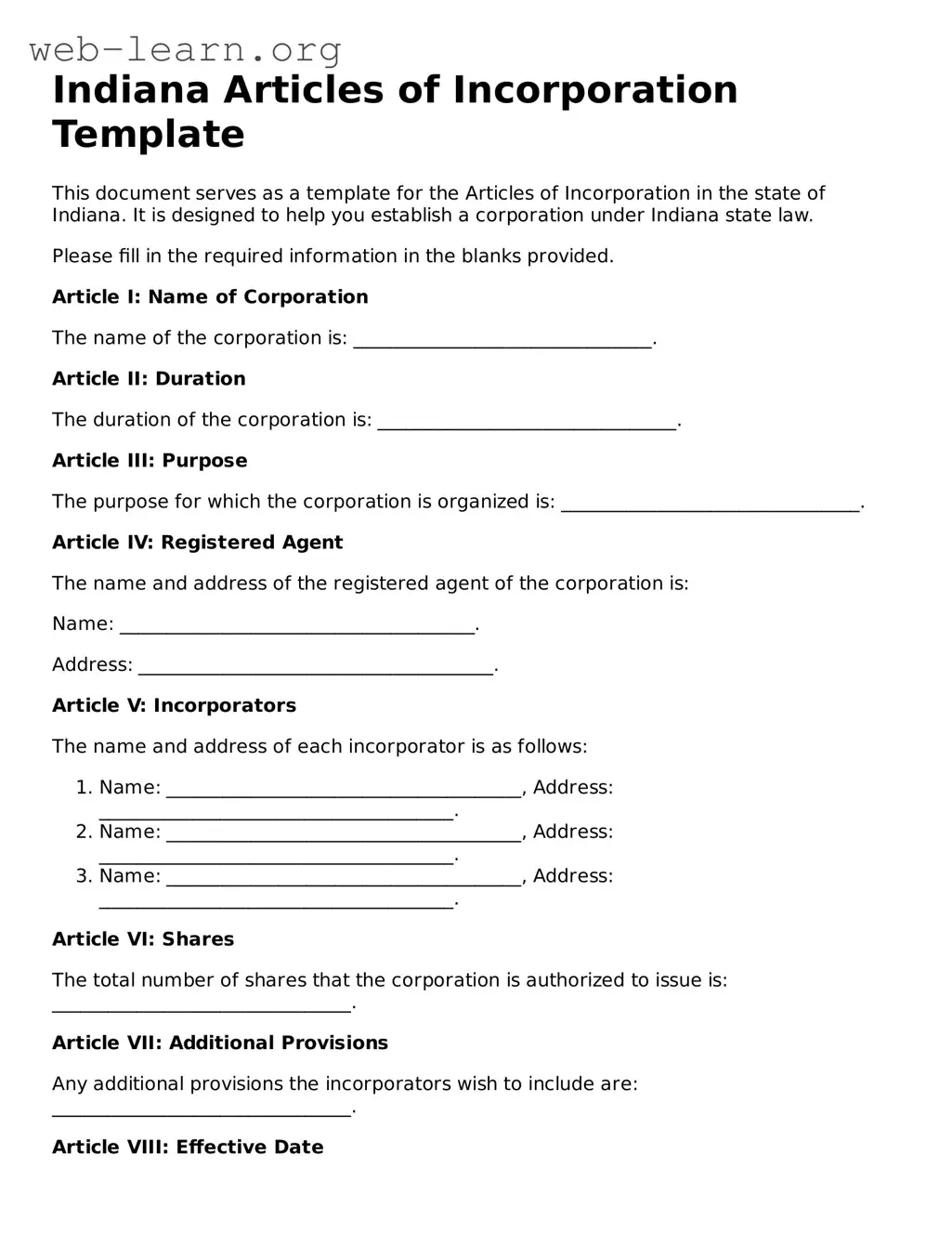
When starting a business in Indiana, one of the first steps is to complete the Articles of Incorporation form. This essential document lays the groundwork for your corporation, establishing its legal existence in the state. It includes key information such as the corporation's name, which must be unique and comply with state naming regulations. Additionally, the form requires the designation of a registered agent, who will act as the official point of contact for legal documents. You’ll also need to provide details about the corporation's purpose, which can be broad but should reflect the nature of your business activities. The number of shares the corporation is authorized to issue must be specified, along with the par value of those shares, if applicable. Finally, the form must be signed by the incorporators, who are responsible for filing the document with the Indiana Secretary of State. Completing this form accurately is crucial, as it ensures your corporation is recognized legally and can operate within the state’s regulations.
Indiana Articles of Incorporation Template
This document serves as a template for the Articles of Incorporation in the state of Indiana. It is designed to help you establish a corporation under Indiana state law.
Please fill in the required information in the blanks provided.
Article I: Name of Corporation
The name of the corporation is: ________________________________.
Article II: Duration
The duration of the corporation is: ________________________________.
Article III: Purpose
The purpose for which the corporation is organized is: ________________________________.
Article IV: Registered Agent
The name and address of the registered agent of the corporation is:
Name: ______________________________________.
Address: ______________________________________.
Article V: Incorporators
The name and address of each incorporator is as follows:
Article VI: Shares
The total number of shares that the corporation is authorized to issue is: ________________________________.
Article VII: Additional Provisions
Any additional provisions the incorporators wish to include are: ________________________________.
Article VIII: Effective Date
This document shall be effective on: ________________________________.
Signature
Incorporator Signature: ________________________________.
Date: ________________________________.
By completing this template, you are taking the first step toward forming your corporation in Indiana. Ensure that all information is accurate and complete before submission.
| Fact Name | Details |
|---|---|
| Purpose | The Indiana Articles of Incorporation form is used to create a corporation in the state of Indiana. |
| Governing Law | This form is governed by Indiana Code Title 23, Article 1. |
| Filing Requirement | Filing the Articles of Incorporation with the Indiana Secretary of State is mandatory to establish a corporation. |
| Information Needed | Key details required include the corporation's name, registered agent, and business address. |
After completing the Indiana Articles of Incorporation form, the next step involves submitting it to the appropriate state office along with any required fees. This process will officially establish your corporation in Indiana.
What are the Articles of Incorporation?
The Articles of Incorporation is a legal document that establishes a corporation in the state of Indiana. It outlines essential information about the company, such as its name, purpose, registered agent, and the number of shares it is authorized to issue. This document is filed with the Indiana Secretary of State to formally create your corporation.
What information is required to complete the Articles of Incorporation?
To complete the Articles of Incorporation, you will need to provide several key details:
How do I file the Articles of Incorporation in Indiana?
Filing the Articles of Incorporation in Indiana can be done online or by mail. For online filing, visit the Indiana Secretary of State's website, where you can complete the form and submit it electronically. If you prefer to file by mail, print the completed form and send it to the appropriate address along with the required filing fee. Ensure that all information is accurate to avoid delays.
What is the filing fee for the Articles of Incorporation?
The filing fee for the Articles of Incorporation in Indiana varies depending on the type of corporation you are establishing. As of the latest information, the fee is typically around $90 for a standard corporation. However, it is wise to check the Indiana Secretary of State's website for the most current fee schedule, as fees can change.
How long does it take to process the Articles of Incorporation?
Processing times for the Articles of Incorporation can vary. Generally, online submissions are processed more quickly than those sent by mail. You can expect a turnaround time of approximately 5 to 10 business days for online filings, while mail submissions may take longer. If you need expedited processing, inquire about available options when filing.
What happens after my Articles of Incorporation are approved?
Once your Articles of Incorporation are approved, you will receive a certificate of incorporation from the Indiana Secretary of State. This document serves as proof that your corporation is officially recognized. After approval, you should consider obtaining an Employer Identification Number (EIN) from the IRS, setting up a corporate bank account, and complying with any local business licenses or permits required for your operations.
Filing the Indiana Articles of Incorporation is a crucial step for anyone looking to establish a corporation in the state. However, many individuals make common mistakes that can lead to delays or even rejection of their application. Understanding these pitfalls can save time and ensure a smoother incorporation process.
One frequent mistake is failing to provide a registered agent. Every corporation in Indiana must designate a registered agent who will receive legal documents on behalf of the corporation. Some applicants overlook this requirement or fail to provide accurate information about the agent. This can result in complications down the line, as the corporation may miss important legal notices.
Another common error is incomplete information about the corporation's purpose. The Articles of Incorporation require a statement of purpose, and many applicants either leave this section blank or write overly vague descriptions. It is essential to provide a clear and specific purpose to comply with state regulations and to inform stakeholders about the nature of the business.
Additionally, many people mistakenly omit the names and addresses of the initial directors. This information is necessary for the formation of the corporation. Failure to include it can lead to processing delays. Applicants should ensure that they list all required directors accurately, as this reflects the governance structure of the corporation.
Another error involves incorrectly stating the number of shares authorized. The Articles of Incorporation must specify the number of shares the corporation is authorized to issue. Some individuals either underestimate or overestimate this number, which can affect future fundraising efforts and ownership structure. It’s important to carefully consider the appropriate number of shares needed for the corporation's goals.
Lastly, many applicants neglect to sign and date the form. A signature is not just a formality; it signifies that the information provided is accurate and that the applicant is committed to the establishment of the corporation. Without a signature, the form is incomplete and will be returned, causing unnecessary delays in the incorporation process.
When forming a corporation in Indiana, the Articles of Incorporation is a crucial document. However, there are several other forms and documents that are often required or recommended to ensure compliance with state laws and to facilitate smooth business operations. Below is a list of these important documents.
Each of these documents plays a significant role in establishing and maintaining a corporation in Indiana. Ensuring that all necessary forms are completed accurately and submitted on time can help avoid legal complications and facilitate the smooth operation of your business.
When filling out the Indiana Articles of Incorporation form, careful attention to detail is essential. Here are five important dos and don'ts to consider:
Following these guidelines can help streamline the incorporation process and reduce the likelihood of delays or rejections.
Many individuals and organizations have misunderstandings about the Indiana Articles of Incorporation form. Here are eight common misconceptions:
Understanding these misconceptions can help individuals and businesses navigate the incorporation process more effectively.
Filling out and using the Indiana Articles of Incorporation form is a crucial step in establishing a business entity in the state. Here are some key takeaways to consider:
By paying careful attention to these elements, individuals can navigate the process of incorporating a business in Indiana more effectively.
Michigan Llc Filing - Specifies how corporate meetings will be conducted.
How Do I Get a Certificate of Good Standing - Specifies the rules for corporate record-keeping.
Articles of Incorporation Kentucky - The form may allow for amendments in the future if needed.