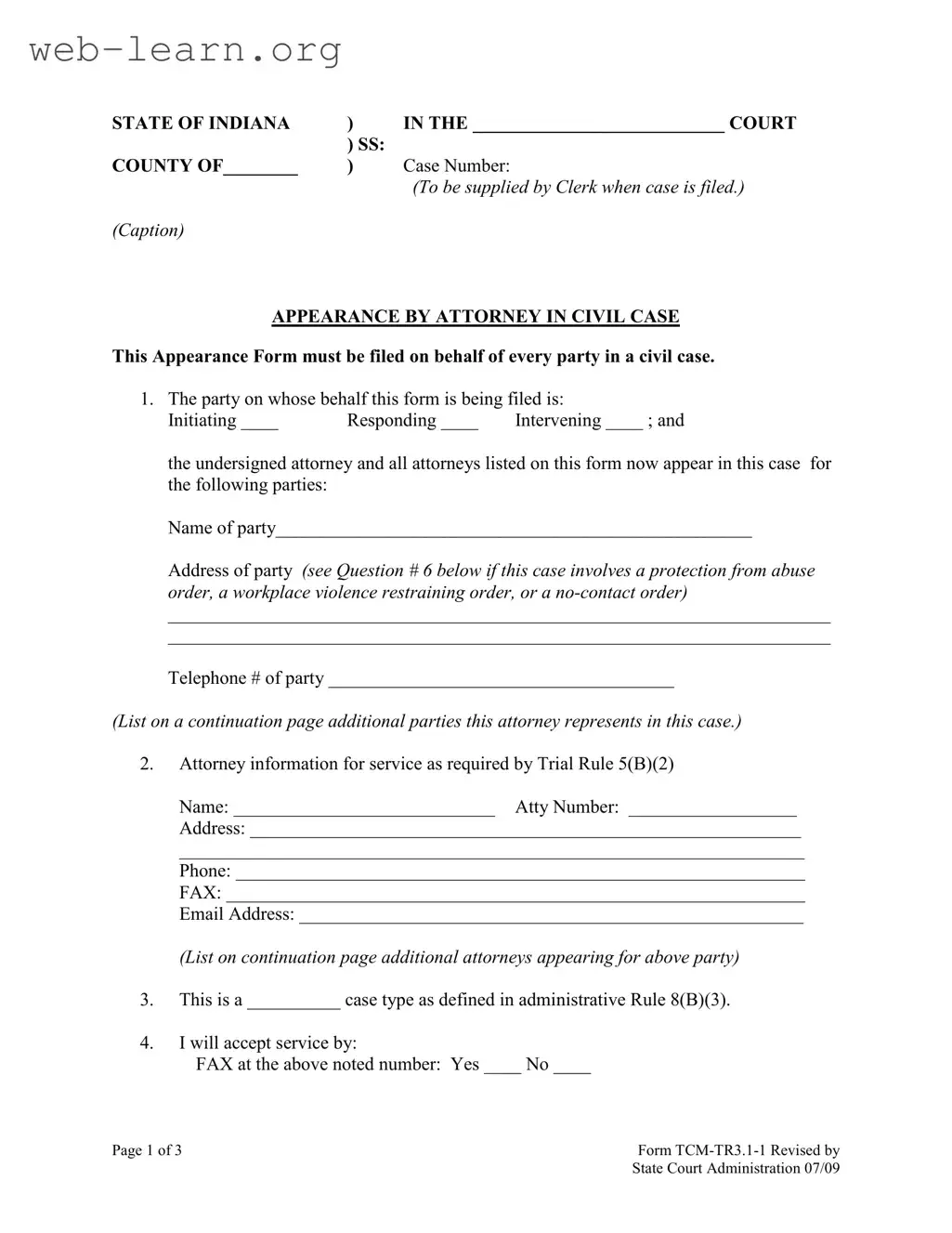
The Indiana Appearance form plays a crucial role in civil litigation within the state. This form must be filed on behalf of every party involved in a civil case, ensuring that all parties are officially represented. The form requires the attorney to indicate whether they are initiating, responding, or intervening in the case. Essential details about the party being represented, including their name, address, and contact information, must be provided. Additionally, the attorney's information is necessary for service of process, which includes their name, attorney number, and preferred methods of communication, such as fax and email. The form also addresses specific case types and issues, such as child support, protection from abuse orders, and involuntary commitment petitions. It is important to note whether there are related cases or additional party members involved, as this information can impact the proceedings. Finally, the form includes a certification that it has been served on all other parties, ensuring that the process adheres to the rules of civil procedure. Understanding the components of the Indiana Appearance form is essential for effective legal representation and compliance with court requirements.
STATE OF INDIANA |
) |
IN THE ___________________________ COURT |
|
) SS: |
|
COUNTY OF________ |
) |
Case Number: |
|
|
(To be supplied by Clerk when case is filed.) |
(Caption) |
|
|
APPEARANCE BY ATTORNEY IN CIVIL CASE This Appearance Form must be filed on behalf of every party in a civil case.
1. The party on whose behalf this form is being filed is:
Initiating ____ |
Responding ____ |
Intervening ____ ; and |
the undersigned attorney and all attorneys listed on this form now appear in this case for the following parties:
Name of party___________________________________________________
Address of party (see Question # 6 below if this case involves a protection from abuse order, a workplace violence restraining order, or a
_______________________________________________________________________
_______________________________________________________________________
Telephone # of party _____________________________________
(List on a continuation page additional parties this attorney represents in this case.)
2.Attorney information for service as required by Trial Rule 5(B)(2)
Name: ____________________________ Atty Number: __________________
Address: ___________________________________________________________
___________________________________________________________________
Phone: _____________________________________________________________
FAX: ______________________________________________________________
Email Address: ______________________________________________________
(List on continuation page additional attorneys appearing for above party)
3.This is a __________ case type as defined in administrative Rule 8(B)(3).
4.I will accept service by:
FAX at the above noted number: Yes ____ No ____
Page 1 of 3 |
Form |
|
State Court Administration 07/09 |
Email at the above noted number: Yes ____ No ____
5.This case involves child support issues. Yes ____ No ____ (If yes, supply social security numbers for all family members on a separately attached document filed as confidential information on light green paper. Use Form
6.This case involves a protection from abuse order, a workplace violence restraining order, or a no – contact order. Yes ____ No ____ (If Yes, the initiating party must provide an address for the purpose of legal service but that address should not be one that exposes the whereabouts of a petitioner.) The party shall use the following address for purposes of legal service:
________ |
Attorney’s address |
________ |
The Attorney General Confidentiality program address |
|
(contact the Attorney General at |
|
|
________ |
Another address (provide) |
______________________________________________________________
7.This case involves a petition for involuntary commitment. Yes ____ No ____
8.If Yes above, provide the following regarding the individual subject to the petition for involuntary commitment:
a.Name of the individual subject to the petition for involuntary commitment if it is not already provided in #1 above: ____________________________________________
b.State of Residence of person subject to petition: _______________
c.At least one of the following pieces of identifying information:
(i)Date of Birth ___________
(ii)Driver’s License Number ______________________
State where issued _____________ Expiration date __________
(iii)State ID number ____________________________
State where issued _____________ Expiration date ___________
(iv)FBI number __________________________
(v)Indiana Department of Corrections Number _______________________
(vi)Social Security Number is available and is being provided in an attached confidential document Yes ____ No ____
9.There are related cases: Yes ____ No ____ (If yes, list on continuation page.)
10.Additional information required by local rule:
_____________________________________________________________________
Page 2 of 3 |
Form |
|
State Court Administration 07/09 |
11.There are other party members: Yes ____ No____ (If yes, list on continuation page.)
12.This form has been served on all other parties and Certificate of Service is attached: Yes___ No___
_________________________________________
(Attorney information shown above.)
Page 3 of 3 |
Form |
|
State Court Administration 07/09 |
| Fact Name | Description |
|---|---|
| Purpose | The Indiana Appearance Form is used for attorneys to formally appear in civil cases on behalf of their clients. |
| Filing Requirement | Every party in a civil case must have this form filed by their attorney. |
| Governing Law | This form is governed by Indiana Trial Rules, specifically Trial Rule 5 and Administrative Rule 8. |
| Case Types | Attorneys must specify the type of case as defined in Administrative Rule 8(B)(3). |
| Service of Process | Attorneys can accept service via FAX or email, as indicated on the form. |
| Confidential Information | If the case involves child support, social security numbers must be submitted separately and confidentially. |
| Protection Orders | In cases involving protection orders, a safe address for legal service must be provided. |
| Related Cases | The form allows for the listing of any related cases, ensuring all relevant information is captured. |
Completing the Indiana Appearance form is a crucial step in civil cases. It ensures that all parties are properly represented and notified. Follow these steps carefully to ensure accurate completion of the form.
What is the purpose of the Indiana Appearance form?
The Indiana Appearance form is a legal document that must be filed in civil cases on behalf of each party involved. It serves to formally notify the court and all other parties of the attorney representing a party in the case. This ensures that all parties are aware of who is handling the legal matters on behalf of each party.
Who needs to file this form?
Every party involved in a civil case is required to have this form filed by their attorney. Whether you are initiating, responding, or intervening in a case, your attorney must submit this form to the court.
What information is required on the form?
The form requires several pieces of information, including:
What if my case involves child support issues?
If your case involves child support, you must indicate this on the form. Additionally, you are required to provide the social security numbers of all family members involved in a separate, confidential document. This document should be filed on light green paper using the specified form.
How should I handle confidentiality for sensitive information?
What is the Certificate of Service, and is it necessary?
The Certificate of Service is a declaration that the form has been served to all other parties involved in the case. This is an essential part of the filing process, as it ensures that everyone is informed about the representation and any developments in the case.
Are there any additional requirements I should be aware of?
Filling out the Indiana Appearance form can seem straightforward, but there are common mistakes that people often make. Recognizing these pitfalls can save time and ensure that the form is processed correctly. Here are five frequent errors to watch out for.
One significant mistake is failing to indicate the party's role in the case. The form requires you to specify whether the party is initiating, responding, or intervening. Omitting this information can lead to confusion and delays in the court's processing of the case. Always ensure that you check the appropriate box to clarify the party's involvement.
Another common error involves incomplete contact information. The form asks for the party's name, address, and telephone number. Leaving any of these fields blank can result in complications later. It is essential to provide accurate and complete details so that the court can reach the party when necessary.
Many individuals overlook the requirement to indicate the type of case. The form includes a section where you must specify the case type as defined in administrative Rule 8(B)(3). Failing to do this can lead to misclassification of the case, affecting how it is handled in court. Be sure to fill this out correctly to avoid unnecessary issues.
Additionally, some people neglect to confirm their acceptance of service methods. The form asks whether you will accept service by fax or email. If you do not provide a clear response, it may cause delays in communication regarding the case. Always check "Yes" or "No" for each service method to ensure clarity.
Lastly, many individuals forget to attach the required documents when necessary. For example, if the case involves child support issues, social security numbers must be provided on a separate confidential document. Failing to include these attachments can lead to the form being rejected. Always double-check that all required documents are included before submission.
The Indiana Appearance form is a crucial document in civil cases, ensuring that all parties are properly represented. Alongside this form, several other documents may be required to facilitate the legal process. Below are four commonly used forms that often accompany the Indiana Appearance form.
Understanding these documents and their purposes can streamline the legal process and ensure that all necessary information is presented to the court. Properly completing and submitting these forms is essential for effective legal representation in Indiana civil cases.
The Indiana Appearance form shares similarities with several other legal documents. Each document serves a specific purpose but often contains comparable elements regarding representation and case details. Here are six documents that are similar to the Indiana Appearance form:
When filling out the Indiana Appearance form, it is important to follow specific guidelines to ensure accuracy and compliance. Here are four key do's and don'ts:
Understanding the Indiana Appearance form is crucial for anyone involved in a civil case in Indiana. However, several misconceptions exist about this form. Here is a list of common misunderstandings:
By clarifying these misconceptions, individuals can better navigate the legal process and ensure compliance with the requirements of the Indiana Appearance form.
Filling out the Indiana Appearance form is an essential step for attorneys representing parties in civil cases. Here are some key takeaways to consider:
By following these guidelines, attorneys can ensure that the Indiana Appearance form is completed accurately and effectively, facilitating a smoother legal process.