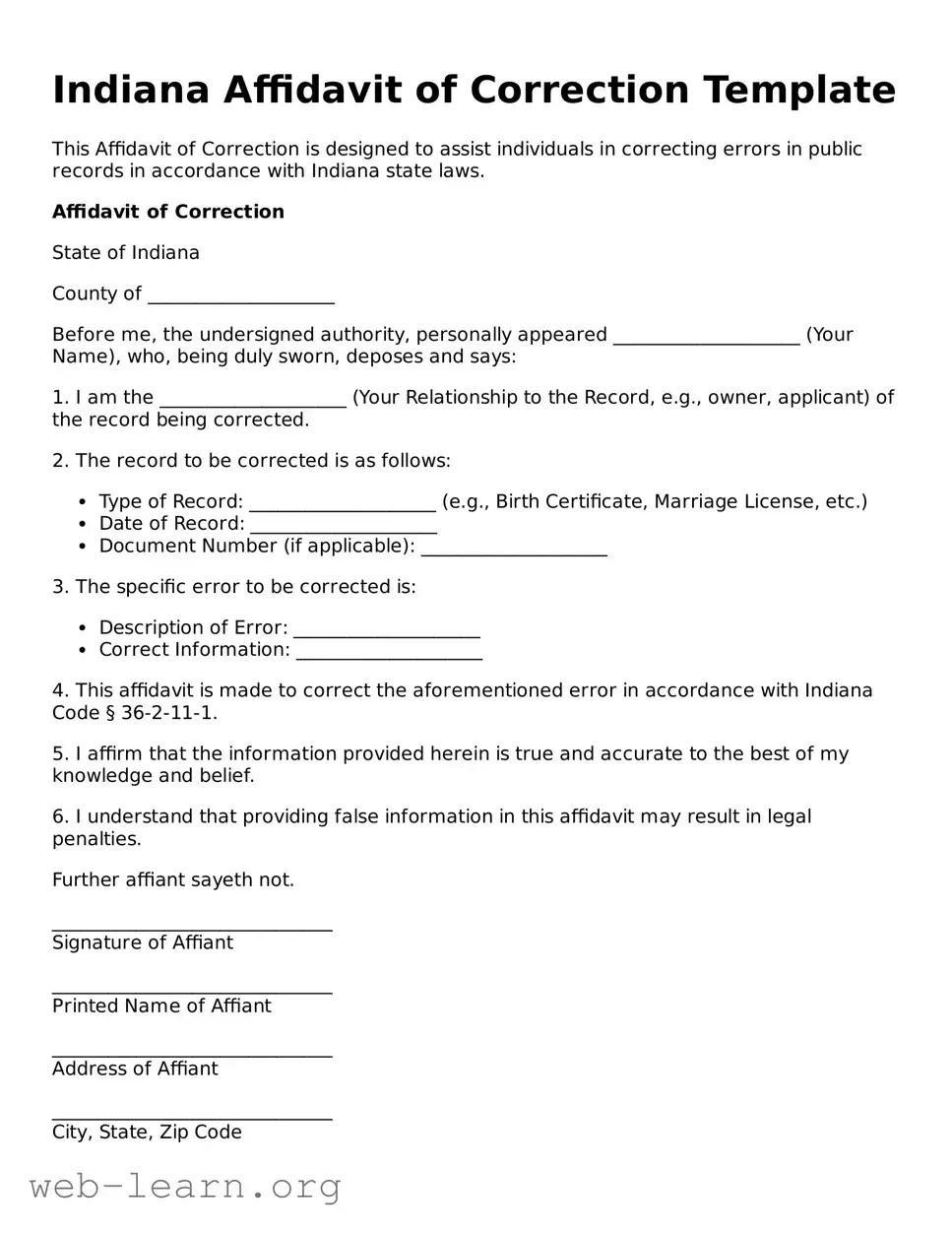
The Indiana Affidavit of Correction form serves as a vital tool for individuals seeking to amend or clarify information in public records. This legal document allows parties to address discrepancies or errors that may have occurred in various official filings, such as deeds, mortgages, or other recorded instruments. By utilizing this form, individuals can ensure that their records accurately reflect the intended information, thereby preventing potential legal complications in the future. The process typically involves providing specific details about the original document, the nature of the correction, and the reasons for the amendment. Furthermore, the affidavit must be signed and notarized, affirming the truthfulness of the information presented. Understanding the nuances of this form is essential for anyone looking to navigate the complexities of public record corrections in Indiana.
Indiana Affidavit of Correction Template
This Affidavit of Correction is designed to assist individuals in correcting errors in public records in accordance with Indiana state laws.
Affidavit of Correction
State of Indiana
County of ____________________
Before me, the undersigned authority, personally appeared ____________________ (Your Name), who, being duly sworn, deposes and says:
1. I am the ____________________ (Your Relationship to the Record, e.g., owner, applicant) of the record being corrected.
2. The record to be corrected is as follows:
3. The specific error to be corrected is:
4. This affidavit is made to correct the aforementioned error in accordance with Indiana Code § 36-2-11-1.
5. I affirm that the information provided herein is true and accurate to the best of my knowledge and belief.
6. I understand that providing false information in this affidavit may result in legal penalties.
Further affiant sayeth not.
______________________________
Signature of Affiant
______________________________
Printed Name of Affiant
______________________________
Address of Affiant
______________________________
City, State, Zip Code
______________________________
Date
Sworn to and subscribed before me this _____ day of ______________, 20__.
______________________________
Notary Public
My commission expires: ________________
| Fact Name | Description |
|---|---|
| Purpose | The Indiana Affidavit of Correction is used to correct errors in public records, ensuring that the information accurately reflects the intended details. |
| Governing Law | This form is governed by Indiana Code § 36-2-11-3, which outlines the procedures for correcting errors in official documents. |
| Eligibility | Any individual or entity who discovers an error in a recorded document may file an Affidavit of Correction to amend the record. |
| Filing Process | The completed affidavit must be filed with the appropriate county recorder's office, along with any required fees. |
| Impact | Once filed, the Affidavit of Correction serves to update the public record, helping to prevent potential disputes related to the inaccurate information. |
After obtaining the Indiana Affidavit of Correction form, it is essential to fill it out accurately to ensure that any necessary corrections are made efficiently. This process requires attention to detail and adherence to the guidelines provided in the form.
What is the Indiana Affidavit of Correction form?
The Indiana Affidavit of Correction form is a legal document used to correct errors in public records. This can include mistakes in property deeds, court documents, or other official filings. The purpose of this affidavit is to provide a clear and formal way to amend inaccuracies that could affect ownership, rights, or responsibilities.
Who can file an Affidavit of Correction in Indiana?
Typically, any party who has a vested interest in the document can file an Affidavit of Correction. This includes property owners, their legal representatives, or other stakeholders affected by the error. It’s important to ensure that the person filing has the authority to do so, as this will help avoid complications later on.
What information is needed to complete the form?
To complete the Indiana Affidavit of Correction form, you will need to provide specific details about the document that contains the error. This includes:
Additionally, the form must be signed by the person making the correction, and it may need to be notarized to validate the affidavit.
Where should the completed Affidavit of Correction be filed?
Once completed, the Indiana Affidavit of Correction should be filed with the same office where the original document was recorded. For property-related documents, this is usually the county recorder’s office. It’s advisable to keep a copy of the filed affidavit for your records, as it serves as proof of the correction made.
Filling out the Indiana Affidavit of Correction form can seem straightforward, but many people make common mistakes that can lead to delays or complications. One frequent error is failing to provide all required information. The form asks for specific details about the original document that needs correction. Omitting any of these details can result in the form being rejected or returned for additional information.
Another mistake is not signing the affidavit. A signature is crucial as it validates the document. Without a signature, the affidavit cannot be processed. Always double-check to ensure that you have signed the form before submission.
People often overlook the importance of using accurate and consistent information. If the name, date, or other details do not match the original document, it can create confusion. This inconsistency can lead to further complications, so it’s vital to cross-reference all information carefully.
Additionally, some individuals forget to include the required notary acknowledgment. The affidavit must be notarized to confirm the identity of the person signing it. Without this step, the affidavit will not hold legal weight, making it essential to find a notary before submitting the form.
Another common pitfall is neglecting to make copies of the completed affidavit. Keeping a copy for your records is important. If there are any issues later, having a copy can help clarify what was submitted and assist in resolving any problems.
Lastly, many people fail to check the submission guidelines. Each county may have different requirements for submitting the affidavit. Failing to follow these guidelines can lead to unnecessary delays. Always verify the submission process for your specific location to ensure a smooth correction.
The Indiana Affidavit of Correction form serves a specific purpose in the correction of public records. However, it is often accompanied by various other forms and documents to ensure the process is complete and compliant with state requirements. Below is a list of documents commonly used alongside the Affidavit of Correction.
Each of these documents plays a crucial role in ensuring that the correction process is handled properly and that all legal requirements are met. Understanding the purpose and necessity of each document can help individuals navigate the correction of public records more effectively.
When filling out the Indiana Affidavit of Correction form, attention to detail is crucial. Below are guidelines that outline what to do and what to avoid.
Things You Should Do:
Things You Shouldn't Do:
The Indiana Affidavit of Correction form is often misunderstood. Here are six common misconceptions surrounding this important document:
Understanding these misconceptions can help individuals navigate the process more effectively and ensure that they use the Indiana Affidavit of Correction form appropriately.
When dealing with the Indiana Affidavit of Correction form, it is essential to understand its purpose and how to properly fill it out. This form is typically used to correct errors in public records, ensuring that the information is accurate and up-to-date. Here are some key takeaways to keep in mind: