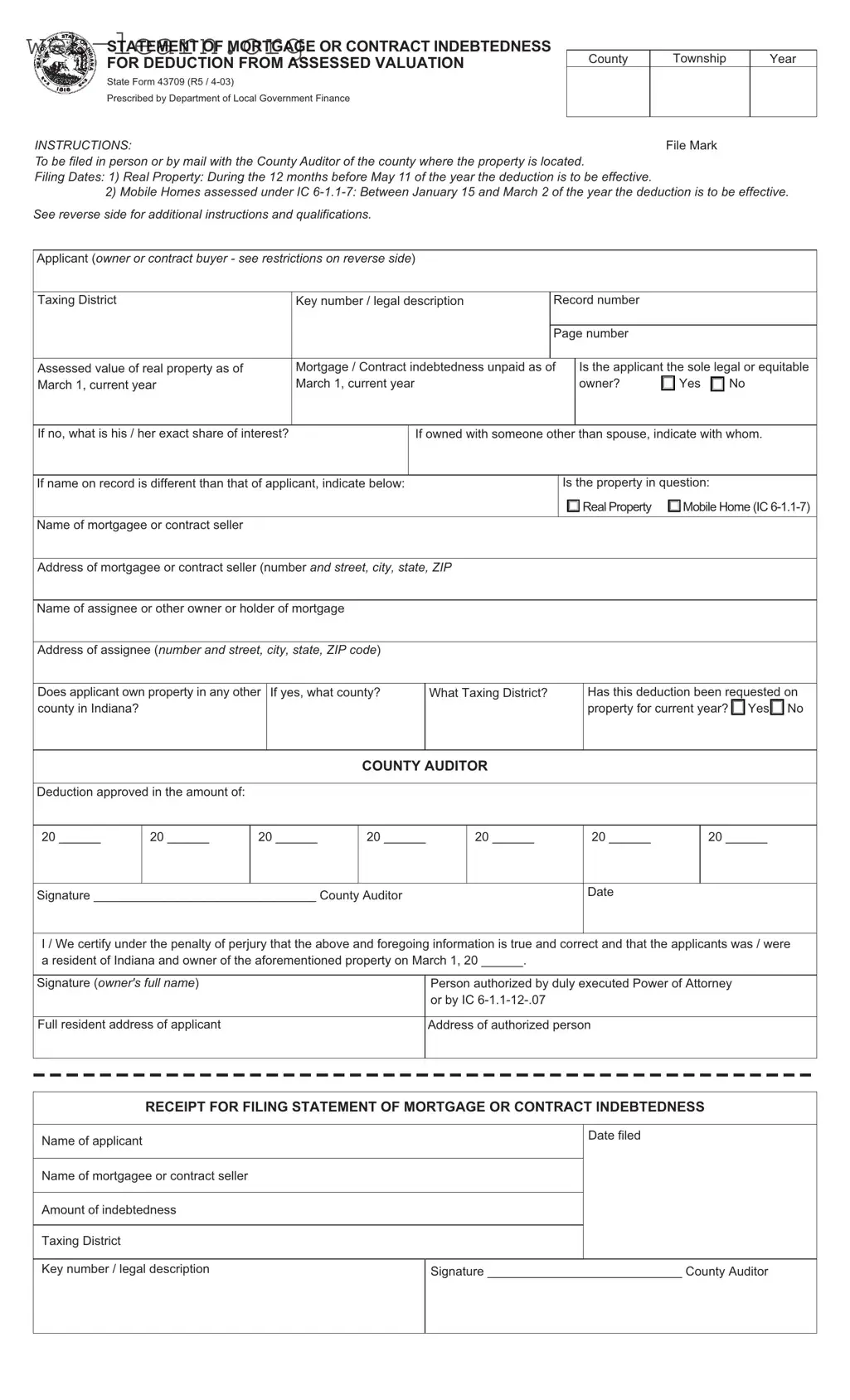
The Indiana 43709 form, officially known as the Statement of Mortgage or Contract Indebtedness for Deduction from Assessed Valuation, plays a crucial role for property owners seeking tax relief in Indiana. This form allows applicants to request a deduction from their assessed property valuation, thereby potentially lowering their tax burden. It is essential for individuals to file this form with the County Auditor in the county where their property is located, either in person or by mail. The filing deadlines vary based on the type of property; for real estate, applications must be submitted within the twelve months leading up to May 11 of the effective year, while mobile home owners have a narrower window from January 15 to March 2. The form requires detailed information about the applicant, including ownership status, mortgage details, and whether the property is a mobile home or real estate. Additionally, applicants must confirm their residency in Indiana and provide a signature certifying the accuracy of their information under penalty of perjury. The deduction amount can be significant, capped at either $3,000, half of the assessed value, or the remaining mortgage balance, whichever is lower. Understanding the nuances of this form is vital for property owners looking to maximize their tax benefits.
STATEMENT OF MORTGAGE OR CONTRACT INDEBTEDNESS FOR DEDUCTION FROM ASSESSED VALUATION
State Form 43709 (R5 /
Prescribed by Department of Local Government Finance
County
Township
Year
INSTRUCTIONS:
To be filed in person or by mail with the County Auditor of the county where the property is located.
Filing Dates: 1) Real Property: During the 12 months before May 11 of the year the deduction is to be effective.
2)Mobile Homes assessed under IC
Applicant (owner or contract buyer - see restrictions on reverse side)
Taxing District |
Key number / legal description |
Record number |
|
|
|
|
|
|
|
|
|
|
|
|
|
|
|
Page number |
|
|
|
|
|
|
|
|
|
|
|
||
Assessed value of real property as of |
Mortgage / Contract indebtedness unpaid as of |
Is the applicant the sole legal or equitable |
|||||
March 1, current year |
March 1, current year |
|
owner? |
|
Yes |
|
No |
|
|
|
|||||
|
|
|
|
|
|
|
|
If no, what is his / her exact share of interest?
If owned with someone other than spouse, indicate with whom.
If name on record is different than that of applicant, indicate below: |
Is the property in question: |
||||
|
|
|
Real Property |
|
Mobile Home (IC |
|
|
|
|
||
|
|
|
|
|
|
Name of mortgagee or contract seller |
|
|
|
|
|
Address of mortgagee or contract seller (number and street, city, state, ZIP
Name of assignee or other owner or holder of mortgage
Address of assignee (number and street, city, state, ZIP code)
Does applicant own property in any other county in Indiana?
If yes, what county?
What Taxing District?
Has this deduction been requested on property for current year? Yes No
COUNTY AUDITOR
Deduction approved in the amount of:
20 ______
20 ______
20 ______
20 ______
20 ______
20 ______
20 ______
Signature ________________________________ County Auditor
Date
I / We certify under the penalty of perjury that the above and foregoing information is true and correct and that the applicants was / were a resident of Indiana and owner of the aforementioned property on March 1, 20 ______.
Signature (owner's full name) |
Person authorized by duly executed Power of Attorney |
|
or by IC |
|
|
Full resident address of applicant |
Address of authorized person |
|
|
RECEIPT FOR FILING STATEMENT OF MORTGAGE OR CONTRACT INDEBTEDNESS
Name of applicant |
Date filed |
|
Name of mortgagee or contract seller
Amount of indebtedness
Taxing District
Key number / legal description |
Signature ____________________________ County Auditor |
|
|

Instructions and Qualifications
Applicants must be residents of the State of Indiana.
Applications must be filed during the periods specified. Once the application is in effect, no other filing is necessary unless there is a change in the status of the property of applicant that would affect the deduction.
This application may be filed in person or by mail. If mailed, the mailing must be postmarked before the last day for filing.
Any person who willfully makes a false statement of the facts in applying for this deduction is guilty of the crime of perjury and on the conviction thereof will be punished in the manner provided by law.
The deduction equals $3,000,
Authority for signing a deduction application may be delegated only by an executed power of attorney or by IC
Signature of only one spouse is required for filing, when owner is a husband and wife as tenants by the entireties.
An Indiana resident who was a member of the United States Armed Forces and who was away from the county of his residence as a result of military service during the time of filing must file a claim for deduction during the twelve months before May 11 of the year next succeeding the year of discharge.
A contract buyer must submit a recorded copy or recorded memorandum of the contract, which contains a legal description with the first statement filed for this deduction.
| Fact Name | Fact Details |
|---|---|
| Form Purpose | The Indiana 43709 form is used to report mortgage or contract indebtedness for a deduction from assessed valuation. |
| Governing Law | This form is governed by Indiana Code IC 6-1.1-12.7 and IC 6-1.1-7. |
| Filing Method | Applicants can file the form in person or by mail with the County Auditor. |
| Filing Dates for Real Property | Real property forms must be filed during the 12 months preceding May 11 of the year the deduction takes effect. |
| Filing Dates for Mobile Homes | Mobile homes must be filed between January 15 and March 2 of the year the deduction is to be effective. |
| Deduction Amount | The deduction can equal $3,000, half of the assessed value of the property, or the balance of the mortgage or contract indebtedness, whichever is less. |
| Residency Requirement | Applicants must be residents of Indiana and owners of the property as of March 1 of the current year. |
Filling out the Indiana 43709 form is a straightforward process that requires accurate information regarding property ownership and mortgage details. Once completed, the form should be submitted to the County Auditor for processing. Below are the steps to fill out the form correctly.
What is the purpose of the Indiana 43709 form?
The Indiana 43709 form is used to apply for a deduction from the assessed valuation of real property or mobile homes. This deduction can help reduce property taxes by allowing eligible applicants to deduct a certain amount of mortgage or contract indebtedness from the assessed value of their property.
Who is eligible to file the Indiana 43709 form?
Eligibility is limited to residents of Indiana who own the property or are contract buyers. Additionally, the applicant must have been a resident of Indiana and the owner of the property as of March 1 of the assessment year.
When should the Indiana 43709 form be filed?
The filing dates vary based on the type of property:
What information is required on the form?
The form requires various details, including:
Is there a limit on the deduction amount?
Yes, the deduction amount is capped at $3,000, one-half of the assessed value of the property, or the balance of the mortgage or contract indebtedness as of the assessment date—whichever is the least.
What happens if the property status changes?
If there are any changes in the status of the property or the applicant that could affect the deduction, a new application must be filed. Once approved, no further filing is necessary unless there are changes.
What are the consequences of providing false information?
Providing false information on the Indiana 43709 form is considered perjury. If convicted, the individual can face legal penalties as outlined by law.
Can someone else file the form on behalf of the applicant?
Yes, authority to sign the application can be delegated through a duly executed power of attorney or under IC 6-1.1-12-.07. If the property is owned by a married couple, only one spouse's signature is required.
What documentation is needed for contract buyers?
Contract buyers must submit a recorded copy or a recorded memorandum of the contract that includes a legal description of the property with their initial application for the deduction.
Filling out the Indiana 43709 form can be straightforward, but many people make mistakes that can delay their application. One common error is not filing the form within the required time frame. For real property, it must be submitted during the 12 months before May 11 of the year the deduction is to take effect. Mobile homes have an even narrower window, requiring submission between January 15 and March 2. Missing these deadlines can result in losing the deduction for that year.
Another frequent mistake is failing to provide accurate information about ownership. Applicants often overlook the question regarding whether they are the sole legal or equitable owner. If there are multiple owners, it is crucial to specify the exact share of interest. Not doing so can lead to confusion and potential rejection of the application.
Many applicants also forget to check if their name on the property record matches the name on the application. If there is a discrepancy, the applicant must indicate this on the form. Ignoring this detail can create complications and delays in processing the application.
Providing incomplete addresses for the mortgagee or contract seller is another common issue. The form requires the full address, including street, city, state, and ZIP code. Omitting any part of this information can hinder the application process and may require resubmission.
Some individuals mistakenly assume that they do not need to disclose ownership of property in other counties. The form specifically asks if the applicant owns property in any other county in Indiana. Not answering this question can raise red flags and complicate the review process.
Applicants should also be cautious about the certification statement at the end of the form. Many people forget to sign it or do not include the date. This certification is critical as it affirms that the information provided is accurate. Missing a signature can lead to automatic rejection.
Another mistake is failing to provide a recorded copy of the contract when applicable. Contract buyers must submit this documentation with their initial statement for the deduction. Without it, the application may not be accepted.
Lastly, applicants sometimes overlook the requirement for a power of attorney. If someone else is signing the form on behalf of the applicant, they must have a duly executed power of attorney. Not adhering to this requirement can invalidate the application.
When dealing with the Indiana 43709 form, several other documents and forms may be necessary to ensure a smooth filing process. Each of these documents serves a specific purpose and may be required depending on individual circumstances. Below is a list of commonly associated forms and documents.
Understanding these documents can help streamline the process of filing for deductions in Indiana. It's always a good idea to gather all necessary forms to ensure compliance and avoid delays. Each document plays a critical role in supporting the information provided on the Indiana 43709 form.
The Indiana 43709 form, used for reporting mortgage or contract indebtedness for property tax deductions, shares similarities with several other documents. Each of these documents serves a specific purpose in property ownership and tax deductions. Below is a list of forms that are comparable to the Indiana 43709 form:
Each of these forms plays a role in financial reporting and tax deductions, highlighting the importance of accurate information regarding property ownership and indebtedness.
When filling out the Indiana 43709 form, it is important to follow specific guidelines to ensure the application is processed correctly. Below is a list of things you should and shouldn't do.
Understanding the Indiana 43709 form can be challenging, especially with the various misconceptions surrounding it. Here are five common misunderstandings, clarified for better comprehension.
This is not true. The Indiana 43709 form must be filed within specific time frames. For real property, it should be submitted during the 12 months leading up to May 11 of the effective year. For mobile homes, the filing period is between January 15 and March 2.
While homeowners are eligible, contract buyers can also apply. However, contract buyers must provide a recorded copy of the contract that includes a legal description of the property.
The deduction is not a set amount. It equals $3,000, half of the assessed property value, or the remaining mortgage or contract indebtedness as of the assessment date—whichever is the least.
This is misleading. If the property is owned by a husband and wife as tenants by the entireties, only one signature is necessary. However, it’s important to ensure that the ownership structure is clear to avoid complications.
This is incorrect. Once the application is approved, it remains in effect unless there is a change in the property’s status or the applicant’s situation that affects the deduction. In such cases, a new application may be required.
Filling out the Indiana 43709 form is an important step for homeowners seeking a mortgage or contract indebtedness deduction. Here are some key takeaways to keep in mind:
By keeping these points in mind, applicants can navigate the process more smoothly and ensure they meet all necessary requirements for the Indiana 43709 form.