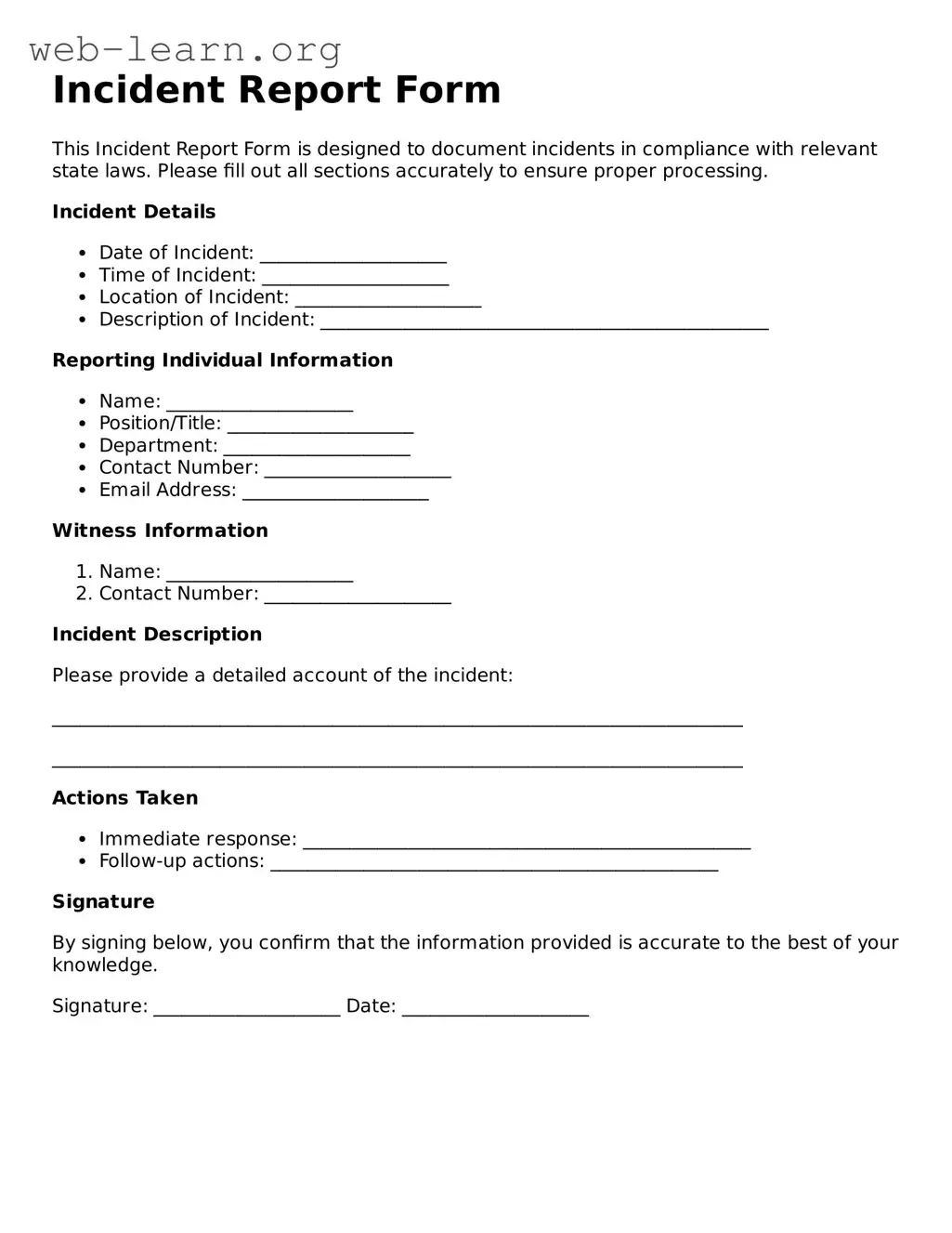
The Incident Report Form is a crucial tool for documenting events that may pose risks or lead to liability. It serves as a structured way to capture essential details about an incident, ensuring that all relevant information is recorded accurately and comprehensively. This form typically includes sections for the date, time, and location of the incident, as well as a description of what occurred. Witness information is also gathered, allowing for a clearer understanding of the circumstances surrounding the event. Additionally, the form often requests details about any injuries sustained and the actions taken in response to the incident. By utilizing this form, organizations can not only comply with legal and regulatory requirements but also foster a culture of safety and accountability. Properly filled out, it can aid in preventing future incidents and serve as a valuable resource for investigations and insurance claims.
Incident Report Form
This Incident Report Form is designed to document incidents in compliance with relevant state laws. Please fill out all sections accurately to ensure proper processing.
Incident Details
Reporting Individual Information
Witness Information
Incident Description
Please provide a detailed account of the incident:
__________________________________________________________________________
__________________________________________________________________________
Actions Taken
Signature
By signing below, you confirm that the information provided is accurate to the best of your knowledge.
Signature: ____________________ Date: ____________________
| Fact Name | Description |
|---|---|
| Purpose | The Incident Report Form is designed to document any incidents that occur within a specific setting, ensuring that all relevant details are captured for future reference. |
| Importance | Accurate documentation can help in understanding the circumstances surrounding an incident, which may be crucial for resolving disputes or claims. |
| Who Uses It? | Employees, supervisors, and managers typically fill out the form to report incidents, accidents, or near misses. |
| Content | The form usually includes sections for date, time, location, individuals involved, and a description of the incident. |
| Submission Process | Once completed, the form is submitted to the appropriate department, such as Human Resources or Safety Management. |
| State-Specific Forms | Different states may have their own versions of the form, tailored to comply with local regulations and requirements. |
| Governing Laws | In California, for instance, the governing law is the California Code of Regulations, Title 8, which outlines workplace safety reporting. |
| Confidentiality | Information on the form is often kept confidential, protecting the privacy of individuals involved in the incident. |
| Follow-Up Actions | After submission, follow-up actions may include investigations, corrective measures, or safety training based on the incident. |
| Retention Period | Organizations typically retain incident reports for a specified period, often for legal or compliance reasons. |
Completing the Incident Report Form requires attention to detail and clarity. Follow the steps below to ensure that all necessary information is accurately provided.
After completing the form, review it for accuracy before submission. Ensure that all required fields are filled out and that the information is clear and concise.
The Incident Report Form serves as a critical tool for documenting any incidents that occur within an organization. This includes accidents, injuries, or any unusual occurrences. By capturing detailed information, the form helps ensure that the organization can respond appropriately, analyze incidents for prevention, and comply with any legal or regulatory requirements.
Any individual who witnesses or is involved in an incident should complete the form. This includes employees, visitors, or contractors. It is essential that the report is filled out as soon as possible after the incident to ensure accuracy and comprehensiveness.
The form typically requires the following information:
Providing thorough details helps in the investigation and future prevention efforts.
Yes, it is crucial to submit the Incident Report Form as soon as possible, ideally within 24 hours of the incident. Prompt reporting allows for timely investigation and response, which can be vital in addressing any safety concerns and preventing future incidents.
Once submitted, the report is typically reviewed by a designated supervisor or safety officer. They will assess the details, investigate further if necessary, and determine any required follow-up actions. This may include corrective measures, employee training, or changes to safety protocols.
Many organizations allow for anonymous reporting to encourage individuals to come forward without fear of retaliation. Check your organization's policy on anonymous submissions, as it may vary. However, providing your contact information can help in the investigation process.
Confidentiality is often a priority in handling incident reports. While the details may be shared with relevant personnel for investigation purposes, the identity of the reporter is usually protected. It is important to understand your organization's specific policies regarding confidentiality.
If you require help completing the Incident Report Form, do not hesitate to reach out to your supervisor or the human resources department. They can provide guidance on how to accurately fill out the form and ensure that all necessary information is included.
Failing to report an incident can have serious implications. It may hinder the organization’s ability to address safety concerns, potentially leading to further incidents. Additionally, some organizations have policies that may impose disciplinary actions for not adhering to reporting protocols.
Filling out an Incident Report Form can be a crucial step in documenting an event accurately. However, many individuals make common mistakes that can lead to confusion or delays in processing. Understanding these pitfalls can help ensure that your report is clear and effective.
One frequent mistake is failing to provide complete information. It’s essential to include all relevant details, such as the date, time, and location of the incident. Omitting any of these elements can create gaps in the narrative, making it difficult for others to understand what occurred.
Another common error is not being specific enough in describing the incident. Vague language can lead to misunderstandings. Instead of saying "something happened," describe the event clearly. Use specific terms and avoid generalizations to convey the situation accurately.
People often neglect to include the names and contact information of witnesses. This information can be vital for follow-up and verification. Failing to list witnesses may hinder the investigation or resolution of the incident.
Inaccurate or incomplete descriptions of injuries or damages can also pose problems. It’s important to detail any injuries sustained or property damage incurred. This helps ensure that all aspects of the incident are addressed properly.
Another mistake is using inappropriate language or tone. The report should maintain a professional tone. Avoid emotional language or personal opinions, as these can detract from the factual nature of the report.
Some individuals forget to sign and date the report. A signature confirms that the information provided is accurate to the best of your knowledge. Without this, the report may be considered incomplete.
Failing to keep a copy of the submitted report is a common oversight. Always retain a copy for your records. This can be useful for future reference and ensures you have documentation of what was reported.
Many people also overlook the importance of reviewing the report before submission. Taking a moment to proofread can catch errors or unclear statements. This simple step can enhance the clarity and professionalism of the report.
Finally, submitting the report to the wrong department or individual can delay the process. Ensure that you know the correct recipient for your report. This will facilitate timely action and resolution.
By avoiding these common mistakes, you can improve the quality of your Incident Report Form. A well-prepared report helps ensure that incidents are addressed promptly and effectively.
When dealing with incidents in various settings, it is essential to have a comprehensive set of documents to ensure that all aspects are covered. The Incident Report Form is a crucial tool, but it often works best in conjunction with other forms. Below is a list of four documents that are commonly used alongside the Incident Report Form.
Utilizing these forms alongside the Incident Report Form can help create a thorough understanding of the incident and contribute to a safer environment. Each document plays a specific role in the overall process, ensuring that nothing is overlooked.
The Incident Report Form is a crucial document used to record details of an incident, typically in workplaces or organizations. Several other documents serve similar purposes, each with its own specific focus. Below are six documents that share similarities with the Incident Report Form:
Filling out an Incident Report Form is an important task that requires attention to detail. Here are some guidelines to help you navigate the process effectively.
Things You Should Do:
Things You Shouldn't Do:
By following these guidelines, you can ensure that your Incident Report Form is filled out accurately and effectively.
Many people have misunderstandings about the Incident Report Form. Here are nine common misconceptions along with explanations to clarify them.
When filling out and using an Incident Report Form, it is essential to follow certain guidelines to ensure clarity and effectiveness. Below are key takeaways to consider:
By adhering to these guidelines, individuals can effectively communicate the details of an incident, facilitating appropriate responses and actions.