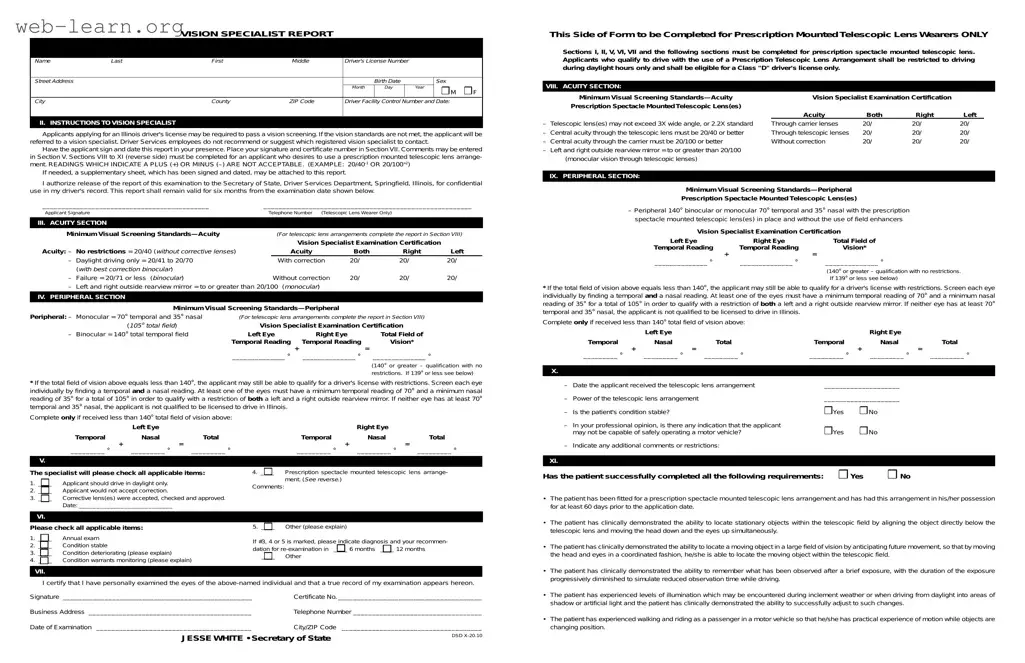
The Illinois Vision Specialist Report form is an essential document for individuals seeking to obtain or renew a driver's license in Illinois, particularly for those who may not meet standard vision requirements. This form plays a critical role in the evaluation process by documenting the results of a vision specialist's examination. It includes sections for personal information, acuity standards, and peripheral vision assessments, which are vital for determining an applicant's fitness to drive. The form outlines specific instructions for vision specialists, emphasizing the need for accurate measurements and the importance of signatures for validation. It also provides criteria for applicants using prescription telescopic lenses, detailing additional requirements that must be met to qualify for a driver's license. By ensuring that all relevant sections are completed, the form helps maintain safety on the roads while accommodating individuals with vision impairments.

VISION SPECIALIST REPORT
|
|
|
|
|
|
|
|
|
|
Name |
Last |
First |
Middle |
Driver's License Number |
|
|
|
||
|
|
|
|
|
|
|
|
|
|
Street Address |
|
|
|
|
Birth Date |
|
Sex |
|
|
|
|
|
|
Month |
Day |
|
Year |
❒ M |
❒ F |
|
|
|
|
|
|
|
|
||
|
|
|
|
|
|
|
|
|
|
City |
|
County |
ZIP Code |
Driver Facility Control Number and Date: |
|
||||
|
|
|
|
|
|
|
|
|
|
II. INSTRUCTIONS TO VISION SPECIALIST
Applicants applying for an Illinois driver's license may be required to pass a vision screening. If the vision standards are not met, the applicant will be referred to a vision specialist. Driver Services employees do not recommend or suggest which registered vision specialist to contact.
Have the applicant sign and date this report in your presence. Place your signature and certificate number in Section VII. Comments may be entered in Section V. Sections VIII to XI (reverse side) must be completed for an applicant who desires to use a prescription mounted telescopic lens arrange- ment. READINGS WHICH INDICATE A PLUS (+) OR MINUS
If needed, a supplementary sheet, which has been signed and dated, may be attached to this report.
I authorize release of the report of this examination to the Secretary of State, Driver Services Department, Springfield, Illinois, for confidential use in my driver's record. This report shall remain valid for six months from the examination date shown below.
____________________________________________ |
_______________________________________________________ |
||||||
Applicant Signature |
Telephone Number (Telescopic Lens Wearer Only) |
|
|||||
|
|
|
|
|
|
|
|
III. ACUITY SECTION |
|
|
|
|
|
|
|
Minimum Visual Screening |
|
(For telescopic lens arrangements complete the report in Section VIII) |
|||||
|
|
|
|
Vision Specialist Examination Certification |
|||
Acuity: – |
No restrictions = 20/40 (without corrective lenses) |
|
|
Acuity |
Both |
Right |
Left |
– |
Daylight driving only = 20/41 to 20/70 |
|
With correction |
20/ |
20/ |
20/ |
|
|
(with best correction binocular) |
|
|
|
|
|
|
– |
Failure = 20/71 or less (binocular) |
|
Without correction |
20/ |
20/ |
20/ |
|
– |
Left and right outside rearview mirror = to or greater than 20/100 (monocular) |
|
|
|
|||
|
|
|
|
|
|
|
|
IV. PERIPHERAL SECTION |
|
|
|
|
|
|
|
|
Minimum Visual Screening |
|
|
|
|||
Peripheral: – |
Monocular = 70° temporal and 35° nasal |
(For telescopic lens arrangements complete the report in Section VIII) |
|
||||
|
(105° total field) |
Vision Specialist Examination Certification |
|
||||
– |
Binocular = 140° total temporal field |
Left Eye |
Right Eye |
|
Total Field of |
|
|
|
Temporal Reading |
Temporal Reading |
Vision* |
|
|||
|
|
|
|
+ |
= |
|
|
|
______________ ° |
______________ ° |
______________ ° |
||||
|
|
|
|
|
|
(140° or greater – qualification with no |
|
|
|
|
|
|
|
restrictions. If 139° |
or less see below) |
*If the total field of vision above equals less than 140° , the applicant may still be able to qualify for a driver's license with restrictions. Screen each eye individually by finding a temporal and a nasal reading. At least one of the eyes must have a minimum temporal reading of 70° and a minimum nasal reading of 35° for a total of 105° in order to qualify with a restriction of both a left and a right outside rearview mirror. If neither eye has at least 70° temporal and 35° nasal, the applicant is not qualified to be licensed to drive in Illinois.
Complete only if received less than 140° total field of vision above:
|
Left Eye |
|
|
Right Eye |
|
Temporal |
Nasal |
Total |
Temporal |
Nasal |
Total |
_________ ° |
+ |
= |
_________ ° |
+ |
= |
_________ ° |
_________ ° |
_________ ° |
_________ ° |
V.
The specialist will please check all applicable items:
1. |
____ |
Applicant should drive in daylight only. |
2. |
____ |
Applicant would not accept correction. |
3. |
____ |
Corrective lens(es) were accepted, checked and approved. |
|
|
Date: ___________________________ |
4. ____ Prescription spectacle mounted telescopic lens arrange-
ment. (See reverse.)
Comments:
VI.
Please check all applicable items:
1. |
____ |
Annual exam |
2. |
____ |
Condition stable |
3. |
____ |
Condition deteriorating (please explain) |
4. |
____ |
Condition warrants monitoring (please explain) |
5. ____ Other (please explain)
If #3, 4 or 5 is marked, please indicate diagnosis and your recommen- dation for
____ Other
VII.
I certify that I have personally examined the eyes of the
Signature __________________________________________________ |
Certificate No. ______________________________________ |
Business Address ___________________________________________ |
Telephone Number __________________________________ |
Date of Examination _________________________________________ |
City/ZIP Code _____________________________________ |
JESSE WHITE • Secretary of State
DSD

This Side of Form to be Completed for Prescription Mounted Telescopic Lens Wearers ONLY
Sections I, II, V, VI, VII and the following sections must be completed for prescription spectacle mounted telescopic lens. Applicants who qualify to drive with the use of a Prescription Telescopic Lens Arrangement shall be restricted to driving during daylight hours only and shall be eligible for a Class "D" driver's license only.
VIII. ACUITY SECTION: |
|
|
|
|
|
|
|
Minimum Visual Screening |
Vision Specialist Examination Certification |
|
|
||
|
Prescription Spectacle Mounted Telescopic Lens(es) |
|
|
|
|
|
|
|
Acuity |
Both |
Right |
Left |
|
– |
Telescopic lens(es) may not exceed 3X wide angle, or 2.2X standard |
Through carrier lenses |
20/ |
20/ |
20/ |
|
– |
Central acuity through the telescopic lens must be 20/40 or better |
Through telescopic lenses |
20/ |
20/ |
20/ |
|
– |
Central acuity through the carrier must be 20/100 or better |
Without correction |
20/ |
20/ |
20/ |
|
–Left and right outside rearview mirror = to or greater than 20/100 (monocular vision through telescopic lenses)
IX. PERIPHERAL SECTION:
Minimum Visual Screening
Prescription Spectacle Mounted Telescopic Lens(es)
–Peripheral 140° binocular or monocular 70° temporal and 35° nasal with the prescription spectacle mounted telescopic lens(es) in place and without the use of field enhancers
Vision Specialist Examination Certification
Left Eye |
Right Eye |
Total Field of |
Temporal Reading |
Temporal Reading |
Vision* |
|
+ |
= |
______________ ° |
______________ ° |
______________ ° |
|
|
(140° or greater – qualification with no restrictions. |
|
|
If 139° or less see below) |
*If the total field of vision above equals less than 140° , the applicant may still be able to qualify for a driver's license with restrictions. Screen each eye individually by finding a temporal and a nasal reading. At least one of the eyes must have a minimum temporal reading of 70° and a minimum nasal reading of 35° for a total of 105° in order to qualify with a restriction of both a left and a right outside rearview mirror. If neither eye has at least 70° temporal and 35° nasal, the applicant is not qualified to be licensed to drive in Illinois.
Complete only if received less than 140° total field of vision above: |
|
|
|
|
|
||
|
Left Eye |
|
|
|
|
Right Eye |
|
Temporal |
Nasal |
Total |
Temporal |
|
Nasal |
Total |
|
_________ ° |
+ |
= |
_________ ° |
+ |
_________ ° |
= |
|
_________ ° |
_________ ° |
|
_________ ° |
||||
|
|
|
|
|
|
|
|
X. |
|
|
|
|
|
|
|
– Date the applicant received the telescopic lens arrangement |
|
____________________ |
|
||||
– Power of the telescopic lens arrangement |
|
____________________ |
|
||||
– Is the patient's condition stable? |
|
|
❒Yes |
❒ No |
|
||
– In your professional opinion, is there any indication that the applicant |
|
❒Yes |
❒ No |
|
|||
may not be capable of safely operating a motor vehicle? |
|
|
|||||
– Indicate any additional comments or restrictions: |
|
|
|
|
|
||
|
|
|
|
|
|
|
|
XI. |
|
|
|
|
|
|
|
Has the patient successfully completed all the following requirements: |
❒ Yes |
❒ No |
|
||||
•The patient has been fitted for a prescription spectacle mounted telescopic lens arrangement and has had this arrangement in his/her possession for at least 60 days prior to the application date.
•The patient has clinically demonstrated the ability to locate stationary objects within the telescopic field by aligning the object directly below the telescopic lens and moving the head down and the eyes up simultaneously.
•The patient has clinically demonstrated the ability to locate a moving object in a large field of vision by anticipating future movement, so that by moving the head and eyes in a coordinated fashion, he/she is able to locate the moving object within the telescopic field.
•The patient has clinically demonstrated the ability to remember what has been observed after a brief exposure, with the duration of the exposure progressively diminished to simulate reduced observation time while driving.
•The patient has experienced levels of illumination which may be encountered during inclement weather or when driving from daylight into areas of shadow or artificial light and the patient has clinically demonstrated the ability to successfully adjust to such changes.
•The patient has experienced walking and riding as a passenger in a motor vehicle so that he/she has practical experience of motion while objects are changing position.
| Fact Name | Fact Description |
|---|---|
| Governing Law | The Illinois Vision Specialist Report is governed by the Illinois Vehicle Code, specifically 625 ILCS 5/6-106.1. |
| Purpose | This form is used to assess the vision of individuals applying for a driver's license in Illinois. |
| Vision Screening Requirement | Applicants may need to pass a vision screening. If they fail, a vision specialist must evaluate them. |
| Signature Requirement | Applicants must sign the report in the presence of the vision specialist. |
| Validity Period | The report remains valid for six months from the date of the examination. |
| Acuity Standards | Minimum visual acuity standards include 20/40 without corrective lenses and 20/100 for monocular vision. |
| Peripheral Vision Standards | Minimum peripheral vision required is 70° temporal and 35° nasal for monocular vision. |
| Telescopic Lens Requirements | For applicants using telescopic lenses, central acuity must be 20/40 or better through the lenses. |
| Driving Restrictions | Individuals qualifying with telescopic lenses may only drive during daylight hours. |
| Additional Comments | Vision specialists can include comments about the applicant's condition and recommendations for re-examination. |
Filling out the Illinois Vision Specialist Report form is a straightforward process, but it’s important to ensure that all sections are completed accurately. This report is essential for applicants who need to meet specific vision standards for their driver’s license. Follow the steps below to complete the form correctly.
What is the purpose of the Illinois Vision Specialist Report form?
The Illinois Vision Specialist Report form is used to document the results of a vision examination for individuals applying for a driver's license in Illinois. If an applicant does not meet the vision screening standards, they are referred to a vision specialist who will complete this form. It ensures that all necessary visual requirements are assessed before issuing a driver's license.
Who needs to fill out the Vision Specialist Report form?
Individuals applying for an Illinois driver's license may need to have this form completed if they do not pass the initial vision screening. The vision specialist, who is a licensed professional, must fill out the form, certifying the applicant's visual acuity and peripheral vision. The applicant must also sign the form in the presence of the specialist.
What are the minimum visual screening standards outlined in the form?
The form specifies minimum visual standards that must be met for various conditions. For example:
For peripheral vision, monocular vision must have a minimum of 70° temporal and 35° nasal readings, while binocular vision must total at least 140°.
What happens if the applicant does not meet the vision standards?
If an applicant fails to meet the vision standards, they may still qualify for a driver's license with restrictions. The vision specialist can recommend specific limitations, such as driving only during daylight hours. The report will indicate any necessary restrictions based on the applicant's vision assessment.
How long is the Vision Specialist Report valid?
The Vision Specialist Report remains valid for six months from the date of the examination. It is essential for applicants to ensure that they submit their report within this timeframe to avoid any issues with their driver's license application.
Completing the Illinois Vision Specialist Report form can be a straightforward process, but there are common mistakes that applicants often make. These errors can lead to delays or complications in obtaining a driver's license. Understanding these pitfalls can help ensure a smoother experience.
One frequent mistake is failing to provide complete personal information. Applicants should ensure that all fields, such as the name, address, and driver's license number, are filled out accurately. Missing or incorrect information can result in the form being rejected or returned for corrections.
Another common error occurs in the acuity section. Some individuals mistakenly enter readings that include a plus (+) or minus (–) sign. The form explicitly states that such readings are not acceptable. It’s crucial to adhere to the specified format to avoid complications.
Additionally, applicants sometimes overlook the signature requirement. Both the applicant and the vision specialist must sign the report in the appropriate sections. A missing signature can invalidate the report, necessitating a new examination and submission.
Incomplete comments can also pose a problem. Section V allows for comments, but if the vision specialist fails to provide necessary details, it may hinder the review process. Clear and concise comments can help clarify any special circumstances regarding the applicant's vision.
Another mistake involves the peripheral vision section. Applicants may not realize the importance of measuring each eye individually. The total field of vision must meet specific criteria, and neglecting to check each eye can lead to an inaccurate assessment, affecting the applicant's qualifications.
Moreover, some applicants do not take note of the expiration date of the report. The form is only valid for six months from the examination date. If an applicant submits the report after this period, they may need to undergo another examination.
Finally, misunderstanding the requirements for telescopic lens wearers can lead to complications. Applicants using these lenses must ensure that all relevant sections are completed correctly. This includes providing details about the power of the lenses and confirming that the applicant has had them for at least 60 days. Failing to provide this information can result in delays or denial of the application.
By being aware of these common mistakes and taking the time to complete the Illinois Vision Specialist Report form accurately, applicants can improve their chances of a successful application process.
When applying for a driver's license in Illinois, several forms and documents may accompany the Illinois Vision Specialist Report. Each document serves a specific purpose in the process of ensuring that applicants meet the necessary vision standards for safe driving.
Having these documents ready can streamline the application process. It is crucial to ensure that all forms are accurately completed and submitted on time to avoid delays in obtaining a driver's license.
When filling out the Illinois Vision Specialist Report form, follow these guidelines to ensure accuracy and compliance.
Understanding the Illinois Vision Specialist Report form can be challenging, and there are several misconceptions that often arise. Here are some common misunderstandings, along with clarifications to help you navigate the process more effectively.
This is not true. The form is required for any applicant who does not meet the vision screening standards, regardless of the severity of their vision issues.
Actually, Driver Services does not recommend or suggest specific vision specialists. It is the applicant's responsibility to choose a registered vision specialist.
In reality, the report remains valid for only six months from the examination date. It is important to keep this timeframe in mind when applying for a driver's license.
This is incorrect. Readings that indicate a plus (+) or minus (–) are not acceptable. Specific formats must be followed for the report to be valid.
This is misleading. For applicants with monocular vision, both eyes must meet specific peripheral vision standards. At least one eye must have a minimum temporal reading of 70° and a nasal reading of 35°.
In fact, comments are encouraged in Section V, especially if there are special considerations regarding the applicant's vision condition.
This is a common misunderstanding. The form includes multiple sections that must be thoroughly completed, including acuity and peripheral sections, along with specific requirements for telescopic lens wearers.
This is not the case. Applicants must wait for their driver's license to be processed and issued before they can legally drive.
By understanding these misconceptions, applicants can better prepare themselves for the vision screening process and ensure a smoother experience when applying for their driver's license in Illinois.
When filling out the Illinois Vision Specialist Report form, keep these key takeaways in mind: