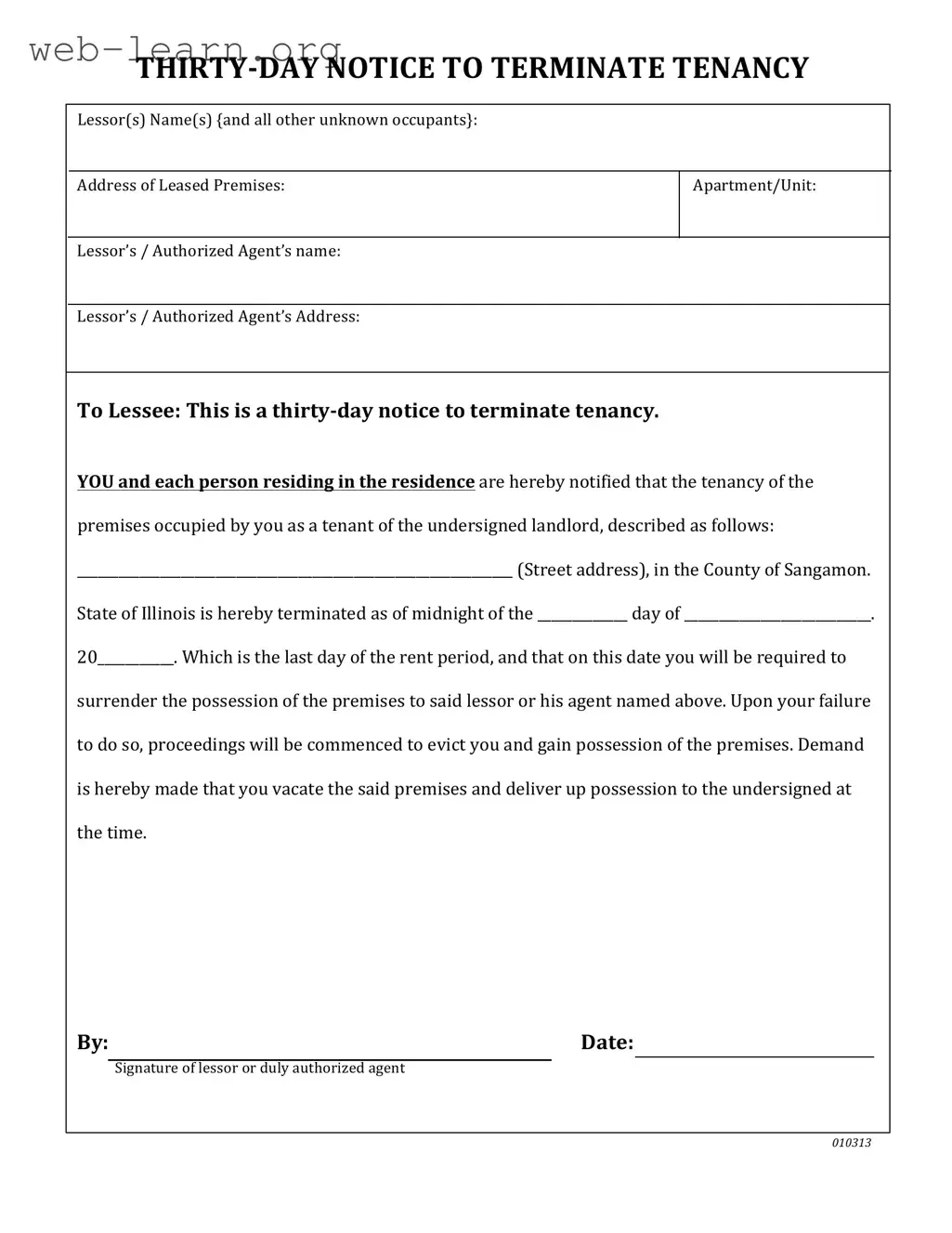
When it comes to ending a tenancy in Illinois, the Illinois Vacate form plays a crucial role in ensuring that both landlords and tenants understand their rights and responsibilities. This form serves as a formal notice from the landlord to the tenant, indicating the intention to terminate the rental agreement. It outlines essential details, including the names of the lessor and lessee, the address of the leased premises, and the specific date by which the tenant must vacate the property. The notice typically provides a thirty-day timeframe for tenants to prepare for their move, emphasizing the importance of compliance. Failure to vacate by the specified date may lead to eviction proceedings, which can be a stressful experience for all parties involved. This document not only serves as a legal requirement but also aims to promote clear communication and a smooth transition for tenants as they prepare to leave the premises.

THIRTY‐DAY NOTICE TO TERMINATE TENANCY
Lessor(s) Name(s) {and all other unknown occupants}:
Address of Leased Premises:Apartment/Unit:
Lessor’s / Authorized Agent’s name:
Lessor’s / Authorized Agent’s Address:
To Lessee: This is a thirty‐day notice to terminate tenancy.
YOU and each person residing in the residence are hereby notified that the tenancy of the premises occupied by you as a tenant of the undersigned landlord, described as follows:
_______________________________________________________________ (Street address), in the County of Sangamon.
State of Illinois is hereby terminated as of midnight of the _____________ day of ___________________________.
20___________. Which is the last day of the rent period, and that on this date you will be required to
surrender the possession of the premises to said lessor or his agent named above. Upon your failure to do so, proceedings will be commenced to evict you and gain possession of the premises. Demand is hereby made that you vacate the said premises and deliver up possession to the undersigned at the time.
By:Date:
Signature of lessor or duly authorized agent
010313
| Fact Name | Description |
|---|---|
| Purpose | The Illinois Vacate form serves as a formal notice to terminate a tenant's lease, allowing landlords to end a tenancy with proper notification. |
| Notice Period | This form requires a thirty-day notice period before the termination of tenancy, giving tenants time to prepare for their move. |
| Governing Law | The use of this form is governed by the Illinois Compiled Statutes, specifically under the Landlord and Tenant Act. |
| Tenant Responsibilities | Tenants must vacate the premises by the specified date, which is the last day of the rent period, to avoid eviction proceedings. |
| Signature Requirement | The form must be signed by the lessor or an authorized agent to validate the notice and ensure its legal standing. |
| Address Information | Complete addresses for both the leased premises and the lessor or agent must be provided to ensure clarity and proper communication. |
After completing the Illinois Vacate form, you will need to deliver it to the tenant. Ensure that the tenant receives it in a timely manner, as this notice serves as an official communication regarding the termination of tenancy. Follow the steps below to fill out the form correctly.
What is the Illinois Vacate form?
The Illinois Vacate form is a legal document used by landlords to notify tenants that their lease is being terminated. This notice typically provides a thirty-day period for tenants to vacate the premises. It is essential for landlords to follow this process to ensure they comply with state laws regarding tenancy termination.
Who should use the Vacate form?
This form is primarily used by landlords or property owners who wish to end a tenancy. If you are a landlord in Illinois and need to terminate a lease agreement, this form is necessary to formally communicate your intent to the tenant.
What information is required on the form?
The Vacate form requires several key pieces of information, including:
How much notice must be given to tenants?
In Illinois, landlords must provide a thirty-day notice to terminate tenancy. This means that tenants should receive the Vacate form at least thirty days before they are expected to leave the property. The notice period is calculated from the end of the current rental period.
What happens if a tenant does not vacate?
If a tenant fails to vacate the premises by the specified date, the landlord may begin eviction proceedings. This legal process allows the landlord to regain possession of the property through the court system. It is important for landlords to follow the legal steps to avoid potential issues.
Can tenants contest a Vacate notice?
Yes, tenants have the right to contest a Vacate notice if they believe it is unjust. They can do this by communicating with the landlord or seeking legal advice. If the dispute escalates, it may lead to a court hearing where both parties can present their cases.
Is the Vacate form available online?
Yes, the Illinois Vacate form can typically be found online through various legal resources or state websites. It is important to ensure that you are using the most current version of the form to comply with state regulations.
When filling out the Illinois Vacate form, individuals often make several critical mistakes that can lead to complications in the eviction process. One common error is failing to provide complete and accurate information regarding the lessor's name and address. Incomplete details can create confusion and may result in the notice being deemed invalid. It is essential to ensure that all names and addresses are clearly stated, as this information is crucial for proper communication.
Another frequent mistake involves the omission of the exact address of the leased premises. This detail is vital, as it specifies the location from which the tenant must vacate. Without a precise street address, the notice may not effectively inform the tenant of their obligations, potentially delaying the eviction process.
Many people also neglect to specify the exact date on which the tenancy will terminate. The form requires a clear indication of the last day of the rent period. If this date is left blank or filled in incorrectly, tenants may not understand their timeline for vacating the property, leading to misunderstandings and disputes.
Additionally, individuals often forget to sign the form. A signature is a critical component that validates the notice. Without it, the document lacks authenticity, and tenants may refuse to acknowledge its legitimacy. It is advisable to double-check that the form is signed and dated before submission.
Some lessors make the mistake of not providing their authorized agent's name, if applicable. If the lessor is not the one delivering the notice, the agent’s name must be included to ensure that the tenant knows who is acting on behalf of the landlord. This omission can create confusion about who is responsible for the eviction process.
Another issue arises when lessors fail to account for all occupants residing in the unit. The form should list all known occupants to ensure that everyone is properly notified. Neglecting to do so may allow unlisted tenants to remain in the property, complicating the eviction process.
Moreover, some individuals overlook the importance of clearly stating the consequences of failing to vacate. The notice should explicitly inform the tenant that eviction proceedings will commence if they do not leave by the specified date. Clarity on this point can help ensure that tenants understand the seriousness of their situation.
Finally, it is crucial to ensure that the notice is delivered properly. Simply filling out the form does not suffice; it must be served to the tenant in accordance with Illinois law. Failure to follow the correct procedure for delivery can render the notice ineffective, prolonging the eviction process unnecessarily.
When dealing with the Illinois Vacate form, several other documents may be necessary to ensure a smooth process. Each of these forms serves a specific purpose and helps clarify the rights and responsibilities of both landlords and tenants. Below is a list of commonly used documents that accompany the Illinois Vacate form.
Understanding these documents can help both landlords and tenants navigate the process of terminating a tenancy. Having the right forms ready can prevent misunderstandings and ensure that both parties fulfill their obligations. Being informed is key to a successful transition.
The Illinois Vacate form is a crucial document in the landlord-tenant relationship, specifically used to notify tenants of the termination of their tenancy. Several other documents serve similar purposes in various contexts, providing tenants and landlords with formal means to communicate about tenancy issues. Below is a list of eight documents that share similarities with the Illinois Vacate form:
Each of these documents serves to clarify the rights and responsibilities of both landlords and tenants, fostering better communication and understanding in the often-complex realm of rental agreements.
When filling out the Illinois Vacate form, it's important to follow certain guidelines to ensure your submission is correct. Here are four things you should and shouldn't do:
By following these guidelines, you can help ensure a smooth process when terminating your tenancy.
Understanding the Illinois Vacate form is essential for both landlords and tenants. However, several misconceptions can lead to confusion. Here are four common misunderstandings:
Many believe that the thirty-day notice must be handed directly to the tenant. In reality, it can also be sent via certified mail, ensuring that there is a record of delivery.
Some tenants think they can negotiate a shorter notice period. However, the law requires a full thirty days' notice, unless otherwise agreed upon in the lease.
Some landlords may assume that a verbal notice is enough to terminate a tenancy. This is incorrect. A written notice is legally required to ensure clarity and compliance.
Some may think that using the Illinois Vacate form is not necessary. However, utilizing this specific form helps to protect both parties and ensures that the termination is legally recognized.
When filling out the Illinois Vacate form, it is essential to pay attention to several key points to ensure the process goes smoothly.