In the state of Illinois, the Transfer-on-Death Deed (TODD) offers a straightforward and effective way for property owners to ensure their real estate is transferred to designated beneficiaries without the complexities of probate. This legal instrument allows individuals to retain full control of their property during their lifetime while designating who will inherit it upon their death. By filling out the TODD form, property owners can name one or more beneficiaries, which can include family members, friends, or even charities. The form must be properly executed and recorded with the local recorder of deeds to be valid, and it can be revoked or modified at any time before the owner’s passing. Importantly, the Transfer-on-Death Deed does not affect the owner’s property rights, and the beneficiaries do not have any claim to the property until the owner dies. Understanding the nuances of this deed is crucial for anyone looking to simplify the transfer of their property and avoid the often lengthy and costly probate process.
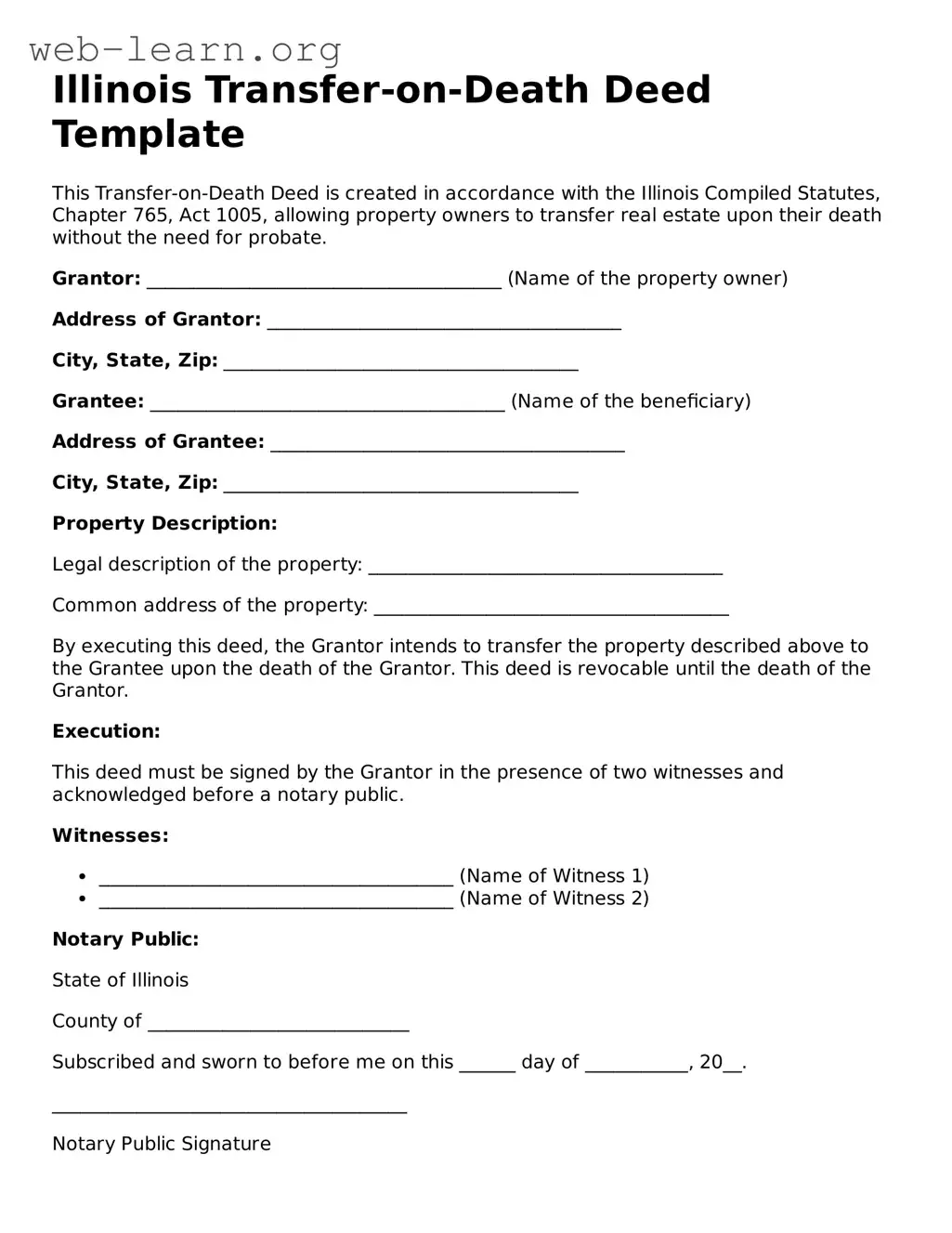
Illinois Transfer-on-Death Deed Template
This Transfer-on-Death Deed is created in accordance with the Illinois Compiled Statutes, Chapter 765, Act 1005, allowing property owners to transfer real estate upon their death without the need for probate.
Grantor: ______________________________________ (Name of the property owner)
Address of Grantor: ______________________________________
City, State, Zip: ______________________________________
Grantee: ______________________________________ (Name of the beneficiary)
Address of Grantee: ______________________________________
City, State, Zip: ______________________________________
Property Description:
Legal description of the property: ______________________________________
Common address of the property: ______________________________________
By executing this deed, the Grantor intends to transfer the property described above to the Grantee upon the death of the Grantor. This deed is revocable until the death of the Grantor.
Execution:
This deed must be signed by the Grantor in the presence of two witnesses and acknowledged before a notary public.
Witnesses:
Notary Public:
State of Illinois
County of ____________________________
Subscribed and sworn to before me on this ______ day of ___________, 20__.
______________________________________
Notary Public Signature
My commission expires: ________________
This document must be recorded in the office of the county recorder where the property is located to be effective.
| Fact Name | Description |
|---|---|
| Definition | The Illinois Transfer-on-Death Deed allows property owners to transfer real estate to beneficiaries upon their death without going through probate. |
| Governing Law | The deed is governed by the Illinois Compiled Statutes, specifically 765 ILCS 1005. |
| Eligibility | Any owner of real property in Illinois can create a Transfer-on-Death Deed, provided they are of legal age and sound mind. |
| Revocation | The deed can be revoked at any time before the owner's death by filing a revocation form or executing a new deed. |
| Beneficiary Rights | Beneficiaries do not have any rights to the property until the owner's death, ensuring the owner retains full control during their lifetime. |
| Filing Requirements | The deed must be signed by the owner and notarized, and it should be recorded with the county recorder's office where the property is located. |
| Tax Implications | Transfer-on-Death Deeds do not affect property taxes during the owner's lifetime, but the property may be subject to estate taxes upon death. |
After completing the Illinois Transfer-on-Death Deed form, you will need to file it with the appropriate county recorder's office. Ensure that the form is signed and notarized as required. This step is crucial for the deed to be legally effective and recognized.
What is a Transfer-on-Death Deed?
A Transfer-on-Death Deed (TOD deed) is a legal document that allows property owners in Illinois to transfer their real estate to a designated beneficiary upon their death. This deed enables the property to pass directly to the beneficiary without going through probate, simplifying the transfer process.
Who can use a Transfer-on-Death Deed?
Any individual who owns real estate in Illinois can utilize a Transfer-on-Death Deed. This includes homeowners and property owners who wish to ensure their property is transferred to specific individuals after their passing.
How do I create a Transfer-on-Death Deed?
To create a Transfer-on-Death Deed, you must fill out the appropriate form, which includes details such as the property description and the beneficiary's information. After completing the form, it must be signed and notarized. Finally, the deed should be recorded with the county recorder’s office where the property is located.
Is there a fee associated with filing a Transfer-on-Death Deed?
Yes, there may be a fee for recording the Transfer-on-Death Deed with the county recorder’s office. The fee varies by county, so it is advisable to check with your local office for the specific amount.
Can I change or revoke a Transfer-on-Death Deed?
Yes, you can change or revoke a Transfer-on-Death Deed at any time during your lifetime. To do this, you must create a new deed that either revokes the previous one or designates a different beneficiary. This new deed must also be signed, notarized, and recorded.
What happens if I do not name a beneficiary?
If no beneficiary is named on the Transfer-on-Death Deed, the property will not be transferred upon your death. Instead, it will be treated as part of your estate and will go through the probate process, which can be time-consuming and costly.
Are there any restrictions on who I can name as a beneficiary?
Generally, you can name anyone as a beneficiary, including family members, friends, or even organizations. However, it is important to ensure that the beneficiary is capable of receiving the property. For example, minors cannot hold title to real estate directly.
Will a Transfer-on-Death Deed affect my property taxes?
A Transfer-on-Death Deed does not change the way property taxes are assessed while you are alive. However, upon your death, the property may be reassessed based on the new ownership. It is wise to consult with a tax professional for guidance on potential tax implications.
Can I use a Transfer-on-Death Deed for all types of property?
A Transfer-on-Death Deed can only be used for real estate, such as homes, land, or commercial properties. It does not apply to personal property, bank accounts, or other assets. For those types of assets, different estate planning tools may be necessary.
Filling out the Illinois Transfer-on-Death Deed form can be straightforward, but many make common mistakes that can lead to complications down the line. One of the most frequent errors is failing to properly identify the property. It's crucial to include the correct legal description of the property being transferred. This description should match what is recorded in the county's property records. If the information is inaccurate or incomplete, it can create confusion and potentially invalidate the deed.
Another common mistake involves not signing the deed correctly. In Illinois, the Transfer-on-Death Deed must be signed by the owner in front of a notary public. Some individuals forget this step or may not have a notary present at the time of signing. Without a proper signature and notarization, the deed will not be legally effective. Always ensure that the signature is clear and that the notary's acknowledgment is included.
People also often overlook the importance of recording the deed. After filling out the form, it must be filed with the appropriate county recorder's office. Failing to record the deed can lead to significant issues, especially when it comes time to transfer ownership. The deed must be on file to be valid, so make sure to complete this step promptly.
Lastly, individuals sometimes forget to consider the implications of the deed for their heirs. While a Transfer-on-Death Deed allows for a smooth transfer of property without going through probate, it does not eliminate other estate planning needs. It’s important to discuss how this deed fits into your overall estate plan. Failing to communicate these intentions can lead to misunderstandings among heirs, which can be avoided with a little foresight.
The Illinois Transfer-on-Death Deed form is an important document for transferring property upon the owner's death without going through probate. However, several other forms and documents may be used alongside it to ensure a smooth transition of assets and clarify intentions. Here’s a list of some of those documents:
Using these documents in conjunction with the Illinois Transfer-on-Death Deed can help ensure that your wishes are honored and that your assets are managed effectively after your passing. It's always a good idea to consult with a professional to ensure everything is in order.
When filling out the Illinois Transfer-on-Death Deed form, there are some important things to keep in mind. Here’s a list of what you should and shouldn't do:
Misconceptions about the Illinois Transfer-on-Death Deed form can lead to confusion regarding its use and implications. Here are seven common misunderstandings:
Understanding these misconceptions can help individuals make informed decisions about estate planning in Illinois.
Filling out and using the Illinois Transfer-on-Death Deed form can streamline the process of transferring property after death. Here are some key takeaways to keep in mind:
Problems With Transfer on Death Deeds in Indiana - Using this deed can provide clarity and reduce potential conflicts among heirs.
Problems With Transfer on Death Deeds in Virginia - This deed is a useful estate planning tool for those wanting to avoid probate delays.
Problems With Transfer on Death Deeds Ohio - They can be a valuable tool for individuals wanting to avoid probate costs.