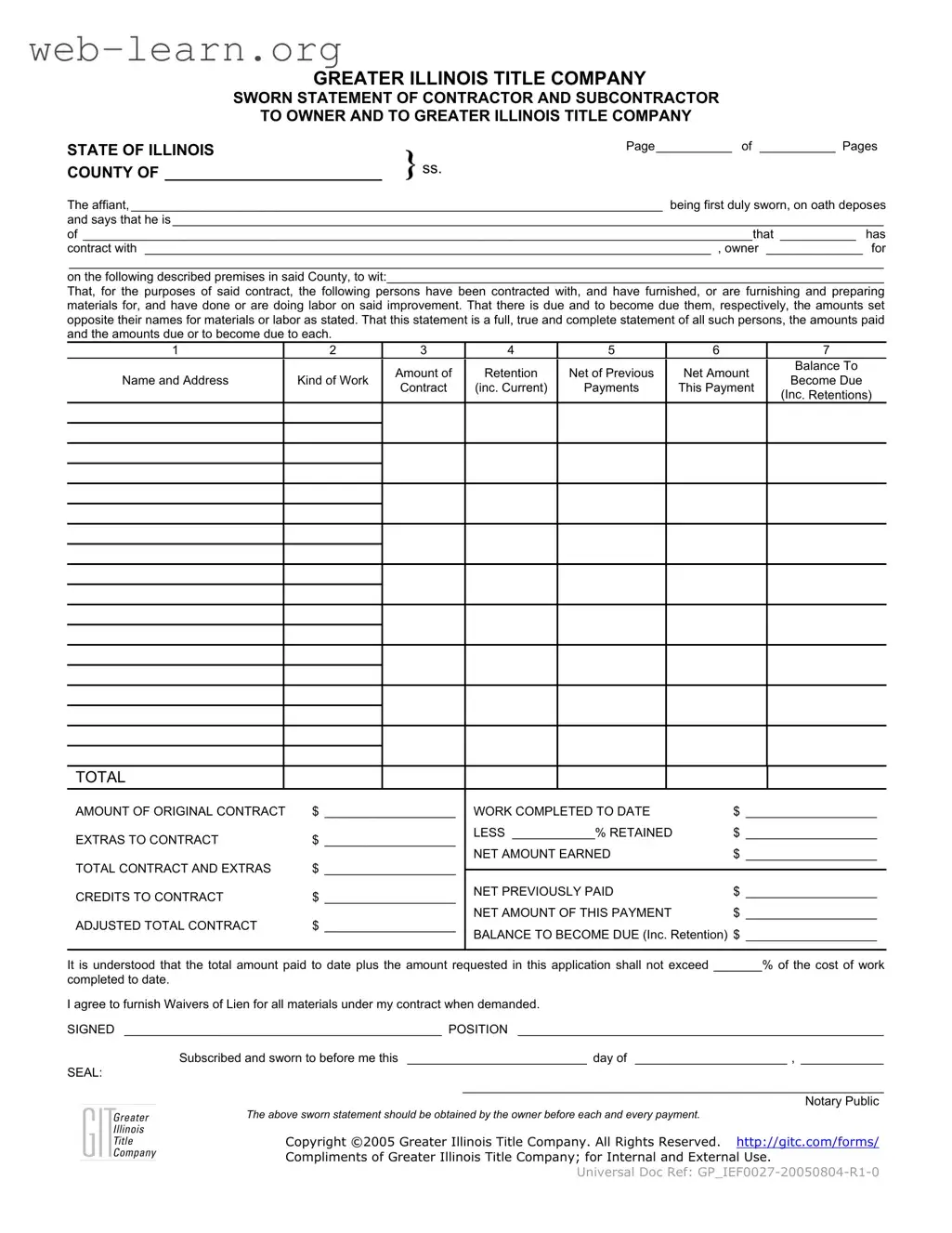
The Illinois Sworn Statement form serves as a crucial document in the construction industry, ensuring transparency and accountability between contractors, subcontractors, and property owners. This form requires the affiant, typically a contractor or subcontractor, to affirm under oath their role in a specific construction project, detailing the contractual obligations involved. It outlines the financial aspects of the project, including amounts due for labor and materials, thereby providing a comprehensive overview of the payments made and those still outstanding. Each section of the form is meticulously designed to capture essential information, such as the names and addresses of individuals or entities involved, the nature of the work performed, and the financial details pertinent to the contract. Additionally, it stipulates the necessity for Waivers of Lien, which protect owners from potential claims against their property. By mandating that this sworn statement be obtained prior to each payment, the form plays a pivotal role in safeguarding all parties’ interests and ensuring that financial transactions align with the progress of the work completed.
GREATER ILLINOIS TITLE COMPANY
SWORN STATEMENT OF CONTRACTOR AND SUBCONTRACTOR
TO OWNER AND TO GREATER ILLINOIS TITLE COMPANY
STATE OF ILLINOIS |
} ss. |
COUNTY OF _________________________ |
Page___________ of ___________ Pages
The affiant, _____________________________________________________________________________ being first duly sworn, on oath deposes
and says that he is _______________________________________________________________________________________________________
of _________________________________________________________________________________________________that ___________ has
contract with __________________________________________________________________________________ , owner ______________ for
______________________________________________________________________________________________________________________
on the following described premises in said County, to wit:________________________________________________________________________
That, for the purposes of said contract, the following persons have been contracted with, and have furnished, or are furnishing and preparing materials for, and have done or are doing labor on said improvement. That there is due and to become due them, respectively, the amounts set opposite their names for materials or labor as stated. That this statement is a full, true and complete statement of all such persons, the amounts paid
and the amounts due or to become due to each. |
|
|
|
|
|
||
|
1 |
2 |
3 |
4 |
5 |
6 |
7 |
|
|
|
Amount of |
Retention |
Net of Previous |
Net Amount |
Balance To |
|
Name and Address |
Kind of Work |
Become Due |
||||
|
Contract |
(inc. Current) |
Payments |
This Payment |
|||
|
|
|
(Inc. Retentions) |
||||
|
|
|
|
|
|
|
|
TOTAL |
|
|
|
|
|
AMOUNT OF ORIGINAL CONTRACT |
$ ___________________ WORK COMPLETED TO DATE |
$ ___________________ |
|||
EXTRAS TO CONTRACT |
$ ___________________ |
LESS ____________% RETAINED |
$ ___________________ |
||
NET AMOUNT EARNED |
$ ___________________ |
||||
TOTAL CONTRACT AND EXTRAS |
$ ___________________ |
||||
|
|
|
|||
NET PREVIOUSLY PAID |
$ ___________________ |
||||
CREDITS TO CONTRACT |
$ ___________________ |
||||
NET AMOUNT OF THIS PAYMENT |
$ ___________________ |
||||
ADJUSTED TOTAL CONTRACT |
$ ___________________ |
||||
BALANCE TO BECOME DUE (Inc. Retention) $ ___________________ |
|||||
|
|
||||
It is understood that the total amount paid to date plus the amount requested in this application shall not exceed _______% of the cost of work
completed to date.
I agree to furnish Waivers of Lien for all materials under my contract when demanded.
SIGNED ______________________________________________ POSITION _____________________________________________________
Subscribed and sworn to before me this __________________________ day of ______________________ , ____________
SEAL:
_____________________________________________________________
Notary Public
The above sworn statement should be obtained by the owner before each and every payment.
Copyright ©2005 Greater Illinois Title Company. All Rights Reserved. http://gitc.com/forms/
Compliments of Greater Illinois Title Company; for Internal and External Use.
Universal Doc Ref:
| Fact Name | Description |
|---|---|
| Purpose | The Illinois Sworn Statement form is used to document payments due to contractors and subcontractors for work completed on a project. |
| Governing Law | This form is governed by the Illinois Mechanics Lien Act (770 ILCS 60). |
| Affiant Requirements | The affiant must be a contractor or subcontractor involved in the project. |
| Notarization | The form must be notarized to ensure its authenticity and legal standing. |
| Payment Documentation | It requires a detailed account of all individuals and entities owed money for labor or materials. |
| Retention Amount | The form includes a section to specify any retention amounts withheld from payments. |
| Waivers of Lien | Contractors must agree to provide Waivers of Lien upon request to release claims against the property. |
| Payment Limits | The total amount requested cannot exceed a certain percentage of the work completed to date. |
| Owner Responsibility | It is the owner's responsibility to obtain this sworn statement before making any payments. |
| Form Updates | The form is copyrighted and should be used as provided by Greater Illinois Title Company. |
Completing the Illinois Sworn Statement form is an important step in ensuring that all parties involved in a construction project are protected. This document serves to confirm the work completed and the payments due to contractors and subcontractors. Follow the steps below to accurately fill out the form.
What is the purpose of the Illinois Sworn Statement form?
The Illinois Sworn Statement form serves as a declaration by contractors and subcontractors regarding the work completed and payments due. It ensures transparency in financial transactions between contractors, subcontractors, and property owners. This form helps protect the interests of all parties by documenting who has been paid and what amounts are still outstanding.
Who needs to complete the Sworn Statement?
The contractor and any subcontractors involved in the project must complete the Sworn Statement. Each party must list their respective contributions and the amounts owed for their work or materials. This ensures that everyone involved in the project is accounted for and that payments are made fairly.
When should the Sworn Statement be submitted?
The Sworn Statement should be obtained by the property owner before making any payments to the contractor. It is advisable to submit this form before each payment to ensure that all parties are aware of the financial status of the project and to confirm that no liens are placed on the property.
What information is required on the form?
The form requires detailed information, including:
Providing accurate information is crucial for the integrity of the document.
What happens if the Sworn Statement is not submitted?
Failure to submit the Sworn Statement can lead to complications. The property owner may be at risk of making payments without knowing the full financial picture, which could result in disputes or even liens against the property. It is essential to obtain this document to safeguard against potential legal issues and ensure all parties are compensated appropriately.
Filling out the Illinois Sworn Statement form can be straightforward, but mistakes can happen. One common error is failing to provide complete information about the contractor or subcontractor. It’s essential to fill in all sections accurately, including names, addresses, and roles. Missing or incorrect details can delay payments and create confusion.
Another mistake is not including the correct contract information. The form requires specific details about the contract, such as the owner’s name and the type of work being done. Omitting this information can lead to complications when processing payments.
People often forget to calculate the amounts correctly. Each section requires precise figures for amounts due, amounts paid, and any retentions. Double-checking these numbers can help avoid discrepancies that could lead to payment issues.
Some individuals neglect to sign the form or forget to have it notarized. A signature is crucial for the document’s validity. Additionally, without a notary, the statement may not be accepted, causing unnecessary delays.
Another common oversight is not updating the form with the latest information. If there are changes to the contract or payment amounts, these should be reflected in the sworn statement. Failing to do so can result in incorrect payments or disputes.
Many people also overlook the requirement to provide Waivers of Lien. The form states that waivers must be furnished upon demand. Not having these ready can hold up payments and complicate the process.
Additionally, some individuals may misinterpret the retention percentage. It’s important to understand how much can be retained and ensure that this percentage is accurately reflected in the totals. Miscalculating retention can lead to financial issues later on.
Lastly, it’s vital to remember that the sworn statement should be obtained before each payment. Some may assume one statement is sufficient for multiple payments, but this is not the case. Each payment requires its own sworn statement to ensure compliance and clarity.
The Illinois Sworn Statement form is essential for contractors and subcontractors to provide transparency regarding payments and work completed. Alongside this form, several other documents are commonly used to ensure compliance and protect the interests of all parties involved. Below are four key forms that often accompany the Illinois Sworn Statement.
Using these documents in conjunction with the Illinois Sworn Statement helps maintain clear communication and accountability among all parties involved in a construction project. Proper documentation not only protects the rights of contractors and subcontractors but also assures property owners that their investments are secure.
The Illinois Sworn Statement form shares similarities with several other documents commonly used in construction and contracting. Each of these documents serves to affirm the accuracy of information regarding payments and work performed. Below are four documents that are similar to the Illinois Sworn Statement:
When filling out the Illinois Sworn Statement form, it is essential to follow certain guidelines to ensure accuracy and compliance. Below is a list of things you should and shouldn't do:
Here are five common misconceptions about the Illinois Sworn Statement form:
This is false. The Illinois Sworn Statement is required for contractors and subcontractors to ensure that all parties involved in a project are compensated fairly. It protects the owner from potential liens by confirming payments made.
In reality, both the contractor and subcontractors must provide their information and signatures. This ensures transparency regarding who has been paid and who is still owed money.
This is incorrect. The sworn statement must be submitted before each payment to the contractor. This practice helps maintain accurate records throughout the project.
While the form outlines amounts due, it does not guarantee payment. It is a declaration of amounts owed and serves as a protective measure for all parties involved.
This is not advisable. Even with trust, obtaining the sworn statement is crucial. It protects the owner from potential claims and ensures all financial obligations are documented.
Here are some key takeaways about filling out and using the Illinois Sworn Statement form: