In the state of Illinois, managing the estate of a deceased individual can often be a daunting task, especially when it comes to smaller estates. The Illinois Small Estate Affidavit serves as a vital tool for heirs and beneficiaries seeking to navigate the probate process with greater ease and efficiency. This legal document simplifies the transfer of assets when the total value of the estate falls below a certain threshold, allowing individuals to bypass the lengthy and often costly probate proceedings. By utilizing this form, eligible heirs can assert their rights to the decedent's property, including personal belongings, bank accounts, and real estate, without the need for court intervention. The affidavit must be executed by a qualified individual, typically a close relative or designated heir, who can affirm their relationship to the deceased and the validity of the claims being made. Additionally, the form requires specific information, such as the names and addresses of all heirs, a description of the assets, and a declaration that the estate qualifies for small estate treatment. Understanding the nuances of this affidavit is crucial for those looking to expedite the distribution of assets and ensure a smoother transition during what can be an emotionally challenging time.
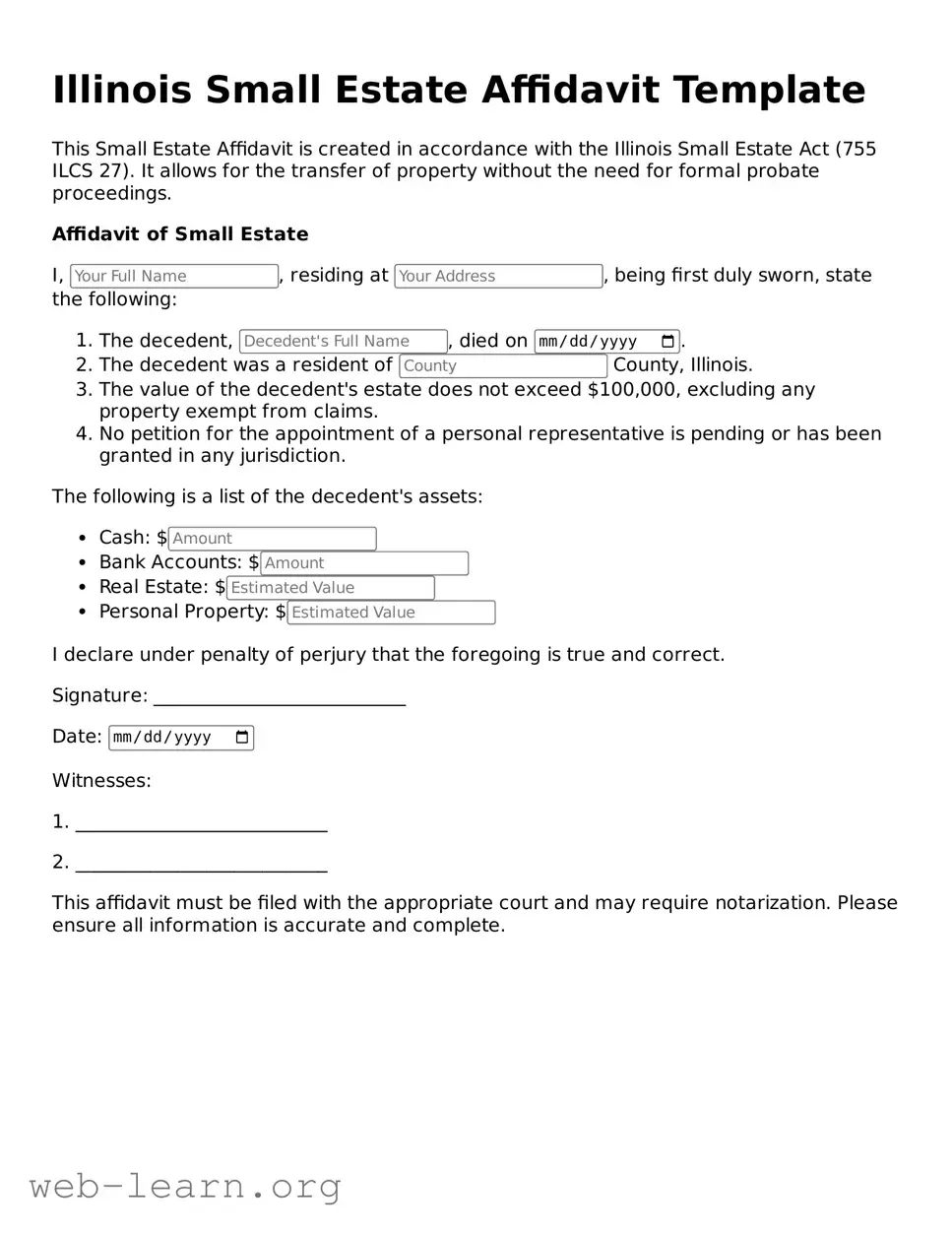
Illinois Small Estate Affidavit Template
This Small Estate Affidavit is created in accordance with the Illinois Small Estate Act (755 ILCS 27). It allows for the transfer of property without the need for formal probate proceedings.
Affidavit of Small Estate
I, , residing at , being first duly sworn, state the following:
The following is a list of the decedent's assets:
I declare under penalty of perjury that the foregoing is true and correct.
Signature: ___________________________
Date:
Witnesses:
1. ___________________________
2. ___________________________
This affidavit must be filed with the appropriate court and may require notarization. Please ensure all information is accurate and complete.
| Fact Name | Description |
|---|---|
| Purpose | The Illinois Small Estate Affidavit allows individuals to claim assets of a deceased person without going through probate. |
| Eligibility | This form is applicable when the total value of the estate is $100,000 or less, excluding real estate. |
| Governing Law | The use of the Small Estate Affidavit is governed by 755 ILCS 27-1 of the Illinois Compiled Statutes. |
| Who Can Use It | Heirs, beneficiaries, or individuals entitled to the estate can use this affidavit to collect assets. |
| Filing Requirements | The affidavit must be signed in front of a notary public and presented to the financial institutions or other entities holding the deceased's assets. |
| Limitations | Real estate cannot be transferred using this form; separate legal procedures are required for real property. |
Once you have gathered the necessary information and documents, you can begin filling out the Illinois Small Estate Affidavit form. This form is used to simplify the process of transferring assets from a deceased person’s estate without going through probate. Follow these steps to complete the form accurately.
What is the Illinois Small Estate Affidavit?
The Illinois Small Estate Affidavit is a legal document that allows individuals to settle the estate of a deceased person without going through the formal probate process. This option is available when the total value of the deceased's assets falls below a certain threshold, which is currently set at $100,000 for personal property and $200,000 for real estate.
Who can use the Small Estate Affidavit?
Any individual who is a qualified heir or beneficiary of the deceased can utilize the Small Estate Affidavit. This typically includes spouses, children, parents, or siblings. The individual must also be willing to assume responsibility for the deceased's debts and distribute the remaining assets according to Illinois law.
What assets qualify for the Small Estate Affidavit?
Assets that qualify include bank accounts, personal property, and certain types of real estate. However, some assets, such as those held in a trust or life insurance policies with designated beneficiaries, do not fall under this category. It is important to evaluate the specific assets involved to determine eligibility.
How do I complete the Small Estate Affidavit?
To complete the Small Estate Affidavit, follow these steps:
Is there a fee associated with filing the Small Estate Affidavit?
Yes, there may be a filing fee when submitting the Small Estate Affidavit to the county clerk’s office. The amount can vary by county, so it is advisable to check with the local office for specific fee details.
How long does the Small Estate Affidavit process take?
The processing time for a Small Estate Affidavit can vary based on the county and the complexity of the estate. Generally, once the affidavit is filed, it can take a few days to a few weeks for the county to process the document and for the assets to be distributed.
Can the Small Estate Affidavit be contested?
Yes, the Small Estate Affidavit can be contested by interested parties, such as other heirs or creditors. If someone believes they have a valid claim against the estate, they may challenge the affidavit in court. This could lead to a more formal probate process if the contest is upheld.
What happens if the estate exceeds the Small Estate threshold?
If the total value of the estate exceeds the Small Estate threshold, the estate will typically need to go through the formal probate process. This process is more complex and involves court supervision to ensure that debts are paid and assets are distributed according to the law.
Filling out the Illinois Small Estate Affidavit form can be a straightforward process, but many individuals encounter pitfalls that can lead to delays or complications. One common mistake is failing to accurately identify all heirs. It is essential to ensure that every individual who has a legal right to inherit is included. Omitting an heir, even unintentionally, can lead to disputes and may require additional legal steps to resolve.
Another frequent error is not providing sufficient documentation to support the claims made in the affidavit. While the form itself may seem simple, it often requires accompanying documents such as death certificates or proof of ownership for certain assets. Without this supporting documentation, the affidavit may be rejected or questioned, causing unnecessary frustration.
People often overlook the importance of notarization. The Illinois Small Estate Affidavit must be signed in the presence of a notary public. Neglecting this crucial step can render the affidavit invalid. It is advisable to double-check that the notarization has been completed properly before submitting the form.
Additionally, some individuals mistakenly assume that they can use the Small Estate Affidavit for any estate, regardless of its value. However, Illinois law stipulates that the total value of the estate must not exceed a certain threshold. Failing to adhere to this limit can lead to legal complications and may require a different probate process altogether.
Another common mistake is not providing a complete list of assets. It is vital to include all relevant assets, such as bank accounts, real estate, and personal property. Incomplete listings can lead to issues in the distribution of the estate and may prolong the process.
People also sometimes misinterpret the role of the affidavit. The Small Estate Affidavit is not a substitute for a will. It is designed for small estates without a will or when the will is not being probated. Understanding this distinction is critical to ensuring that the right legal processes are followed.
Failing to update the affidavit can also be problematic. If circumstances change, such as the discovery of additional heirs or assets, it is important to revise the affidavit accordingly. Ignoring these changes can lead to legal challenges and may complicate the settlement of the estate.
Lastly, individuals may rush through the process, leading to errors in filling out the form. Taking the time to carefully review each section, ensuring accuracy and completeness, is essential. Rushing can result in mistakes that may require additional time and resources to correct.
The Illinois Small Estate Affidavit is a valuable tool for individuals seeking to settle the estate of a deceased person without the need for formal probate proceedings. When utilizing this form, several other documents may be necessary to ensure a smooth process. Below is a list of commonly used forms and documents that accompany the Small Estate Affidavit.
Gathering these documents can help streamline the process of settling an estate using the Illinois Small Estate Affidavit. By ensuring that all necessary paperwork is in order, individuals can honor the wishes of the deceased while providing clarity and support to the heirs involved.
The Small Estate Affidavit is a useful document in the process of settling an estate with minimal assets. It shares similarities with several other legal documents that also facilitate the transfer of property or assets. Here are six documents that resemble the Small Estate Affidavit:
When filling out the Illinois Small Estate Affidavit form, it is important to follow certain guidelines to ensure the process goes smoothly. Below is a list of things to do and avoid.
The Illinois Small Estate Affidavit is a useful tool for settling estates that fall below a certain value threshold. However, several misconceptions can lead to confusion. Here are eight common misunderstandings about the form:
While heirs are typically the ones who benefit from the affidavit, other individuals, such as designated beneficiaries, may also use it to claim property.
This is not accurate. The affidavit is specifically designed for certain types of assets, such as bank accounts and personal property, but cannot be used for real estate or assets held in a trust.
In Illinois, the total value of the estate must be under $100,000, excluding certain assets, to qualify for the Small Estate Affidavit.
This is a common misconception. The Small Estate Affidavit does not need to be filed in court; it is presented directly to institutions holding the deceased's assets.
While it's advisable to address debts, the affidavit can still be used even if some debts remain unpaid, as long as the estate qualifies.
In reality, the process can be relatively quick, often taking only a few days to gather the necessary information and submit the affidavit.
This is incorrect. Multiple affidavits can be used if there are different assets held in various institutions, as long as each affidavit meets the requirements.
While legal advice can be beneficial, it is not a requirement. Many individuals successfully complete the process on their own.
When dealing with the Illinois Small Estate Affidavit form, it is essential to understand the key points to ensure a smooth process. Below are important takeaways to consider: