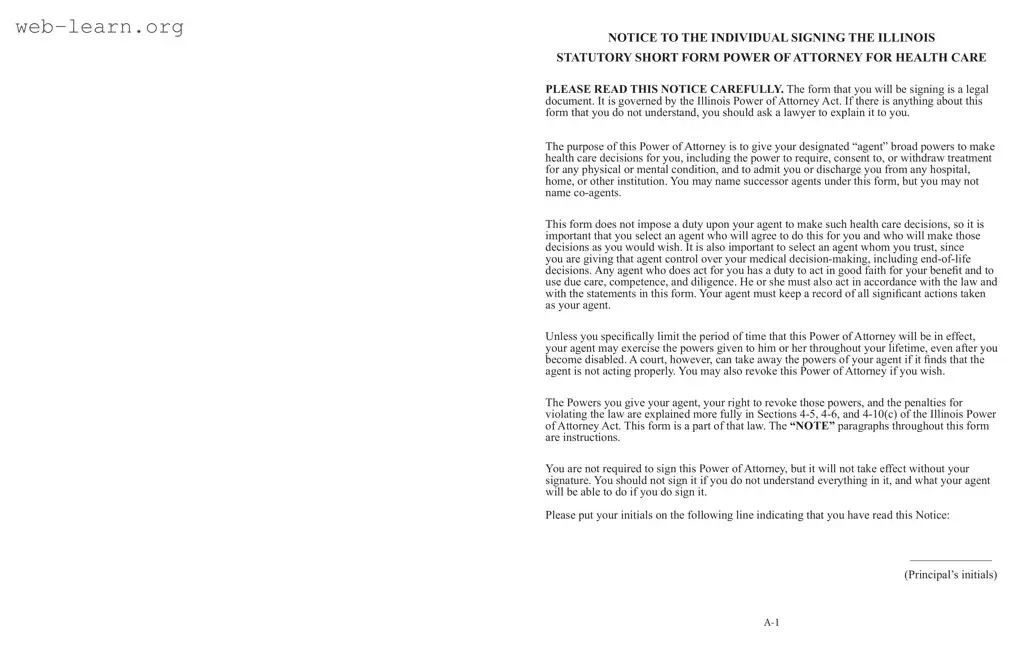
The Illinois Statutory Short Form Power of Attorney for Health Care is a crucial legal document that empowers an individual to designate someone else, known as an agent, to make health care decisions on their behalf. This form is governed by the Illinois Power of Attorney Act and is designed to ensure that your medical preferences are respected, especially in situations where you may be unable to communicate your wishes. By signing this document, you grant your agent broad authority to make decisions regarding your medical treatment, hospitalization, and even end-of-life care. Importantly, you can specify successor agents, but co-agents are not permitted. The form does not obligate your agent to act; therefore, selecting someone you trust is essential. Your agent will be responsible for keeping records of their decisions and must act in good faith, adhering to your expressed wishes. The power of attorney remains effective throughout your lifetime unless you decide to revoke it or a court determines otherwise. It is vital to read the notice carefully, understand its implications, and consult a lawyer if you have any questions before signing. This form also addresses issues such as anatomical gifts, autopsy authorization, and the handling of your medical records, ensuring comprehensive coverage of your health care preferences.
NOTICE TO THE INDIVIDUAL SIGNING THE ILLINOIS
STATUTORY SHORT FORM POWER OF ATTORNEY FOR HEALTH CARE
PLEASE READ THIS NOTICE CAREFULLY. The form that you will be signing is a legal document. It is governed by the Illinois Power of Attorney Act. If there is anything about this form that you do not understand, you should ask a lawyer to explain it to you.
The purpose of this Power of Attorney is to give your designated “agent” broad powers to make health care decisions for you, including the power to require, consent to, or withdraw treatment for any physical or mental condition, and to admit you or discharge you from any hospital, home, or other institution. You may name successor agents under this form, but you may not name
This form does not impose a duty upon your agent to make such health care decisions, so it is important that you select an agent who will agree to do this for you and who will make those decisions as you would wish. It is also important to select an agent whom you trust, since
you are giving that agent control over your medical
Unless you speciically limit the period of time that this Power of Attorney will be in effect, your agent may exercise the powers given to him or her throughout your lifetime, even after you become disabled. A court, however, can take away the powers of your agent if it inds that the agent is not acting properly. You may also revoke this Power of Attorney if you wish.
The Powers you give your agent, your right to revoke those powers, and the penalties for violating the law are explained more fully in Sections
You are not required to sign this Power of Attorney, but it will not take effect without your signature. You should not sign it if you do not understand everything in it, and what your agent will be able to do if you do sign it.
Please put your initials on the following line indicating that you have read this Notice:
______________
(Principal’s initials)
ILLINOIS STATUTORY SHORT FORM
POWER OF ATTORNEY FOR HEALTH CARE
1.I, _______________________________________________________________________, (insert name and address of principal)
hereby revoke all prior powers of attorney for health care executed by me and appoint:
_____________________________________________________________________________
(insert name and address of agent)
(NOTE: You may not name
as my
A.My agent shall have the same access to my medical records that I have, including the right to disclose the contents to others.
B.Effective upon my death, my agent has the full power to make an anatomical gift of the following:
(NOTE: Initial one. In the event none of the options are initialed, then it shall be concluded that you do not wish to grant your agent any such authority.)
______ Any organs, tissues, or eyes suitable for transplantation or used for research or education.
______ Speciic Organs:____________________________________________________
______ I do not grant my agent authority to make any anatomical gifts.
C.My agent shall also have full power to authorize an autopsy and direct the disposition of my remains. I intend for this power of attorney to be in substantial compliance with Section 10 of the Disposition of Remains Act. All decisions made by my agent with respect to the disposition of my remains, including cremation, shall be binding. I hereby direct any cemetery organization, business operating a crematory or columbarium or both, funeral director or embalmer, or funeral establishment who receives a copy of this document to act under it.
D.I intend for the person named as my agent to be treated as I would be with respect to my rights regarding the use and disclosure of my individually identiiable health information or other medical records, including records or communications governed by the Mental Health and Developmental Disabilities Conidentiality Act. This release authority applies to any information governed by the Health Insurance Portability and Accountability Act of 1996
(“HIPAA”) and regulations thereunder. I intend for the person named as my agent to serve as my “personal representative” as that term is deined under HIPAA and regulations thereunder.
(i)The person named as my agent shall have the power to authorize the release of information governed by HIPAA to third parties.
(ii)I authorize any physician, health care professional, dentist, health plan, hospital, clinic, laboratory, pharmacy or other covered health care provider, any insurance company and the Medical Informational Bureau, Inc., or any other health care clearinghouse that has provided treatment or services to me, or that has paid for or is seeking payment for me
for such services to give, disclose, and release to the person named as my agent, without restriction, all of my individually identiiable health information and medical records, regarding any past, present, or future medical or mental health condition, including all information relating to the diagnosis and treatment of HIV/AIDS, sexually transmitted
diseases, drug or alcohol abuse, and mental illness (including records or communications governed by the Mental Health and Developmental Disabilities Conidentiality Act).
(iii)The authority given to the person named as my agent shall supersede any prior agreement
that I may have with my health care providers to restrict access to, or disclosure of, my individually identiiable health information. The authority given to the person named as my agent has no expiration date and shall expire only in the event that I revoke the authority in writing and deliver it to my health care provider.
(NOTE: The above grant of power is intended to be as broad as possible so that your agent will have the authority to make any decision you could make to obtain or terminate any type of health care, including withdrawal of food and water and other
scope of your agent’s powers or prescribe special rules or limit the power to make an anatomical gift, authorize autopsy or dispose of remains, you may do so in the following paragraphs.)
2.The powers granted above shall not include the following powers or shall be subject to the following rules or limitations:
(NOTE: Here you may include any speciic limitations you deem appropriate, such as: your own deinition of when
of treatment that are inconsistent with your religious beliefs or unacceptable to you for any
other reason, such as blood transfusion,
_____________________________________________________________________________
_____________________________________________________________________________
_____________________________________________________________________________
_____________________________________________________________________________
_____________________________________________________________________________
(NOTE: The subject of
guidance for your agent, who shall give careful consideration to the statement you initial when engaging in health care
I do not want my life to be prolonged nor do I want
the possible extension of my life in making decisions concerning
Initialed __________
I want my life to be prolonged and I want
standards at the time of reference, in a state of “permanent unconsciousness” or suffer from an “incurable or irreversible condition” or “terminal condition”, as those terms are deined in Section
conditions, I want
Initialed __________
I want my life to be prolonged to the greatest extent possible in accordance with reasonable medical standards without regard to my condition, the chances I have for recovery or the cost of the procedures.
Initialed __________
(NOTE: This power of attorney may be amended or revoked by you in the manner provided in Section
3.This power of attorney shall become effective on: _________________________________
_____________________________________________________________________________
(NOTE: In Line 3 above, insert a future date or event during your lifetime, such as a court
determination of your disability or a written determination by your physician that you are incapacitated, when you want this power to irst take effect.)
(NOTE: If you do not amend or revoke this power, or if you do not specify a speciic ending date
in paragraph 4, it will remain in effect until your death; except that your agent will still have the
authority to donate your organs, authorize an autopsy, and dispose of your remains after your death, if you grant that authority to your agent.)
4.This power of attorney shall terminate on: _______________________________________
_____________________________________________________________________________
(NOTE: In Line 4 above, insert a future date or event, such as a court determination that you
are not under a legal disability or a written determination by your physician that you are not incapacitated, if you want this power to terminate prior to your death.)
(NOTE: You cannot use this form to name
5.If any agent named by me shall die, become incompetent, resign, refuse to accept the ofice of agent or be unavailable, I name the following (each to act alone and successively, in the order named) as successors to such agent:
_____________________________________________________________________________
(insert name and address of successor agent)
_____________________________________________________________________________
(insert name and address of successor agent)
For purposes of this paragraph 5, a person shall be considered to be incompetent if and while the
person is a minor, or an adjudicated incompetent or disabled person, or the person is unable to give prompt and intelligent consideration to health care matters, as certiied by a licensed physician.
(NOTE: If you wish to, you may name your agent as guardian of your person if a court decides
that one should be appointed. To do this, retain paragraph 6, and the court will appoint your agent if the court inds that this appointment will serve your best interests and welfare. Strike out paragraph 6 if you do not want your agent to act as guardian.)
6.If a guardian of my person is to be appointed, I nominate the agent acting under this power of attorney as such guardian, to serve without bond or security.
7.I am fully informed as to all the contents of this form and understand the full import of this grant of powers to my agent.
Dated: ___________________ |
Signed: __________________________________________ |
|
(principal’s signature or mark) |
|
The principal has had an opportunity to review the above form and has signed the form or
acknowledged his or her signature or mark on the form in my presence. The undersigned witness certiies that the witness is not: (a) the attending physician or mental health service provider or a
relative of the physician or provider; (b) an owner, operator, or relative of an owner or operator of a health care facility in which the principal is a patient or resident; (c) a parent, sibling or descendant, or any spouse of such parent, sibling, or descendant of either the principal or any agent or successor agent under the foregoing power of attorney, whether such relationship is by blood, marriage, or adoption; or
(d) an agent or successor agent under the foregoing power of attorney.
______________________________________
(Witness Signature)
______________________________________
(Print Witness Name)
______________________________________
(Street Address)
______________________________________
(City, State, ZIP)
(NOTE: You may, but are not required to, request your agent and successor agents to provide
specimen signatures below. If you include specimen signatures in this power of attorney, you must complete the certiication opposite the signatures of the agents.)
Specimen signatures of agent (and successors). |
I certify that the signatures of my agent (and |
|
successors) are correct. |
________________________________________ |
________________________________________ |
(agent) |
(principal) |
________________________________________ |
________________________________________ |
(successor agent) |
(principal) |
________________________________________ |
________________________________________ |
(successor agent) |
(principal) |
(NOTE: The name, address, and phone number of the person preparing this form or who assisted the principal in completing this form is optional.)
___________________________________
(name of preparer)
___________________________________
(address)
___________________________________
(address)
___________________________________
(phone)
| Fact Name | Fact Description |
|---|---|
| Governing Law | This form is governed by the Illinois Power of Attorney Act. |
| Purpose | The purpose is to appoint an agent to make health care decisions on your behalf. |
| Agent Authority | Your agent can consent to or withdraw treatment and manage hospital admissions. |
| Successor Agents | You may name successor agents, but co-agents are not allowed. |
| Agent's Duty | Your agent must act in good faith and in your best interest. |
| Record Keeping | Your agent is required to keep a record of significant actions taken on your behalf. |
| Revocation | You can revoke this power of attorney at any time if you choose. |
| Life-Sustaining Treatment | You can specify your preferences regarding life-sustaining treatment in the form. |
| Effective Date | The power of attorney can become effective upon a specified future event or date. |
Filling out the Illinois Short Power of Attorney for Health Care form is an important step in ensuring that your health care decisions are made according to your wishes. This document allows you to appoint an agent who will make medical decisions on your behalf if you are unable to do so. It is essential to carefully consider your choices and the implications of this form before proceeding.
Once you have completed the form, it is advisable to keep it in a safe place and share copies with your agent and any relevant family members or health care providers. This ensures that your wishes are known and can be honored when needed.
The Illinois Short Power of Attorney for Health Care is a legal document that allows you to appoint an agent to make health care decisions on your behalf. This includes decisions about medical treatment, hospitalization, and end-of-life care. It is governed by the Illinois Power of Attorney Act.
You can appoint any adult you trust as your agent. This person will have the authority to make health care decisions for you when you are unable to do so yourself. However, you cannot name co-agents; you can only appoint one agent at a time.
Yes, you can specify limitations on the powers granted to your agent. For example, you may choose to restrict certain types of medical treatments or specify your wishes regarding life-sustaining measures. It's important to clearly outline any limitations in the document.
If you become incapacitated, your agent can begin making health care decisions on your behalf, as long as the power of attorney is effective at that time. You can specify when the power of attorney becomes effective, such as upon a physician's determination of your incapacity.
Yes, you have the right to revoke the Power of Attorney at any time. To do this, you must provide a written notice of revocation to your agent and any health care providers involved in your care.
Your agent has a duty to act in your best interest and to make decisions that align with your wishes. They must keep a record of significant actions taken on your behalf and act in good faith.
If your appointed agent is unable to serve due to death, incompetence, or refusal, you can name successor agents in the document. These successors will step in to make decisions for you in the order you specify.
The “Notice” section is meant to inform you about the implications of signing the Power of Attorney. It emphasizes the importance of understanding the document fully and encourages you to seek legal advice if you have questions.
Yes, your agent will have the same access to your medical records as you do. This includes the authority to disclose information to others as necessary for your care.
The Power of Attorney remains in effect until your death unless you specify an earlier termination date or revoke it. Your agent will retain authority to make decisions even after you become disabled, as long as the document is valid.
Filling out the Illinois Short Power of Attorney for Health Care can be a straightforward process, but many people make common mistakes that can lead to significant issues later. Understanding these pitfalls is crucial for ensuring that your health care wishes are respected.
One frequent mistake is failing to clearly identify the agent. When you fill out the form, you must provide the full name and address of your chosen agent. Leaving this information incomplete can result in confusion or disputes about who is authorized to make decisions on your behalf.
Another common error is neglecting to revoke prior powers of attorney. If you do not explicitly state that previous powers of attorney are revoked, they may still be considered valid. This can create conflicting instructions and complicate decision-making during critical times.
Some individuals forget to initial the anatomical gift section. If you do not indicate your wishes regarding organ donation, it will be assumed that you do not want to grant this authority to your agent. This oversight can prevent your agent from acting according to your desires.
People often overlook the importance of specifying limitations on the agent's powers. If you have particular wishes about life-sustaining treatment or other medical decisions, you must clearly outline these preferences in the designated section. Failing to do so may lead to decisions that do not align with your values.
Additionally, many signers do not read the notice at the beginning of the form carefully. This notice contains essential information about the powers you are granting and the responsibilities of your agent. Ignoring this notice can lead to misunderstandings about the scope of the authority you are giving.
Another mistake is not dating the form correctly. The power of attorney becomes effective on the date you specify. If you leave this blank or write an incorrect date, it can create confusion about when your agent can begin making decisions on your behalf.
Some individuals also fail to consider the implications of naming successor agents. If your primary agent is unavailable, you must ensure that you have designated successors properly. Not doing so can leave a gap in decision-making authority during critical moments.
Lastly, many people forget to sign the document. Without your signature, the power of attorney is not valid. This simple oversight can nullify your intentions, leaving your health care decisions in limbo.
By being aware of these common mistakes, you can take the necessary steps to ensure that your Illinois Short Power of Attorney for Health Care is filled out correctly. It is essential to approach this process with care and consideration to safeguard your health care wishes.
The Illinois Short Power of Attorney for Health Care is an important document that allows you to designate someone to make medical decisions on your behalf. When preparing this document, it is often beneficial to consider other forms and documents that complement it. Here are four additional forms that are commonly used alongside the Illinois Short Power of Attorney for Health Care.
By considering these additional documents, you can create a more complete plan that addresses both your health care and financial needs. Each form plays a vital role in ensuring that your wishes are respected and that your designated agents can act effectively on your behalf when necessary.
When filling out the Illinois Short Power of Attorney for Health Care form, it is crucial to follow specific guidelines to ensure that the document serves its intended purpose effectively. Here are five essential dos and don'ts:
Understanding the Illinois Short Power of Attorney for Health Care is essential for making informed decisions about your medical care. However, several misconceptions often arise regarding this important document. Here are four common misconceptions:
This is not entirely accurate. While the agent should strive to make decisions in alignment with the principal’s wishes, they are not legally bound to do so. The agent has the discretion to make choices based on their understanding of the principal's desires and best interests.
This misconception overlooks the fact that anyone, regardless of age, can experience a medical emergency or become incapacitated. Therefore, having this document in place is a prudent decision for adults of all ages.
Contrary to this belief, the principal retains the right to revoke or amend the power of attorney at any time, as long as they are mentally competent. This flexibility allows for adjustments based on changing circumstances or preferences.
This is misleading. While the agent does have broad authority to make health care decisions, the principal can specify limitations within the document. It is crucial to articulate any restrictions or specific instructions to ensure the agent acts within the desired boundaries.
Understanding the Illinois Short Power of Attorney for Health Care is essential for making informed decisions about your health care preferences. Here are some key takeaways:
By keeping these points in mind, you can navigate the process of creating a power of attorney with confidence and clarity.