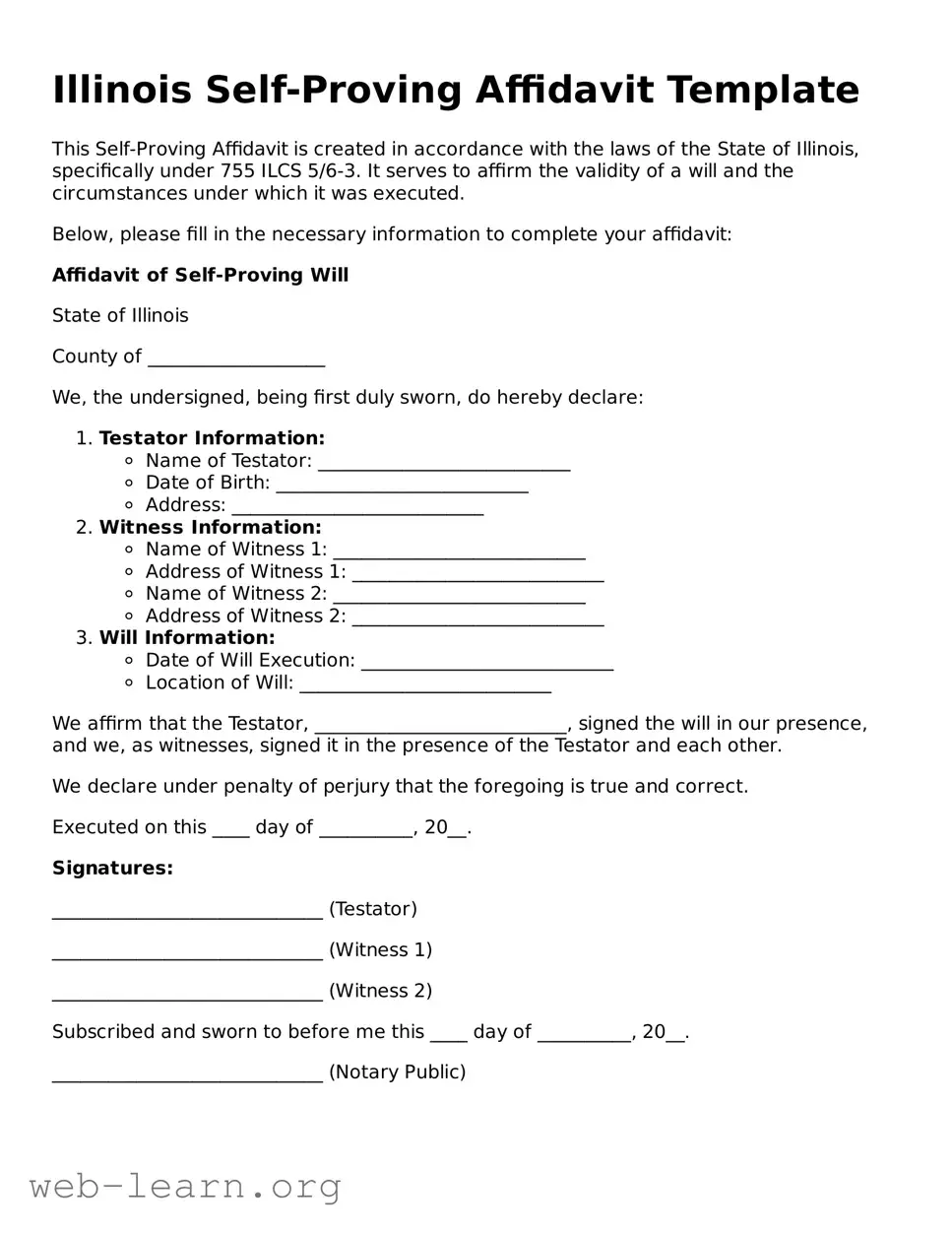
The Illinois Self-Proving Affidavit form serves as an important tool in the estate planning process, particularly when it comes to validating a will. This form allows a testator—someone who has made a will—to affirm their intentions in front of witnesses, thus simplifying the probate process. By completing this affidavit, the testator and witnesses declare that the will was signed voluntarily and that the testator was of sound mind at the time of signing. The form typically includes spaces for the names and signatures of the testator and witnesses, along with a notary public's acknowledgment. This notarization adds an extra layer of authenticity, making it more difficult to challenge the will's validity later on. Utilizing the Illinois Self-Proving Affidavit can expedite the probate process, as it eliminates the need for witnesses to testify in court about the will's execution. As such, understanding this form is essential for anyone involved in estate planning in Illinois, ensuring that the testator's wishes are honored with minimal complications.
Illinois Self-Proving Affidavit Template
This Self-Proving Affidavit is created in accordance with the laws of the State of Illinois, specifically under 755 ILCS 5/6-3. It serves to affirm the validity of a will and the circumstances under which it was executed.
Below, please fill in the necessary information to complete your affidavit:
Affidavit of Self-Proving Will
State of Illinois
County of ___________________
We, the undersigned, being first duly sworn, do hereby declare:
We affirm that the Testator, ___________________________, signed the will in our presence, and we, as witnesses, signed it in the presence of the Testator and each other.
We declare under penalty of perjury that the foregoing is true and correct.
Executed on this ____ day of __________, 20__.
Signatures:
_____________________________ (Testator)
_____________________________ (Witness 1)
_____________________________ (Witness 2)
Subscribed and sworn to before me this ____ day of __________, 20__.
_____________________________ (Notary Public)
| Fact Name | Details |
|---|---|
| Definition | The Illinois Self-Proving Affidavit is a legal document that allows a will to be validated without the need for witnesses to testify in court. |
| Governing Law | This affidavit is governed by the Illinois Probate Act, specifically 755 ILCS 5/6-3. |
| Purpose | The primary purpose is to simplify the probate process by confirming the authenticity of the will. |
| Signature Requirement | The testator must sign the affidavit in the presence of a notary public and two witnesses. |
| Effectiveness | The self-proving affidavit can expedite the probate process, making it smoother and less time-consuming. |
| Storage | It is advisable to keep the affidavit with the will in a safe place, such as a safe deposit box or with an attorney. |
| Revocation | A self-proving affidavit can be revoked or replaced if the testator decides to change their will. |
Once you have gathered the necessary information and documents, you can begin filling out the Illinois Self-Proving Affidavit form. This form is essential for verifying the authenticity of a will and ensuring that it can be processed smoothly in probate court.
After completing the form, keep it with your will and ensure that all involved parties have copies. This will help streamline the probate process when the time comes.
A Self-Proving Affidavit is a legal document that allows a will to be validated without the need for witnesses to testify in court. In Illinois, this affidavit is attached to a will and serves as proof that the will was properly executed. It simplifies the probate process by confirming the authenticity of the will at the time of its creation.
Any individual who is at least 18 years old and of sound mind can create a Self-Proving Affidavit. Typically, the testator (the person making the will) and at least two witnesses must sign the affidavit. These witnesses should also be at least 18 years old and not beneficiaries of the will.
A Self-Proving Affidavit generally includes:
No, a Self-Proving Affidavit is not legally required in Illinois. However, including one can significantly streamline the probate process. It eliminates the need for witnesses to appear in court to validate the will, saving time and resources.
By including a Self-Proving Affidavit, the probate court can accept the will without requiring witness testimony. This can lead to a quicker resolution of the estate and reduce potential disputes among heirs or beneficiaries regarding the will's validity.
Yes, a Self-Proving Affidavit can be revoked if the testator creates a new will or modifies the existing one. If a new will is created, it should include a new Self-Proving Affidavit to ensure that it is recognized in the probate process.
To execute a Self-Proving Affidavit, follow these steps:
It is advisable to store the Self-Proving Affidavit with the original will in a safe and secure location, such as a safe deposit box or with an attorney. Ensure that your loved ones know where to find these documents when needed.
Filling out the Illinois Self-Proving Affidavit form can be a straightforward process, but mistakes can lead to complications in the probate process. One common error is failing to include the required information about the testator. The testator's name, address, and other identifying details must be clearly stated. Omitting this information can raise questions about the validity of the affidavit.
Another frequent mistake involves the signatures of witnesses. The affidavit requires the signatures of at least two witnesses who observed the testator signing the will. If the witnesses do not sign in the appropriate section or if their signatures are missing altogether, the affidavit may be deemed incomplete. It is essential that witnesses sign in the correct area to validate the document.
People often overlook the date on the affidavit. The form must include the date when the testator and witnesses signed the document. A missing or incorrect date can create confusion and potentially challenge the legitimacy of the will. Ensuring that the date is accurate and clearly indicated is crucial for the affidavit's acceptance.
Additionally, some individuals neglect to have the affidavit notarized. While the affidavit can be signed in front of witnesses, it typically requires notarization to be considered self-proving. Without a notary's signature and seal, the affidavit may not fulfill its intended purpose, leading to delays in the probate process.
Another common error is not providing adequate identification for the witnesses. The affidavit should include the names and addresses of the witnesses, but it may also require additional identification information. Failure to provide this can lead to questions about the witnesses' credibility and their ability to confirm the testator's intent.
Finally, people sometimes use outdated versions of the Self-Proving Affidavit form. Laws and requirements can change, so it is essential to ensure that the most current form is being used. Using an outdated version can result in non-compliance with current legal standards, which may invalidate the affidavit.
The Illinois Self-Proving Affidavit is a crucial document in the estate planning process. It serves to validate a will by confirming the testator's signature and the presence of witnesses. Along with this affidavit, several other forms and documents are often utilized to ensure comprehensive estate management and legal compliance. Below is a list of these commonly used documents.
Utilizing these documents in conjunction with the Illinois Self-Proving Affidavit can streamline the estate planning process and help ensure that an individual's wishes are honored. It is advisable to consult with a legal professional to ensure that all documents are correctly prepared and executed.
The Self-Proving Affidavit is an important document in estate planning, particularly in the context of wills. It serves to affirm that the will was executed properly and can simplify the probate process. Here are four documents that share similarities with the Self-Proving Affidavit:
When filling out the Illinois Self-Proving Affidavit form, it is important to follow specific guidelines to ensure accuracy and compliance. Below are some key dos and don'ts to consider.
The Illinois Self-Proving Affidavit form is often misunderstood. Below are ten common misconceptions about this legal document, along with clarifications.
This is not true. While it is advisable to consult with an attorney, individuals can prepare the affidavit themselves as long as they follow the required format and guidelines.
The Self-Proving Affidavit is not a will. It is a document that serves to validate a will by affirming that the testator and witnesses signed the will in each other's presence.
This misconception overlooks the fact that a Self-Proving Affidavit can be beneficial for any estate, regardless of size. It simplifies the probate process by reducing the need for witness testimony.
While a Self-Proving Affidavit can be executed after a will is created, it must be done in accordance with Illinois law. It is best to include it at the time of the will's signing.
This is incorrect. Witnesses must be present when the testator signs the will and the Self-Proving Affidavit to ensure its validity.
The Self-Proving Affidavit is legally binding in Illinois, as long as it meets the state's requirements. It serves as a sworn statement that can expedite the probate process.
Each state has its own laws regarding Self-Proving Affidavits. While Illinois recognizes this form, other states may have different requirements or may not recognize it at all.
While a Self-Proving Affidavit is a formal declaration, it can be revoked or replaced with a new affidavit if the will is updated or changed.
This is a misconception. Anyone can use the Self-Proving Affidavit, even if they choose to prepare their will without legal assistance.
When dealing with the Illinois Self-Proving Affidavit form, it is essential to understand its purpose and the process involved. Here are some key takeaways:
By understanding these key points, individuals can better navigate the process of creating a self-proving will in Illinois.