Homepage Blank Illinois School Transfer Form
Outline

When a student transitions from one school district to another in Illinois, the Illinois School Transfer form plays a crucial role in ensuring a smooth and compliant transfer process. This form is designed to verify the student's status, confirming whether they are “in good standing” and whether their medical records are up-to-date. The definition of “in good standing” indicates that the student is not currently facing disciplinary actions such as suspension or expulsion, thereby allowing them to continue their education without interruption. It is important to note that no new school can accept a student without this form, which must be provided directly from the student's previous school district. Parents or guardians will need to fill out key information, including the student's identification number, personal details, and the name of the school they will be transferring to. The principal of the current school must also attest to the student's standing and medical record status, ensuring that all necessary documentation is in order before the transfer occurs. This form not only facilitates the administrative aspects of changing schools but also serves to protect the rights and educational opportunities of students during their transition.

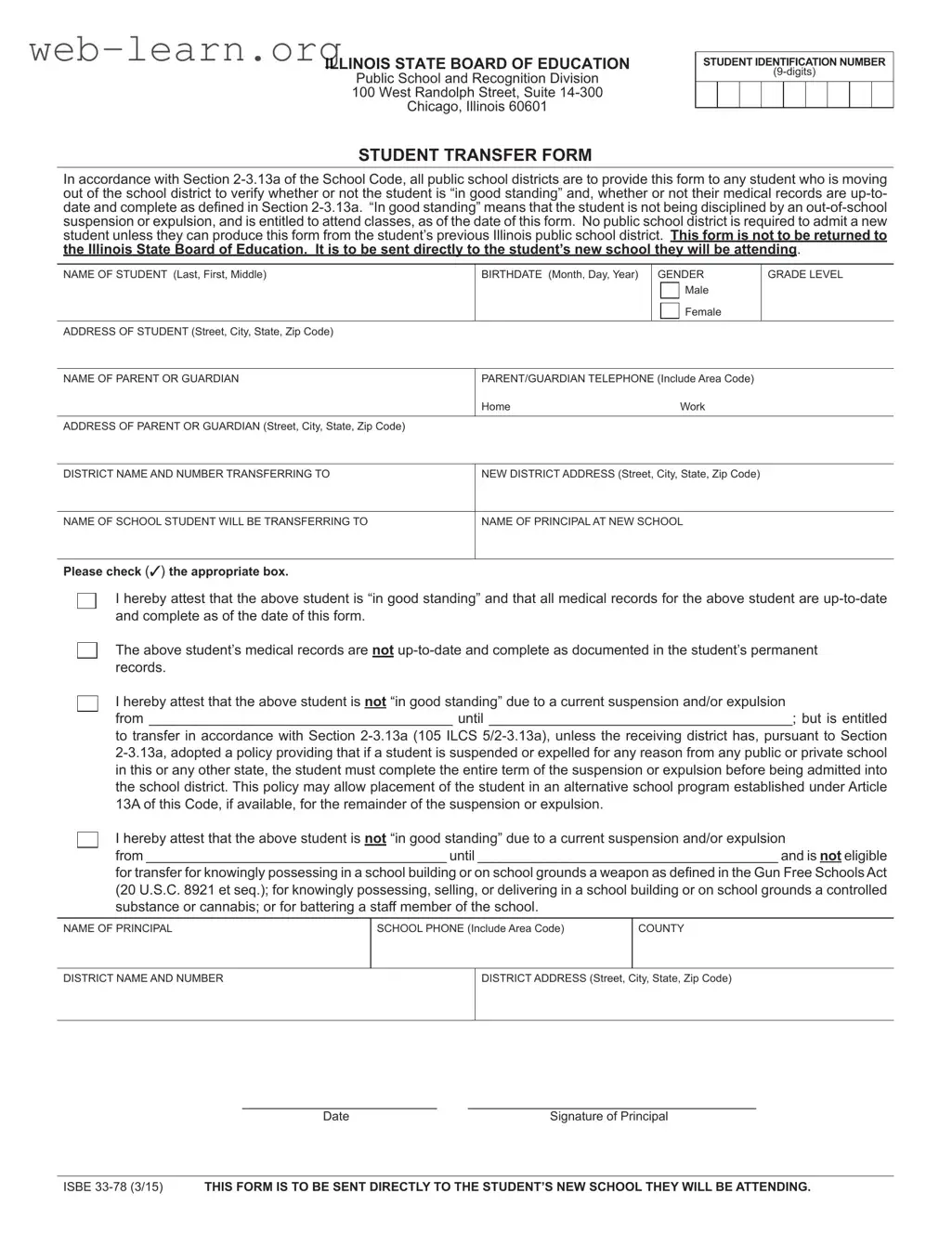
Sample - Illinois School Transfer Form

ILLINOIS STATE BOARD OF EDUCATION

Public School and Recognition Division

100 West Randolph Street, Suite 14-300

Chicago, Illinois 60601

STUDENT IDENTIFICATION NUMBER

(9-digits)

STUDENT TRANSFER FORM

In accordance with Section 2-3.13a of the School Code, all public school districts are to provide this form to any student who is moving out of the school district to verify whether or not the student is “in good standing” and, whether or not their medical records are up-to- date and complete as deined in Section 2-3.13a. “In good standing” means that the student is not being disciplined by an out-of-school suspension or expulsion, and is entitled to attend classes, as of the date of this form. No public school district is required to admit a new student unless they can produce this form from the student’s previous Illinois public school district. This form is not to be returned to the Illinois State Board of Education. It is to be sent directly to the student’s new school they will be attending.

NAME OF STUDENT (Last, First, Middle)

BIRTHDATE (Month, Day, Year)

GENDER

GRADE LEVEL


Male


Female


ADDRESS OF STUDENT (Street, City, State, Zip Code)


NAME OF PARENT OR GUARDIAN

PARENT/GUARDIAN TELEPHONE (Include Area Code)


Home

Work


ADDRESS OF PARENT OR GUARDIAN (Street, City, State, Zip Code)


DISTRICT NAME AND NUMBER TRANSFERRING TO

NEW DISTRICT ADDRESS (Street, City, State, Zip Code)


NAME OF SCHOOL STUDENT WILL BE TRANSFERRING TO

NAME OF PRINCIPAL AT NEW SCHOOL


Please check () the appropriate box.

I hereby attest that the above student is “in good standing” and that all medical records for the above student are up-to-date and complete as of the date of this form.

The above student’s medical records are not up-to-date and complete as documented in the student’s permanent records.

I hereby attest that the above student is not “in good standing” due to a current suspension and/or expulsion

from _______________________________________ until _______________________________________; but is entitled

to transfer in accordance with Section 2-3.13a (105 ILCS 5/2-3.13a), unless the receiving district has, pursuant to Section 2-3.13a, adopted a policy providing that if a student is suspended or expelled for any reason from any public or private school in this or any other state, the student must complete the entire term of the suspension or expulsion before being admitted into the school district. This policy may allow placement of the student in an alternative school program established under Article 13A of this Code, if available, for the remainder of the suspension or expulsion.

I hereby attest that the above student is not “in good standing” due to a current suspension and/or expulsion

from _______________________________________ until _______________________________________ and is not eligible

for transfer for knowingly possessing in a school building or on school grounds a weapon as deined in the Gun Free Schools Act (20 U.S.C. 8921 et seq.); for knowingly possessing, selling, or delivering in a school building or on school grounds a controlled substance or cannabis; or for battering a staff member of the school.

NAME OF PRINCIPAL

SCHOOL PHONE (Include Area Code)

COUNTY

DISTRICT NAME AND NUMBER

DISTRICT ADDRESS (Street, City, State, Zip Code)

_________________________

_____________________________________

Date

Signature of Principal

ISBE 33-78 (3/15) THIS FORM IS TO BE SENT DIRECTLY TO THE STUDENT’S NEW SCHOOL THEY WILL BE ATTENDING.

Form Information

Fact Name Details
Governing Law This form is governed by Section 2-3.13a of the Illinois School Code (105 ILCS 5/2-3.13a).
Purpose of the Form The form verifies if a student is “in good standing” and whether their medical records are complete when transferring to a new school.
Submission Requirements The completed form must be sent directly to the new school the student will be attending, not to the Illinois State Board of Education.
Impact of Suspension or Expulsion If a student is currently suspended or expelled, they may not be eligible for transfer until the terms of their suspension or expulsion are fulfilled, as outlined in the form.

Detailed Guide for Filling Out Illinois School Transfer

After completing the Illinois School Transfer form, ensure it is sent directly to the student’s new school. The new school will require this form for enrollment purposes.

  1. Obtain the Illinois School Transfer form from the current school district.
  2. Fill in the student identification number with a 9-digit number.
  3. Enter the name of the student in the format of Last, First, Middle.
  4. Provide the birthdate in the format of Month, Day, Year.
  5. Select the gender of the student by checking the appropriate box.
  6. Indicate the grade level the student is currently in.
  7. Complete the address of the student including Street, City, State, and Zip Code.
  8. Fill in the name of the parent or guardian.
  9. Provide the parent/guardian telephone number, including the area code for both home and work.
  10. Complete the address of the parent or guardian including Street, City, State, and Zip Code.
  11. Write the district name and number the student is transferring to.
  12. Fill in the new district address including Street, City, State, and Zip Code.
  13. Enter the name of the school the student will be transferring to.
  14. Provide the name of the principal at the new school.
  15. Check the appropriate box to attest whether the student is “in good standing” and if medical records are up-to-date.
  16. If applicable, provide details regarding any current suspension or expulsion.
  17. Fill in the name of the principal at the current school.
  18. Provide the school phone number, including the area code.
  19. Complete the county where the current school is located.
  20. Write the district name and number for the current school.
  21. Fill in the district address for the current school including Street, City, State, and Zip Code.
  22. Sign and date the form where indicated.

Obtain Answers on Illinois School Transfer

  1. What is the purpose of the Illinois School Transfer form?

    The Illinois School Transfer form is used to verify a student's status when transferring from one public school district to another. It ensures that the student is "in good standing," meaning they are not currently suspended or expelled, and that their medical records are complete and up-to-date.

  2. Who needs to fill out this form?

    The form must be filled out by the principal of the student's current school. It is necessary for any student moving out of their current school district to a new one within Illinois.

  3. What does "in good standing" mean?

    "In good standing" indicates that the student is eligible to attend classes without any disciplinary actions, such as out-of-school suspensions or expulsions, affecting their status as of the date of the form.

  4. Where should the completed form be sent?

    The completed form should be sent directly to the new school that the student will be attending. It should not be returned to the Illinois State Board of Education.

  5. What information is required on the form?

    • Student's name, birthdate, gender, and grade level.
    • Address of the student and their parent or guardian.
    • Name and address of the new school and the principal.
    • Confirmation of the student's standing and medical record status.
  6. Can a student transfer if they are currently suspended or expelled?

  7. What happens if a student is not "in good standing"?

    If a student is not "in good standing," the form must indicate the reason. This could include a current suspension or expulsion. The new school may have specific policies regarding admission in such cases.

  8. What types of disciplinary actions affect a student's transfer?

    Disciplinary actions such as suspensions, expulsions, or serious violations like possession of weapons or controlled substances can impact a student's eligibility to transfer. The new school may require the student to complete their disciplinary term before enrollment.

  9. Is there a specific format for the form?

    Yes, the form must be completed as specified by the Illinois State Board of Education. It includes sections for student information, confirmation of good standing, and signatures from the principal of the current school.

Common mistakes

Filling out the Illinois School Transfer form can be straightforward, but many individuals make common mistakes that can delay the process. One frequent error is failing to provide the student identification number. This number is crucial for the new school to access the student’s records. Omitting it can lead to unnecessary complications and delays in enrollment.

Another common mistake is not ensuring that the student's medical records are up-to-date. The form requires an attestation regarding the completeness of medical records. If these records are outdated, the new school may refuse admission until the necessary documentation is provided. Parents should double-check these records before submitting the form.

Inaccurate information about the student's current status can also create issues. The form asks whether the student is “in good standing.” If a student is currently suspended or expelled, this must be clearly stated. Failing to disclose this information can lead to serious consequences for both the student and the new school.

Another oversight occurs when individuals neglect to fill in the new district address completely. The address should include the street, city, state, and zip code. Incomplete information may result in delays or miscommunication between the old and new schools.

Additionally, people often forget to include the principal's name and contact information from the new school. This information is vital for verification and communication purposes. Without it, the transfer process may be stalled as the new school cannot easily reach out to confirm details.

Signature errors also happen frequently. The form requires a signature from the principal of the current school. If this signature is missing or incorrectly dated, the transfer will not be valid. It is essential to ensure that all required signatures are present before submission.

Finally, failing to send the form directly to the new school is a common mistake. Some individuals mistakenly believe they should return the form to the Illinois State Board of Education. This is incorrect; the form must be sent directly to the new school for the transfer to be processed properly.

Documents used along the form

The Illinois School Transfer Form is essential for students moving between public school districts in Illinois. However, several other documents often accompany this form to ensure a smooth transition. Below is a list of commonly used forms and documents relevant to the school transfer process.

  • Proof of Residency: This document verifies the student's current address within the new school district. It may include utility bills, lease agreements, or mortgage statements.
  • Student Health Records: Schools typically require up-to-date health records, including immunization history and any relevant medical information. This ensures the new school is aware of any health needs.
  • Report Cards or Transcripts: Academic records from the previous school provide insight into the student's performance and help the new school place the student appropriately in classes.
  • Special Education Records: If applicable, these documents detail any Individualized Education Programs (IEPs) or accommodations the student may require, ensuring continuity in support services.
  • Withdrawal Form: This form is often required by the previous school to officially document the student's departure. It confirms that the student is leaving in good standing.

These documents collectively support the transfer process, ensuring that the new school has all necessary information to facilitate the student's enrollment and educational continuity.

Similar forms

The Illinois School Transfer form serves a specific purpose in facilitating student transfers between school districts. Several other documents share similarities in function and intent. Here’s a list of nine such documents:

  • Student Enrollment Form: This form collects essential information about a new student enrolling in a school, including personal details and previous school history. Like the transfer form, it verifies the student's eligibility to attend classes.
  • Withdrawal Form: When a student leaves a school, this form officially documents the withdrawal. It often includes information about the student’s academic standing, similar to how the transfer form confirms a student’s status.
  • Health Records Release Form: This document allows schools to share a student’s health information with new institutions. It parallels the transfer form's requirement for up-to-date medical records.
  • Request for Student Records: Schools often require this form to obtain a student’s academic records from their previous school. It functions similarly to the transfer form by ensuring the new school has necessary information about the student.
  • Affidavit of Residency: This document verifies a student’s residency within a school district. Like the transfer form, it helps confirm eligibility based on geographical location.
  • Behavioral Record Release Form: This form allows the transfer of a student’s disciplinary records to a new school. It is akin to the transfer form, which addresses whether a student is in good standing.
  • IEP Transfer Form: For students with Individualized Education Programs, this form ensures that educational plans are transferred to the new school. It shares the goal of maintaining educational continuity, similar to the Illinois School Transfer form.
  • Emergency Contact Form: While primarily for safety, this document collects crucial information that schools need. It complements the transfer process by ensuring that the new school has necessary contact details.
  • Consent for Release of Information: This form allows schools to share information with third parties. It aligns with the transfer form’s purpose of ensuring that relevant educational and health information is accessible to the new school.

Each of these documents plays a vital role in the educational transition process, ensuring that students are properly supported as they move from one school to another.

Dos and Don'ts

When filling out the Illinois School Transfer form, it is essential to ensure that the process goes smoothly. Here are seven recommendations to guide you through this important task:

  • Do ensure accuracy. Double-check all personal information such as the student’s name, birthdate, and address. Errors can lead to delays.
  • Do verify the student’s standing. Confirm that the student is “in good standing” and that their medical records are complete before submitting the form.
  • Do provide complete contact information. Include both home and work phone numbers for the parent or guardian to facilitate communication.
  • Do send the form to the correct school. Ensure that the completed form is sent directly to the new school the student will be attending, not to the Illinois State Board of Education.
  • Don't leave any sections blank. Fill out every part of the form to avoid unnecessary complications or rejections.
  • Don't forget to sign the form. The signature of the principal is required, so make sure it is included before submission.
  • Don't ignore deadlines. Be aware of any timelines for transferring and ensure that the form is submitted promptly to avoid any interruptions in the student’s education.

Following these guidelines will help ensure a successful transfer process for the student. Properly completing the form is crucial to facilitate a smooth transition to the new school.

Misconceptions

Misconceptions about the Illinois School Transfer form can lead to confusion for families and students. Here are nine common misunderstandings:

  1. The form is submitted to the Illinois State Board of Education. Many believe that the transfer form must be sent to the state board. In reality, it should be sent directly to the new school the student will be attending.
  2. All students can transfer without restrictions. Some assume that any student can transfer freely. However, students who are currently suspended or expelled may face restrictions based on district policies.
  3. The form verifies only academic standing. There is a misconception that the form only checks academic status. It also verifies if the student's medical records are up-to-date and complete.
  4. Only the parent needs to sign the form. Some think that only a parent or guardian's signature is necessary. The principal at the current school must also sign to attest to the student's standing.
  5. Students can transfer without proof of good standing. Many believe they can transfer without providing proof of good standing. In fact, the form serves as verification that the student is not facing disciplinary actions.
  6. The form is optional for transferring students. Some families think the form is optional. It is required for a student to enroll in a new public school district in Illinois.
  7. Medical records are not important for the transfer. There is a belief that medical records do not matter during the transfer process. However, the form specifically requires that these records be complete and up-to-date.
  8. Students can transfer immediately after filling out the form. Some individuals assume that completing the form allows for immediate transfer. The new school must first review the form and confirm eligibility.
  9. The transfer form is the same for all states. Many think that the Illinois transfer form is standard across the U.S. Each state has its own regulations and forms, making it essential to follow Illinois-specific guidelines.

Key takeaways

When filling out and using the Illinois School Transfer form, it is essential to keep several key points in mind. Understanding these can help ensure a smooth transition for the student.

  • Student Identification: Provide the student's 9-digit identification number accurately to avoid processing delays.
  • Good Standing Status: Confirm that the student is “in good standing.” This means they are not currently suspended or expelled.
  • Medical Records: Ensure that the student’s medical records are up-to-date and complete. This is a requirement for the transfer.
  • Direct Submission: Send the completed form directly to the new school. Do not return it to the Illinois State Board of Education.
  • Principal's Signature: The form must be signed by the principal of the current school. This signature verifies the information provided.
  • Transfer Eligibility: Be aware that if a student is under suspension or expulsion, they may not be eligible for transfer until the term is completed, depending on the new district’s policies.
  • Alternative School Programs: Some districts may offer alternative school programs for students who are suspended or expelled. Check with the new school for availability.
  • Weapon and Drug Policies: Understand that students may be ineligible for transfer if they have violated specific policies regarding weapons or controlled substances.
  • Contact Information: Include accurate contact details for both the student and the parent or guardian to facilitate communication during the transfer process.

By following these guidelines, families can help ensure that the transfer process is as efficient and stress-free as possible.