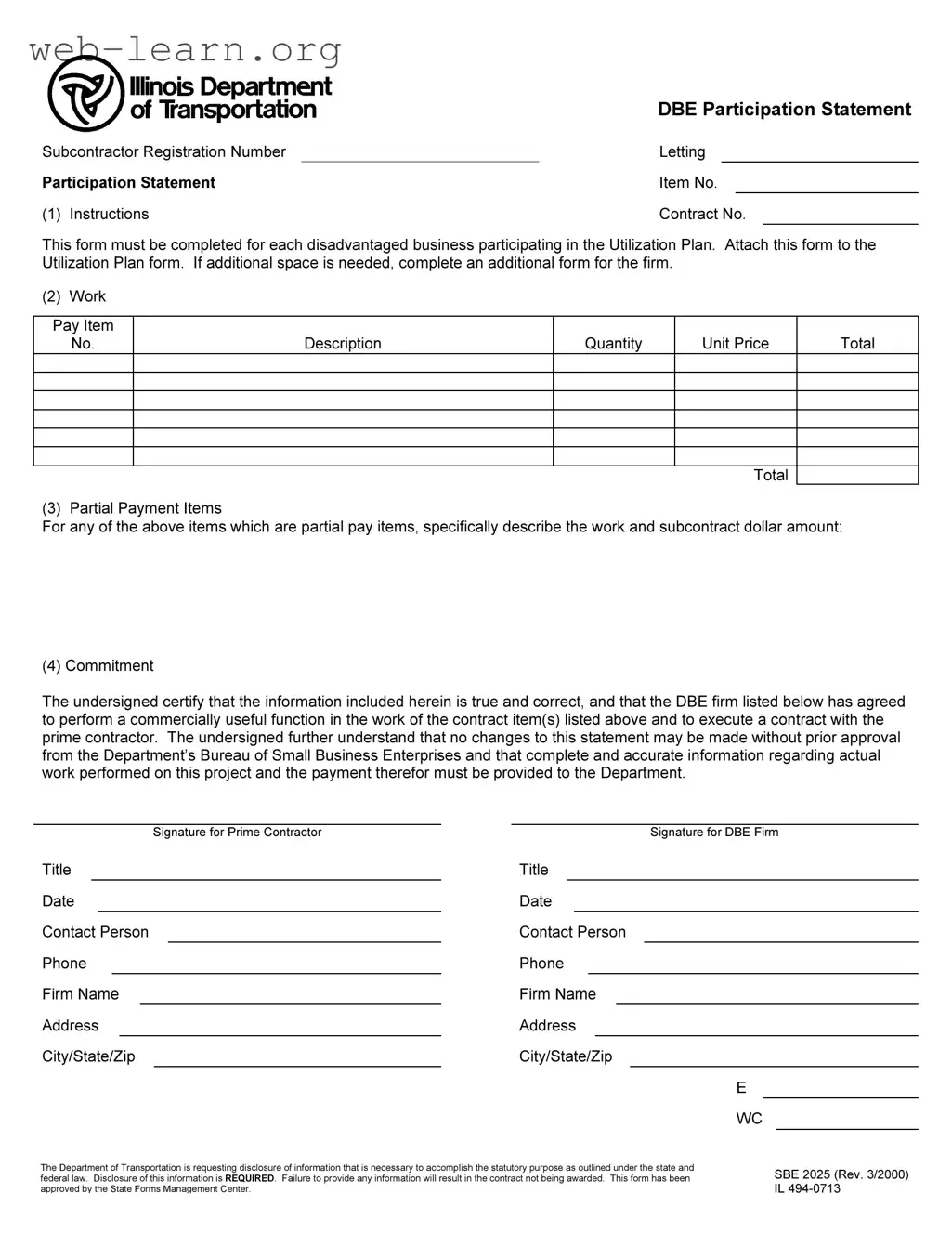
The Illinois SBE 2025 form plays a crucial role in ensuring that disadvantaged businesses can participate in state contracts. This form is specifically designed for reporting the involvement of Disadvantaged Business Enterprises (DBEs) in a project’s Utilization Plan. When submitting the form, contractors must include details such as the subcontractor registration number, contract number, and a breakdown of work items, including descriptions and pricing. Each DBE participating in the contract must be accounted for, and if more space is needed, additional forms can be completed. Importantly, the form requires a commitment from both the prime contractor and the DBE, certifying that the information provided is accurate and that the DBE will perform a commercially useful function in the project. Any changes to this commitment must receive prior approval from the Department’s Bureau of Small Business Enterprises. Additionally, the Department of Transportation mandates that all information disclosed is necessary for compliance with state and federal laws, emphasizing that failure to provide complete information could jeopardize the contract award. The SBE 2025 form, therefore, serves not only as a tool for accountability but also as a means of promoting equitable business opportunities within the state.
|
|
DBE Participation Statement |
|||
Subcontractor Registration Number |
|
Letting |
|
||
Participation Statement |
|
Item No. |
|
||
(1) Instructions |
|
Contract No. |
|
||
This form must be completed for each disadvantaged business participating in the Utilization Plan. Attach this form to the Utilization Plan form. If additional space is needed, complete an additional form for the firm.
(2) Work
Pay Item
No.
Description |
Quantity |
Unit Price |
Total |
|
|
|
|
Total
(3) Partial Payment Items
For any of the above items which are partial pay items, specifically describe the work and subcontract dollar amount:
(4) Commitment
The undersigned certify that the information included herein is true and correct, and that the DBE firm listed below has agreed to perform a commercially useful function in the work of the contract item(s) listed above and to execute a contract with the prime contractor. The undersigned further understand that no changes to this statement may be made without prior approval from the Department’s Bureau of Small Business Enterprises and that complete and accurate information regarding actual work performed on this project and the payment therefor must be provided to the Department.
|
|
|
|
|
Signature for Prime Contractor |
|
|
|
|
|
|
|
Signature for DBE Firm |
||||
Title |
|
Title |
|
||||||||||||||
Date |
|
Date |
|
||||||||||||||
Contact Person |
|
Contact Person |
|
||||||||||||||
Phone |
|
Phone |
|
||||||||||||||
Firm Name |
|
Firm Name |
|
||||||||||||||
Address |
|
Address |
|
||||||||||||||
City/State/Zip |
City/State/Zip |
||||||||||||||||
|
|
|
|
|
|
|
|
|
|
|
|
|
|
|
E |
|
|
|
|
|
|
|
|
|
|
|
|
|
|
|
|
|
WC |
|
|
The Department of Transportation is requesting disclosure of information that is necessary to accomplish the statutory purpose as outlined under the state and federal law. Disclosure of this information is REQUIRED. Failure to provide any information will result in the contract not being awarded. This form has been approved by the State Forms Management Center.
SBE 2025 (Rev. 3/2000) IL
| Fact Name | Description |
|---|---|
| Purpose | The Illinois SBE 2025 form is used to document the participation of disadvantaged businesses in a project’s Utilization Plan. |
| Submission Requirement | This form must be completed for each disadvantaged business participating in the Utilization Plan and attached to the Utilization Plan form. |
| Certification | Signatures from both the prime contractor and the DBE firm are required to certify the accuracy of the information provided and the agreement to perform specified work. |
| Governing Law | This form is governed by the laws of the State of Illinois, specifically under the Department of Transportation regulations regarding small business enterprises. |
Completing the Illinois SBE 2025 form is a crucial step in ensuring that disadvantaged businesses are recognized and properly documented in the Utilization Plan. Following the steps outlined below will help streamline the process and ensure compliance with the necessary requirements.
What is the purpose of the Illinois SBE 2025 form?
The Illinois SBE 2025 form serves as a Disadvantaged Business Enterprise (DBE) Participation Statement. It is required for each disadvantaged business participating in a project’s Utilization Plan. This form ensures that all parties involved understand the commitments made by the DBE firms and helps the Department of Transportation track participation and compliance with statutory requirements.
Who needs to complete the SBE 2025 form?
Any prime contractor who plans to include a disadvantaged business in their contract must complete the SBE 2025 form. Each DBE participating in the project requires a separate form. If more space is needed for additional firms, another form can be filled out.
What information is required on the form?
The form requires several key pieces of information, including:
Each section must be filled out accurately to ensure compliance with regulations.
What happens if the information on the form is incorrect?
Providing inaccurate information on the SBE 2025 form can lead to serious consequences. The Department of Transportation requires complete and truthful disclosures. If discrepancies are found, it may result in the contract not being awarded or could lead to penalties for the prime contractor.
How do I submit the SBE 2025 form?
The completed SBE 2025 form must be attached to the Utilization Plan form. It is essential to ensure that all required signatures are obtained from both the prime contractor and the DBE firm before submission. Following these steps will facilitate a smoother review process by the Department.
When filling out the Illinois SBE 2025 form, many individuals make common mistakes that can lead to delays or even disqualification from the contract process. Understanding these pitfalls can help ensure a smoother experience.
One frequent error is failing to include the Subcontractor Registration Number. This number is crucial for identifying the disadvantaged business enterprise (DBE) involved. Without it, the form may be considered incomplete, causing unnecessary setbacks.
Another mistake occurs when participants overlook the Contract No. section. This number links the form to a specific contract, and omitting it can create confusion. Always double-check that this information is accurately filled in to avoid complications.
Many people also forget to provide the Letting Participation Statement Item No. and Work Pay Item No.. These details are essential for tracking the specific work and payments associated with the project. Missing this information can lead to misunderstandings about the scope of work.
Inaccurate descriptions of work and subcontract dollar amounts for partial pay items are another common issue. Each item must be clearly defined to ensure that everyone understands the commitments being made. Ambiguities can lead to disputes later on.
Additionally, individuals often neglect to include the signature of both the prime contractor and the DBE firm. This certification is a vital part of the process, confirming that both parties agree to the terms outlined in the form. Without these signatures, the document may not be valid.
Another mistake involves failing to provide complete and accurate information regarding the actual work performed and payments made. This information is critical for compliance and must be reported to the Department. Incomplete data can jeopardize the contract.
Lastly, some individuals do not pay attention to the requirement for prior approval from the Department’s Bureau of Small Business Enterprises before making any changes to the statement. Ignoring this step can lead to penalties or the rejection of the form.
By avoiding these mistakes, participants can help ensure their forms are processed efficiently and their contracts are awarded without unnecessary delays.
The Illinois SBE 2025 form is a crucial document for contractors seeking to engage disadvantaged business enterprises (DBEs) in their projects. Along with this form, several other documents are commonly required to ensure compliance with state regulations and to facilitate the participation of DBEs. Below is a list of these documents, along with brief descriptions of each.
Each of these documents plays a vital role in the successful integration of DBEs into construction projects in Illinois. Ensuring that all forms are completed accurately and submitted on time is essential for compliance and project success.
The Illinois SBE 2025 form is a crucial document used in the context of disadvantaged business enterprise (DBE) participation in contracts. Several other documents share similarities with the SBE 2025 form, often serving related purposes in the realm of contract compliance and reporting. Below is a list of nine such documents, highlighting how each is similar to the Illinois SBE 2025 form.
Each of these documents plays a vital role in promoting the participation of disadvantaged businesses in public contracting, ensuring that opportunities are equitably distributed and that compliance is maintained throughout the contract lifecycle.
When filling out the Illinois SBE 2025 form, it is important to follow certain guidelines to ensure accuracy and compliance. Here are five things you should do and five things you should avoid.
Following these guidelines can help streamline the process and improve the chances of contract approval.
Here are ten common misconceptions about the Illinois SBE 2025 form:
The SBE 2025 form is not limited to minority-owned businesses. It applies to all disadvantaged business enterprises (DBEs) as defined by federal and state laws.
Each DBE participating in the Utilization Plan requires its own completed SBE 2025 form. If there are multiple DBEs, you must fill out a separate form for each.
Submitting the SBE 2025 form is mandatory for any contract that involves DBE participation. Failure to submit it can result in the contract not being awarded.
Once submitted, any changes to the information on the SBE 2025 form require prior approval from the Department’s Bureau of Small Business Enterprises.
While financial details are included, the form also requires a commitment from the DBE to perform a commercially useful function in the contract work.
Disclosure of information on the form is required. Incomplete information may lead to disqualification from the bidding process.
The SBE 2025 form must be submitted with the Utilization Plan before the contract is awarded, not after.
The form must be signed by authorized representatives of both the prime contractor and the DBE firm, ensuring accountability.
The SBE 2025 form is applicable to both state and federally funded contracts that require DBE participation.
Depending on the project, the SBE 2025 form may need to be updated or resubmitted if changes occur during the contract period.
When filling out and using the Illinois SBE 2025 form, it is crucial to keep the following key takeaways in mind: