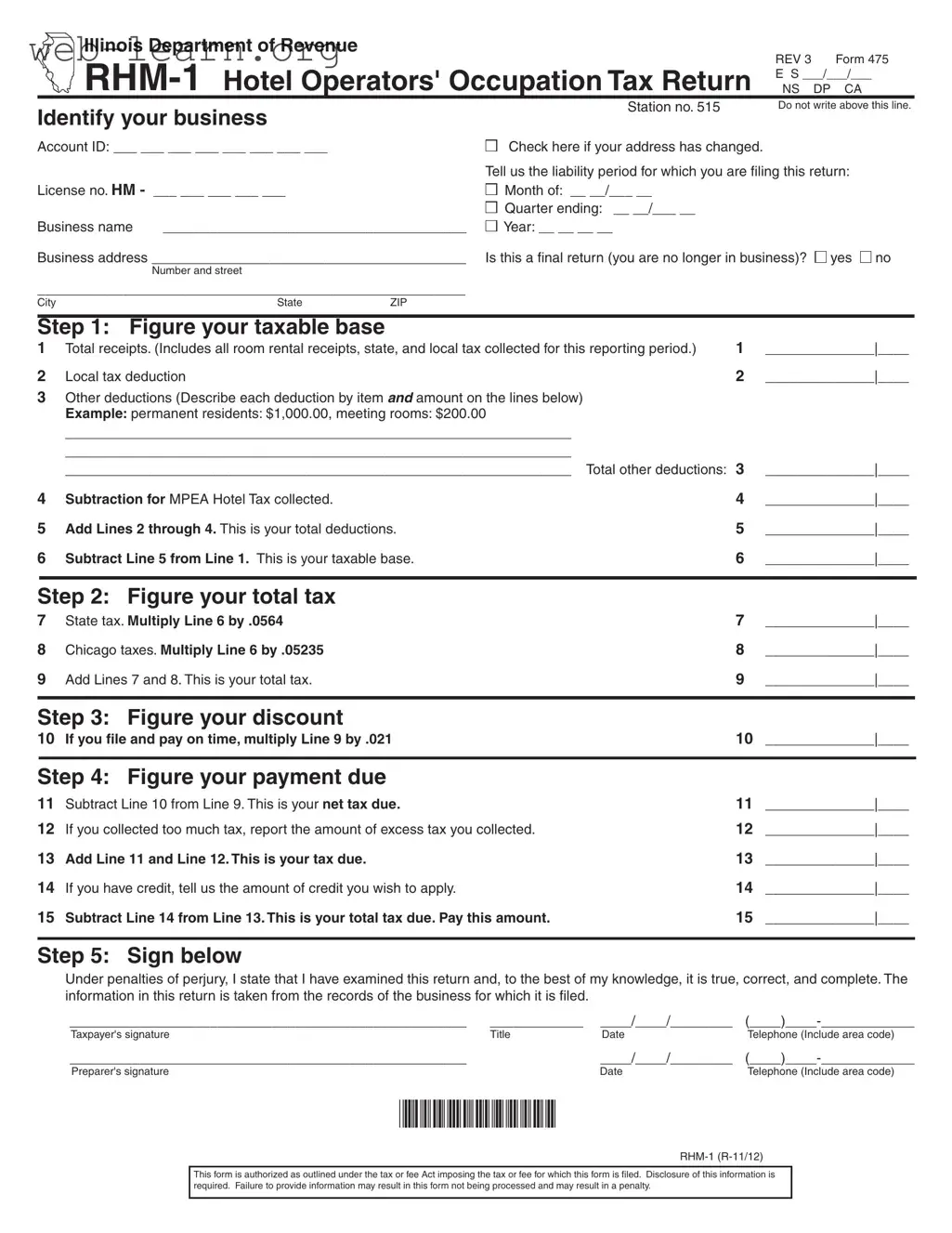
The Illinois RHM-1 form is essential for hotel operators to report their occupancy tax obligations accurately. This form is specifically designed for the Hotel Operators' Occupation Tax Return, enabling businesses to calculate their taxable base and total tax due for a specified liability period. Key sections of the RHM-1 include fields for identifying the business, such as the account ID and license number, as well as the business address. Operators must provide total receipts, including room rentals and applicable taxes collected, and detail any local tax deductions or other deductions, such as those for permanent residents or meeting rooms. The form guides users through calculating state and local taxes based on their taxable base, offering a discount for timely filing and payment. Finally, it requires signatures from both the taxpayer and the preparer, affirming the accuracy of the information provided. Proper completion of the RHM-1 is crucial, as any errors may lead to processing delays or penalties.

Illinois Department of Revenue
|
REV 3 |
Form 475 |
||||
|
E S ___/___/___ |
|||||
|
NS |
DP CA |
||||
Identify your business |
|
Station no. 515 |
|
Do not write above this line. |
||
|
|
|
|
|
||
Account ID: ___ ___ ___ ___ ___ ___ ___ ___ |
|
Check here if your address has changed. |
|
|
||
|
|
|
Tell us the liability period for which you are filing this return: |
|||
License no. HM - ___ ___ ___ ___ ___ |
|
Month of: __ __/___ __ |
|
|
|
|
|
|
|
Quarter ending: __ __/___ __ |
|
|
|
Business name _______________________________________ |
Year: __ __ __ __ |
|
|
|
||
Business address ________________________________________ |
Is this a final return (you are no longer in business)? |
yes no |
||||
|
Number and street |
|
|
|
|
|
_______________________________________________________ |
|
|
|
|
||
City |
State |
ZIP |
|
|
|
|
|
|
|
|
|
|
|
Step 1: Figure your taxable base |
|
|
|
|
|
|
1 Total receipts. (Includes all room rental receipts, state, and local tax collected for this reporting period.) |
1 |
______________|____ |
||||
2 |
Local tax deduction |
|
|
2 |
______________|____ |
|
3Other deductions (Describe each deduction by item AND amount on the lines below) Example: permanent residents: $1,000.00, meeting rooms: $200.00
_________________________________________________________________
_________________________________________________________________
|
_________________________________________________________________ |
Total other deductions: 3 |
______________|____ |
4 |
Subtraction for MPEA Hotel Tax collected. |
4 |
______________|____ |
5 |
Add Lines 2 through 4. This is your total deductions. |
5 |
______________|____ |
6 |
Subtract Line 5 from Line 1. This is your taxable base. |
6 |
______________|____ |
Step 2: Figure your total tax
7 |
State tax. Multiply Line 6 by .0564 |
7 |
______________|____ |
8 |
Chicago taxes. Multiply Line 6 by .05235 |
8 |
______________|____ |
9 |
Add Lines 7 and 8. This is your total tax. |
9 |
______________|____ |
|
|
|
|
Step 3: Figure your discount
10 If you file and pay on time, multiply Line 9 by .021 |
10 ______________|____ |
Step 4: Figure your payment due
11 |
Subtract Line 10 from Line 9. This is your net tax due. |
11 |
______________|____ |
12 |
If you collected too much tax, report the amount of excess tax you collected. |
12 |
______________|____ |
13 |
Add Line 11 and Line 12. This is your tax due. |
13 |
______________|____ |
14 |
If you have credit, tell us the amount of credit you wish to apply. |
14 |
______________|____ |
15 |
Subtract Line 14 from Line 13. This is your total tax due. Pay this amount. |
15 |
______________|____ |
Step 5: Sign below
Under penalties of perjury, I state that I have examined this return and, to the best of my knowledge, it is true, correct, and complete. The information in this return is taken from the records of the business for which it is filed.
___________________________________________________ |
____________ ____/____/________ |
||
Taxpayer's signature |
Title |
Date |
Telephone (Include area code) |
___________________________________________________ |
|
____/____/________ |
|
Preparer's signature |
|
Date |
Telephone (Include area code) |
*247501110*
This form is authorized as outlined under the tax or fee Act imposing the tax or fee for which this form is filed. Disclosure of this information is required. Failure to provide information may result in this form not being processed and may result in a penalty.
| Fact Name | Description |
|---|---|
| Form Title | The form is officially known as the Illinois Department of Revenue RHM-1 Hotel Operators' Occupation Tax Return. |
| Governing Law | This form is governed by the Illinois Hotel Operators' Occupation Tax Act. |
| Filing Requirement | Hotel operators must file this return to report and pay taxes collected from room rentals. |
| Tax Calculation | The state tax rate is 5.64%, while the Chicago tax rate is 5.235% on the taxable base. |
| Liability Period | Filing requires the identification of the liability period, which can be monthly or quarterly. |
| Final Return Option | Operators can indicate if this is a final return, signifying that they are no longer in business. |
| Discount for Timely Filing | A discount of 2.1% is available if the tax is filed and paid on time. |
| Signature Requirement | The form must be signed by the taxpayer and, if applicable, the preparer, under penalties of perjury. |
Completing the Illinois RHM-1 form requires careful attention to detail and accuracy. After filling out the form, you will need to submit it to the Illinois Department of Revenue by the specified deadline. Ensure that all information is correct to avoid any potential issues or penalties.
The Illinois RHM-1 form is the Hotel Operators' Occupation Tax Return. It is required for hotel operators in Illinois to report their taxable receipts, calculate taxes owed, and remit payment to the Illinois Department of Revenue.
Any business that operates as a hotel or provides lodging services in Illinois must file this form. This includes hotels, motels, bed and breakfasts, and any other establishments that rent rooms to guests.
The form requires various details, including:
To calculate the tax, follow these steps:
If you collected more tax than owed, you must report the excess amount on the form. This amount will be added to your total tax due, allowing for adjustments in future filings.
Yes, failure to file the RHM-1 form or provide accurate information can result in penalties. The Illinois Department of Revenue may not process the form, and additional fines may be imposed.
The filing deadline typically aligns with the end of the reporting period. It is essential to check the Illinois Department of Revenue's guidelines for specific dates to ensure timely submission.
To ensure timely processing, file the form accurately and on time. Double-check all calculations and required information before submission. If you file and pay on time, you may also qualify for a discount on your tax due.
Filling out the Illinois RHM-1 form can seem straightforward, but many people make common mistakes that can lead to delays or issues with their tax return. One frequent error occurs in the section where taxpayers are asked to identify their business. It’s crucial to ensure that the business name is spelled correctly and matches what is on file with the state. Any discrepancies can cause confusion and may lead to processing delays.
Another common mistake is neglecting to check the box if the business address has changed. If the address has been updated and this box is left unchecked, it can result in important correspondence being sent to the wrong location. This oversight can hinder communication with the Illinois Department of Revenue, leading to potential penalties or missed deadlines.
When it comes to reporting total receipts, some individuals mistakenly include amounts that should not be counted, such as state and local taxes that were collected. It’s essential to accurately report only the room rental receipts for the reporting period. Miscalculating this figure can significantly affect the taxable base and, consequently, the total tax owed.
Additionally, when detailing deductions, individuals often fail to provide sufficient descriptions or itemizations. Each deduction must be clearly explained, including the type and amount. For instance, stating "permanent residents: $1,000.00" is necessary to clarify the nature of the deduction. Without this information, the deductions may be questioned or disallowed.
Many people also overlook the importance of calculating the total deductions correctly. After listing all deductions, it’s vital to ensure that the sum of these deductions is accurately reflected on the form. A simple arithmetic error can lead to an incorrect taxable base, which can have a ripple effect on the entire tax calculation.
Another mistake occurs in the calculation of the tax due. Individuals sometimes forget to multiply the taxable base by the correct rates for state and local taxes. Each line must be calculated carefully to avoid underreporting or overreporting the total tax owed. This miscalculation can result in penalties or interest if the amount reported is incorrect.
Signing the form is often taken for granted, but it’s a critical step. Both the taxpayer and the preparer, if applicable, must sign the form. Failing to sign can lead to the return being deemed incomplete, which may delay processing and result in penalties. It’s also important to ensure that the signatures are dated accurately.
Lastly, taxpayers should be cautious when reporting any excess tax collected. This section can be easily overlooked, yet it is essential for ensuring that the correct tax amount is reported. If too much tax was collected, it must be clearly stated to avoid overpayment. Accurate reporting in this area helps maintain compliance and prevents unnecessary complications.
The Illinois RHM-1 form is a critical document for hotel operators to report their occupancy tax. Alongside this form, several other documents are commonly used to ensure compliance with state regulations. Each of these documents serves a specific purpose in the tax reporting and payment process.
Utilizing these forms and documents in conjunction with the Illinois RHM-1 ensures that hotel operators remain compliant with state and local tax laws. Proper documentation is essential for maintaining accurate records and avoiding potential penalties.
Illinois Sales Tax Return (ST-1): This document is similar in purpose as it also involves reporting taxable sales and calculating the tax owed. Both forms require businesses to detail their total receipts and any deductions, ensuring accurate tax reporting.
Illinois Income Tax Return (IL-1040): Like the RHM-1 form, this return requires individuals or businesses to report income and calculate taxes owed. Both documents necessitate detailed record-keeping and provide a mechanism for claiming deductions and credits.
Illinois Corporate Income and Replacement Tax Return (IL-1120): This form is used by corporations to report their income and calculate taxes. It shares similarities with the RHM-1 in that both require a comprehensive breakdown of income and applicable deductions to determine the final tax liability.
Hotel/Motel Tax Return: Many municipalities have their own hotel or motel tax forms. These documents often mirror the RHM-1 in structure, requiring businesses to report room rental receipts and calculate local taxes based on similar guidelines.
Illinois Use Tax Return (ST-44): This form is relevant for reporting purchases made outside of Illinois that are subject to tax. It aligns with the RHM-1 in that both involve calculating tax based on the value of transactions, ensuring compliance with state tax obligations.
Filling out the Illinois RHM-1 form can seem daunting, but with a little guidance, you can navigate it smoothly. Here are some do's and don'ts to keep in mind:
Understanding the Illinois RHM-1 form can be challenging, especially with the various misconceptions surrounding it. Here are seven common misunderstandings that often arise:
Clearing up these misconceptions can help ensure compliance with tax regulations and promote a smoother filing experience for all lodging operators in Illinois.
When filling out the Illinois RHM-1 form, there are several important points to keep in mind to ensure accuracy and compliance. Below are key takeaways that can assist in the process:
By following these guidelines, you can effectively navigate the completion of the Illinois RHM-1 form and ensure compliance with tax obligations.