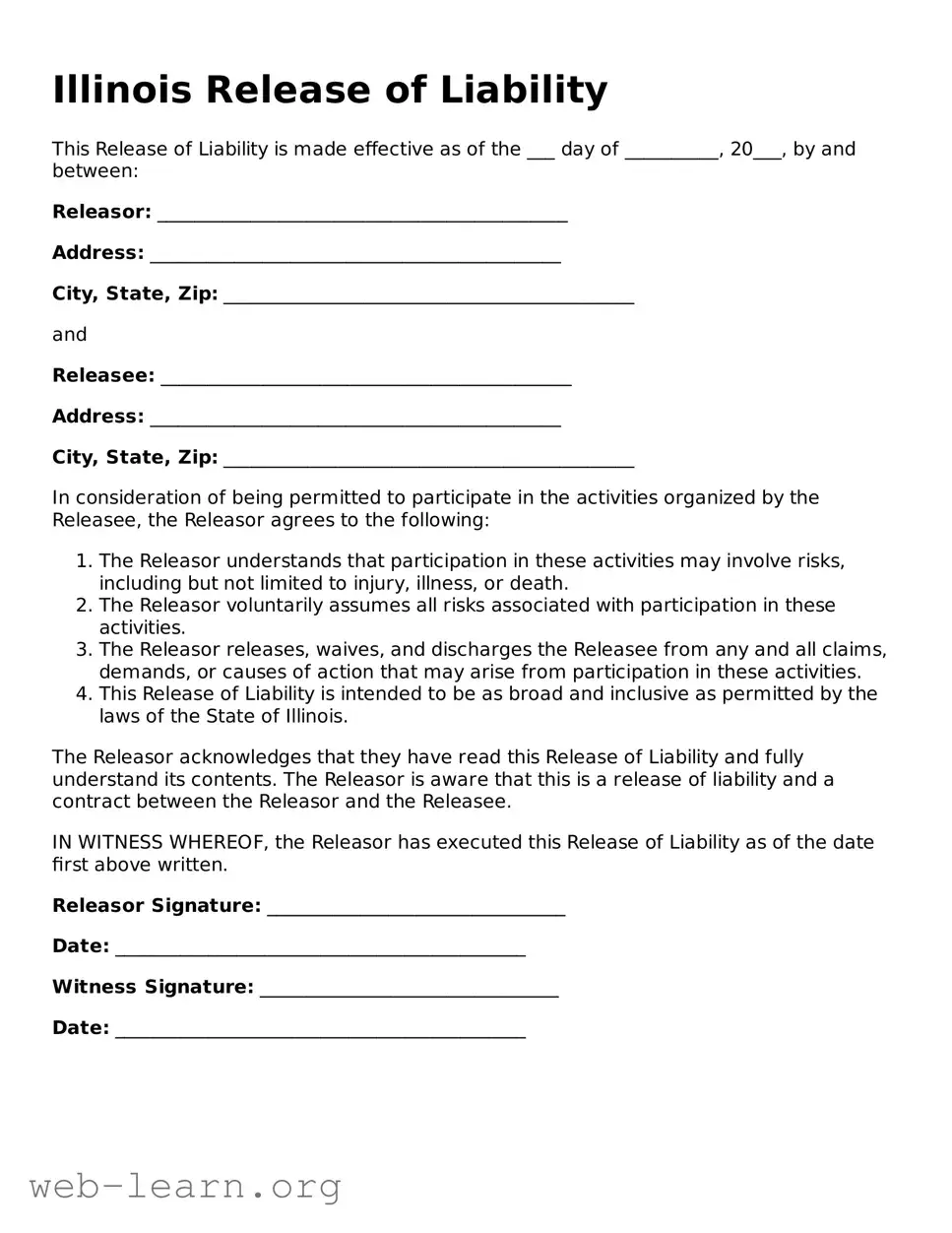
The Illinois Release of Liability form serves as a crucial document for individuals and organizations looking to mitigate risk associated with various activities. This form is often utilized in contexts such as recreational sports, events, and other activities where there is a potential for injury. By signing this form, participants acknowledge the inherent risks involved and agree not to hold the organizers or sponsors liable for any injuries that may occur. The form typically outlines specific details, including the nature of the activity, the risks involved, and the rights being waived. It is essential for both parties to understand the implications of the agreement, as it can significantly impact legal recourse in the event of an accident. Overall, the Illinois Release of Liability form is a vital tool for promoting safety while allowing individuals to engage in activities they enjoy, all while providing a layer of protection for those facilitating these experiences.
Illinois Release of Liability
This Release of Liability is made effective as of the ___ day of __________, 20___, by and between:
Releasor: ____________________________________________
Address: ____________________________________________
City, State, Zip: ____________________________________________
and
Releasee: ____________________________________________
Address: ____________________________________________
City, State, Zip: ____________________________________________
In consideration of being permitted to participate in the activities organized by the Releasee, the Releasor agrees to the following:
The Releasor acknowledges that they have read this Release of Liability and fully understand its contents. The Releasor is aware that this is a release of liability and a contract between the Releasor and the Releasee.
IN WITNESS WHEREOF, the Releasor has executed this Release of Liability as of the date first above written.
Releasor Signature: ________________________________
Date: ____________________________________________
Witness Signature: ________________________________
Date: ____________________________________________
| Fact Name | Description |
|---|---|
| Purpose | The Illinois Release of Liability form is designed to protect individuals and organizations from legal claims arising from participation in activities. |
| Governing Law | This form is governed by the laws of the State of Illinois, particularly under the Illinois Compiled Statutes. |
| Voluntary Participation | Participants must acknowledge that they are voluntarily participating in the activity, understanding the risks involved. |
| Scope of Release | The release typically covers all claims, including those related to negligence, unless specifically excluded. |
| Minors | For participants under 18, a parent or guardian must sign the form to ensure legal validity. |
| Signature Requirement | A valid signature from the participant (or guardian) is essential for the release to be enforceable. |
| Consideration | Some form of consideration, such as participation in the activity, must be provided for the release to be legally binding. |
| Duration | The release of liability generally remains in effect for the duration of the activity and may also cover future claims. |
| Legal Advice | It is advisable for individuals to seek legal counsel before signing the form to fully understand their rights and obligations. |
| Enforceability | Illinois courts generally uphold these forms, provided they are clear, unambiguous, and entered into voluntarily. |
After gathering the necessary information, you are ready to fill out the Illinois Release of Liability form. Follow these steps carefully to ensure that all required information is provided accurately.
Once you have completed the form, review it for accuracy. Ensure all sections are filled out correctly before submitting it to the appropriate party.
What is a Release of Liability form in Illinois?
A Release of Liability form is a legal document that protects an individual or organization from being held liable for injuries or damages that may occur during a specific activity or event. In Illinois, these forms are commonly used in activities such as sports, recreational events, and other potentially risky endeavors.
Why should I use a Release of Liability form?
Using a Release of Liability form helps to clearly communicate the risks involved in an activity. By signing the form, participants acknowledge these risks and agree not to hold the organizer responsible for any injuries that may arise. This can be crucial for protecting individuals and organizations from lawsuits.
Who should sign a Release of Liability form?
Typically, all participants in an activity should sign the form. If a participant is a minor, a parent or legal guardian must sign on their behalf. This ensures that all parties are aware of the risks and agree to the terms outlined in the document.
Are there specific requirements for a Release of Liability form in Illinois?
While there are no strict statutory requirements for a Release of Liability form in Illinois, it should be clear, concise, and specific about the risks involved. It is also important that the language used is understandable to the average person. Including a statement that the participant is signing voluntarily can further strengthen the document.
Can a Release of Liability form be enforced in Illinois?
Yes, a properly drafted and executed Release of Liability form can be enforced in Illinois. However, courts may consider factors such as the clarity of the language, the understanding of the signer, and whether the form was signed voluntarily. If any part of the form is deemed unconscionable or misleading, it may not be enforceable.
What activities commonly require a Release of Liability form?
Common activities that may require a Release of Liability form include:
What happens if someone is injured despite signing the form?
Even with a signed Release of Liability form, an injured party may still pursue legal action. However, the existence of the form can serve as a strong defense for the organizer. The outcome will depend on the circumstances of the injury and whether negligence can be proven.
Can I modify a Release of Liability form?
Yes, a Release of Liability form can be modified to fit the specific needs of an event or activity. However, it is advisable to consult with a legal professional to ensure that any modifications do not compromise the enforceability of the document.
Is it necessary to have a lawyer draft the Release of Liability form?
While it is not strictly necessary to have a lawyer draft the form, it is highly recommended. A legal professional can ensure that the document complies with Illinois law and adequately protects against potential liabilities.
How long is a Release of Liability form valid?
A Release of Liability form remains valid as long as the activity or event it pertains to is ongoing. Once the activity is completed, the liability waiver typically applies only to incidents that occurred during that specific time frame. However, the enforceability may vary based on specific circumstances and legal interpretations.
Filling out the Illinois Release of Liability form can seem straightforward, but many individuals make common mistakes that can affect the validity of the document. One frequent error is not reading the entire form before signing. Many people rush through the process, overlooking important clauses that clarify their rights and responsibilities. Understanding these details is crucial to ensure that the form serves its intended purpose.
Another mistake occurs when individuals fail to provide accurate personal information. This includes not only names but also addresses and contact details. Inaccurate information can lead to complications if a claim needs to be processed later. Always double-check the entries to ensure they are correct.
Many people neglect to date the form properly. Leaving the date blank or entering an incorrect date can render the release ineffective. The date is essential for establishing when the agreement was made and can impact the enforcement of the release.
Some individuals forget to include specific details about the activity for which they are releasing liability. The form should clearly outline the activity and any associated risks. Failing to do so may result in ambiguity, which can be challenged in court.
Another common oversight is not understanding the scope of the release. People often sign without realizing that they may be waiving their rights to seek compensation for certain injuries or damages. It is important to fully comprehend what rights are being relinquished.
In addition, signatures can be a point of contention. Some individuals may sign the form without proper identification or in the presence of a witness, if required. This can lead to disputes over the authenticity of the signature later on.
Not consulting with a legal professional is another mistake many make. While the form may appear simple, legal nuances can affect its enforceability. Seeking advice can help clarify any uncertainties and ensure that the form is filled out correctly.
Finally, failing to keep a copy of the signed form can create problems down the line. Individuals should always retain a copy for their records. This serves as proof of the agreement and can be critical if any issues arise in the future.
When engaging in activities that may involve risk, individuals and organizations often utilize a variety of forms and documents to protect themselves legally. The Illinois Release of Liability form is one such document, but it is frequently accompanied by others that serve complementary purposes. Below are five common forms that are often used alongside the Release of Liability form.
Utilizing these forms in conjunction with the Illinois Release of Liability can help create a comprehensive framework for managing risk. Each document serves a specific purpose and collectively enhances the legal protections for organizations and individuals involved in potentially hazardous activities.
When filling out the Illinois Release of Liability form, it’s important to approach the task with care. Here are nine things you should and shouldn't do:
By following these guidelines, you can ensure that you complete the form correctly and protect your interests.
Misconception 1: A Release of Liability form completely protects a business from all legal claims.
This is not entirely true. While it can limit liability for certain activities, it does not protect against gross negligence or willful misconduct. Courts may invalidate a release if it is deemed overly broad or unfair.
Misconception 2: Signing a Release of Liability means you cannot sue under any circumstances.
This form does limit your ability to sue for specific incidents, but it does not eliminate your right to take legal action in cases of serious harm or negligence. Understanding the specific terms is crucial.
Misconception 3: A Release of Liability is only necessary for high-risk activities.
While commonly used for activities like sports or adventure events, it can also be beneficial for lower-risk activities. Any business that engages with clients should consider this form to clarify responsibilities.
Misconception 4: Once signed, a Release of Liability cannot be challenged.
In certain situations, individuals can challenge the enforceability of the form. Factors such as clarity of language, the presence of coercion, or lack of understanding can lead to legal disputes.
Misconception 5: A Release of Liability does not need to be tailored to specific situations.
This is a critical error. Each release should be customized to reflect the particular risks and activities involved. A generic form may not provide adequate protection and could lead to confusion.
When dealing with the Illinois Release of Liability form, it’s important to understand its purpose and how to fill it out correctly. Here are some key takeaways to keep in mind:
By keeping these points in mind, you can navigate the process of using the Illinois Release of Liability form more effectively.