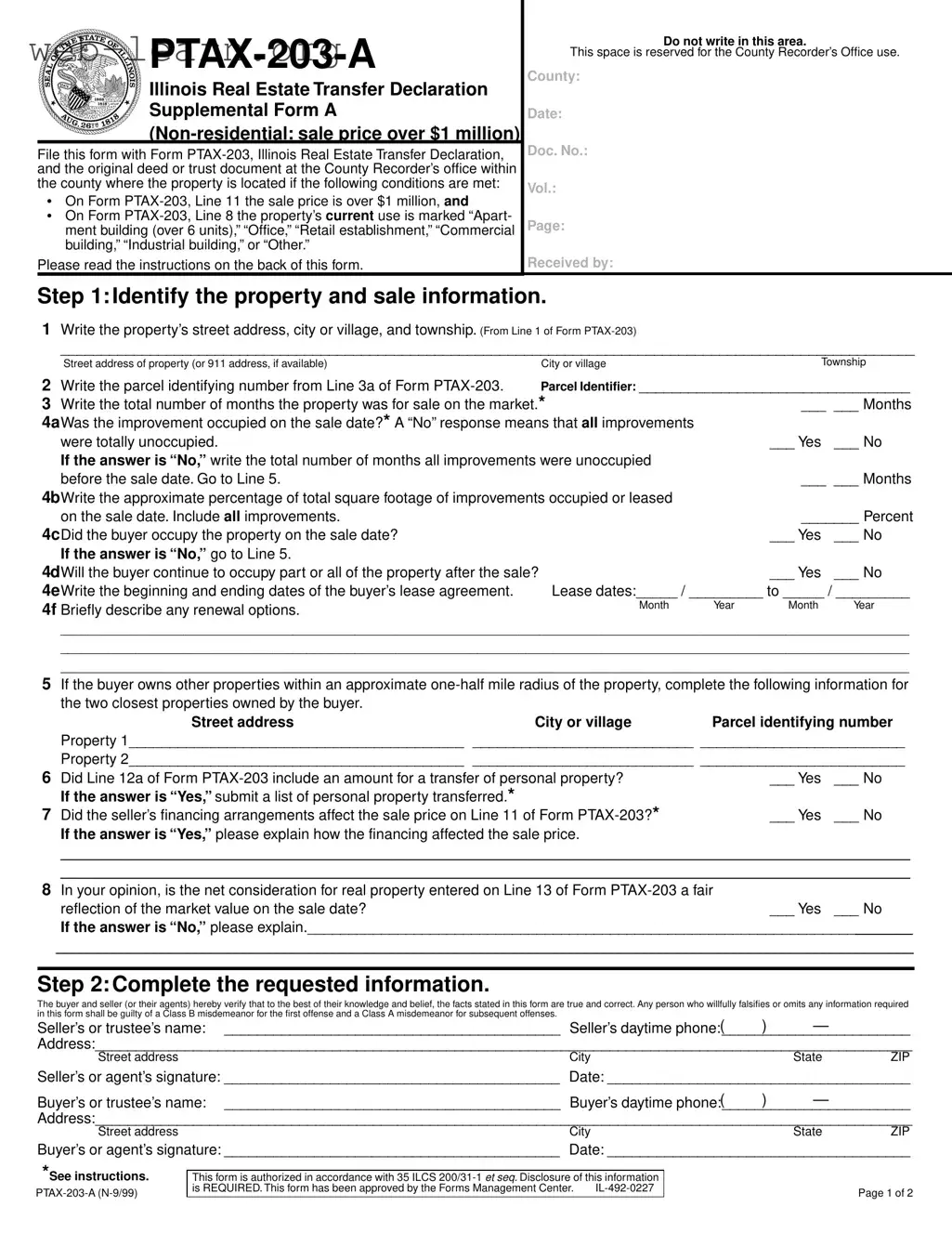
The Illinois PTAX-203 A form, known as the Real Estate Transfer Declaration Supplemental Form A, is a critical document for non-residential property transactions where the sale price exceeds $1 million. This form must be submitted alongside Form PTAX-203 and the original deed or trust document at the County Recorder's office in the relevant county. Specific conditions trigger the requirement to file this form, notably when the property’s current use is categorized as an apartment building (over 6 units), office, retail establishment, commercial building, industrial building, or other specified types. The form guides users through essential steps, starting with identifying the property and sale details, including the property's address, parcel number, and the duration it was on the market. It also prompts sellers and buyers to confirm occupancy status, lease agreements, and any personal property included in the transaction. Accurate completion is crucial, as any misinformation can lead to legal consequences. Understanding the PTAX-203 A form is essential for anyone involved in substantial real estate transactions in Illinois, ensuring compliance and facilitating a smooth transfer process.

Illinois Real Estate Transfer Declaration Supplemental Form A
File this form with Form
•On Form
•On Form
Please read the instructions on the back of this form.
Do not write in this area.
This space is reserved for the County Recorder’s Office use.
County:
Date:
Doc. No.:
Vol.:
Page:
Received by:
Step 1: Identify the property and sale information.
1Write the property’s street address, city or village, and township. (From Line 1 of Form
_________________________________________________________________________________________________________
|
Street address of property (or 911 address, if available) |
City or village |
|
|
Township |
2 |
Write the parcel identifying number from Line 3a of Form |
Parcel Identifier: _________________________________ |
|||
3 |
Write the total number of months the property was for sale on the market.* |
|
___ ___ Months |
||
4aWas the improvement occupied on the sale date?* A “No” response means that all improvements |
|
|
|
||
|
were totally unoccupied. |
|
|
___ Yes |
___ No |
|
If the answer is “No,” write the total number of months all improvements were unoccupied |
|
|
|
|
|
before the sale date. Go to Line 5. |
|
|
___ ___ Months |
|
4bWrite the approximate percentage of total square footage of improvements occupied or leased |
|
|
|
||
|
on the sale date. Include all improvements. |
|
|
_______ Percent |
|
4cDid the buyer occupy the property on the sale date? |
|
|
___ Yes |
___ No |
|
|
If the answer is “No,” go to Line 5. |
|
|
|
|
4dWill the buyer continue to occupy part or all of the property after the sale? |
|
|
___ Yes |
___ No |
|
4eWrite the beginning and ending dates of the buyer’s lease agreement. |
Lease dates:_____ / _________ to _____ / _________ |
||||
4f |
Briefly describe any renewal options. |
Month |
Year |
Month |
Year |
|
|
|
|
||
____________________________________________________________________________________________________________________________
____________________________________________________________________________________________________________________________
____________________________________________________________________________________________________________________________
5If the buyer owns other properties within an approximate
|
Street address |
City or village |
Parcel identifying number |
|
|
Property 1_________________________________________ ___________________________ _________________________ |
|||
|
Property 2_________________________________________ ___________________________ _________________________ |
|||
6 |
Did Line 12a of Form |
___ Yes |
___ No |
|
|
If the answer is “Yes,” submit a list of personal property transferred.* |
|
|
|
7 |
Did the seller’s financing arrangements affect the sale price on Line 11 of Form |
___ Yes |
___ No |
|
|
If the answer is “Yes,” please explain how the financing affected the sale price. |
|
|
|
________________________________________________________________________________________________________
________________________________________________________________________________________________________
8In your opinion, is the net consideration for real property entered on Line 13 of Form
reflection of the market value on the sale date?___ Yes ___ No
If the answer is “No,” please explain.__________________________________________________________________________
_________________________________________________________________________________________________________
Step 2: Complete the requested information.
The buyer and seller (or their agents) hereby verify that to the best of their knowledge and belief, the facts stated in this form are true and correct. Any person who willfully falsifies or omits any information required in this form shall be guilty of a Class B misdemeanor for the first offense and a Class A misdemeanor for subsequent offenses.
Seller’s or trustee’s name: |
_________________________________________ |
Seller’s daytime phone:( |
) |
— |
|
Address:____________________________________________________________________________________________________ |
|||||
Street address |
|
City |
|
State |
ZIP |
Seller’s or agent’s signature: _________________________________________ |
Date: _____________________________________ |
||||
Buyer’s or trustee’s name: |
_________________________________________ |
Buyer’s daytime phone:( |
) |
— |
|
Address:____________________________________________________________________________________________________ |
|||||
Street address |
|
City |
|
State |
ZIP |
Buyer’s or agent’s signature: _________________________________________ |
Date: _____________________________________ |
||||
*See instructions.
This form is authorized in accordance with 35 ILCS
is REQUIRED. This form has been approved by the Forms Management Center. |
Page 1 of 2

Instructions for Completing Form
Step 1: Identify the property and sale information.
Line 3
Write the total number of months that the property was advertised for sale by a real estate agent, newspaper, trade publication, radio/electronic media, or a sign. If the property has been advertised for sale for more than 99 months, enter “99.”
Lines 4a through 4f
Line 4a — Answer “Yes” or “No” (indicate with an “X”) depending on whether or not the improvement (i.e., structure) was occupied on the sale date. If the property has more than one improvement, answer “No” only if all the improvements were totally unoccupied on the sale date.
If the answer to Line 4a is “No,” write the total number of months that all improvements were totally unoccupied before the sale date and go to Line 5. If the property has been unoccupied for more than 99 months, enter “99.” If the answer to Line 4a is “Yes,” go to Lines 4b and 4c.
Line 4b — Write the approximate percentage of the total square footage of all the improvements that was occupied or leased on the sale date. This applies to the improvements only, not the land.
Line 4c — Answer “Yes” or “No” (indicate with an “X”) depending on whether or not the buyer was a current occupant of the property at the time of the sale. If the answer is “No,” go to Line 5. If the answer is “Yes,” go to Line 4d.
Line 4d — Answer “Yes” or “No” (indicate with an “X”) depending on whether or not the buyer will continue to occupy part or all of the property after the sale. If the answer is “No,” go to Line 5. If the answer is “Yes,” go to Line 4e.
Line 4e — Write the beginning and ending dates of the buyer’s lease agreement, if applicable.
Line 4f — Briefly describe in the space provided any options to renew the lease agreement between the seller and the buyer.
Example:
Line 5
If the buyer owns other properties within an approximate
Line 6
Answer “Yes” or “No” (indicate with an “X”) depending on whether or not Line 12a of Form
Line 7
Answer “Yes” or “No” (indicate with an “X”) depending on whether or not the amount on Line 11 of the Form
If the answer is “Yes,” please explain, in the space provided, how the financing affected the sale price.
Line 8
Answer “Yes” or “No” (indicate with an “X”) depending on whether or not, in your opinion, the net consideration for real property entered on Line 13 of the Form
Step 2: Complete the requested information.
Write the requested information for the seller and the buyer. Write the addresses and daytime phone numbers where the seller and buyer can be contacted after the sale. The seller and the buyer (or their agents) must sign this form. By signing the form, the parties involved in the real estate transfer verify that
•they have examined the completed Form
•the information provided on this form is true and correct; and
•they are aware of the criminal penalties of law (printed in the instructions for Form
Page 2 of 2 |
| Fact Name | Details |
|---|---|
| Form Purpose | PTAX-203-A is used for non-residential real estate transfers with a sale price over $1 million. |
| Filing Requirement | This form must be filed with Form PTAX-203 and the original deed at the County Recorder’s office. |
| Governing Law | The form is authorized under 35 ILCS 200/31-1 et seq. |
| Sale Price Condition | Form PTAX-203 must show a sale price over $1 million on Line 11. |
| Property Use Condition | The property’s current use must be marked as specific types, such as "Office" or "Retail establishment." |
| Occupancy Information | Questions about occupancy on the sale date are included in the form. |
| Lease Agreement Details | The form requires information on the buyer’s lease agreement if applicable. |
| Personal Property Transfer | If applicable, a list of personal property transferred must be submitted. |
| Financing Impact | Questions regarding whether seller financing affected the sale price are included. |
| Verification Requirement | Both buyer and seller must verify the accuracy of the information by signing the form. |
Filling out the Illinois PTAX-203 A form is a straightforward process, but it requires careful attention to detail. This form must be submitted alongside the PTAX-203 and the original deed or trust document at the County Recorder’s office. Ensure that all information is accurate and complete to avoid any delays in processing.
What is the Illinois PTAX-203 A form?
The Illinois PTAX-203 A form is a supplemental document required for non-residential real estate transactions where the sale price exceeds $1 million. It must be filed alongside the PTAX-203 form and the original deed or trust document at the County Recorder’s office. This form collects specific information about the property and the sale to ensure compliance with state regulations.
When do I need to file the PTAX-203 A form?
You must file the PTAX-203 A form if two conditions are met: the sale price on Line 11 of the PTAX-203 exceeds $1 million, and the property’s current use is identified as one of the following: apartment building (over 6 units), office, retail establishment, commercial building, industrial building, or other specified uses. Ensure that you file it within the required timeframe at the appropriate County Recorder’s office.
What information is required on the form?
The form requires various details, including:
What happens if the property was unoccupied before the sale?
If the property was unoccupied on the sale date, you must indicate this on the form. Additionally, you will need to provide the total number of months that the improvements were unoccupied prior to the sale. This information helps assess the property’s market value accurately.
How do I determine if the sale price reflects market value?
What are the consequences of providing false information?
Providing false or misleading information on the PTAX-203 A form can lead to serious legal consequences. Specifically, willfully falsifying or omitting required information is classified as a Class B misdemeanor for the first offense and a Class A misdemeanor for subsequent offenses. Accuracy is essential.
Who needs to sign the form?
Both the seller and the buyer (or their agents) must sign the PTAX-203 A form. By signing, they verify that the information is true and correct. It’s important to ensure that all parties involved have reviewed the form before signing to avoid any potential issues.
Where do I submit the completed form?
The completed PTAX-203 A form, along with the PTAX-203 form and the original deed or trust document, should be submitted to the County Recorder’s office in the county where the property is located. Make sure to file it within the designated timeframe to avoid any penalties.
Filling out the Illinois PTAX-203 A form can be straightforward, but there are common mistakes that people often make. One frequent error is failing to provide the correct property address. It’s essential to ensure that the street address, city or village, and township are accurately filled in. A simple typo can lead to delays or complications in processing the form.
Another common mistake involves the parcel identifying number. This number must be taken from Line 3a of Form PTAX-203. Omitting this information or entering it incorrectly can cause significant issues, as the county needs this number to identify the property accurately.
Many individuals also struggle with the section regarding the occupancy status of the property. When answering whether the improvement was occupied on the sale date, it’s crucial to answer truthfully. If the answer is “No,” it’s necessary to specify how long the property was unoccupied. Failing to provide this detail can lead to misunderstandings about the property's condition at the time of sale.
In addition, people sometimes overlook the requirement to describe any renewal options in the lease agreement. This information is essential if the buyer intends to occupy the property. Not providing this detail could result in questions from the county regarding the occupancy status and future use of the property.
Another mistake occurs when individuals do not include an itemized list of personal property transferred. If Line 12a of Form PTAX-203 indicates that personal property was included in the sale, a detailed list must accompany the form. Forgetting to submit this list can lead to complications and delays in processing the transfer.
Lastly, some filers fail to consider how financing arrangements may have affected the sale price. If the seller’s financing arrangements influenced the sale price, it’s important to explain this on the form. Neglecting to provide this information can raise red flags and potentially complicate the transaction.
The Illinois PTAX 203 A form is often accompanied by several other important documents. These documents help ensure a smooth transaction and compliance with state regulations. Below are four commonly used forms that you may encounter alongside the PTAX 203 A.
Having these documents prepared and organized can significantly ease the process of real estate transactions in Illinois. Always ensure that all forms are accurately completed and submitted to avoid any delays or complications.
The Illinois PTAX-203-A form is essential for real estate transactions involving non-residential properties sold for over $1 million. It shares similarities with several other documents used in real estate transactions. Below is a list of seven documents that are comparable to the PTAX-203-A form, along with an explanation of how they are similar:
When filling out the Illinois PTAX 203 A form, there are several important dos and don'ts to keep in mind. Following these guidelines can help ensure that your submission is accurate and complete.
This form is specifically designed for non-residential properties with a sale price over $1 million. It applies to various types of commercial real estate, such as office buildings, retail establishments, and industrial buildings.
It’s crucial to file the PTAX-203-A form with the County Recorder’s office immediately after the sale. Delays could result in penalties or complications with the property transfer.
The PTAX-203-A requires detailed information about the property, including its sale history, occupancy status, and the buyer's lease agreements. Incomplete information can lead to issues down the line.
Both the seller and the buyer, or their agents, must sign the PTAX-203-A. This verifies that all parties have reviewed the information and confirm its accuracy.
If personal property is included in the sale, you must disclose this on the form. An itemized list of the transferred personal property is required if applicable.
Here are some key takeaways about filling out and using the Illinois PTAX-203 A form:
Completing this form accurately is crucial to avoid potential legal issues. Always double-check the information before submission.