Homepage Attorney-Approved Promissory Note Template Attorney-Approved Promissory Note Document for the State of Illinois
Outline

The Illinois Promissory Note form serves as a crucial legal document that outlines the agreement between a borrower and a lender regarding the repayment of a loan. This form typically includes essential details such as the principal amount borrowed, the interest rate applicable, and the repayment schedule. It also specifies the consequences of default, providing clarity on what happens if the borrower fails to meet their obligations. Additionally, the form may include provisions for prepayment, allowing borrowers the option to pay off their debt early without incurring penalties. Importantly, the Illinois Promissory Note is designed to be straightforward, ensuring that both parties understand their rights and responsibilities. By establishing clear terms, the document aims to prevent disputes and foster trust in financial transactions. Whether used for personal loans, business financing, or other forms of credit, this form plays a vital role in facilitating lending practices throughout the state.

Sample - Illinois Promissory Note Form

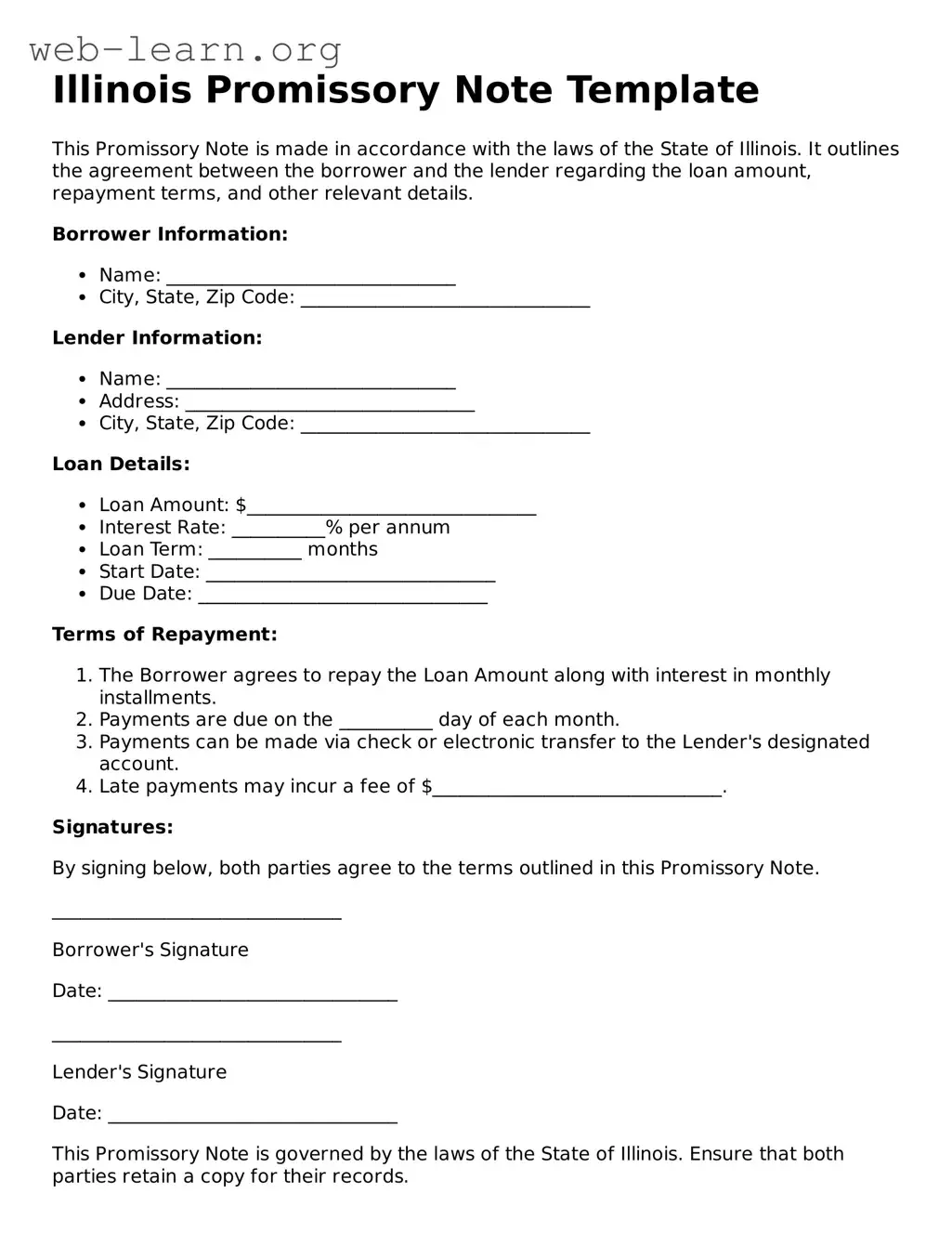
Illinois Promissory Note Template

This Promissory Note is made in accordance with the laws of the State of Illinois. It outlines the agreement between the borrower and the lender regarding the loan amount, repayment terms, and other relevant details.

Borrower Information:

  • Name: _______________________________
  • City, State, Zip Code: _______________________________

Lender Information:

  • Name: _______________________________
  • Address: _______________________________
  • City, State, Zip Code: _______________________________

Loan Details:

  • Loan Amount: $_______________________________
  • Interest Rate: __________% per annum
  • Loan Term: __________ months
  • Start Date: _______________________________
  • Due Date: _______________________________

Terms of Repayment:

  1. The Borrower agrees to repay the Loan Amount along with interest in monthly installments.
  2. Payments are due on the __________ day of each month.
  3. Payments can be made via check or electronic transfer to the Lender's designated account.
  4. Late payments may incur a fee of $_______________________________.

Signatures:

By signing below, both parties agree to the terms outlined in this Promissory Note.

_______________________________

Borrower's Signature

Date: _______________________________

_______________________________

Lender's Signature

Date: _______________________________

This Promissory Note is governed by the laws of the State of Illinois. Ensure that both parties retain a copy for their records.

File Characteristics

Fact Name Description
Definition An Illinois Promissory Note is a written promise to pay a specified amount of money to a designated person or entity at a defined future date or on demand.
Governing Law The Illinois Promissory Note is governed by the Illinois Uniform Commercial Code (UCC), specifically Article 3, which deals with negotiable instruments.
Requirements For a promissory note to be valid in Illinois, it must include the amount to be paid, the payment terms, and the signatures of the parties involved.
Enforceability Promissory notes in Illinois are enforceable as long as they meet the legal requirements and are not subject to any defenses such as fraud or duress.

Detailed Guide for Filling Out Illinois Promissory Note

After obtaining the Illinois Promissory Note form, you will need to fill it out accurately to ensure that all necessary information is included. Follow the steps below to complete the form correctly.

  1. Begin by entering the date at the top of the form.
  2. Fill in the name and address of the borrower. This is the person who will be repaying the loan.
  3. Next, provide the name and address of the lender. This is the individual or entity providing the loan.
  4. Clearly state the principal amount being borrowed. This is the total amount of money that the borrower will repay.
  5. Indicate the interest rate, if applicable. This is the percentage of the principal that will be charged as interest.
  6. Specify the repayment terms, including the due date for payments and the frequency of payments (e.g., monthly, quarterly).
  7. Include any additional terms or conditions that apply to the loan. This may cover late fees or prepayment options.
  8. Sign and date the form at the bottom. The borrower must sign to acknowledge the agreement.
  9. If required, have a witness or notary public sign the document to validate it.

Obtain Answers on Illinois Promissory Note

  1. What is a promissory note?

    A promissory note is a written promise to pay a specific amount of money to a designated person or entity at a specified time or on demand. In Illinois, this document serves as a legal instrument that outlines the terms of the loan, including the amount borrowed, interest rate, repayment schedule, and any penalties for late payment.

  2. What should be included in an Illinois promissory note?

    When drafting an Illinois promissory note, it’s essential to include the following key elements:

    • The names and addresses of the borrower and lender.
    • The principal amount of the loan.
    • The interest rate, if applicable.
    • The repayment schedule, including due dates.
    • Any late fees or penalties for missed payments.
    • Conditions for default and any remedies available to the lender.
  3. Is a promissory note legally binding in Illinois?

    Yes, a promissory note is legally binding in Illinois as long as it meets the necessary legal requirements. Both parties must agree to the terms, and the document should be signed by the borrower. While notarization is not strictly required, having the note notarized can provide additional legal protection and help verify the identities of the parties involved.

  4. Can a promissory note be modified after it is signed?

    Yes, a promissory note can be modified after it is signed, but both parties must agree to the changes. It’s important to document any modifications in writing and have both parties sign the revised note. This ensures clarity and helps prevent disputes in the future.

  5. What happens if the borrower defaults on the promissory note?

    If the borrower defaults, the lender has several options. The lender may pursue legal action to recover the owed amount, which could involve filing a lawsuit. Additionally, the lender may be entitled to charge late fees or interest as outlined in the note. It’s crucial for lenders to understand their rights and responsibilities in such situations to effectively manage the default.

Common mistakes

When filling out the Illinois Promissory Note form, individuals often overlook key details that can lead to complications later. One common mistake is failing to include the date. Without a clear date, the terms of the agreement may become ambiguous, potentially causing disputes about when the repayment period begins.

Another frequent error is neglecting to specify the interest rate. Leaving this blank can create confusion regarding how much is owed over time. It's essential to state the interest rate clearly, as it affects the total amount to be repaid.

People sometimes forget to include the names and addresses of both the borrower and the lender. This information is crucial for identifying the parties involved. Omitting it can lead to issues in enforcing the note if necessary.

Additionally, some individuals do not indicate the repayment schedule. Whether payments are due monthly, quarterly, or annually, this detail must be clearly outlined to avoid misunderstandings.

Another mistake is not signing the document. A promissory note is not legally binding without the appropriate signatures. Both parties must sign to validate the agreement.

In some cases, borrowers fail to read the terms thoroughly before signing. This oversight can lead to unexpected obligations. It is vital to understand all terms and conditions before committing.

People may also forget to initial any changes made to the form. If modifications are necessary, initialing them ensures that both parties acknowledge and agree to the changes.

Another common error involves using vague language. Being specific about the terms helps prevent disputes. Clear and concise language is essential for clarity.

Lastly, individuals often neglect to keep copies of the signed document. Having a copy is important for both parties to reference in case of any future disagreements. Proper documentation is key to maintaining a good record of the agreement.

Documents used along the form

The Illinois Promissory Note is a crucial document that outlines the terms of a loan between a borrower and a lender. However, it is often accompanied by various other forms and documents that help to clarify the agreement and protect the interests of both parties involved. Below is a list of commonly used documents that complement the Promissory Note.

  • Loan Agreement: This document details the terms and conditions of the loan, including the amount, interest rate, repayment schedule, and any collateral involved. It serves as a comprehensive guide to the borrowing arrangement.
  • Security Agreement: If the loan is secured by collateral, this agreement outlines the specific assets that the lender can claim if the borrower defaults on the loan.
  • Disclosure Statement: This document provides borrowers with important information about the loan terms, including fees, interest rates, and the total cost of borrowing, ensuring transparency in the transaction.
  • Personal Guarantee: In some cases, a personal guarantee may be required from a third party, ensuring that they will repay the loan if the primary borrower fails to do so.
  • Amortization Schedule: This schedule breaks down the repayment of the loan into regular installments, showing how much of each payment goes toward interest and principal over time.
  • Release of Liability: Once the loan is repaid, this document formally releases the borrower from any further obligations related to the loan, providing peace of mind.
  • Modification Agreement: If any terms of the original Promissory Note need to be changed, this document records the new terms and ensures that both parties agree to the modifications.
  • Default Notice: Should the borrower fail to meet their obligations, this document serves as a formal notice of default, outlining the consequences and next steps.
  • Payment Receipt: This is a simple yet important document acknowledging that a payment has been made toward the loan, providing proof for both the borrower and lender.

Understanding these accompanying documents can help both borrowers and lenders navigate their financial agreements more effectively. Each form plays a specific role in ensuring clarity and security in the lending process, making it essential to consider them alongside the Illinois Promissory Note.

Similar forms

A Promissory Note is a financial document that outlines a promise to pay a specific amount of money to a designated person or entity under agreed-upon terms. Several other documents share similarities with a Promissory Note, often serving related purposes in financial transactions. Below is a list of nine documents that resemble a Promissory Note, along with a brief explanation of how they are similar.

  • Loan Agreement: Like a Promissory Note, a Loan Agreement details the terms of a loan, including the amount borrowed, interest rate, and repayment schedule. However, it often includes additional clauses regarding collateral and default conditions.
  • Mortgage: A Mortgage is a specific type of loan secured by real estate. It includes a Promissory Note as part of the documentation, committing the borrower to repay the loan while also outlining the property as collateral.
  • IOU (I Owe You): An IOU is an informal document acknowledging a debt. While it may lack the formal structure of a Promissory Note, it serves a similar purpose by indicating that one party owes money to another.
  • Secured Note: This document is a Promissory Note backed by collateral. It provides the lender with additional security, similar to how a Promissory Note outlines repayment obligations.
  • Unsecured Note: An Unsecured Note is a Promissory Note without collateral. It still requires repayment under specified terms, focusing solely on the borrower's promise to pay.
  • Bond: A Bond is a formal debt instrument issued by corporations or governments. It represents a loan made by an investor to the issuer, similar to a Promissory Note in that it outlines repayment terms and interest.
  • Credit Agreement: This document outlines the terms under which a lender extends credit to a borrower. It shares similarities with a Promissory Note in that it specifies repayment terms and conditions.
  • Lease Agreement: While primarily for rental purposes, a Lease Agreement can include a Promissory Note for any payments due. It outlines the obligations of the lessee, similar to how a Promissory Note details the borrower's repayment obligations.
  • Repayment Agreement: This document specifies the terms for repaying a debt. It is similar to a Promissory Note as it outlines the amounts due and the timeline for repayment.

Understanding these documents can help individuals navigate financial agreements more effectively. Each serves a unique purpose but shares the core concept of outlining financial obligations and repayment terms.

Dos and Don'ts

When filling out the Illinois Promissory Note form, it's important to follow specific guidelines to ensure the document is valid and enforceable. Here’s a list of things you should and shouldn't do:

  • Do provide accurate information for all parties involved, including names and addresses.
  • Do clearly state the loan amount in both numbers and words to avoid confusion.
  • Do specify the interest rate, if applicable, and ensure it complies with state laws.
  • Do include a repayment schedule detailing when payments are due.
  • Don't leave any sections blank; fill in all required fields to prevent disputes.
  • Don't use ambiguous language; be clear and concise in your terms.
  • Don't forget to sign and date the document, as this is essential for its validity.

Misconceptions

When it comes to the Illinois Promissory Note form, several misconceptions can lead to confusion. Here are ten common misunderstandings:

  1. All promissory notes are the same. Many believe that all promissory notes have the same structure and terms. In reality, each note can be customized to fit the specific agreement between the parties involved.
  2. A promissory note does not need to be in writing. While verbal agreements can be valid, having a written promissory note is crucial for clarity and enforceability. A written document provides proof of the terms agreed upon.
  3. Only banks can issue promissory notes. This is not true. Individuals and businesses can create promissory notes for personal loans or business transactions, not just financial institutions.
  4. Promissory notes are only for large amounts of money. Some people think these notes are only applicable for significant loans. However, they can be used for any amount, large or small, depending on the agreement.
  5. A promissory note is the same as a loan agreement. While both documents involve borrowing money, a promissory note is a promise to repay, whereas a loan agreement outlines the terms and conditions of the loan in detail.
  6. There is no need for witnesses or notarization. Although not always required, having a witness or notarizing the document can add an extra layer of security and authenticity to the promissory note.
  7. Interest rates are not necessary in a promissory note. Some people think that a promissory note can only be valid without interest. However, it can include interest rates, which should be clearly stated.
  8. Once signed, a promissory note cannot be changed. This is a misconception. Parties can amend a promissory note if both agree to the changes, but it is advisable to document any modifications formally.
  9. Defaulting on a promissory note has no consequences. Failing to repay a promissory note can lead to serious repercussions, including legal action and damage to credit ratings.
  10. Promissory notes are only for personal loans. Many assume these notes are limited to personal lending. In fact, they are commonly used in business transactions, real estate deals, and various financial arrangements.

Understanding these misconceptions can help individuals and businesses navigate the use of promissory notes more effectively. Clarity on these points ensures that all parties involved are on the same page and aware of their rights and responsibilities.

Key takeaways

When filling out and using the Illinois Promissory Note form, it's essential to keep several key points in mind. Here are some important takeaways:

  • Understand the Purpose: A promissory note is a legal document that outlines a borrower's promise to repay a loan to a lender.
  • Identify the Parties: Clearly state the names and addresses of both the borrower and the lender to avoid confusion.
  • Specify the Loan Amount: Clearly indicate the total amount of money being borrowed in both numerical and written form.
  • Detail the Interest Rate: If applicable, specify the interest rate. Ensure it complies with Illinois laws regarding maximum interest rates.
  • Set a Repayment Schedule: Include the dates and amounts of payments, whether they are monthly, quarterly, or otherwise.
  • Include Default Terms: Clearly outline what happens if the borrower fails to make payments on time, including any penalties.
  • Signatures Required: Both parties must sign and date the document to make it legally binding.
  • Consider Notarization: While not always necessary, having the document notarized can provide additional legal protection.

By following these guidelines, individuals can ensure that their Illinois Promissory Note is completed accurately and serves its intended purpose effectively.