The Illinois Power of Attorney for a Child form serves as a vital legal tool for parents and guardians who wish to delegate certain parental responsibilities to another trusted adult. This form allows a designated individual to make important decisions regarding a child's care, education, and welfare in the absence of the parent or guardian. Key elements of the form include the identification of the child, the appointing of the agent, and the specific powers granted, which may encompass medical decisions, educational matters, and general day-to-day care. It is essential for parents to understand that this document is temporary and can be revoked at any time, ensuring flexibility and control over the child's well-being. Additionally, the form must be signed in the presence of a notary public to ensure its validity, providing an added layer of security for all parties involved. By utilizing this form, parents can ensure that their child's needs are met, even when they are not physically present to provide guidance and support.
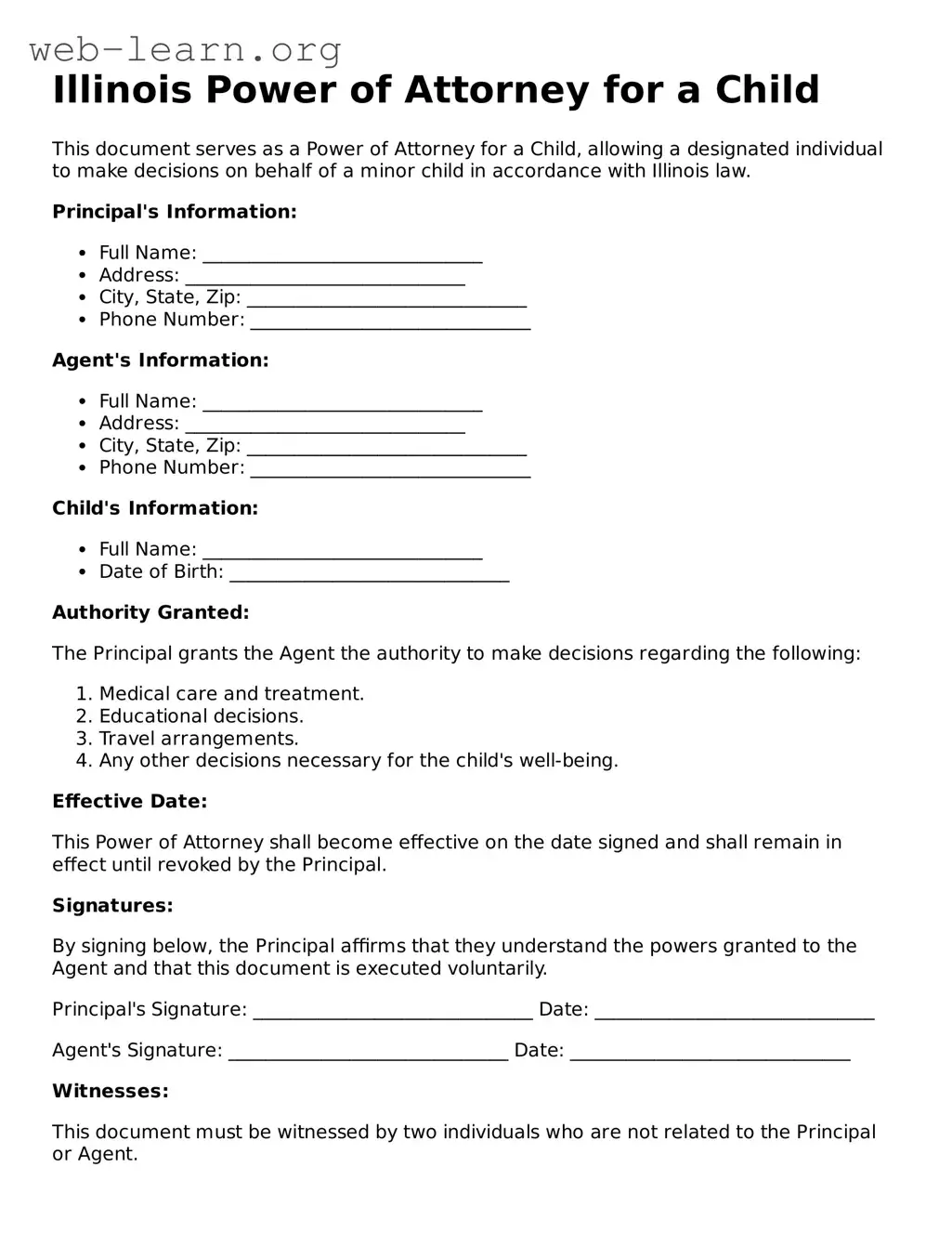
Illinois Power of Attorney for a Child
This document serves as a Power of Attorney for a Child, allowing a designated individual to make decisions on behalf of a minor child in accordance with Illinois law.
Principal's Information:
Agent's Information:
Child's Information:
Authority Granted:
The Principal grants the Agent the authority to make decisions regarding the following:
Effective Date:
This Power of Attorney shall become effective on the date signed and shall remain in effect until revoked by the Principal.
Signatures:
By signing below, the Principal affirms that they understand the powers granted to the Agent and that this document is executed voluntarily.
Principal's Signature: ______________________________ Date: ______________________________
Agent's Signature: ______________________________ Date: ______________________________
Witnesses:
This document must be witnessed by two individuals who are not related to the Principal or Agent.
Witness 1 Signature: ______________________________ Date: ______________________________
Witness 2 Signature: ______________________________ Date: ______________________________
| Fact Name | Details |
|---|---|
| Purpose | The Illinois Power of Attorney for a Child form allows a parent or guardian to designate another adult to make decisions for their child in their absence. |
| Governing Law | This form is governed by the Illinois Compiled Statutes, specifically 755 ILCS 45/1-1 et seq. |
| Duration | The authority granted by this form remains effective until the child turns 18 or until the parent revokes it. |
| Requirements | The form must be signed by the parent or legal guardian in the presence of a notary public to be valid. |
Filling out the Illinois Power of Attorney for a Child form is an important step for parents or guardians who wish to designate someone else to make decisions on behalf of their child. By completing this form, you are taking proactive steps to ensure that your child's needs are met when you are unable to be present. Below are the steps to guide you through the process of filling out the form.
Once you have filled out and notarized the form, it is crucial to keep a copy for your records. This ensures that you can refer back to it whenever necessary and that the designated agent has the authority to act on your behalf when required. Always remember to review the form periodically to ensure it reflects your current wishes and circumstances.
What is a Power of Attorney for a Child in Illinois?
A Power of Attorney for a Child in Illinois is a legal document that allows a parent or guardian to grant another adult the authority to make decisions on behalf of their child. This can include decisions about medical care, education, and general welfare. It is particularly useful when a parent is unable to be present for their child due to travel, work commitments, or other reasons.
Who can be appointed as an agent in the Power of Attorney for a Child?
The agent, or the person who is given the authority to act on behalf of the child, must be an adult. This can be a family member, friend, or any trusted individual who is willing and able to take on this responsibility. It’s important to choose someone who understands your wishes and can act in the best interest of your child.
How long does the Power of Attorney for a Child remain in effect?
The Power of Attorney for a Child remains effective until the specified expiration date, if one is included in the document. If no expiration date is provided, the authority typically lasts until the child turns 18 years old. However, it can be revoked by the parent or guardian at any time before it expires.
What decisions can the agent make on behalf of the child?
The agent can make a variety of decisions, including:
Is the Power of Attorney for a Child form required to be notarized?
Yes, in Illinois, the Power of Attorney for a Child form must be signed in the presence of a notary public. This step adds an extra layer of authenticity and ensures that the document is legally binding.
Can a Power of Attorney for a Child be revoked?
Absolutely. A parent or guardian can revoke the Power of Attorney at any time, as long as they do so in writing. It’s advisable to notify the agent and any relevant parties about the revocation to prevent any confusion.
What happens if the agent is unable to fulfill their duties?
If the appointed agent is unable to fulfill their duties, it is important to have a backup agent named in the document. If no backup is designated, the parent or guardian may need to appoint a new agent through a new Power of Attorney form.
Do I need a lawyer to create a Power of Attorney for a Child?
While it is not legally required to have a lawyer to create this document, consulting with one can be beneficial. A lawyer can help ensure that the document meets all legal requirements and accurately reflects your wishes.
Where can I obtain a Power of Attorney for a Child form?
Power of Attorney for a Child forms can typically be obtained from various sources, including legal websites, local government offices, or family law attorneys. It is important to ensure that you are using the most current version of the form to comply with Illinois laws.
When filling out the Illinois Power of Attorney for a Child form, many individuals make common mistakes that can lead to complications down the line. One prevalent error is failing to provide accurate information about the child. Parents or guardians must ensure that the child’s full name, date of birth, and other identifying details are correct. Omitting or misspelling this information can create confusion and may even delay the legal process.
Another mistake often encountered is not specifying the powers granted to the agent. The form allows for a range of responsibilities, from making medical decisions to handling educational matters. If the powers are too vague or not clearly defined, the appointed agent may face challenges in fulfilling their role. Clarity is essential to ensure that the agent understands their responsibilities and can act in the best interest of the child.
Additionally, individuals sometimes overlook the importance of signatures. Both the parent or guardian and the agent must sign the form for it to be legally binding. Neglecting to include a signature or failing to have the document notarized can render the Power of Attorney ineffective. It is crucial to double-check that all required signatures are present before submitting the form.
Lastly, many people forget to review the expiration date of the Power of Attorney. This document is not permanent and typically has a specified duration. Failing to indicate an expiration date or not understanding the timeline can lead to misunderstandings. It is vital to be aware of when the authority granted to the agent ends to avoid any legal complications in the future.
When establishing a Power of Attorney for a Child in Illinois, there are several other important forms and documents that may be necessary to ensure comprehensive care and legal authority. Each document serves a specific purpose and can facilitate various aspects of child care and legal responsibilities.
Having these documents in place can provide peace of mind for both parents and caregivers. They help ensure that the child’s needs are met and that legal authority is clear, which is vital for effective care and decision-making.
Filling out the Illinois Power of Attorney for a Child form is an important step in ensuring that your child's needs are met when you are unable to be there. Here are some things to keep in mind:
By following these guidelines, you can help ensure that the Power of Attorney for a Child form is filled out correctly and serves its intended purpose.
Understanding the Illinois Power of Attorney for a Child form is essential for parents and guardians. However, several misconceptions exist that may cause confusion. Here are seven common misunderstandings:
By clarifying these misconceptions, parents can make informed decisions about using the Illinois Power of Attorney for a Child form. Always consider consulting a legal professional for personalized advice.
Filling out and using the Illinois Power of Attorney for a Child form is an important step for parents and guardians. Here are some key takeaways to keep in mind:
Understanding these aspects can help ensure that the Power of Attorney for a Child form is used effectively and in the best interest of the child.
How to Get Power of Attorney in Hawaii - This document can be vital for single parents who may need additional support with childcare.
Idaho Power of Attorney Requirements - This form can be a critical part of a family’s emergency preparedness plan.