Homepage Attorney-Approved Operating Agreement Template Attorney-Approved Operating Agreement Document for the State of Illinois
Outline

The Illinois Operating Agreement form is an essential document for any Limited Liability Company (LLC) operating in the state. This form outlines the internal workings of the LLC, detailing the rights and responsibilities of its members. It covers key aspects such as management structure, profit distribution, and decision-making processes. By establishing clear guidelines, the Operating Agreement helps prevent misunderstandings and disputes among members. Additionally, it can address important topics like member contributions and procedures for adding or removing members. Having a well-crafted Operating Agreement is crucial for ensuring that the LLC operates smoothly and in compliance with state laws.

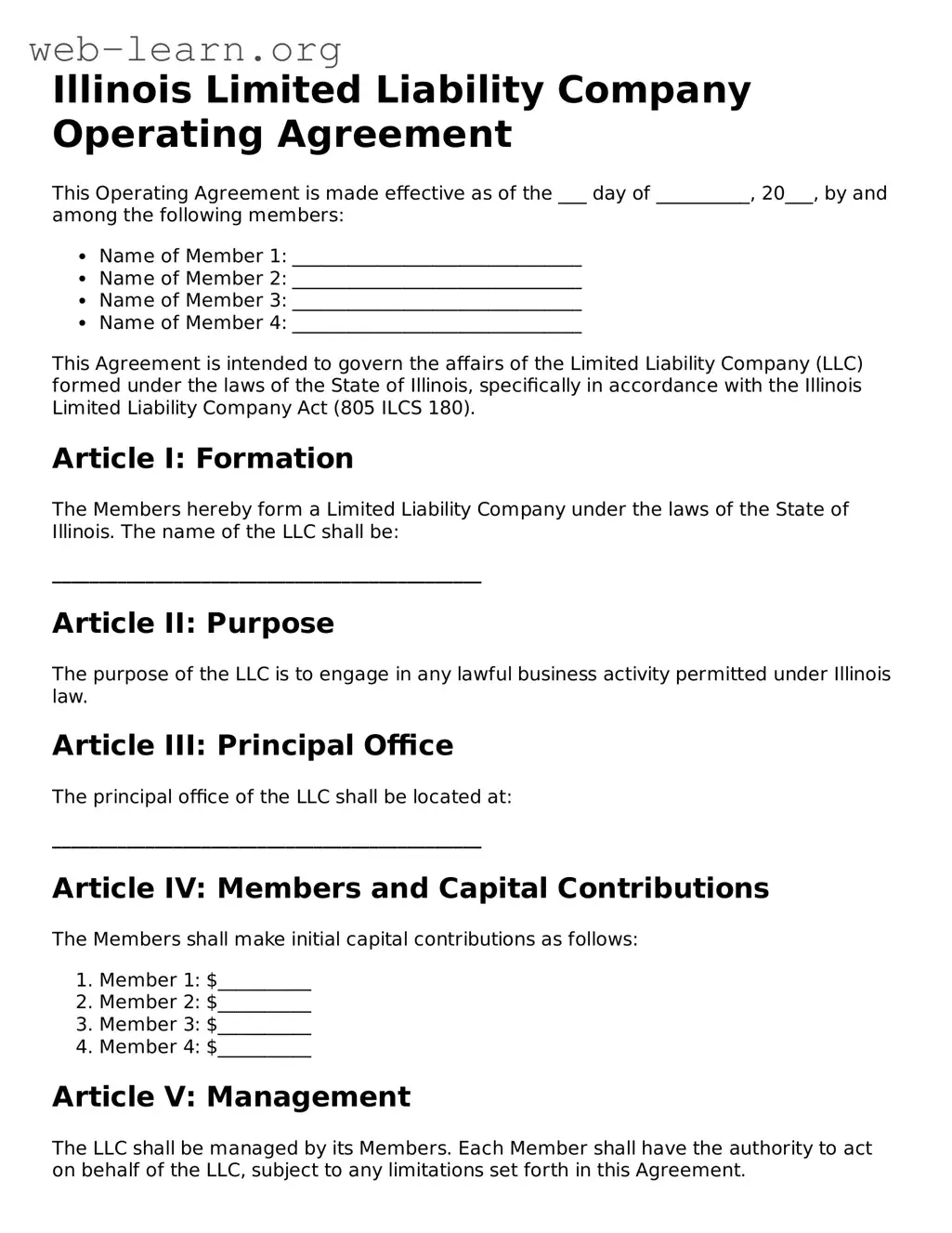
Sample - Illinois Operating Agreement Form

Illinois Limited Liability Company Operating Agreement

This Operating Agreement is made effective as of the ___ day of __________, 20___, by and among the following members:

  • Name of Member 1: _______________________________
  • Name of Member 2: _______________________________
  • Name of Member 3: _______________________________
  • Name of Member 4: _______________________________

This Agreement is intended to govern the affairs of the Limited Liability Company (LLC) formed under the laws of the State of Illinois, specifically in accordance with the Illinois Limited Liability Company Act (805 ILCS 180).

Article I: Formation

The Members hereby form a Limited Liability Company under the laws of the State of Illinois. The name of the LLC shall be:

______________________________________________

Article II: Purpose

The purpose of the LLC is to engage in any lawful business activity permitted under Illinois law.

Article III: Principal Office

The principal office of the LLC shall be located at:

______________________________________________

Article IV: Members and Capital Contributions

The Members shall make initial capital contributions as follows:

  1. Member 1: $__________
  2. Member 2: $__________
  3. Member 3: $__________
  4. Member 4: $__________

Article V: Management

The LLC shall be managed by its Members. Each Member shall have the authority to act on behalf of the LLC, subject to any limitations set forth in this Agreement.

Article VI: Distributions

Distributions of profits shall be made to the Members in proportion to their respective capital contributions, unless otherwise agreed upon in writing by all Members.

Article VII: Indemnification

The LLC shall indemnify and hold harmless each Member from any liability incurred in connection with the LLC, to the fullest extent permitted by Illinois law.

Article VIII: Amendments

This Operating Agreement may be amended only by a written agreement signed by all Members.

Article IX: Governing Law

This Agreement shall be governed by and construed in accordance with the laws of the State of Illinois.

IN WITNESS WHEREOF, the undersigned have executed this Operating Agreement as of the date first above written.

______________________________

Member 1 Signature

______________________________

Member 2 Signature

______________________________

Member 3 Signature

______________________________

Member 4 Signature

File Characteristics

Fact Name Description
Purpose The Illinois Operating Agreement outlines the management structure and operational procedures of a limited liability company (LLC) in Illinois.
Governing Law The agreement is governed by the Illinois Limited Liability Company Act (805 ILCS 180).
Members All members of the LLC should sign the Operating Agreement to ensure mutual understanding and agreement on the terms.
Flexibility Illinois law allows LLCs to customize their Operating Agreement to fit their specific needs, which provides significant flexibility.
Dispute Resolution The agreement can include provisions for resolving disputes among members, which can help avoid costly litigation.
Amendments Members can amend the Operating Agreement as needed, provided that the process for amendments is clearly outlined within the document.
Not Mandatory While an Operating Agreement is not legally required in Illinois, having one is highly recommended to clarify roles and responsibilities.

Detailed Guide for Filling Out Illinois Operating Agreement

Completing the Illinois Operating Agreement form is essential for establishing the internal rules and structure of your business. This document will outline the rights and responsibilities of members, ensuring clarity and organization within your company. Follow the steps below to accurately fill out the form.

  1. Begin with the title section. Clearly state "Operating Agreement" at the top of the document.
  2. Enter the name of the LLC as it appears on your Articles of Organization.
  3. Provide the principal office address of the LLC. This should be a physical address, not a P.O. Box.
  4. List the names and addresses of all members involved in the LLC. Include full names and current addresses.
  5. Specify the purpose of the LLC. Describe the business activities the LLC will engage in.
  6. Outline the management structure. Indicate whether the LLC will be member-managed or manager-managed.
  7. Detail the capital contributions of each member. Clearly state how much each member is contributing to the LLC.
  8. Describe the profit and loss distribution. Explain how profits and losses will be allocated among members.
  9. Include provisions for meetings. State how often meetings will be held and the process for calling them.
  10. Provide a section for amendments. Outline how changes to the agreement can be made in the future.
  11. Conclude with a signature section. Ensure all members sign and date the agreement to validate it.

Obtain Answers on Illinois Operating Agreement

  1. What is an Illinois Operating Agreement?

    An Illinois Operating Agreement is a legal document that outlines the management structure and operational procedures of a limited liability company (LLC) in Illinois. It serves as a roadmap for the members of the LLC, detailing their rights, responsibilities, and the procedures for making decisions. While not required by law, having an Operating Agreement is highly recommended as it helps prevent misunderstandings and disputes among members.

  2. Who should create an Operating Agreement?

    All members of an LLC should participate in creating the Operating Agreement. This includes both managing and non-managing members. Involving everyone ensures that all perspectives are considered, which can lead to a more effective and comprehensive document. Even single-member LLCs benefit from having an Operating Agreement, as it provides a clear framework for operations and can help establish credibility with banks and investors.

  3. What should be included in the Operating Agreement?

    While the specifics can vary, an Operating Agreement typically includes:

    • The name and purpose of the LLC
    • The names of the members and their ownership percentages
    • Management structure and decision-making processes
    • Procedures for adding or removing members
    • Distribution of profits and losses
    • Dispute resolution mechanisms

    Including these elements helps ensure that all members are on the same page regarding the operation of the LLC.

  4. Is the Operating Agreement filed with the state?

    No, the Operating Agreement is not filed with the state of Illinois. It is an internal document that remains with the LLC. However, it is essential for members to keep it updated and accessible, as it can be referenced in case of disputes or legal issues. Having a well-drafted Operating Agreement can also be beneficial if the LLC faces audits or other legal scrutiny.

Common mistakes

When completing the Illinois Operating Agreement form, individuals often overlook critical details that can lead to complications down the line. One common mistake is failing to include all members of the LLC. Each member’s name and contribution should be clearly stated. Omitting a member can create disputes and legal issues later on.

Another frequent error is not specifying the management structure. The agreement should outline whether the LLC will be managed by its members or by appointed managers. This clarity helps prevent confusion about decision-making authority and responsibilities.

People sometimes neglect to address profit and loss distribution. The agreement should clearly state how profits and losses will be allocated among members. Without this information, misunderstandings may arise, leading to potential conflicts.

Additionally, many individuals forget to include provisions for member withdrawal or the addition of new members. The agreement should outline the process for these changes to ensure a smooth transition. Ignoring this aspect can complicate future adjustments and lead to disputes.

Another mistake is the lack of a dispute resolution clause. It’s wise to include a method for resolving conflicts, such as mediation or arbitration. This proactive approach can save time and resources if disagreements arise.

Finally, failing to review the agreement thoroughly before signing is a significant oversight. Each member should understand the terms and conditions laid out in the agreement. Taking the time to review ensures that all parties are on the same page and can help prevent future misunderstandings.

Documents used along the form

When forming a limited liability company (LLC) in Illinois, the Operating Agreement is a crucial document that outlines the management structure and operational procedures of the business. However, several other forms and documents are often used in conjunction with the Operating Agreement to ensure compliance with state laws and to facilitate smooth operations. Here is a list of some commonly associated documents:

  • Articles of Organization: This is the foundational document filed with the Illinois Secretary of State to officially create the LLC. It includes essential information such as the name of the LLC, the address, and the names of the members.
  • Employer Identification Number (EIN): This is a unique number assigned by the IRS for tax purposes. An EIN is necessary for opening a business bank account, hiring employees, and filing taxes.
  • Operating Agreement Addendum: This document allows for modifications or additions to the original Operating Agreement. It can be used to address changes in membership, management structure, or other operational aspects.
  • Membership Certificates: These certificates serve as proof of ownership for each member of the LLC. They can be issued to members to signify their investment and ownership stake in the company.
  • Meeting Minutes: These are records of the decisions made during meetings of the members or managers of the LLC. Keeping accurate minutes is important for maintaining transparency and can be beneficial in legal situations.
  • Bylaws: Although not required for LLCs, bylaws can provide additional structure and guidelines for the internal governance of the company. They may cover topics such as member voting rights and procedures for holding meetings.

Each of these documents plays a vital role in the formation and operation of an LLC in Illinois. Ensuring that they are properly prepared and maintained can help prevent future disputes and facilitate compliance with legal requirements.

Similar forms

  • Bylaws: Similar to an Operating Agreement, bylaws outline the internal rules and procedures for a corporation. They govern how the corporation operates, including details about meetings, voting, and the roles of officers and directors.
  • Partnership Agreement: This document establishes the terms of a partnership, detailing the rights and responsibilities of each partner. Like an Operating Agreement, it helps prevent disputes by clarifying expectations and contributions.
  • Shareholder Agreement: A shareholder agreement is akin to an Operating Agreement but is specific to corporations. It outlines the rights of shareholders, including how shares can be sold or transferred, and establishes procedures for decision-making.
  • LLC Membership Agreement: This document serves a similar purpose as an Operating Agreement for limited liability companies (LLCs). It details the roles of members, their financial contributions, and how profits and losses are distributed.
  • Joint Venture Agreement: A joint venture agreement outlines the terms of a partnership between two or more parties for a specific project. Like an Operating Agreement, it defines roles, contributions, and how profits or losses will be shared.
  • Franchise Agreement: This document governs the relationship between a franchisor and franchisee. It specifies the rights and obligations of both parties, similar to how an Operating Agreement defines the relationship among LLC members.
  • Service Agreement: A service agreement outlines the terms under which services will be provided between parties. It shares similarities with an Operating Agreement in that it specifies roles, responsibilities, and expectations.
  • Employment Agreement: This document details the terms of employment between an employer and an employee. Like an Operating Agreement, it establishes roles and responsibilities, as well as compensation and benefits.
  • Confidentiality Agreement: Also known as a non-disclosure agreement (NDA), this document protects sensitive information shared between parties. It is similar to an Operating Agreement in that it helps maintain trust and clarity in business relationships.

Dos and Don'ts

When filling out the Illinois Operating Agreement form, it's essential to approach the task thoughtfully. Here are some key do's and don'ts to keep in mind:

  • Do read the instructions carefully before you start. Understanding what each section requires will save you time and prevent errors.
  • Do provide accurate information. Double-check names, addresses, and any other details to ensure everything is correct.
  • Do consult with a legal professional if you have questions. Getting expert advice can clarify any uncertainties you may have.
  • Don't rush through the form. Taking your time will help you avoid mistakes that could lead to complications later on.
  • Don't leave any required fields blank. Incomplete forms can lead to delays or rejections, so make sure every necessary section is filled out.

Misconceptions

Understanding the Illinois Operating Agreement form is essential for anyone involved in a limited liability company (LLC). However, several misconceptions often arise regarding this important document. Here are ten common misunderstandings:

  1. It is not necessary to have an Operating Agreement. Many people believe that an Operating Agreement is optional for an LLC in Illinois. In reality, while the state does not require one, having this document is crucial for outlining the management structure and operational procedures of the company.
  2. All LLCs in Illinois must use a standard template. Some assume that there is a one-size-fits-all template for Operating Agreements. However, each LLC has unique needs and should customize its agreement to reflect its specific goals and structure.
  3. Operating Agreements are only for multi-member LLCs. Many think that only LLCs with multiple members need an Operating Agreement. In truth, even single-member LLCs benefit from having this document to establish clear operational guidelines.
  4. The Operating Agreement can be verbal. Some individuals believe that a verbal agreement suffices. However, for clarity and legal protection, it is essential to have a written Operating Agreement.
  5. Once created, the Operating Agreement cannot be changed. There is a misconception that Operating Agreements are set in stone. In fact, they can be amended as the needs of the LLC change, provided all members agree to the modifications.
  6. The Operating Agreement is only relevant during disputes. Some think that this document is only necessary when conflicts arise. In reality, it serves as a guiding framework for daily operations and decision-making.
  7. Operating Agreements are not legally binding. There is a belief that these agreements hold no legal weight. On the contrary, a well-drafted Operating Agreement is enforceable in court and can protect members' rights.
  8. All members must sign the Operating Agreement for it to be valid. Some believe that if one member does not sign, the agreement is void. While it is best practice to have all members sign, the agreement can still be valid if it reflects the intent of the members.
  9. Operating Agreements do not need to be filed with the state. Many think that the Operating Agreement must be submitted to the state. However, it is an internal document and does not need to be filed with the Illinois Secretary of State.
  10. Legal advice is not necessary when drafting an Operating Agreement. Some individuals believe they can create an Operating Agreement without professional help. While it is possible to draft one independently, consulting a legal expert can ensure that the document meets all necessary legal requirements and adequately protects the members' interests.

Clarifying these misconceptions can help LLC members in Illinois understand the importance of the Operating Agreement and its role in the successful operation of their business.

Key takeaways

When filling out and using the Illinois Operating Agreement form, there are several important points to keep in mind. Below are key takeaways that can help ensure the process is smooth and effective.

  • The Operating Agreement outlines the management structure and operational procedures of your LLC.
  • It is not mandatory to file the Operating Agreement with the state, but it is crucial for internal governance.
  • Clearly define the roles and responsibilities of each member in the agreement.
  • Include provisions for profit distribution to avoid future disputes among members.
  • Specify the process for adding or removing members from the LLC.
  • Consider including a buy-sell agreement to manage ownership transitions effectively.
  • Address how decisions will be made, including voting rights and procedures.
  • Review the agreement regularly to ensure it reflects any changes in the business or membership.
  • Consult with legal professionals to ensure compliance with state laws and regulations.
  • Keep the Operating Agreement accessible to all members for reference and transparency.