The Illinois Notice to Quit form serves as a crucial document in the landlord-tenant relationship, particularly when a landlord seeks to terminate a lease agreement. This form outlines the necessary steps for a landlord to formally notify a tenant that they must vacate the rental property. It typically includes important details such as the reason for the eviction, the date by which the tenant is expected to leave, and any relevant state laws that apply to the situation. Understanding the implications of this notice is essential for both parties involved. For landlords, it provides a legal pathway to regain possession of their property, while tenants must recognize their rights and the timeline they must adhere to. The form can vary depending on the specific circumstances, such as non-payment of rent or lease violations, and it is important to ensure that it is completed accurately to avoid potential disputes. By adhering to the proper procedures outlined in the Notice to Quit, both landlords and tenants can navigate the often complex process of eviction with greater clarity and compliance with Illinois law.
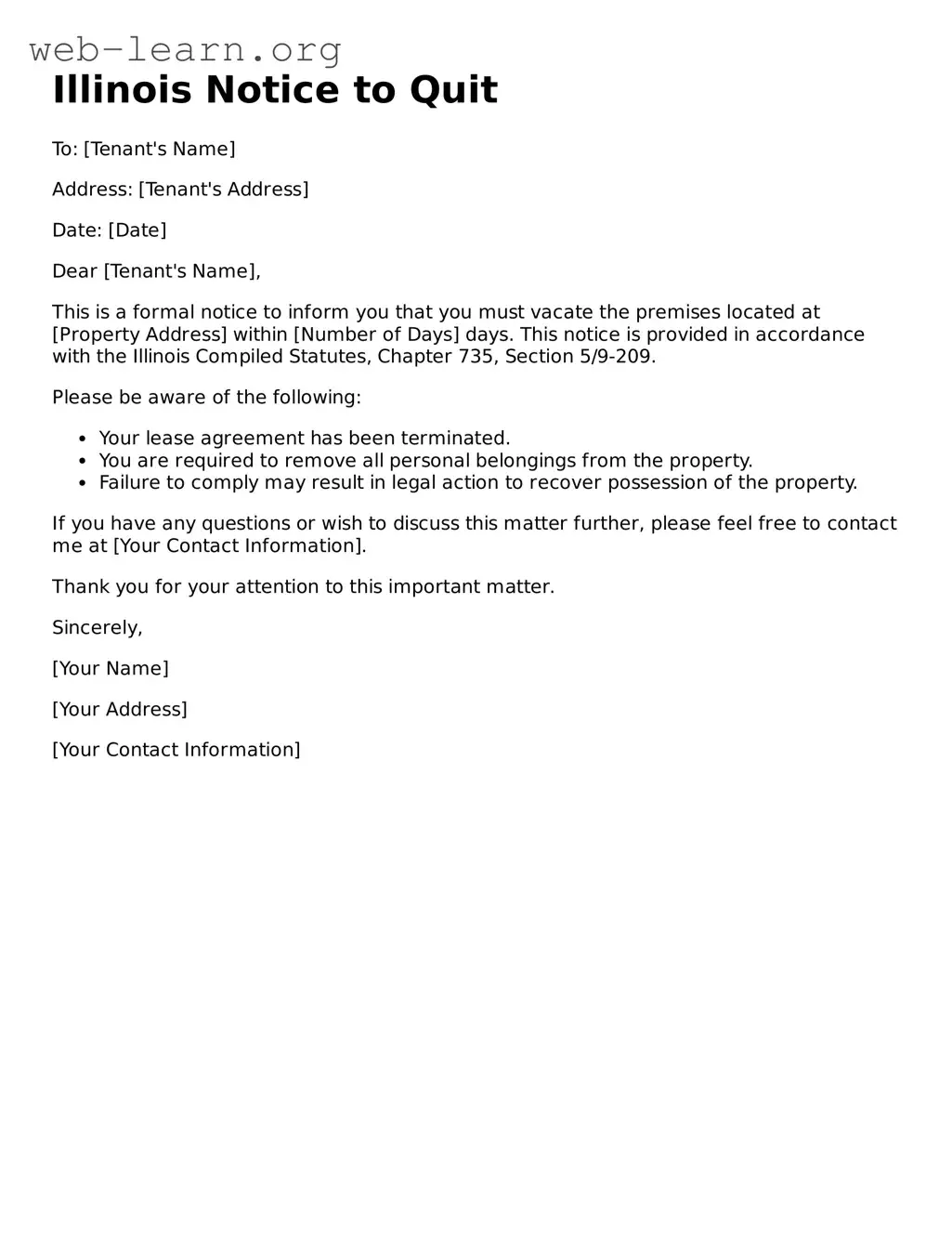
Illinois Notice to Quit
To: [Tenant's Name]
Address: [Tenant's Address]
Date: [Date]
Dear [Tenant's Name],
This is a formal notice to inform you that you must vacate the premises located at [Property Address] within [Number of Days] days. This notice is provided in accordance with the Illinois Compiled Statutes, Chapter 735, Section 5/9-209.
Please be aware of the following:
If you have any questions or wish to discuss this matter further, please feel free to contact me at [Your Contact Information].
Thank you for your attention to this important matter.
Sincerely,
[Your Name]
[Your Address]
[Your Contact Information]
| Fact Name | Details |
|---|---|
| Purpose | The Illinois Notice to Quit form is used by landlords to inform tenants of the termination of their lease agreement. |
| Governing Law | This form is governed by the Illinois Compiled Statutes, specifically 735 ILCS 5/9-207. |
| Notice Period | Landlords must provide a minimum of 5 days' notice for non-payment of rent and 10 days for lease violations. |
| Delivery Method | The notice can be delivered in person, by mail, or posted on the premises. |
| Tenant's Rights | Tenants have the right to respond to the notice and may contest the eviction in court. |
| Form Requirements | The form must clearly state the reason for termination and the date by which the tenant must vacate. |
| Signature Requirement | The landlord must sign the notice to validate it. |
| Legal Consequences | Failure to comply with the notice can lead to eviction proceedings in court. |
Filling out the Illinois Notice to Quit form is an important step in the process of addressing a rental issue. Once the form is completed, it will need to be served to the tenant, which can initiate the next steps in resolving the situation. Here’s how to fill out the form correctly:
Once the form is filled out, it should be served to the tenant in a manner consistent with local laws. Keeping a copy for your records is essential, as it may be needed later in the process. Be prepared to follow up based on the tenant's response or lack thereof.
The Illinois Notice to Quit form is a legal document that a landlord uses to inform a tenant that they must vacate the rental property. This notice is typically issued when a tenant has violated the terms of their lease or has not paid rent. It serves as a formal request for the tenant to leave the premises within a specified time frame.
A landlord may issue a Notice to Quit for various reasons, including:
It is important for landlords to follow the correct legal procedures when issuing this notice to ensure that they have the right to evict the tenant if necessary.
The amount of notice required can vary based on the reason for the eviction. Generally, landlords must provide:
It is crucial to check local laws, as they may impose different requirements.
Once a Notice to Quit is issued, the tenant has the specified amount of time to vacate the property. If the tenant does not leave by the deadline, the landlord may proceed with filing an eviction lawsuit, known as a forcible entry and detainer action, in the appropriate court. This step is essential to ensure the eviction is lawful.
Yes, a tenant has the right to contest a Notice to Quit. If they believe the notice is unjust or that they have rectified the issue (like paying overdue rent), they can respond to the landlord or defend themselves in court. It is advisable for tenants to seek legal assistance to understand their rights and options fully.
When filling out the Illinois Notice to Quit form, many individuals make critical mistakes that can delay the eviction process or even lead to legal complications. Understanding these common errors can help ensure that the form is completed correctly and effectively. Here are nine mistakes to avoid.
One frequent mistake is failing to provide accurate tenant information. It’s essential to include the full names of all tenants residing at the property. Incomplete or incorrect names can lead to confusion and may invalidate the notice.
Another common error is not specifying the reason for the eviction. The Notice to Quit must clearly state the grounds for termination of the tenancy. Without this clarity, the tenant may not understand why they are being asked to leave, which could result in unnecessary disputes.
Additionally, some people neglect to include the correct date. The notice must indicate when it was served and the date by which the tenant must vacate the premises. Missing or incorrect dates can complicate the eviction timeline.
Many individuals also forget to sign the notice. A signature is crucial as it validates the document. Without a signature, the notice may be deemed ineffective, leading to further delays in the eviction process.
Another mistake involves not providing a copy of the notice to the tenant. Simply filling out the form is not enough; it must be served to the tenant in accordance with Illinois law. Failure to do so can result in the notice being challenged in court.
Some people also overlook the requirement for proper delivery methods. The law specifies how the notice must be served, whether by personal delivery, mail, or posting on the property. Ignoring these methods can jeopardize the entire eviction process.
Moreover, failing to keep a copy of the notice for personal records is a significant oversight. It’s important to have documentation of what was served, when it was served, and how it was delivered. This can be vital if the case goes to court.
Another mistake is not adhering to the appropriate notice period. Different reasons for eviction have different time frames. For example, a 5-day notice may be required for non-payment of rent, while a 10-day notice may be necessary for lease violations. Ignoring these timelines can lead to complications.
Lastly, some individuals do not seek legal advice when needed. Navigating eviction laws can be complex. Consulting with a legal expert can provide clarity and ensure that the Notice to Quit is filled out correctly, reducing the risk of errors.
The Illinois Notice to Quit form is an essential document for landlords seeking to terminate a rental agreement. However, it is often used in conjunction with other forms to ensure a smooth transition in the eviction process. Below are five additional forms and documents that are commonly utilized alongside the Notice to Quit.
Using these forms in conjunction with the Illinois Notice to Quit can help ensure that landlords follow proper legal procedures, protecting their rights and facilitating a more efficient eviction process if necessary. It is crucial to stay informed and organized throughout this process.
The Notice to Quit form is an important document in landlord-tenant law. It serves as a formal notice to a tenant that they must vacate the rental property. Here are four other documents that are similar to the Notice to Quit form, along with an explanation of how they are alike:
When filling out the Illinois Notice to Quit form, it’s important to approach the process carefully. Here are some essential dos and don’ts to consider:
Following these guidelines can help ensure that the process goes smoothly and legally. Remember, clarity and compliance are key.
Understanding the Illinois Notice to Quit form can be challenging, and several misconceptions often arise. Here are six common misunderstandings about this important document:
Misconception 1: A Notice to Quit is an eviction notice.
Many people mistakenly believe that a Notice to Quit is the same as an eviction notice. In reality, it is a preliminary step that informs the tenant they must vacate the property. An eviction process follows if the tenant does not comply.
Misconception 2: A landlord can use a Notice to Quit for any reason.
This is not true. In Illinois, a Notice to Quit must be issued for specific reasons, such as non-payment of rent or lease violations. Landlords cannot arbitrarily decide to issue this notice without a valid cause.
Misconception 3: Tenants have no rights after receiving a Notice to Quit.
Receiving a Notice to Quit does not strip tenants of their rights. They have the right to contest the notice and can seek legal advice to understand their options. It is important for tenants to know they can respond and potentially negotiate.
Misconception 4: The Notice to Quit must be delivered in person.
While personal delivery is one method, the Notice to Quit can also be sent via certified mail or posted on the property. The key is that it must be delivered in a manner that ensures the tenant receives it.
Misconception 5: A Notice to Quit is effective immediately.
This is a common misunderstanding. In Illinois, a Notice to Quit typically provides a specific timeframe for the tenant to vacate, which can vary based on the reason for the notice. It is essential to adhere to this timeline.
Misconception 6: Once a Notice to Quit is issued, the landlord cannot change their mind.
Landlords do have the option to withdraw a Notice to Quit before the eviction process begins. If the issue is resolved, the landlord can choose to allow the tenant to remain in the property.
Understanding these misconceptions can help both landlords and tenants navigate the complexities of rental agreements and eviction processes more effectively.
When dealing with the Illinois Notice to Quit form, it's important to understand its purpose and proper usage. Here are some key takeaways:
Understanding these points can help ensure a smoother process when issuing a Notice to Quit in Illinois.
Three Day Notice to Quit - Some states have specific forms that must be used for the Notice to Quit.
Free Eviction Notice Alabama - This notice is often the first step in a landlord's effort to reclaim their property.
Georgia Tenant at Will 60 Day Notice - Failure to respond to a Notice to Quit can lead to legal action and potential eviction.