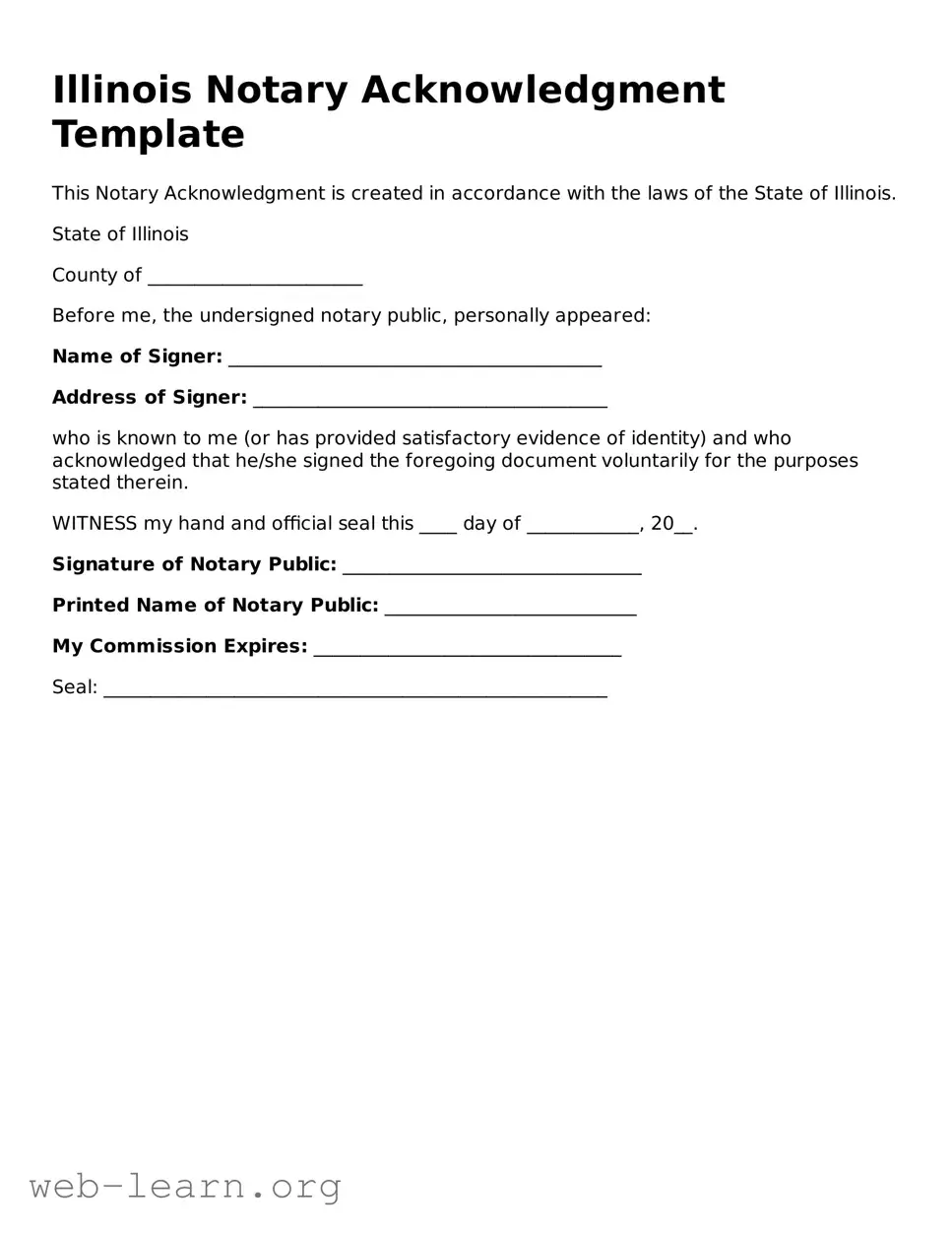
The Illinois Notary Acknowledgment form serves a crucial role in the notarization process, providing a way for individuals to affirm the authenticity of their signatures on various documents. This form is commonly used when a person needs to confirm their identity and the voluntary nature of their signature, often required for legal documents such as deeds, contracts, and affidavits. When completing the form, the notary public will typically ask the signer to appear in person, ensuring that the individual understands the document they are signing. The form includes specific details, such as the date of the acknowledgment, the name of the signer, and the notary's official signature and seal. It is important for signers to understand that the acknowledgment does not validate the content of the document itself; rather, it confirms that the signature was made willingly and is genuine. Understanding the elements and purpose of the Illinois Notary Acknowledgment form can help individuals navigate the notarization process more effectively.
Illinois Notary Acknowledgment Template
This Notary Acknowledgment is created in accordance with the laws of the State of Illinois.
State of Illinois
County of _______________________
Before me, the undersigned notary public, personally appeared:
Name of Signer: ________________________________________
Address of Signer: ______________________________________
who is known to me (or has provided satisfactory evidence of identity) and who acknowledged that he/she signed the foregoing document voluntarily for the purposes stated therein.
WITNESS my hand and official seal this ____ day of ____________, 20__.
Signature of Notary Public: ________________________________
Printed Name of Notary Public: ___________________________
My Commission Expires: _________________________________
Seal: ______________________________________________________
| Fact Name | Description |
|---|---|
| Definition | An Illinois Notary Acknowledgment form is used to verify the identity of a signer and their willingness to sign a document. |
| Governing Law | The use of the Notary Acknowledgment form is governed by the Illinois Notary Public Act, 5 ILCS 312. |
| Purpose | This form helps prevent fraud by ensuring that the person signing the document is who they claim to be. |
| Signature Requirement | The signer must be present when the notary public completes the acknowledgment. |
| Identification | The notary must verify the identity of the signer, typically through a government-issued ID. |
| Form Language | The acknowledgment must include specific language indicating the signer appeared before the notary. |
| Record Keeping | Notaries are required to keep a record of all acknowledgments performed in their notary journal. |
| Expiration | Notary acknowledgments do not expire but the notary's commission does, and must be renewed. |
| Fees | Notaries in Illinois may charge a fee for their services, typically no more than $1 per acknowledgment. |
| Electronic Acknowledgments | Illinois law allows for electronic notarization, but specific requirements must be met. |
Once you have the Illinois Notary Acknowledgment form in front of you, it's time to fill it out accurately. This process is straightforward, and following the steps carefully will ensure that the form is completed correctly.
After completing these steps, review the form for any errors or omissions. Once verified, the form is ready for submission or filing as needed.
What is an Illinois Notary Acknowledgement form?
The Illinois Notary Acknowledgement form is a legal document used to confirm that a person has willingly signed a document in the presence of a notary public. This form is often required for various legal transactions, such as property deeds, contracts, and other important documents.
When do I need to use this form?
You will need to use the Illinois Notary Acknowledgement form whenever you are signing a document that requires notarization. This is particularly important for documents that need to be filed with government agencies or that have legal implications. Always check if the document specifies the need for notarization.
Who can act as a notary public in Illinois?
In Illinois, a notary public must be at least 18 years old, a resident of Illinois or a business owner in the state, and must have completed the necessary training and application process. They are authorized to witness signatures and administer oaths, providing an essential service in legal and business transactions.
What information is required on the form?
The Illinois Notary Acknowledgement form typically includes the following information:
How do I complete the form?
To complete the Illinois Notary Acknowledgement form, follow these steps:
Ensure that all information is accurate to avoid any issues later on.
Is there a fee for notarization?
Yes, notaries in Illinois can charge a fee for their services. The maximum fee is typically set by state law, so it’s a good idea to ask the notary about their charges beforehand. Some notaries may offer their services for free, especially if they are part of a larger organization or business.
Can I use the form for documents from other states?
The Illinois Notary Acknowledgement form is specifically designed for use within Illinois. If you have a document from another state, you should check the requirements of that state to ensure compliance. Each state may have different rules and forms for notarization.
Filling out the Illinois Notary Acknowledgement form requires attention to detail. One common mistake is failing to include the correct name of the signer. The name must match the identification presented. If the name is misspelled or incomplete, the acknowledgment may be deemed invalid.
Another frequent error is neglecting to specify the date of the acknowledgment. This date is crucial, as it indicates when the notary performed the acknowledgment. Without a date, the form may not serve its intended purpose, leading to potential legal complications.
People often overlook the requirement for the notary's signature. The notary must sign the form in the designated area. If this step is missed, the acknowledgment will not be recognized as valid, which can create issues for the document in question.
In addition, some individuals forget to include the notary's seal. The seal serves as an official mark of the notary's authority. A form without this seal may not be accepted by courts or other entities requiring notarization.
Another mistake involves using the wrong type of identification. The signer must present an acceptable form of ID, such as a driver's license or passport. If the notary does not verify the ID properly, the acknowledgment may be challenged later.
Lastly, failing to complete the notary's section accurately can lead to problems. This section includes important information about the notary's commission, such as the expiration date. Inaccuracies here can render the acknowledgment ineffective.
When working with the Illinois Notary Acknowledgement form, several other documents may be necessary to ensure proper legal procedures are followed. Each document serves a specific purpose and complements the notarial process. Here are some common forms you might encounter:
Understanding these documents can help streamline your legal processes. Always ensure that you have the necessary forms completed and notarized to avoid complications.
The Notary Acknowledgement form serves a specific purpose in the legal process, but there are several other documents that share similarities in function and intent. Below is a list of nine documents that are comparable to the Notary Acknowledgement form, along with a brief explanation of how they are similar.
When filling out the Illinois Notary Acknowledgment form, it's important to follow certain guidelines to ensure accuracy and compliance. Here are ten things to keep in mind.
Following these guidelines can help ensure that the notary acknowledgment process goes smoothly and meets legal requirements.
Misconceptions about the Illinois Notary Acknowledgement form can lead to confusion regarding its use and requirements. Below are nine common misconceptions along with clarifications.
Many people believe that notaries have the authority to certify copies of documents. In Illinois, notaries are not authorized to perform this function unless they are also licensed to do so under specific circumstances.
It is a common misunderstanding that any document can be notarized. In Illinois, only certain types of documents are eligible for notarization, and the notary must ensure that the document meets these criteria.
Some individuals think that a notary must be present when the document is signed. However, the notary's role is to acknowledge that the signer appeared before them and confirmed their identity, not necessarily to witness the signing itself.
There is a misconception that notaries can offer legal advice. In reality, notaries are prohibited from providing legal counsel and should not interpret the documents they notarize.
Many believe that notarization ensures a document's validity. However, notarization only verifies the identity of the signer and does not guarantee that the content of the document is legally binding or accurate.
Some people think that all notaries have the same qualifications and responsibilities. In Illinois, notaries must meet specific requirements and follow state regulations, which can vary from those in other states.
While notaries have discretion in their duties, they cannot refuse to notarize a document arbitrarily. They must have valid reasons, such as concerns about the signer's identity or the legality of the document.
There is a belief that notaries can set their own fees. In Illinois, notaries are limited to charging a maximum fee set by state law for their services.
Some individuals think that a notarized document is final and cannot be altered. While notarization adds a level of authenticity, changes can still be made to the document, but it may require re-notarization.