Homepage Attorney-Approved Non-disclosure Agreement Document for the State of Illinois
Table of Contents

In the realm of business and professional relationships, protecting sensitive information is crucial. The Illinois Non-disclosure Agreement (NDA) serves as a vital tool for individuals and organizations looking to safeguard their proprietary information. This legally binding document outlines the terms under which confidential information can be shared, ensuring that parties involved understand their obligations. Typically, the form includes key elements such as the definition of confidential information, the duration of the agreement, and the responsibilities of each party regarding the handling of sensitive data. Additionally, it may specify the consequences of breaches, providing a framework for legal recourse if necessary. By establishing clear guidelines, the Illinois NDA not only fosters trust but also encourages open communication, allowing businesses to collaborate without fear of compromising their valuable assets.

Sample - Illinois Non-disclosure Agreement Form

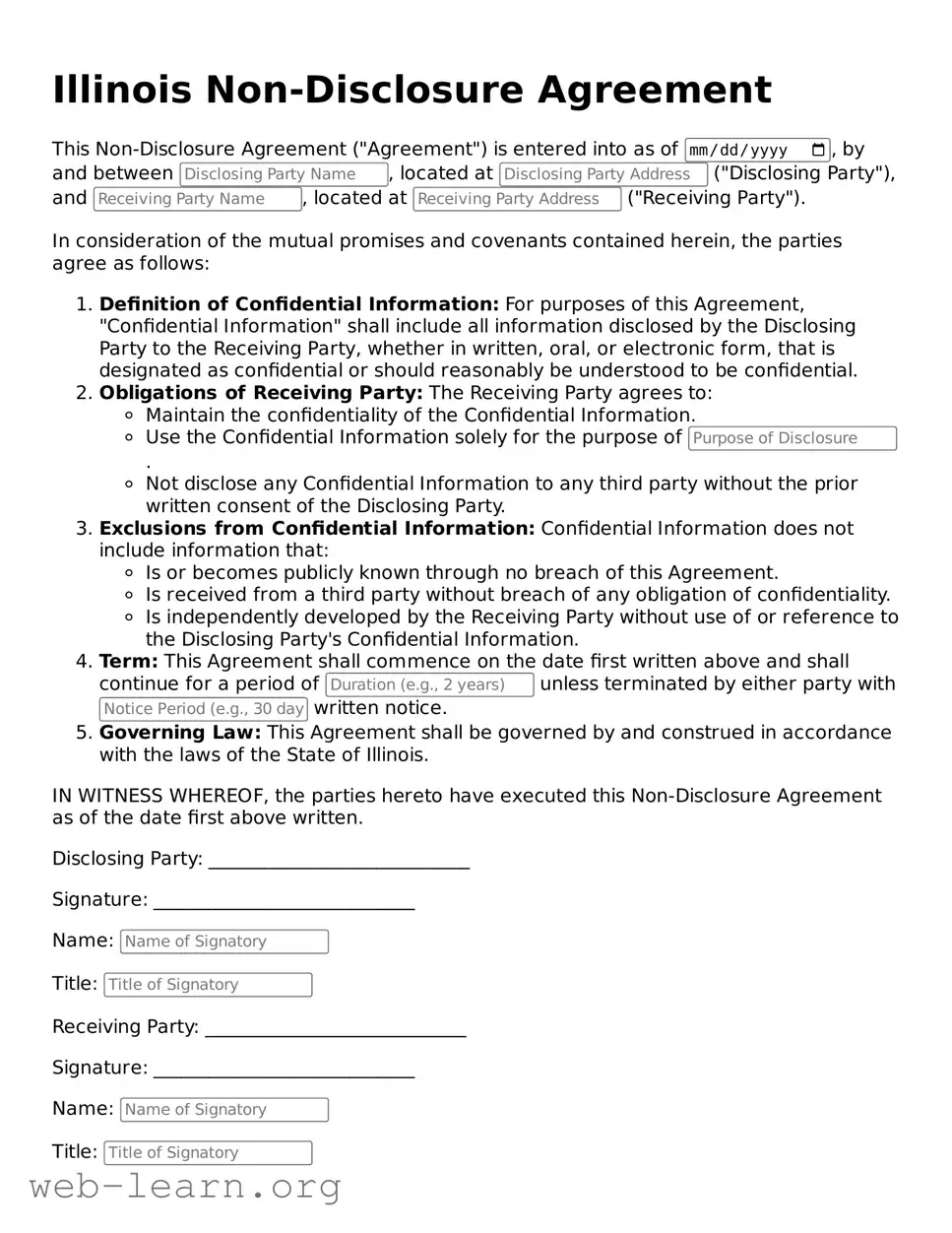
Illinois Non-Disclosure Agreement

This Non-Disclosure Agreement ("Agreement") is entered into as of , by and between , located at ("Disclosing Party"), and , located at ("Receiving Party").

In consideration of the mutual promises and covenants contained herein, the parties agree as follows:

  1. Definition of Confidential Information: For purposes of this Agreement, "Confidential Information" shall include all information disclosed by the Disclosing Party to the Receiving Party, whether in written, oral, or electronic form, that is designated as confidential or should reasonably be understood to be confidential.
  2. Obligations of Receiving Party: The Receiving Party agrees to:
    • Maintain the confidentiality of the Confidential Information.
    • Use the Confidential Information solely for the purpose of .
    • Not disclose any Confidential Information to any third party without the prior written consent of the Disclosing Party.
  3. Exclusions from Confidential Information: Confidential Information does not include information that:
    • Is or becomes publicly known through no breach of this Agreement.
    • Is received from a third party without breach of any obligation of confidentiality.
    • Is independently developed by the Receiving Party without use of or reference to the Disclosing Party's Confidential Information.
  4. Term: This Agreement shall commence on the date first written above and shall continue for a period of unless terminated by either party with written notice.
  5. Governing Law: This Agreement shall be governed by and construed in accordance with the laws of the State of Illinois.

IN WITNESS WHEREOF, the parties hereto have executed this Non-Disclosure Agreement as of the date first above written.

Disclosing Party: ____________________________

Signature: ____________________________

Name:

Title:

Receiving Party: ____________________________

Signature: ____________________________

Name:

Title:

File Characteristics

Fact Name Description
Purpose The Illinois Non-disclosure Agreement (NDA) is designed to protect confidential information shared between parties.
Parties Involved The NDA typically involves at least two parties: the disclosing party and the receiving party.
Governing Law Illinois law governs the terms and enforcement of the NDA, ensuring that state-specific regulations are followed.
Duration of Confidentiality The agreement should specify how long the confidentiality obligations will last, which can vary based on the nature of the information.
Enforcement If a breach occurs, the injured party may seek legal remedies, including injunctions or monetary damages, under Illinois law.

Detailed Guide for Filling Out Illinois Non-disclosure Agreement

Completing the Illinois Non-disclosure Agreement form is a straightforward process. Once you have filled out the necessary sections, you will be prepared to protect sensitive information and establish trust in your professional relationships.

  1. Begin by downloading the Illinois Non-disclosure Agreement form from a reliable source or your legal advisor.
  2. Read through the entire form to understand what information is required.
  3. At the top of the form, fill in the names of the parties involved. This includes the disclosing party and the receiving party.
  4. Provide the date when the agreement is being signed.
  5. In the designated section, clearly describe the confidential information that will be shared. Be specific to avoid ambiguity.
  6. Next, outline the obligations of the receiving party regarding the confidential information. This may include how the information should be handled and any restrictions on its use.
  7. Identify the duration of the confidentiality obligations. Specify how long the agreement will remain in effect.
  8. If applicable, include any exceptions to the confidentiality obligations, such as information that is already public knowledge.
  9. Sign and date the form. Ensure that both parties have signed to make the agreement valid.
  10. Make copies of the signed agreement for both parties to retain for their records.

Obtain Answers on Illinois Non-disclosure Agreement

  1. What is a Non-disclosure Agreement (NDA) in Illinois?

    An NDA is a legal contract that establishes a confidential relationship between parties. In Illinois, it is used to protect sensitive information from being disclosed to unauthorized individuals. This agreement is crucial for businesses and individuals who want to safeguard trade secrets, proprietary information, or any confidential data.

  2. Why should I use an NDA?

    Using an NDA helps prevent the unauthorized sharing of confidential information. It provides legal recourse if the agreement is violated. By establishing clear boundaries, an NDA can foster trust between parties, encouraging open communication without fear of information being misused.

  3. Who can enter into an NDA?

    Any individual or entity can enter into an NDA. This includes businesses, employees, contractors, and even partners. As long as both parties agree to the terms, they can establish a binding confidentiality agreement.

  4. What information is typically covered by an NDA?

    NDAs often cover a range of sensitive information, including:

    • Business plans
    • Financial data
    • Client lists
    • Product designs
    • Marketing strategies

    However, the specific information covered should be clearly defined in the NDA to avoid ambiguity.

  5. How long does the confidentiality obligation last?

    The duration of the confidentiality obligation can vary. Many NDAs specify a time frame, often ranging from one to five years. In some cases, the obligation may last indefinitely, especially for trade secrets. It is essential to outline this duration in the agreement.

  6. Can an NDA be enforced in court?

    Yes, an NDA is a legally binding contract. If one party breaches the agreement, the other party can seek legal remedies. This may include monetary damages or injunctive relief, which can prevent further disclosures.

  7. What happens if I accidentally disclose information covered by an NDA?

    Accidental disclosures can complicate matters. If you unintentionally share confidential information, it is crucial to notify the other party as soon as possible. Depending on the circumstances, you may still be held accountable, but demonstrating that the disclosure was unintentional may influence the outcome.

  8. Is a verbal NDA enforceable in Illinois?

    While verbal agreements can be enforceable, they are much harder to prove than written agreements. It is highly recommended to have a written NDA to clearly outline the terms and conditions, reducing the risk of misunderstandings.

  9. Do I need a lawyer to draft an NDA?

    While it is not strictly necessary to hire a lawyer, consulting one can be beneficial. A lawyer can ensure that the NDA complies with Illinois law and adequately protects your interests. This is especially important for complex agreements or when significant assets are at stake.

  10. Can I modify an existing NDA?

    Yes, an existing NDA can be modified if both parties agree to the changes. It is important to document any modifications in writing to maintain clarity and enforceability. This ensures that both parties understand and accept the new terms.

Common mistakes

When filling out the Illinois Non-disclosure Agreement (NDA) form, individuals often overlook important details that can lead to misunderstandings or enforceability issues. One common mistake is failing to clearly define the confidential information. Without a precise description, it may be difficult to determine what information is protected under the agreement.

Another frequent error is neglecting to specify the duration of the confidentiality obligation. Many people assume that confidentiality lasts indefinitely, but this is not always the case. It’s crucial to state how long the NDA will remain in effect. This clarity helps both parties understand their responsibilities over time.

Some individuals forget to include the purpose of sharing the confidential information. An NDA should outline why the information is being disclosed. This helps establish the context and ensures that both parties are on the same page regarding the intended use of the information.

Additionally, people often overlook the importance of including the parties involved. Clearly identifying all parties in the agreement is essential. If a party is not named, they may not be bound by the terms, which can undermine the agreement's effectiveness.

Another mistake is failing to address the consequences of a breach. It’s important to outline what will happen if one party violates the NDA. This could include legal action or financial penalties. By specifying these consequences, both parties are more likely to take the agreement seriously.

Finally, some individuals neglect to seek legal advice before signing the NDA. This can lead to misunderstandings about the rights and obligations set forth in the document. Consulting with a legal professional can provide valuable insights and ensure that the agreement meets all necessary legal standards.

Documents used along the form

When entering into a Non-disclosure Agreement (NDA) in Illinois, several other documents may accompany it to ensure a comprehensive understanding and protection of sensitive information. These documents serve various purposes, from clarifying terms to establishing the framework for the business relationship. Below is a list of commonly used forms and documents that often go hand-in-hand with an NDA.

  • Confidentiality Agreement: Similar to an NDA, this document specifically outlines the confidential information shared between parties and the obligations to protect that information.
  • Mutual Non-disclosure Agreement: This agreement is used when both parties intend to share confidential information. It establishes reciprocal obligations to safeguard each other's sensitive information.
  • Non-compete Agreement: This document restricts one party from entering into direct competition with another for a specified period and within a defined geographic area, often used to protect business interests.
  • Non-solicitation Agreement: This agreement prevents one party from soliciting the other party's clients, employees, or contractors, helping to maintain business relationships and workforce stability.
  • Service Agreement: This document outlines the terms under which services will be provided, including scope, payment, and confidentiality obligations, ensuring clarity in the business arrangement.
  • Letter of Intent: A preliminary document that outlines the intention to enter into a formal agreement, often used in negotiations to establish the main terms before drafting a detailed contract.
  • Partnership Agreement: If the parties are forming a partnership, this document details the roles, responsibilities, and profit-sharing arrangements among the partners.
  • Employment Agreement: This agreement outlines the terms of employment for an individual, including confidentiality clauses that protect the employer's proprietary information.
  • Intellectual Property Assignment Agreement: This document transfers ownership of intellectual property rights from one party to another, ensuring that proprietary information remains protected and properly assigned.

These documents, when used alongside an NDA, help create a robust framework for protecting sensitive information and defining the relationships between parties. Each serves a specific purpose and contributes to the overall security and clarity of business dealings. Consider the unique circumstances of your situation to determine which documents are necessary for your agreements.

Similar forms

  • Confidentiality Agreement: This document serves a similar purpose as a Non-disclosure Agreement (NDA). Both aim to protect sensitive information shared between parties. A Confidentiality Agreement may be broader in scope, covering various types of confidential information beyond trade secrets.
  • Mutual Non-disclosure Agreement: Unlike a standard NDA, which typically protects one party, a Mutual Non-disclosure Agreement protects both parties involved. This means that both sides agree not to disclose each other's confidential information.
  • Proprietary Information Agreement: This document focuses specifically on proprietary information, which is a subset of confidential information. It ensures that sensitive business information, such as formulas or processes, remains protected.
  • Non-compete Agreement: While primarily aimed at restricting competition, a Non-compete Agreement often includes clauses about confidentiality. It prevents individuals from sharing sensitive business information after leaving a company.
  • Service Agreement: Many Service Agreements include confidentiality clauses to protect the information shared during the service relationship. This ensures that any sensitive data remains secure while the service is being provided.
  • Employment Agreement: These agreements often contain confidentiality provisions. They ensure that employees do not disclose proprietary information or trade secrets learned during their employment.
  • Partnership Agreement: When forming a partnership, parties may include confidentiality clauses to protect each other's business interests. This helps maintain trust and security within the partnership.
  • Licensing Agreement: In a Licensing Agreement, the licensor may share proprietary information with the licensee. Confidentiality clauses are typically included to protect this information from being disclosed to third parties.
  • Joint Venture Agreement: When two or more entities collaborate on a project, a Joint Venture Agreement often includes confidentiality provisions. These ensure that sensitive information shared during the collaboration remains protected.
  • Consulting Agreement: Similar to Service Agreements, Consulting Agreements frequently include confidentiality clauses. These protect the information shared between the consultant and the client, ensuring that sensitive data is not disclosed.

Dos and Don'ts

When filling out the Illinois Non-disclosure Agreement (NDA) form, it is essential to approach the task with care and attention to detail. Below is a list of ten things to keep in mind, divided into what you should do and what you should avoid.

Things You Should Do:

  • Read the entire NDA carefully to understand its terms and implications.
  • Clearly identify all parties involved in the agreement.
  • Specify the type of confidential information that will be protected.
  • Include a duration for which the NDA will remain in effect.
  • Consult with a legal professional if you have any questions or concerns.

Things You Shouldn't Do:

  • Do not leave any sections of the form blank unless instructed to do so.
  • Avoid using vague language that could lead to misunderstandings.
  • Do not sign the NDA without fully understanding its terms.
  • Refrain from including unnecessary information that does not pertain to the agreement.
  • Do not rush the process; take your time to ensure accuracy.

Misconceptions

Understanding the Illinois Non-disclosure Agreement (NDA) is crucial for protecting sensitive information. However, several misconceptions often arise. Here are ten common misunderstandings about NDAs in Illinois:

  1. All NDAs are the same. Many believe that all NDAs follow a standard format. In reality, NDAs can vary significantly based on the specifics of the agreement and the parties involved.
  2. NDAs are only for businesses. While commonly used in business contexts, individuals can also utilize NDAs to protect personal information, such as during negotiations or collaborations.
  3. Signing an NDA means you can never speak about the information. NDAs typically limit disclosure but may allow sharing under specific circumstances, such as with consent or by law.
  4. NDAs are enforceable regardless of content. An NDA must have reasonable terms. If the agreement is overly broad or vague, it may not be enforceable in court.
  5. Once signed, an NDA lasts forever. Most NDAs have a defined duration. They may specify a time period during which the information must remain confidential.
  6. Only written NDAs are valid. While written agreements are preferable, verbal NDAs can also be enforceable in Illinois, provided there is clear evidence of the agreement.
  7. NDAs can protect any type of information. NDAs are designed to protect trade secrets and proprietary information, but they cannot protect publicly available information or ideas.
  8. All parties must sign the same NDA. Different parties can sign different NDAs tailored to their specific roles and the information they will access.
  9. NDAs eliminate all risk of information leaks. While NDAs provide legal recourse, they do not guarantee absolute protection against breaches. Vigilance is still necessary.
  10. Enforcement of NDAs is straightforward. While NDAs can be enforced, the process can be complex. Legal action may involve proving the breach and the damages incurred.

By clarifying these misconceptions, individuals and businesses can better navigate the complexities of NDAs in Illinois.

Key takeaways

When considering the Illinois Non-disclosure Agreement (NDA), it is important to understand its purpose and proper use. Here are key takeaways to keep in mind:

  • The NDA is designed to protect confidential information shared between parties.
  • Both parties should clearly define what constitutes "confidential information" in the agreement.
  • Specify the duration of confidentiality. This could be for a set number of years or until the information is no longer confidential.
  • Include the obligations of both parties regarding the handling of confidential information.
  • Consider any exceptions to confidentiality, such as information that is already public or independently developed.
  • Ensure that the NDA is signed before any confidential information is exchanged.
  • Both parties should keep a copy of the signed NDA for their records.
  • Review the NDA periodically to ensure it remains relevant and enforceable.
  • Consult with a legal professional if there are any uncertainties about the terms or implications of the NDA.

Understanding these points can help ensure that the NDA serves its intended purpose effectively.