In the competitive landscape of today’s job market, protecting business interests while respecting employee rights is crucial. The Illinois Non-compete Agreement form serves as a vital tool for employers seeking to safeguard their trade secrets and proprietary information. This legally binding document outlines the terms under which an employee agrees not to engage in similar work or start a competing business within a specified geographical area and timeframe after leaving their position. Key elements of the form include the duration of the non-compete clause, the geographic scope of the restriction, and the specific activities that are prohibited. Additionally, the agreement must be reasonable in its scope and duration to be enforceable under Illinois law. Employers must also provide some form of consideration—such as a job offer or promotion—in exchange for the employee's agreement to these terms. Understanding the nuances of this form is essential for both employers and employees to ensure compliance with state regulations and to foster fair employment practices.
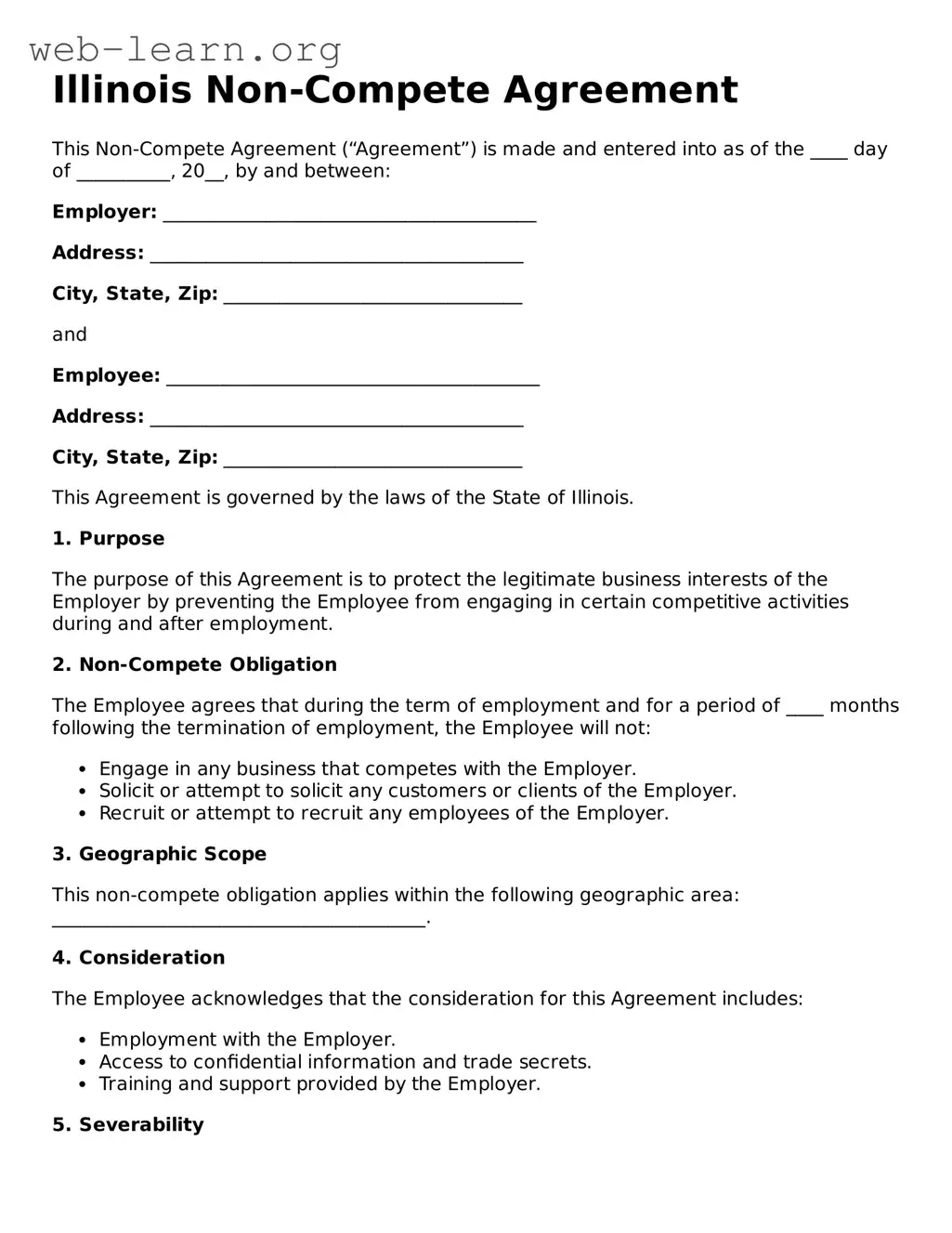
Illinois Non-Compete Agreement
This Non-Compete Agreement (“Agreement”) is made and entered into as of the ____ day of __________, 20__, by and between:
Employer: ________________________________________
Address: ________________________________________
City, State, Zip: ________________________________
and
Employee: ________________________________________
Address: ________________________________________
City, State, Zip: ________________________________
This Agreement is governed by the laws of the State of Illinois.
1. Purpose
The purpose of this Agreement is to protect the legitimate business interests of the Employer by preventing the Employee from engaging in certain competitive activities during and after employment.
2. Non-Compete Obligation
The Employee agrees that during the term of employment and for a period of ____ months following the termination of employment, the Employee will not:
3. Geographic Scope
This non-compete obligation applies within the following geographic area: ________________________________________.
4. Consideration
The Employee acknowledges that the consideration for this Agreement includes:
5. Severability
If any provision of this Agreement is found to be unenforceable, the remaining provisions will continue to be valid and enforceable.
6. Governing Law
This Agreement shall be governed by and construed in accordance with the laws of the State of Illinois.
7. Entire Agreement
This Agreement constitutes the entire understanding between the parties regarding the subject matter herein and supersedes all prior agreements and understandings.
IN WITNESS WHEREOF, the parties have executed this Non-Compete Agreement as of the date first above written.
Employer Signature: ___________________________
Date: ______________________________________
Employee Signature: __________________________
Date: ______________________________________
| Fact Name | Description |
|---|---|
| Governing Law | The Illinois Non-compete Agreement is governed by Illinois law, specifically the Illinois Freedom to Work Act. |
| Enforceability | Non-compete agreements are enforceable in Illinois if they are reasonable in duration, geographic scope, and the specific activities they restrict. |
| Consideration Requirement | For a non-compete agreement to be valid, there must be adequate consideration, such as employment or promotion. |
| Duration Limits | Generally, non-compete agreements should not exceed two years in duration for them to be considered reasonable. |
| Geographic Scope | The geographic area restricted by the agreement must be reasonable and directly related to the business interests of the employer. |
| Employee Protections | Illinois law prohibits non-compete agreements for low-wage employees, defined as those earning less than $75,000 annually. |
| Judicial Review | Illinois courts will review non-compete agreements to ensure they do not impose undue hardship on the employee or harm the public interest. |
Completing the Illinois Non-compete Agreement form requires careful attention to detail. After filling out the form, it will need to be signed by both parties involved. This ensures that everyone understands and agrees to the terms laid out in the document.
What is a Non-compete Agreement?
A Non-compete Agreement is a legal contract between an employer and an employee. It restricts the employee from engaging in certain competitive activities after leaving the company. Typically, this means the employee cannot work for a competitor or start a similar business within a specified geographic area and time frame.
Why would an employer require a Non-compete Agreement?
Employers often use Non-compete Agreements to protect their business interests. These agreements help safeguard sensitive information, trade secrets, and client relationships. By preventing employees from joining competitors or starting similar ventures, businesses aim to maintain their competitive edge in the market.
Are Non-compete Agreements enforceable in Illinois?
Yes, Non-compete Agreements can be enforceable in Illinois, but specific criteria must be met. The agreement must be reasonable in duration, geographic scope, and must protect legitimate business interests. Courts in Illinois evaluate these factors carefully, ensuring that the agreement does not impose an undue hardship on the employee.
What are the key elements of a valid Non-compete Agreement in Illinois?
Each element plays a crucial role in determining the enforceability of the agreement. If any part is deemed unreasonable, the entire agreement may be invalidated.
How long can a Non-compete Agreement last?
The duration of a Non-compete Agreement in Illinois should be reasonable. While there is no strict rule, most courts consider a duration of six months to two years as acceptable. However, the length may vary based on the nature of the business and the employee's role. It’s important to tailor the duration to the specific circumstances of the agreement.
Can I negotiate the terms of a Non-compete Agreement?
Yes, you can negotiate the terms of a Non-compete Agreement. If you feel that the restrictions are too broad or unreasonable, it is advisable to discuss your concerns with your employer before signing. Open communication can lead to a more balanced agreement that protects both parties' interests.
When completing the Illinois Non-compete Agreement form, individuals often overlook important details. One common mistake is failing to include accurate information about the parties involved. It's crucial to ensure that the names and addresses of both the employer and the employee are correct. Errors in this section can lead to complications later on.
Another frequent error is not specifying the duration of the non-compete clause. The agreement should clearly state how long the restrictions will be in effect. Without this information, the enforceability of the agreement may be questioned.
People sometimes forget to define the geographic area covered by the non-compete. It's essential to outline the specific regions where the restrictions apply. Vague language can create confusion and weaken the agreement.
Additionally, some individuals neglect to include the consideration, or the benefit received in exchange for signing the agreement. This could be a job offer, a promotion, or other incentives. Without this, the agreement may not hold up in court.
Another mistake is using overly broad language. Non-compete agreements should be reasonable in scope. If the terms are too restrictive, they may not be enforceable. It's important to balance the interests of the employer with the rights of the employee.
People often fail to review the agreement thoroughly before signing. Skimming through the document can lead to misunderstandings about the obligations involved. Taking the time to read and understand the terms is essential.
Some individuals do not seek legal advice when filling out the form. Consulting with a lawyer can provide clarity on the implications of the agreement. This step can help avoid potential pitfalls down the line.
Lastly, many overlook the importance of keeping a copy of the signed agreement. Having a record of the terms can be beneficial for future reference. It ensures that both parties are aware of their rights and responsibilities.
The Illinois Non-compete Agreement is a critical document for employers seeking to protect their business interests. However, several other forms and documents often accompany this agreement to ensure clarity and enforceability. Below is a list of these documents, each playing a vital role in the contractual process.
These documents work together with the Illinois Non-compete Agreement to create a comprehensive legal framework that protects both the employer's interests and the employee's rights. Understanding each of these forms is essential for anyone involved in the employment process.
A Non-compete Agreement is a legal document that restricts an individual from engaging in certain activities that could compete with their employer after leaving the job. Here are eight other documents that share similarities with a Non-compete Agreement:
When filling out the Illinois Non-compete Agreement form, it’s important to be careful and thorough. Here’s a list of things you should and shouldn’t do:
Many people have misunderstandings about the Illinois Non-compete Agreement form. Here are seven common misconceptions:
This is not true. In Illinois, non-compete agreements must meet certain criteria to be enforceable. They need to be reasonable in scope, duration, and geographic area.
Not every employee is required to sign a non-compete agreement. Typically, these agreements are reserved for employees who have access to sensitive information or trade secrets.
These are different types of agreements. A non-compete agreement restricts an employee from working for competitors after leaving a job, while a non-disclosure agreement protects confidential information.
This is misleading. Non-compete agreements can be challenged in court, and their enforceability can depend on various factors, including changes in the employee's role or circumstances.
While executives often sign these agreements, non-compete clauses can apply to employees at various levels, especially if they have access to important business information.
This is incorrect. Non-compete agreements usually specify a limited time frame and geographic area where the restrictions apply. After this period, employees can return to their field.
This is a misconception. In Illinois, there must be consideration, or something of value exchanged, for the agreement to be valid. This could be a job offer or a promotion.
When considering the Illinois Non-compete Agreement form, it's important to keep several key points in mind. These takeaways will help ensure that the agreement is effective and compliant with state laws.
By keeping these takeaways in mind, you can create a non-compete agreement that is fair, enforceable, and beneficial for both parties involved.
Are Non Competes Enforceable in Louisiana - Non-compete Agreements are common in industries with sensitive information, such as technology and finance.
How to Beat a Non Compete in New Jersey - This agreement typically specifies the duration of the non-compete period, which can vary by industry and role.