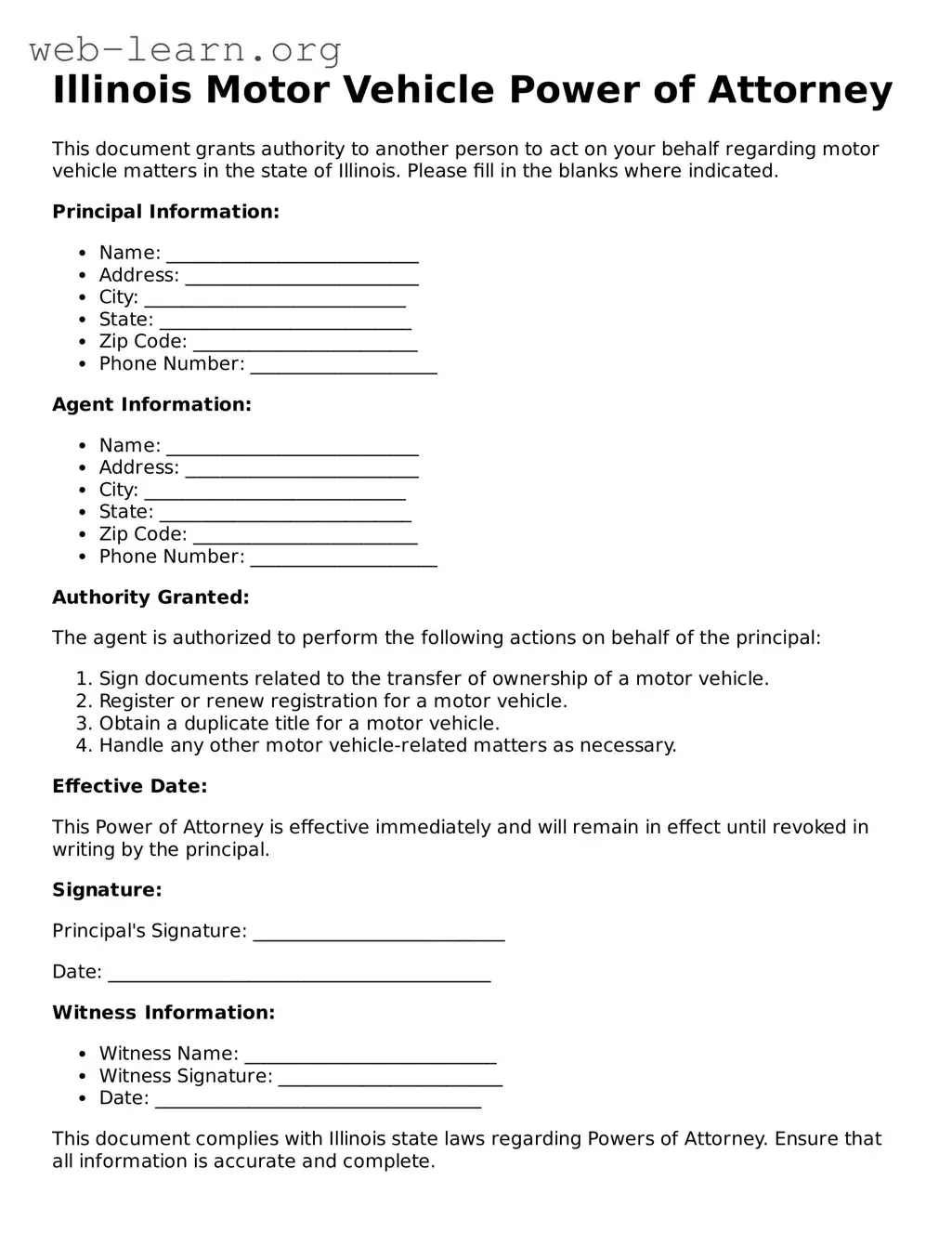
The Illinois Motor Vehicle Power of Attorney form serves as a crucial tool for individuals who need to delegate authority regarding their vehicle-related matters. This form allows one person, known as the principal, to appoint another person, called the agent, to handle various tasks associated with motor vehicles. These tasks may include signing documents for vehicle registration, title transfers, and other transactions with the Illinois Secretary of State. It’s important to note that this power of attorney is specifically tailored for motor vehicles, ensuring that the agent can act in the best interests of the principal when it comes to their vehicle. Additionally, the form requires specific information, such as the names and addresses of both the principal and the agent, as well as details about the vehicle in question. By utilizing this form, individuals can simplify processes that may otherwise be time-consuming or complicated, especially in situations where the principal is unable to be present to manage their vehicle affairs. Understanding the nuances of this form can help ensure that all necessary actions are taken efficiently and legally.
Illinois Motor Vehicle Power of Attorney
This document grants authority to another person to act on your behalf regarding motor vehicle matters in the state of Illinois. Please fill in the blanks where indicated.
Principal Information:
Agent Information:
Authority Granted:
The agent is authorized to perform the following actions on behalf of the principal:
Effective Date:
This Power of Attorney is effective immediately and will remain in effect until revoked in writing by the principal.
Signature:
Principal's Signature: ___________________________
Date: _________________________________________
Witness Information:
This document complies with Illinois state laws regarding Powers of Attorney. Ensure that all information is accurate and complete.
| Fact Name | Description |
|---|---|
| Purpose | The Illinois Motor Vehicle Power of Attorney form allows an individual to designate someone else to act on their behalf regarding vehicle-related matters. |
| Governing Law | This form is governed by the Illinois Vehicle Code, specifically 625 ILCS 5/3-401. |
| Eligibility | Any individual who owns a motor vehicle in Illinois can complete this form to grant power of attorney. |
| Signature Requirement | The form must be signed by the principal (the person granting authority) in the presence of a notary public. |
| Revocation | The principal can revoke the power of attorney at any time by providing written notice to the agent. |
| Agent Responsibilities | The agent must act in the best interest of the principal and handle vehicle matters responsibly. |
| Use Cases | This form can be used for tasks like transferring vehicle titles, registering vehicles, and dealing with the Secretary of State. |
| Duration | The power of attorney remains in effect until revoked by the principal or until the principal's death. |
After obtaining the Illinois Motor Vehicle Power of Attorney form, it is important to carefully fill it out to ensure all necessary information is provided. Follow these steps to complete the form accurately.
What is the Illinois Motor Vehicle Power of Attorney form?
The Illinois Motor Vehicle Power of Attorney form is a legal document that allows you to designate someone else to act on your behalf regarding your motor vehicle. This includes tasks such as transferring ownership, registering a vehicle, or handling any related matters with the Illinois Secretary of State.
Who can be designated as an agent?
You can choose any individual as your agent, as long as they are at least 18 years old and capable of understanding the responsibilities involved. This can be a family member, friend, or even a professional, such as an attorney or a licensed dealer.
How do I complete the form?
To complete the form, follow these steps:
Is notarization required?
Yes, the Illinois Motor Vehicle Power of Attorney form must be notarized. This ensures that the document is legally binding and that you are signing it voluntarily. A notary public will verify your identity and witness your signature.
How long is the Power of Attorney valid?
The Power of Attorney remains valid until you revoke it or until the specific tasks you authorized are completed. If you decide to revoke it, you must notify your agent and any relevant authorities in writing.
Where do I submit the form?
After completing and notarizing the form, you should keep a copy for your records. Submit the original form to the Illinois Secretary of State when you need to carry out the actions specified in the Power of Attorney, such as transferring ownership of a vehicle.
Filling out the Illinois Motor Vehicle Power of Attorney form can be straightforward, but many people make common mistakes that can lead to complications. One frequent error is failing to provide complete information. It’s essential to include all required details about both the principal and the agent. Missing names, addresses, or signatures can render the document invalid.
Another mistake involves not specifying the powers granted to the agent. Some individuals assume that the general language in the form covers everything, but it’s better to clearly outline what the agent can do. This clarity helps prevent misunderstandings later on.
People often overlook the importance of signing and dating the form correctly. The principal must sign the document, and it should be dated appropriately. If the date is missing or incorrect, it could cause issues when the agent attempts to use the power of attorney.
Additionally, many individuals do not have the form notarized when required. Notarization adds an extra layer of authenticity to the document. Without it, some institutions may refuse to accept the power of attorney, leading to unnecessary delays.
Another common error is failing to provide a copy of the completed form to the agent. The agent needs to have a copy on hand to act on behalf of the principal. If the agent doesn’t have access to the document, they may face challenges when trying to perform their duties.
Some people forget to review the form for accuracy before submitting it. Simple typos or incorrect information can lead to significant problems. Taking the time to double-check all entries ensures that everything is correct.
Moreover, individuals sometimes neglect to consider the timing of the document. It’s important to fill out the power of attorney when you are in good health and capable of making decisions. Waiting until a crisis occurs can lead to rushed decisions and errors.
Lastly, many do not understand that the power of attorney can be revoked. People often assume that once it’s signed, it’s permanent. However, if circumstances change, the principal can revoke the power of attorney at any time, provided they are still competent to do so.
When handling vehicle-related matters in Illinois, the Motor Vehicle Power of Attorney form is often accompanied by several other important documents. These forms help ensure that all aspects of vehicle ownership and transfer are properly managed. Below is a list of commonly used documents that may be necessary alongside the Power of Attorney.
Having these documents ready can streamline the process of managing vehicle transactions in Illinois. Each form plays a critical role in ensuring that all legal requirements are met, making the transfer of ownership as smooth as possible.
When filling out the Illinois Motor Vehicle Power of Attorney form, it is essential to approach the task with care. Here are some important dos and don'ts to consider:
Many people have misunderstandings about the Illinois Motor Vehicle Power of Attorney form. Clearing up these misconceptions can help individuals use the form correctly and effectively. Here are five common misconceptions:
While the form is often associated with transactions like buying or selling, it can also be used for other purposes. This includes registering a vehicle, obtaining a title, or even transferring ownership in certain situations.
This is not true. Anyone can complete the Illinois Motor Vehicle Power of Attorney form. However, it’s important to ensure that all information is accurate to avoid complications later.
In fact, you can revoke the Power of Attorney at any time. To do this, you must notify the person you appointed and, ideally, complete a revocation form.
The Illinois Motor Vehicle Power of Attorney does not have an expiration date unless specified. It remains valid until revoked or until the purpose for which it was created is fulfilled.
Notarization is not a requirement for the form to be valid in Illinois. However, having it notarized can add an extra layer of protection and authenticity.
Understanding these points can help individuals navigate the process of using the Illinois Motor Vehicle Power of Attorney more effectively.
Filling out and using the Illinois Motor Vehicle Power of Attorney form is a straightforward process, but there are several important points to keep in mind.
Kansas Vehicle Power of Attorney - With this form, you can designate an agent to handle the sale or purchase of a vehicle on your behalf.
How to Get Power of Attorney in Arizona - A Motor Vehicle Power of Attorney can also be used to authorize someone to manage vehicle-related insurance matters.