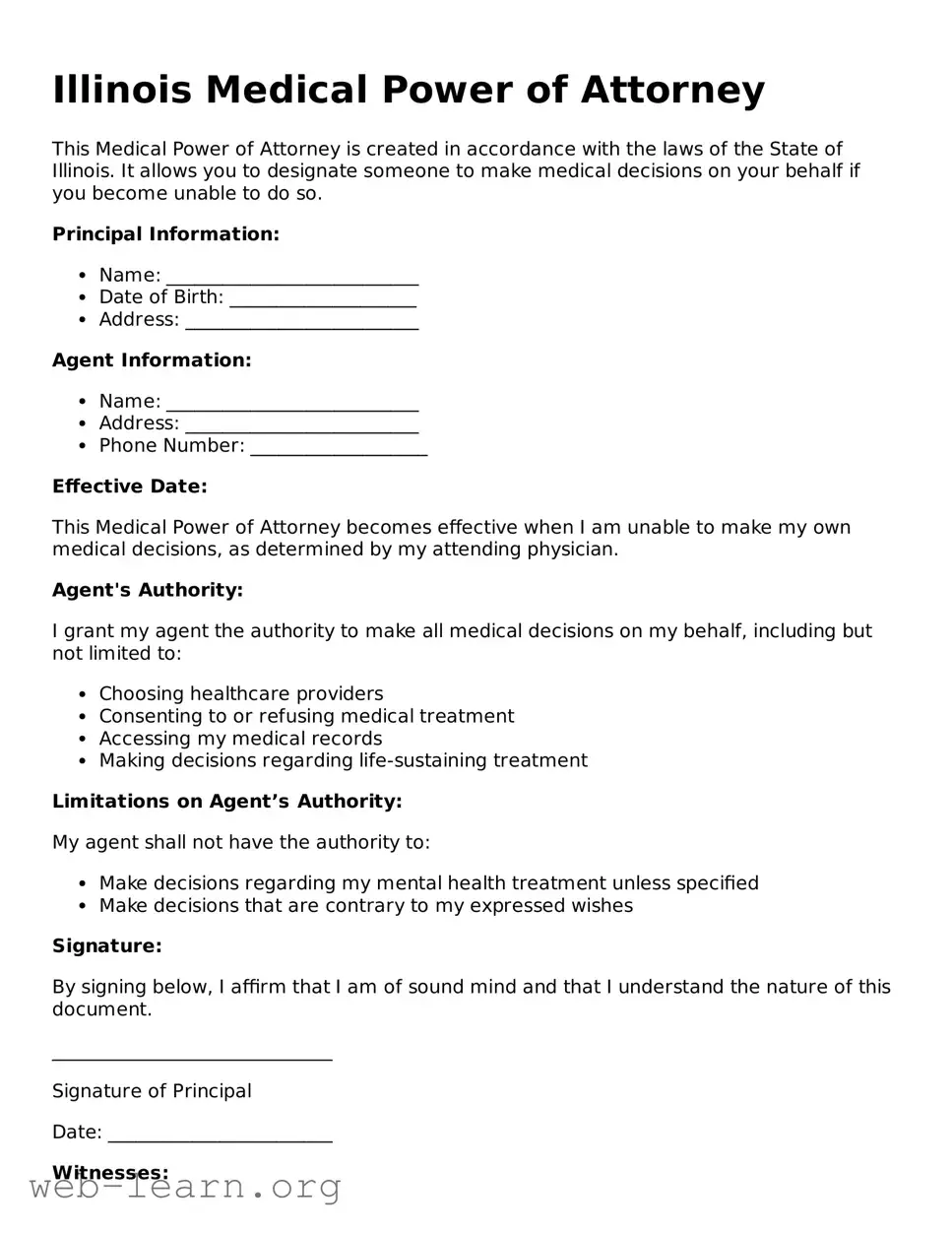
The Illinois Medical Power of Attorney form is a crucial legal document that empowers individuals to make healthcare decisions on behalf of another person when that person is unable to do so. This form allows you to designate a trusted agent—often a family member or close friend—who will have the authority to make medical decisions based on your wishes. It is essential to ensure that your healthcare preferences are honored, especially in emergencies or situations where you cannot communicate. The form requires specific information, including the name of the principal, the agent, and any alternate agents, along with clear instructions regarding the types of medical treatments you would or would not want. Additionally, it is important to note that the Illinois Medical Power of Attorney must be signed in the presence of a witness or a notary public to be legally binding. Understanding the nuances of this form can help safeguard your health care rights and ensure that your values are respected during critical times.
Illinois Medical Power of Attorney
This Medical Power of Attorney is created in accordance with the laws of the State of Illinois. It allows you to designate someone to make medical decisions on your behalf if you become unable to do so.
Principal Information:
Agent Information:
Effective Date:
This Medical Power of Attorney becomes effective when I am unable to make my own medical decisions, as determined by my attending physician.
Agent's Authority:
I grant my agent the authority to make all medical decisions on my behalf, including but not limited to:
Limitations on Agent’s Authority:
My agent shall not have the authority to:
Signature:
By signing below, I affirm that I am of sound mind and that I understand the nature of this document.
______________________________
Signature of Principal
Date: ________________________
Witnesses:
This document must be signed in the presence of two witnesses who are not related to me or my agent.
Witness 1: ______________________
Signature: ______________________
Date: __________________________
Witness 2: ______________________
Signature: ______________________
Date: __________________________
| Fact Name | Description |
|---|---|
| Definition | The Illinois Medical Power of Attorney form allows individuals to appoint someone to make healthcare decisions on their behalf if they become unable to do so. |
| Governing Law | This form is governed by the Illinois Power of Attorney Act (755 ILCS 45/1-1 et seq.). |
| Eligibility | Any adult who is at least 18 years old and of sound mind can complete this form. |
| Signature Requirement | The form must be signed by the principal (the person granting authority) and witnessed by two adults or notarized. |
| Revocation | The principal can revoke the Medical Power of Attorney at any time, as long as they are competent. |
| Durability | This power of attorney remains effective even if the principal becomes incapacitated. |
| Healthcare Decisions | The appointed agent can make a wide range of healthcare decisions, including treatment options and end-of-life care. |
Completing the Illinois Medical Power of Attorney form is a crucial step in ensuring that your healthcare preferences are respected. This process involves carefully filling out the form to designate an individual who will make medical decisions on your behalf in the event that you become unable to do so. Below are the steps to effectively complete this form.
A Medical Power of Attorney is a legal document that allows you to appoint someone to make medical decisions on your behalf if you become unable to do so. This person, known as your agent or attorney-in-fact, will have the authority to make healthcare choices based on your preferences and best interests.
Your agent can be anyone you trust to make medical decisions for you. This can include family members, friends, or even a trusted advisor. However, certain individuals, such as your healthcare provider or an employee of your healthcare facility, cannot serve as your agent.
To create a Medical Power of Attorney in Illinois, you need to complete a specific form that meets state requirements. You must sign the document in the presence of a witness or a notary public. Ensure that the form clearly states your wishes regarding medical treatment.
Yes, you can change or revoke your Medical Power of Attorney at any time as long as you are mentally competent. To revoke it, simply create a new document stating that the previous one is no longer valid, or destroy the original document.
If you do not have a Medical Power of Attorney and become incapacitated, medical decisions will be made by healthcare providers or a court-appointed guardian. This may not align with your personal wishes, making it crucial to have a designated agent.
Yes, your agent can only make decisions that you have authorized. This may include choices about medical treatment, procedures, and end-of-life care. However, your agent cannot make decisions that contradict your expressed wishes or beliefs.
While it is not required, providing your agent with specific instructions can be very helpful. Discuss your values and preferences regarding medical treatment. This will guide them in making decisions that reflect your wishes.
A Medical Power of Attorney created in Illinois is generally valid in other states, but laws can vary. It’s advisable to check the requirements of your new state or consider executing a new document that complies with local laws.
Yes, you can have both. A Medical Power of Attorney appoints someone to make decisions for you, while a Living Will outlines your wishes regarding medical treatment in situations where you cannot communicate. Together, they provide comprehensive guidance for your healthcare.
Filling out the Illinois Medical Power of Attorney form can be a straightforward process, but many people make common mistakes that can lead to confusion or even legal issues. One frequent error is not choosing the right agent. Your agent should be someone you trust completely to make medical decisions on your behalf. If you select someone who doesn’t understand your wishes or is not comfortable making those choices, it can create problems later.
Another mistake is failing to discuss your wishes with your chosen agent. It’s essential to have a conversation about your healthcare preferences. If your agent is unaware of your desires, they might make decisions that don’t align with your values.
Some individuals forget to sign and date the form. A signature is crucial for the document to be valid. Without it, the form may not hold up when needed. Additionally, it’s important to have witnesses present when you sign the form. If the document lacks the required witness signatures, it could be challenged in the future.
People often overlook the importance of updating the form. Life changes, such as marriage, divorce, or the death of a chosen agent, can affect your medical decisions. Regularly reviewing and updating your Medical Power of Attorney ensures it reflects your current wishes.
Another common mistake is using outdated forms. Laws and regulations can change, so always use the most current version of the Illinois Medical Power of Attorney form. Using an old version may result in invalidation of your document.
Some individuals neglect to consider alternate agents. If your primary agent is unavailable or unable to act, having a backup is crucial. This ensures that someone can step in and make decisions on your behalf when needed.
Another mistake is not specifying the powers granted to the agent. While the form generally provides broad authority, you may want to limit or specify certain powers. Clearly stating your preferences can prevent misunderstandings.
People sometimes forget to provide copies of the completed form to their healthcare providers and family members. Sharing the document ensures that everyone involved knows your wishes and can act accordingly in an emergency.
Lastly, some individuals may not realize the importance of legal advice. While the form is designed to be user-friendly, consulting with a legal professional can help clarify any uncertainties and ensure that your document meets all legal requirements.
The Illinois Medical Power of Attorney form is an essential document that allows individuals to designate someone to make medical decisions on their behalf if they become unable to do so. Alongside this form, several other documents can enhance an individual's healthcare planning and ensure that their wishes are respected. Below is a list of commonly used forms that complement the Illinois Medical Power of Attorney.
Using these documents in conjunction with the Illinois Medical Power of Attorney can provide a comprehensive approach to healthcare planning. They help ensure that personal preferences are respected and that trusted individuals are empowered to make decisions when needed.
The Medical Power of Attorney form shares similarities with several other legal documents. Here are six documents that are comparable:
When filling out the Illinois Medical Power of Attorney form, it is crucial to follow specific guidelines to ensure that the document is valid and reflects your wishes. Below is a list of things you should and shouldn't do.
By following these guidelines, you can create a Medical Power of Attorney that accurately reflects your healthcare preferences and ensures your wishes are honored.
Understanding the Illinois Medical Power of Attorney form is crucial for individuals looking to make decisions about their healthcare in advance. However, several misconceptions exist regarding this important document. Below is a list of nine common misconceptions, along with clarifications.
While both documents relate to healthcare decisions, a Medical Power of Attorney specifically designates someone to make decisions on your behalf, whereas a living will outlines your wishes regarding medical treatment in specific situations.
Anyone over the age of 18 can benefit from having a Medical Power of Attorney, as unexpected health issues can arise at any age.
Individuals can revoke or update their Medical Power of Attorney at any time, provided they follow the proper procedures.
Without a Medical Power of Attorney, a spouse does not automatically have the legal authority to make healthcare decisions on behalf of their partner.
In Illinois, the Medical Power of Attorney can be set to take effect immediately or only when you are unable to make decisions for yourself, depending on your preferences.
While it is common to appoint one agent, individuals can designate multiple agents and specify how decisions should be made if they disagree.
Healthcare providers are required to follow the directives outlined in the Medical Power of Attorney, but they may also consider other factors, such as medical standards and ethics.
Open communication with your chosen agent is essential. Discussing your values and preferences ensures that they can make informed decisions on your behalf.
The Medical Power of Attorney remains valid until it is revoked or until the principal passes away, so regular reviews are advisable to ensure it still reflects your wishes.
Filling out and using the Illinois Medical Power of Attorney form is an important step in ensuring your healthcare decisions are respected. Here are some key takeaways to consider:
By taking these steps, you can ensure that your medical preferences are honored, even when you cannot voice them yourself.