Creating a Last Will and Testament is a crucial step in ensuring that your wishes are honored after your passing. In Illinois, this form serves as a legal document that outlines how your assets will be distributed and who will be responsible for managing your estate. It addresses key components such as the appointment of an executor, who will carry out your directives, and the designation of beneficiaries, those individuals or organizations who will receive your property. Additionally, the form allows you to specify guardians for any minor children, ensuring their care is entrusted to someone you trust. It is essential to understand that a properly executed will must meet certain requirements, including being signed in the presence of witnesses. This document not only reflects your personal intentions but also provides clarity and reduces potential disputes among heirs. By taking the time to complete an Illinois Last Will and Testament, you can provide peace of mind for yourself and your loved ones during a difficult time.
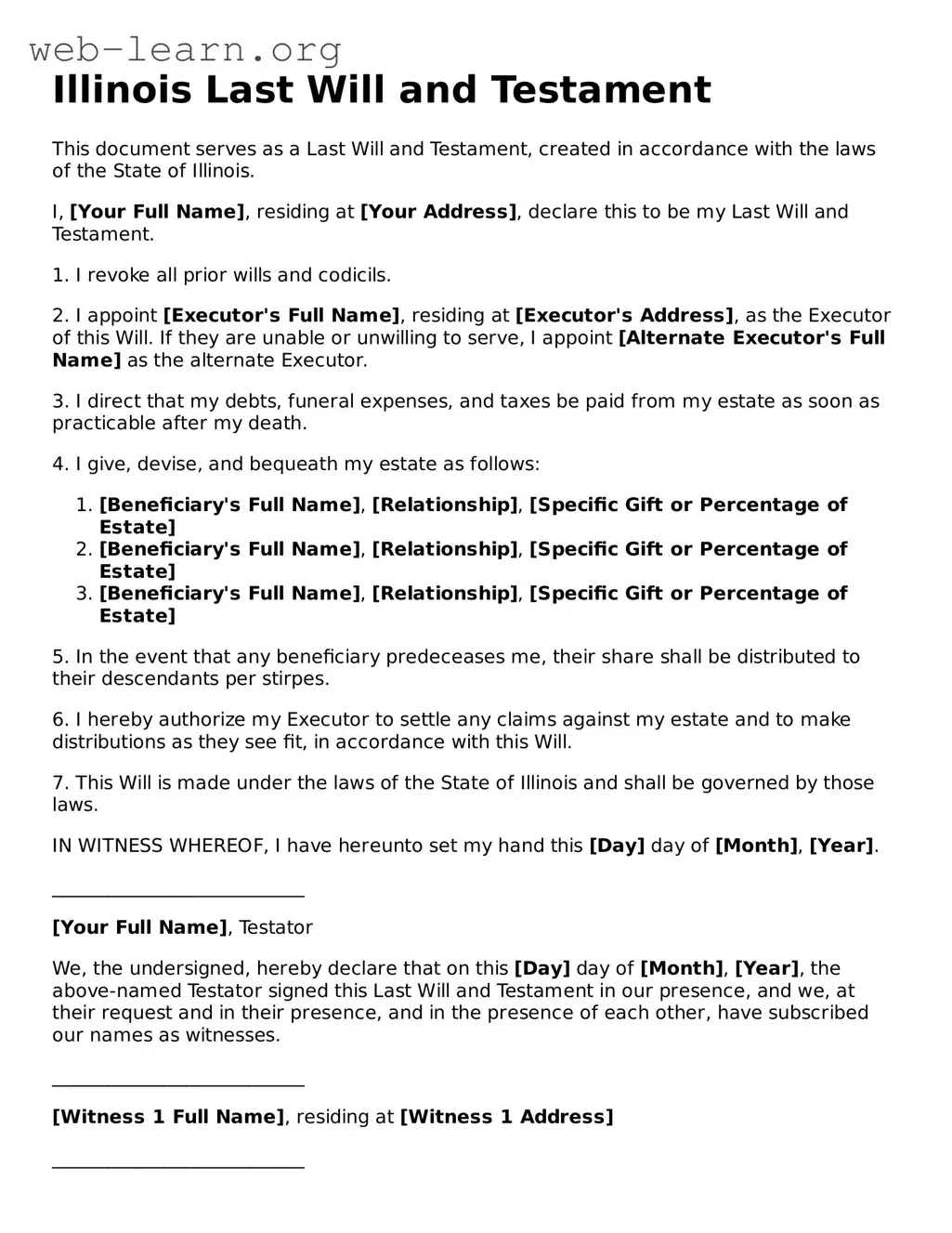
Illinois Last Will and Testament
This document serves as a Last Will and Testament, created in accordance with the laws of the State of Illinois.
I, [Your Full Name], residing at [Your Address], declare this to be my Last Will and Testament.
1. I revoke all prior wills and codicils.
2. I appoint [Executor's Full Name], residing at [Executor's Address], as the Executor of this Will. If they are unable or unwilling to serve, I appoint [Alternate Executor's Full Name] as the alternate Executor.
3. I direct that my debts, funeral expenses, and taxes be paid from my estate as soon as practicable after my death.
4. I give, devise, and bequeath my estate as follows:
5. In the event that any beneficiary predeceases me, their share shall be distributed to their descendants per stirpes.
6. I hereby authorize my Executor to settle any claims against my estate and to make distributions as they see fit, in accordance with this Will.
7. This Will is made under the laws of the State of Illinois and shall be governed by those laws.
IN WITNESS WHEREOF, I have hereunto set my hand this [Day] day of [Month], [Year].
___________________________
[Your Full Name], Testator
We, the undersigned, hereby declare that on this [Day] day of [Month], [Year], the above-named Testator signed this Last Will and Testament in our presence, and we, at their request and in their presence, and in the presence of each other, have subscribed our names as witnesses.
___________________________
[Witness 1 Full Name], residing at [Witness 1 Address]
___________________________
[Witness 2 Full Name], residing at [Witness 2 Address]
| Fact Name | Description |
|---|---|
| Legal Age Requirement | In Illinois, individuals must be at least 18 years old to create a valid Last Will and Testament. |
| Witness Requirement | The will must be signed by at least two witnesses who are present at the same time. |
| Revocation of Previous Wills | Creating a new will automatically revokes any prior wills unless stated otherwise in the new document. |
| Self-Proving Will | Illinois allows for a self-proving will, which simplifies the probate process by including notarized witness signatures. |
| Governing Law | The Illinois Probate Act governs the creation and execution of Last Wills and Testaments in the state. |
Filling out the Illinois Last Will and Testament form is an important step in ensuring that your wishes regarding your estate are honored after your passing. This document allows you to specify how you would like your assets distributed, who will manage your estate, and other personal directives. Understanding the process can help you create a clear and effective will.
A Last Will and Testament is a legal document that outlines how a person’s assets and affairs should be handled after their death. In Illinois, this document allows you to specify beneficiaries, appoint an executor, and make decisions regarding guardianship for minor children. It serves as a clear guide for your loved ones and helps ensure that your wishes are honored.
While it’s not legally required to have a lawyer, consulting one is highly recommended. A lawyer can help ensure that your will meets all legal requirements and accurately reflects your wishes. However, you can also create a will using templates or online services, provided you follow Illinois laws, such as signing the document in front of two witnesses.
If you pass away without a will, your estate will be distributed according to Illinois intestacy laws. This means your assets will be divided among your heirs based on a predetermined formula, which may not align with your wishes. To avoid this, it’s best to have a will in place that clearly outlines your intentions.
Yes, you can change your will at any time while you are still alive and mentally competent. To make changes, you can either create a new will or add a codicil, which is an amendment to the existing will. Just remember that any changes must be properly signed and witnessed to be valid under Illinois law.
Creating a Last Will and Testament is a significant step in ensuring that your wishes are honored after you pass away. However, many individuals make common mistakes when filling out the Illinois form. Recognizing these pitfalls can help ensure that your will is valid and reflects your intentions.
One frequent error occurs when individuals forget to include all of their assets. It’s essential to list everything, from real estate and bank accounts to personal belongings. Omitting even a small asset can lead to confusion or disputes among heirs.
Another mistake is failing to designate an executor. The executor is responsible for carrying out the terms of the will. If you do not name someone, the court may appoint an administrator, which may not align with your wishes.
Many people also neglect to sign their will in the presence of witnesses. In Illinois, the law requires that the will be signed by the testator and at least two witnesses. If this step is skipped, the will may not be considered valid.
Moreover, some individuals may not update their wills after major life events, such as marriage, divorce, or the birth of children. A will should reflect your current situation and intentions. Failing to update it can lead to unintended distributions of your assets.
Another common oversight is using vague language. Ambiguity can create confusion and disputes among beneficiaries. Clear and specific language helps ensure that your wishes are understood and followed.
People sometimes forget to include alternate beneficiaries. Life is unpredictable, and it’s wise to have a backup plan in place. If a primary beneficiary passes away before you, having an alternate named ensures your assets are still distributed according to your wishes.
Additionally, some individuals may not consider the tax implications of their estate. Understanding how taxes can affect your heirs is crucial. Consulting with a financial advisor can provide valuable insights into this aspect.
Another mistake is not keeping the will in a safe but accessible location. If the will cannot be found after your passing, your wishes may not be honored. It’s essential to inform trusted family members or friends about where the will is stored.
Finally, some people may attempt to create a will without seeking legal advice, assuming they can handle it on their own. While DIY wills are possible, they often lack the necessary legal language or structure. Consulting with a professional can help ensure that your will is legally sound and meets all requirements.
When preparing a Last Will and Testament in Illinois, several other forms and documents may be necessary to ensure that your wishes are clearly articulated and legally binding. These documents can help clarify your intentions and facilitate the estate planning process.
Each of these documents serves a unique purpose in the estate planning process, helping to ensure that your wishes are respected and your loved ones are cared for. Consider discussing these options with a legal professional to tailor your estate plan to your specific needs.
When filling out the Illinois Last Will and Testament form, it’s important to approach the task with care. Here are some essential dos and don'ts to keep in mind:
When it comes to creating a Last Will and Testament in Illinois, several misconceptions can lead to confusion. Here are six common misunderstandings:
While notarization can add an extra layer of validation, it is not a requirement in Illinois. A will is valid as long as it is signed by the testator and witnessed by two individuals.
Everyone can benefit from having a will, regardless of their financial status. A will ensures that your wishes are carried out regarding your assets and guardianship of minor children.
In Illinois, handwritten wills, also known as holographic wills, can be valid if they meet certain criteria. They must be signed by the testator and the material provisions must be in the testator's handwriting.
This is a myth. A will can be amended or revoked at any time as long as the testator is of sound mind. It’s important to keep your will updated to reflect your current wishes.
While having an attorney can be helpful, it is not necessary to create a valid will. Many people use templates or online services to draft their own wills, as long as they adhere to Illinois laws.
A will can do more than just distribute assets. It can also name guardians for minor children and specify funeral arrangements, making it a comprehensive document for end-of-life planning.
When filling out and using the Illinois Last Will and Testament form, consider the following key takeaways:
Following these steps can help ensure that your wishes are clearly communicated and legally recognized.
Online Wills Oregon - Helps ensure that personal values and wishes are honored in the distribution process.
How to Make a Will in Arkansas - Can be updated as life circumstances change, such as marriage or divorce.
California Holographic Will - Ensures that wishes regarding personal belongings are clearly stated.
Colorado Diy Will - Can be a source of comfort for loved ones during a difficult time.