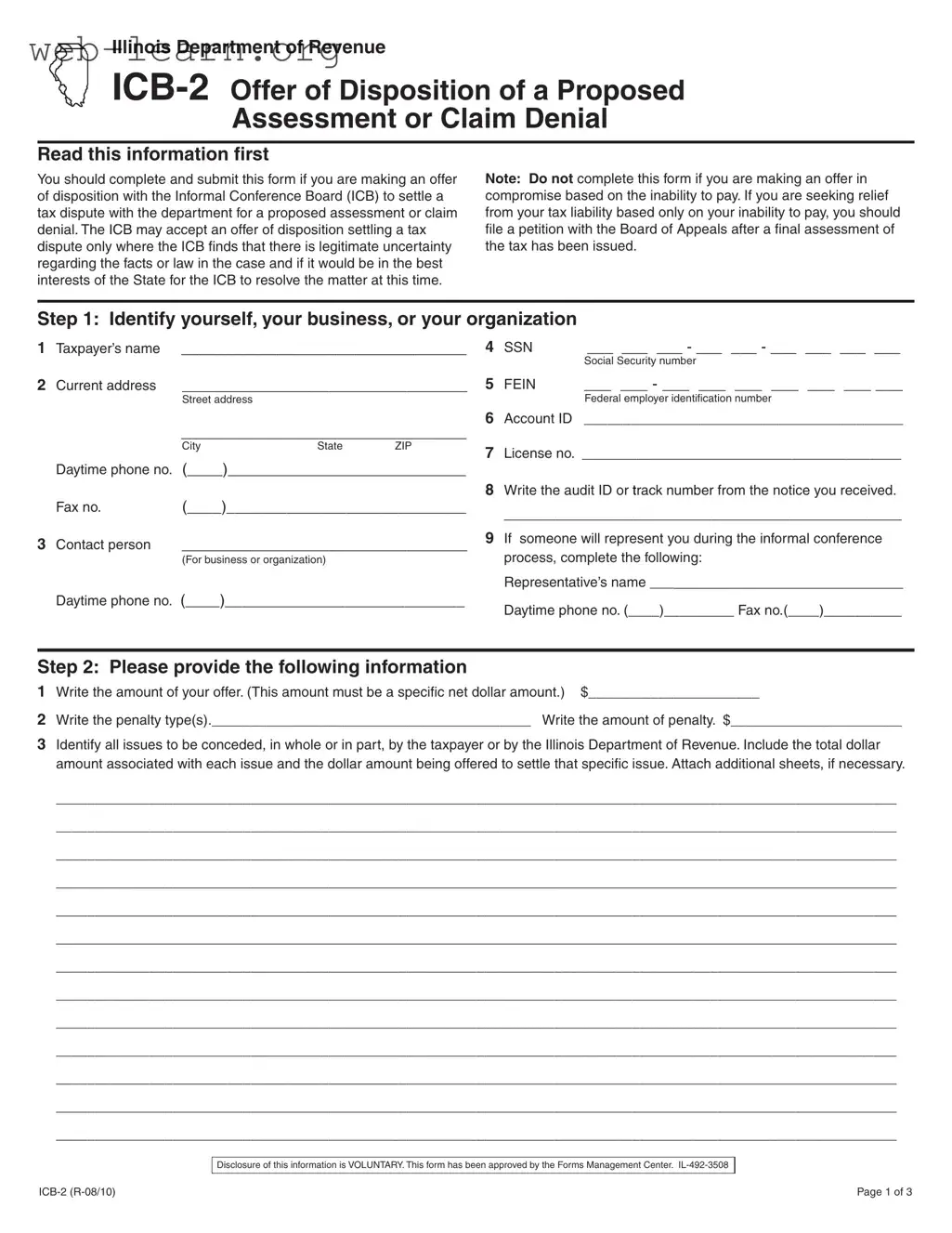
The Illinois ICB-2 form serves as a critical tool for taxpayers seeking to resolve disputes with the Illinois Department of Revenue regarding proposed assessments or claim denials. By submitting this form, individuals and businesses can present an offer of disposition to the Informal Conference Board (ICB), which may accept the offer if there is genuine uncertainty about the facts or legal interpretations involved. The form requires taxpayers to provide essential information, including their identification details, the amount they are offering to settle the dispute, and any penalties they wish to address. Additionally, it asks for a thorough explanation of why the ICB should accept the offer, including any relevant legal or factual justifications. Taxpayers must ensure that the form is properly signed, as a lack of signature will result in the ICB not considering the offer. It is important to note that this form is not applicable for those seeking to settle based solely on an inability to pay; such cases should be directed to the Board of Appeals after a final tax assessment. Understanding the nuances of the ICB-2 form is essential for effective navigation through the tax dispute resolution process in Illinois.

Illinois Department of Revenue
Read this information first
You should complete and submit this form if you are making an offer of disposition with the Informal Conference Board (ICB) to settle a tax dispute with the department for a proposed assessment or claim denial. The ICB may accept an offer of disposition settling a tax dispute only where the ICB finds that there is legitimate uncertainty regarding the facts or law in the case and if it would be in the best interests of the State for the ICB to resolve the matter at this time.
Note: Do not complete this form if you are making an offer in compromise based on the inability to pay. If you are seeking relief from your tax liability based only on your inability to pay, you should file a petition with the Board of Appeals after a final assessment of the tax has been issued.
Step 1: Identify yourself, your business, or your organization
1 |
Taxpayer’s name |
_________________________________ |
||
2 |
Current address |
_________________________________ |
||
|
|
Street address |
|
|
|
|
_________________________________ |
||
|
|
City |
State |
ZIP |
|
Daytime phone no. (____)___________________________ |
|||
|
Fax no. |
(____)____________________________ |
||
3 |
Contact person |
_________________________________ |
||
|
|
(For business or organization) |
|
|
4 SSN ___ ___ ___ - ___ ___ - ___ ___ ___ ___
Social Security number
5 FEIN ___ ___ - ___ ___ ___ ___ ___ ___ ___
Federal employer identification number
6Account ID _________________________________________
7License no. _________________________________________
8Write the audit ID or track number from the notice you received.
______________________________________________
9If someone will represent you during the informal conference process, complete the following:
Daytime phone no. (____)____________________________
Representative’s name _____________________________
Daytime phone no. (____)_________ Fax no.(____)__________
Step 2: Please provide the following information
1 Write the amount of your offer. (This amount must be a specific net dollar amount.) $______________________
2Write the penalty type(s)._________________________________________ Write the amount of penalty. $______________________
3Identify all issues to be conceded, in whole or in part, by the taxpayer or by the Illinois Department of Revenue. Include the total dollar amount associated with each issue and the dollar amount being offered to settle that specific issue. Attach additional sheets, if necessary.
____________________________________________________________________________________________________________
____________________________________________________________________________________________________________
____________________________________________________________________________________________________________
____________________________________________________________________________________________________________
____________________________________________________________________________________________________________
____________________________________________________________________________________________________________
____________________________________________________________________________________________________________
____________________________________________________________________________________________________________
____________________________________________________________________________________________________________
____________________________________________________________________________________________________________
____________________________________________________________________________________________________________
____________________________________________________________________________________________________________
____________________________________________________________________________________________________________
Disclosure of this information is VOLUNTARY. This form has been approved by the Forms Management Center.
Page 1 of 3 |

4Explain why the ICB should accept your offer of disposition. Please be as complete and thorough as possible in explaining your reasons. Include all factual and legal basis to support your position and offer of disposition. Attach additional sheets, if necessary.
____________________________________________________________________________________________________________
____________________________________________________________________________________________________________
____________________________________________________________________________________________________________
____________________________________________________________________________________________________________
____________________________________________________________________________________________________________
____________________________________________________________________________________________________________
____________________________________________________________________________________________________________
____________________________________________________________________________________________________________
____________________________________________________________________________________________________________
____________________________________________________________________________________________________________
____________________________________________________________________________________________________________
____________________________________________________________________________________________________________
____________________________________________________________________________________________________________
____________________________________________________________________________________________________________
____________________________________________________________________________________________________________
____________________________________________________________________________________________________________
____________________________________________________________________________________________________________
____________________________________________________________________________________________________________
____________________________________________________________________________________________________________
____________________________________________________________________________________________________________
____________________________________________________________________________________________________________
____________________________________________________________________________________________________________
____________________________________________________________________________________________________________
____________________________________________________________________________________________________________
Step 3: Taxpayer or taxpayer’s representative must sign below
If signing as a corporate officer, partner, fiduciary, or individual on behalf of the taxpayer, I certify that I have the authority to execute this request on behalf of the taxpayer.
__________________________________________________ _____/_____/_____ _________________________________________
Taxpayer’s signatureTitle, if applicable DatePrint taxpayer’s name (if corporation, print duly authorized officer’s name)
________________________________________________ |
_____/_____/____ |
|
|
Taxpayer’s representative’s signature* |
Title, if applicable |
Date |
|
*Representative must be duly authorized under valid power of attorney. |
|
||
If you are not submitting this disposition with Form |
Informal Conference Board |
||
|
|
|
Illinois Department of Revenue |
|
|
|
100 W. Randolph, |
|
|
|
Chicago, IL 60601 |
Page 2 of 3 |

Form
General Information
You should complete and submit Form
The ICB will consider an offer of disposition to settle a tax dispute only in those situations where the ICB determines that it is not in the best interests of the department to issue the assessment, or claim denial.
Your Form
Note: The statements you make in completing Form
Step 1: Identify yourself, your business, or your organization
Lines 1 and 2 — Write your name and address as it appears on your Notice of Proposed Deficiency, Notice of Proposed Liability, Notice of Proposed Claim Denial, or Notice of Proposed Liability and Claim Denial.
Line 3 — If you are a business or an organization, please write the name of the contact person and a daytime phone number.
Lines 4 through 8 — Write all identification numbers applicable to you.
Line 9 — Write the audit ID or track number that appears on the face of your Notice of Proposed Deficiency, Notice of Proposed Liability, Notice of Proposed Claim Denial, or Notice of Proposed Liability and Claim Denial.
Line 10 — If someone will represent you during the informal conference process, write the representative’s name, daytime phone number, and fax number on the lines provided.
Step 2: Please provide the following information
Line 1 — Write the amount you are offering to settle the tax dispute. This amount must be a specific net dollar amount.
Line 2 — If you are requesting the ICB to consider a waiver of penalty or penalties as part of your offer, write the penalty type(s) and the amount of penalty.
Line 3 — You must identify all issues you propose to be conceded by you or by the department as part of your offer. You also must identify the total dollar amount you were assessed on each of your issues and the specific dollar amount you are offering to settle each issue. If you need more space, you may attach additional sheets of paper.
Line 4 — You must provide an explanation of the reasons why the ICB should accept your offer. Please be as complete and thorough as possible in explaining your reason. Your explanation should include all case law, statutory, regulatory, or other legal bases which support your position that the proposed audit adjustment is incorrect and should be settled by the ICB. Any documentation supporting your rationale should be included and referenced in your explanation. If you need more space, you may attach additional sheets of paper.
Step 3: Taxpayer or taxpayer’s representative must sign below
Form
If you need additional assistance or information
If you need assistance in completing this form or have any questions, you may call the ICB at 312
For additional information about the ICB, please refer to 86 Ill. Adm. Code Part 215, Informal Conference Board. A copy of these regulations may be found by visiting our web site at
tax.illnois.gov.
Page 3 of 3 |
| Fact Name | Fact Description |
|---|---|
| Purpose | The ICB-2 form is used to make an offer of disposition to settle a tax dispute with the Illinois Department of Revenue. |
| Governing Law | This form operates under the Illinois Administrative Code, specifically 86 Ill. Adm. Code Part 215. |
| Submission Requirement | Taxpayers must submit the ICB-2 form if they are disputing a proposed assessment or claim denial. |
| Legitimate Uncertainty | The ICB may accept the offer only if there is legitimate uncertainty regarding the facts or law in the case. |
| Inability to Pay | This form should not be used if the taxpayer is seeking relief solely based on inability to pay. |
| Offer Amount | The taxpayer must specify a net dollar amount in the offer, which is essential for consideration. |
| Penalty Information | Taxpayers must provide details on any penalties being contested, including the type and amount. |
| Conceded Issues | All issues to be conceded by the taxpayer or the Department must be clearly identified, along with associated dollar amounts. |
| Explanation Requirement | A thorough explanation is required to justify why the ICB should accept the offer, including legal bases. |
| Signature Requirement | The form must be signed by the taxpayer or their authorized representative for it to be considered valid. |
After gathering the necessary information, individuals can proceed to complete the Illinois ICB-2 form. This form is essential for making an offer of disposition to settle a tax dispute with the Illinois Department of Revenue. Following the steps below will ensure accurate and complete submission.
Once the form is completed, it should be submitted to the Informal Conference Board at the specified address. This submission will initiate the review process by the ICB, which will notify you of their decision regarding your offer.
What is the purpose of the Illinois ICB-2 form?
The Illinois ICB-2 form is used to make an offer of disposition to the Informal Conference Board (ICB) to settle a tax dispute. This form is applicable when you are contesting a proposed assessment or a claim denial from the Illinois Department of Revenue. The ICB will consider your offer only if there is uncertainty regarding the facts or law in your case and if resolving the matter serves the best interests of the State.
Who should complete the ICB-2 form?
Individuals, businesses, or organizations facing a proposed assessment or claim denial should complete the ICB-2 form. It is essential that the form is filled out accurately to ensure proper processing. If someone else will represent you, their information must also be included.
When should I not use the ICB-2 form?
You should not use the ICB-2 form if your offer is based solely on your inability to pay. In such cases, it is advisable to file a petition with the Board of Appeals after receiving a final assessment of your tax liability.
What information is required on the ICB-2 form?
The form requires various details, including:
What happens after I submit the ICB-2 form?
Once you submit the ICB-2 form, the ICB will review your offer. They may accept, reject, or counter your offer. You will receive written notification regarding their decision.
Can my statements in the ICB-2 form be used against me later?
No, the statements you make while completing the ICB-2 form are considered part of good faith negotiations. Therefore, they cannot be used against you in any future proceedings related to the dispute.
What if I need assistance with the ICB-2 form?
If you require help completing the ICB-2 form or have questions, you can contact the ICB at 312-814-1722. They are available to provide guidance and answer your inquiries.
Is there a specific way to submit the ICB-2 form?
You can submit the ICB-2 form with your Form ICB-1, or send it directly to the Informal Conference Board at the address provided on the form. Ensure that it is properly signed and dated before submission.
What if I need more space to provide information on the ICB-2 form?
If you need additional space for any section of the form, you may attach extra sheets of paper. Make sure to reference any attachments clearly in your submission.
When filling out the Illinois ICB-2 form, many individuals make mistakes that can hinder their chances of successfully resolving a tax dispute. One common error is failing to provide complete and accurate identification information. The form requires specific details such as the taxpayer’s name, address, and identification numbers. Incomplete or incorrect information can lead to delays or even rejection of the offer.
Another mistake often seen is not clearly stating the amount of the offer. It’s essential to provide a specific net dollar amount that you are willing to settle for. Vague or ambiguous figures can create confusion and may result in the Informal Conference Board (ICB) rejecting the offer outright. Be precise and ensure that the amount aligns with the issues being conceded.
Additionally, many people neglect to thoroughly explain why their offer should be accepted. The form requires a detailed explanation that includes factual and legal bases supporting the position. A lack of detail can weaken your case, as the ICB needs to understand the rationale behind your offer. It's important to articulate your reasons clearly and back them up with any relevant documentation.
Finally, failing to properly sign and date the form is a mistake that can easily be overlooked. The ICB will not consider any offer that is not signed by the taxpayer or their authorized representative. Ensure that all necessary signatures are present, as this is a crucial step in the submission process. By avoiding these common pitfalls, you can enhance your chances of a favorable outcome in your tax dispute.
When navigating tax disputes in Illinois, several forms and documents complement the Illinois ICB-2 form. Each of these documents serves a unique purpose in the process of resolving tax-related issues. Understanding their roles can help you effectively manage your situation.
In summary, each of these forms and documents plays a vital role in addressing tax disputes in Illinois. By familiarizing yourself with them, you can better navigate the complexities of the tax resolution process and advocate effectively for your interests.
When filling out the Illinois ICB-2 form, it is important to follow specific guidelines to ensure your submission is complete and accurate. Below is a list of things you should and shouldn't do.
Understanding the Illinois ICB-2 form is crucial for taxpayers looking to settle tax disputes. However, several misconceptions can lead to confusion. Here are nine common misconceptions about the ICB-2 form:
Being aware of these misconceptions can help taxpayers navigate the process more effectively and increase the chances of a favorable outcome.
Here are some key takeaways about filling out and using the Illinois ICB-2 form:
Completing the ICB-2 form accurately and thoroughly can significantly impact the resolution of your tax dispute. Be sure to follow all instructions carefully.