In Illinois, families who choose to homeschool their children must navigate certain requirements to ensure compliance with state laws. One essential step in this process is the completion of the Homeschool Letter of Intent form. This form serves as a formal notification to the local school district of a family's intention to educate their child at home. It typically includes important information such as the names and ages of the children being homeschooled, as well as the address of the family. By submitting this letter, parents affirm their commitment to providing an educational experience tailored to their children's needs. Additionally, the form may outline the educational plan that families intend to follow, helping to clarify their approach to homeschooling. Understanding the significance of this document is crucial for parents embarking on this educational journey, as it lays the groundwork for a successful homeschooling experience while ensuring adherence to state regulations.
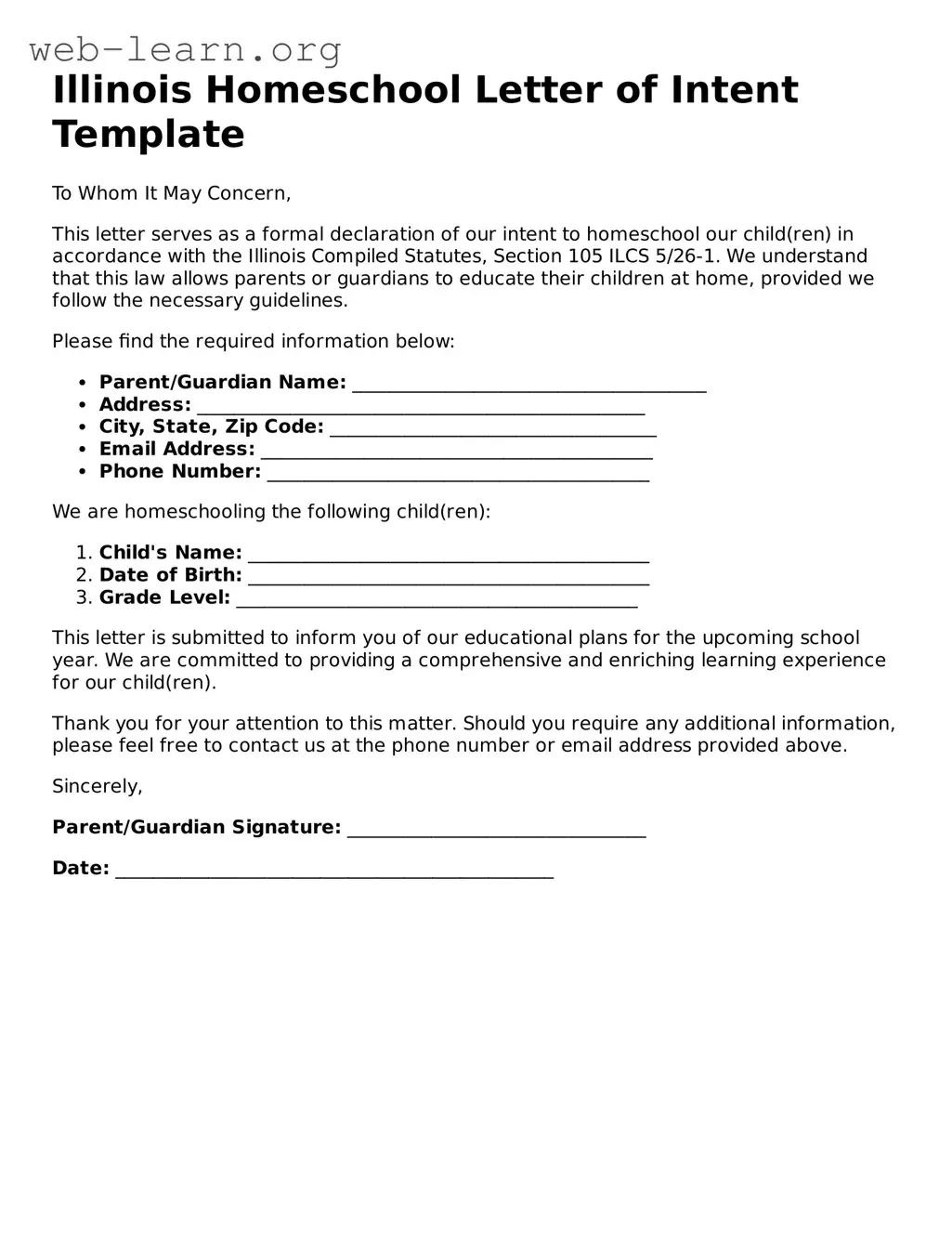
Illinois Homeschool Letter of Intent Template
To Whom It May Concern,
This letter serves as a formal declaration of our intent to homeschool our child(ren) in accordance with the Illinois Compiled Statutes, Section 105 ILCS 5/26-1. We understand that this law allows parents or guardians to educate their children at home, provided we follow the necessary guidelines.
Please find the required information below:
We are homeschooling the following child(ren):
This letter is submitted to inform you of our educational plans for the upcoming school year. We are committed to providing a comprehensive and enriching learning experience for our child(ren).
Thank you for your attention to this matter. Should you require any additional information, please feel free to contact us at the phone number or email address provided above.
Sincerely,
Parent/Guardian Signature: ________________________________
Date: _______________________________________________
| Fact Name | Details |
|---|---|
| Governing Law | The Illinois Homeschool Letter of Intent is governed by the Illinois Compulsory School Attendance Law (105 ILCS 5/26-1). |
| Purpose | This form notifies the local school district of your intent to homeschool your child. |
| Eligibility | Parents or guardians of children aged 6 to 17 can submit this form. |
| Submission Deadline | The form should be submitted at the beginning of the school year or when starting homeschooling. |
| Required Information | You must provide the child's name, address, and birthdate on the form. |
| Signature Requirement | The form must be signed by the parent or guardian who is homeschooling the child. |
| Record Keeping | Keep a copy of the submitted form for your records. |
| School District Notification | The school district will receive a copy of your Letter of Intent once submitted. |
| Updates | If your homeschooling situation changes, you should update the school district with a new form. |
After you complete the Illinois Homeschool Letter of Intent form, you will need to submit it to your local school district. This is an important step in ensuring that your homeschooling journey is recognized by the state. Below are the steps to help you fill out the form accurately.
Once you have filled out the form, ensure that you submit it to the appropriate school district office. This will help you stay compliant with state regulations regarding homeschooling.
The Illinois Homeschool Letter of Intent is a document that parents or guardians must submit to formally notify their local school district of their intention to homeschool their children. This letter serves as an official declaration that the parents are taking responsibility for the educational needs of their children outside of the traditional school system.
Any parent or guardian who wishes to homeschool their child in Illinois must submit the Letter of Intent. This requirement applies to children who are of compulsory school age, typically between the ages of 6 and 17. It is important to notify the local school district to avoid any misunderstandings regarding the child's educational status.
The Letter of Intent should be submitted at the beginning of the homeschooling period. Ideally, parents should send it before the start of the school year or as soon as they decide to withdraw their child from public or private school. This proactive approach helps ensure compliance with state laws and provides clear communication with the local school district.
The Letter of Intent typically includes the following information:
While there is no official form mandated by the state, it is essential that all relevant information is included to ensure clarity and compliance.
There is no prescribed format for the Letter of Intent in Illinois. Parents can create a simple letter that includes all necessary information. However, it is advisable to keep the letter clear and concise. Many families choose to use a template or sample letter available online to ensure they cover all required elements.
Once the Letter of Intent is submitted, the local school district will typically acknowledge receipt of the letter. They may not provide any further feedback unless there are concerns about compliance with homeschooling regulations. Parents should keep a copy of the letter for their records, as it serves as proof of their intent to homeschool.
In Illinois, after submitting the Letter of Intent, there are no formal follow-up requirements mandated by the state. However, parents are encouraged to maintain records of their educational activities and progress. Keeping documentation can be beneficial in case of inquiries from the school district or for personal reference.
When families decide to homeschool their children in Illinois, they must submit a Homeschool Letter of Intent to their local school district. However, several common mistakes can occur during this process, which may lead to unnecessary complications. One frequent error is failing to provide complete information. The form requires specific details, such as the names and ages of the children being homeschooled. Omitting any of this information can result in delays or even rejection of the application.
Another mistake often made is not signing the form. It may seem like a minor detail, but an unsigned letter can render the entire submission invalid. Parents should take care to review the document thoroughly before submitting it, ensuring that all required signatures are present. This small step can save time and prevent frustration down the line.
Additionally, some families may overlook the importance of submitting the letter within the appropriate timeframe. The state of Illinois requires that the Letter of Intent be filed within 14 days of beginning the homeschool process. Missing this deadline can lead to misunderstandings with the school district and potential legal issues. Being aware of this timeline is crucial for a smooth transition into homeschooling.
Finally, misunderstanding the requirements for educational plans can also pose a challenge. While the letter itself does not need to include a detailed curriculum, parents should be prepared to outline their educational approach if requested. Failing to have a clear plan can create uncertainty for both the family and the school district. By being informed and organized, families can avoid these common pitfalls and ensure a successful homeschooling experience.
When embarking on the journey of homeschooling in Illinois, it's essential to be well-prepared with the necessary documentation. While the Illinois Homeschool Letter of Intent is a crucial starting point, there are several other forms and documents that can support your homeschooling efforts. Here’s a brief overview of five commonly used documents.
By organizing these documents alongside your Illinois Homeschool Letter of Intent, you can create a solid foundation for your homeschooling experience. Each piece plays a role in ensuring compliance with state laws and enhancing your child's educational journey.
When filling out the Illinois Homeschool Letter of Intent form, it's crucial to follow specific guidelines to ensure your submission is accurate and complete. Here are six important do's and don'ts to consider:
By following these guidelines, you can ensure a smoother process for your homeschooling journey in Illinois.
When it comes to homeschooling in Illinois, many families have questions about the Homeschool Letter of Intent form. Here are seven common misconceptions that can lead to confusion:
Some believe that submitting the Letter of Intent is not necessary. However, in Illinois, it is a requirement for families who wish to homeschool their children.
Many think that only children of specific ages must have a Letter of Intent. In reality, any child who is being homeschooled, regardless of age, requires this document.
This misconception suggests that homeschooling is primarily a choice for religious families. In truth, families choose to homeschool for various reasons, including academic flexibility and personalized learning.
Some individuals believe that the Letter of Intent must be notarized. However, this is not a requirement in Illinois; simply filling it out and submitting it is sufficient.
Many think that homeschooling is heavily regulated regarding curriculum and teaching methods. While families must provide an education, they have significant freedom in how they do so.
Some believe that once the Letter of Intent is submitted, it cannot be altered. In fact, families can update their information if circumstances change.
This misconception implies that homeschooling is only suitable for high-achieving students. In reality, homeschooling can benefit all types of learners, catering to their individual needs.
Understanding these misconceptions can help families navigate the homeschooling process more effectively and ensure they meet all necessary requirements.
When considering the Illinois Homeschool Letter of Intent form, there are several important aspects to keep in mind. These key takeaways can help ensure a smooth process for families embarking on their homeschooling journey.
By following these guidelines, families can navigate the process of homeschooling in Illinois with greater confidence and clarity.
Unschooling in Ct - Including a brief overview of the intended curriculum can strengthen the letter's effectiveness.
Best Homeschool Programs in Hawaii - It can also help you connect with local homeschooling resources and communities.
Kansas Home-schooling - Indicates the child's interests and how they will be incorporated into learning.
Oregon Home-schooling - Submitting this letter helps establish your educational plan with local education authorities.