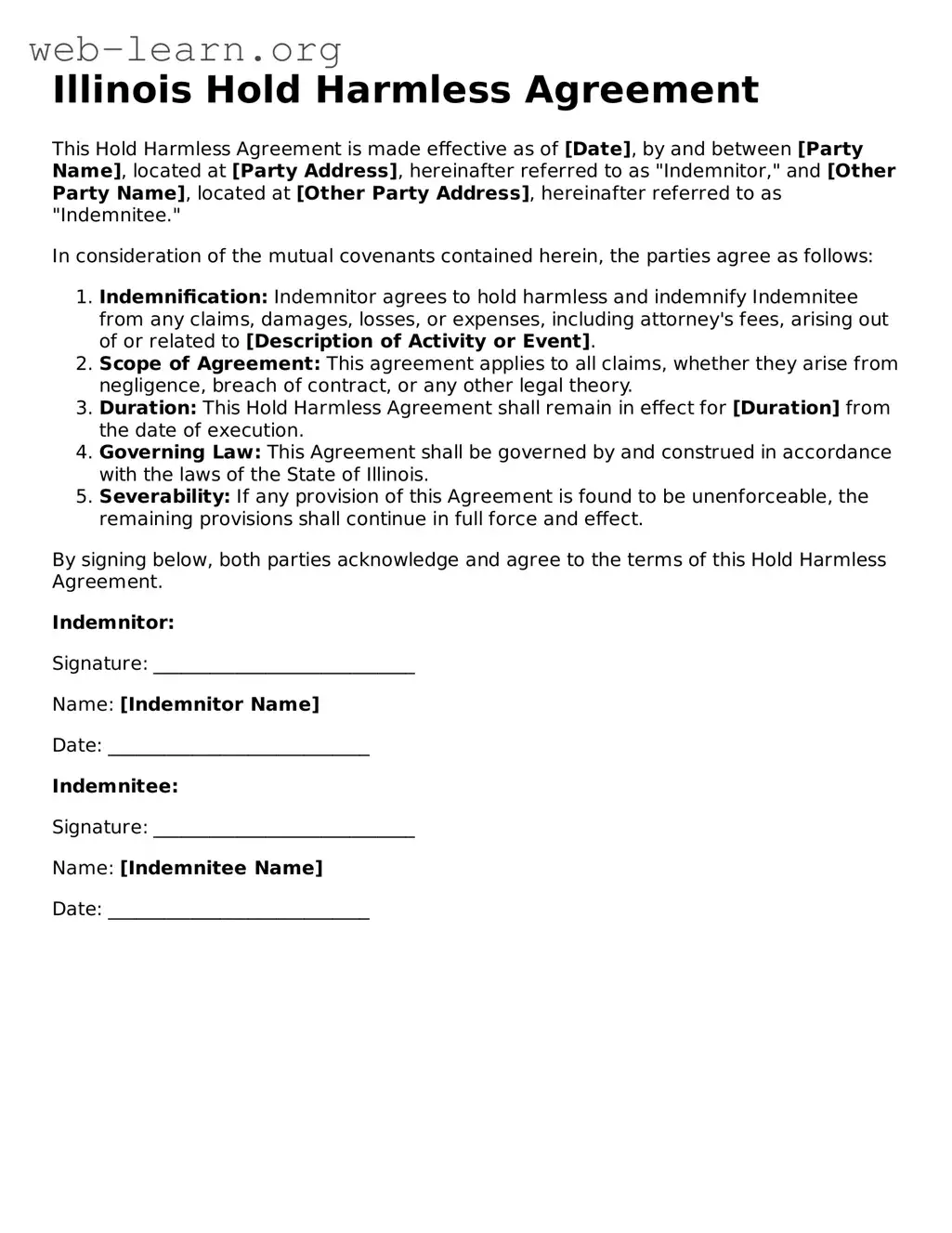
The Illinois Hold Harmless Agreement form plays a crucial role in various legal and business transactions, offering a layer of protection for parties involved. Designed to allocate risk, this agreement ensures that one party agrees to assume responsibility for certain liabilities, thereby shielding the other party from potential legal claims or damages. It is commonly used in situations such as construction projects, rental agreements, and events where one party may be exposed to risks associated with the activities of another. Key components of the form include clear definitions of the parties involved, the specific activities or circumstances covered, and the extent of the liability being assumed. By signing this document, individuals and businesses can foster a sense of security, knowing that they have taken proactive steps to mitigate risks associated with their engagements. Understanding the nuances of this agreement is essential for anyone looking to navigate the complexities of liability in Illinois effectively.
Illinois Hold Harmless Agreement
This Hold Harmless Agreement is made effective as of [Date], by and between [Party Name], located at [Party Address], hereinafter referred to as "Indemnitor," and [Other Party Name], located at [Other Party Address], hereinafter referred to as "Indemnitee."
In consideration of the mutual covenants contained herein, the parties agree as follows:
By signing below, both parties acknowledge and agree to the terms of this Hold Harmless Agreement.
Indemnitor:
Signature: ____________________________
Name: [Indemnitor Name]
Date: ____________________________
Indemnitee:
Signature: ____________________________
Name: [Indemnitee Name]
Date: ____________________________
| Fact Name | Details |
|---|---|
| Definition | The Illinois Hold Harmless Agreement is a legal document that protects one party from liability for damages or injuries that may occur during an activity. |
| Purpose | Its primary purpose is to shift the risk of liability from one party to another, often used in contracts involving events, services, or property use. |
| Governing Law | The agreement is governed by Illinois state law, specifically under the principles of contract law. |
| Parties Involved | Typically, there are two parties: the indemnitor (the party assuming liability) and the indemnitee (the party being protected). |
| Enforceability | For the agreement to be enforceable, it must be clear, specific, and voluntarily entered into by both parties. |
| Limitations | Illinois law does not allow hold harmless agreements to absolve a party from liability for their own gross negligence or willful misconduct. |
| Common Uses | These agreements are often used in recreational activities, construction contracts, and lease agreements. |
| Required Elements | A valid hold harmless agreement should include a clear statement of indemnification, the scope of protection, and signatures from both parties. |
Completing the Illinois Hold Harmless Agreement form is a straightforward process. After filling out the form, you will be able to submit it according to the specific requirements of your situation. Follow these steps to ensure that you fill out the form correctly.
What is a Hold Harmless Agreement?
A Hold Harmless Agreement is a legal document that protects one party from liability for any injuries or damages that may occur during a specific activity or event. In Illinois, these agreements are often used in various contexts, such as in sports, events, or rental agreements. By signing this document, one party agrees not to hold the other responsible for certain risks associated with the activity.
Who typically uses a Hold Harmless Agreement in Illinois?
Many different individuals and organizations use Hold Harmless Agreements. For example, event organizers may require participants to sign one to limit their liability in case of accidents. Similarly, property owners may ask tenants or guests to sign an agreement before using their facilities. This helps ensure that everyone understands the risks involved and agrees to take responsibility for their own safety.
What should be included in a Hold Harmless Agreement?
When drafting a Hold Harmless Agreement, it’s important to include several key elements:
Including these elements helps ensure that the agreement is clear and enforceable.
Is a Hold Harmless Agreement legally binding in Illinois?
Yes, a Hold Harmless Agreement can be legally binding in Illinois, provided it is properly drafted and signed by all parties involved. However, it’s essential to note that certain limitations may apply. For instance, the agreement cannot waive liability for gross negligence or willful misconduct. Courts may also scrutinize these agreements to ensure they are fair and reasonable. Therefore, it is advisable to consult with a legal expert when creating or signing such an agreement.
When filling out the Illinois Hold Harmless Agreement form, individuals often make several common mistakes that can lead to confusion or legal issues. Understanding these pitfalls can help ensure that the form is completed correctly and effectively protects the parties involved.
One frequent mistake is failing to read the entire agreement before signing. Many people skim through the document, missing critical details that outline their responsibilities and liabilities. This oversight can lead to misunderstandings about what is being agreed upon.
Another common error is neglecting to include specific names and dates. The form should clearly identify all parties involved, as well as the date of the agreement. Omitting this information can render the agreement unenforceable.
Some individuals mistakenly assume that the Hold Harmless Agreement protects them from all liability. This is not true. The agreement typically covers specific risks and does not absolve a party from all responsibility. Understanding the scope of the agreement is crucial.
Using vague language is also a significant mistake. The terms of the agreement should be clear and precise. Ambiguities can lead to disputes later on, as parties may interpret the agreement differently.
Another error is failing to consult with legal counsel. While many people believe they can handle the form on their own, seeking professional advice can help clarify complex legal language and ensure the agreement meets legal standards.
Some individuals forget to consider the jurisdiction. The Hold Harmless Agreement should comply with Illinois law, and failing to adhere to state-specific regulations can undermine the agreement's validity.
Additionally, people often overlook the importance of signatures. All parties involved must sign the document for it to be legally binding. Missing signatures can invalidate the agreement entirely.
Not keeping a copy of the signed agreement is another mistake. After completing the form, it is essential to retain a copy for personal records. This serves as proof of the agreement and can be referenced in case of disputes.
Finally, some individuals rush through the process, leading to errors in filling out the form. Taking the time to review and ensure accuracy can prevent future complications. Patience and attention to detail are vital when completing legal documents.
The Illinois Hold Harmless Agreement is a crucial document designed to protect one party from liability for certain risks associated with an activity or event. However, it is often used in conjunction with other forms and documents that provide additional context or legal clarity. Below are four commonly associated documents.
These documents work together to create a comprehensive framework that helps manage risks and liabilities effectively. Understanding each document's role can aid in ensuring that all parties are adequately protected during various activities and events.
A Hold Harmless Agreement is a legal document that protects one party from liability for any damages or injuries that may occur during a specific activity or event. Here are ten documents that share similarities with a Hold Harmless Agreement:
When filling out the Illinois Hold Harmless Agreement form, it’s important to follow certain guidelines to ensure everything is done correctly. Here’s a list of what you should and shouldn’t do:
Misconceptions about the Illinois Hold Harmless Agreement form can lead to misunderstandings about its purpose and implications. Here are seven common misconceptions:
Many believe that signing a Hold Harmless Agreement means one cannot be held liable for any actions. In reality, while it can limit liability, it does not grant total immunity, especially in cases of gross negligence or willful misconduct.
Some people think Hold Harmless Agreements are only relevant for businesses. However, individuals can also use them in personal agreements, such as for events or recreational activities.
Assuming that a generic form will suffice can be misleading. Each situation is unique, and it is crucial to tailor the agreement to fit specific circumstances and parties involved.
While the agreement may limit the ability to sue for certain claims, it does not eliminate the right to pursue legal action altogether. The enforceability of the agreement can also depend on its wording and the context in which it was signed.
People often think Hold Harmless Agreements are only needed for activities like skydiving or extreme sports. In truth, they can be beneficial for a wide range of activities, including simple gatherings or community events.
Some believe that signing a Hold Harmless Agreement means they can act without regard for safety or others' well-being. This is not true; individuals still have a duty to act reasonably and responsibly.
While insurance can provide financial protection, it does not replace the need for a Hold Harmless Agreement. The agreement serves as a legal document outlining the responsibilities and expectations of the parties involved.
The Illinois Hold Harmless Agreement form is an important legal document. It outlines the responsibilities and liabilities of the parties involved. Here are key takeaways for filling out and using this form:
Release and Hold Harmless Agreement - It is a necessary step in protecting against unforeseen liabilities.
California Hold Harmless Agreement - The agreement often emphasizes the voluntary nature of participation in the activity.
What Is a Hold Harmless Agreement - This agreement can help clarify liability in multi-party situations.