The Illinois General Power of Attorney form is a crucial legal document that empowers an individual, known as the agent or attorney-in-fact, to make decisions on behalf of another person, referred to as the principal. This form allows the agent to manage a wide range of financial and legal affairs, including handling bank transactions, managing real estate, and making healthcare decisions, depending on the specific powers granted. It is essential to understand that the powers can be customized, allowing the principal to specify exactly what the agent can and cannot do. The document remains effective until the principal revokes it or becomes incapacitated, unless it is designed to be durable, in which case it continues to operate even if the principal loses the ability to make decisions. Proper execution and witnessing of the form are critical to ensure its validity. Understanding the nuances of this form can provide peace of mind, knowing that someone trusted will manage your affairs when you cannot.
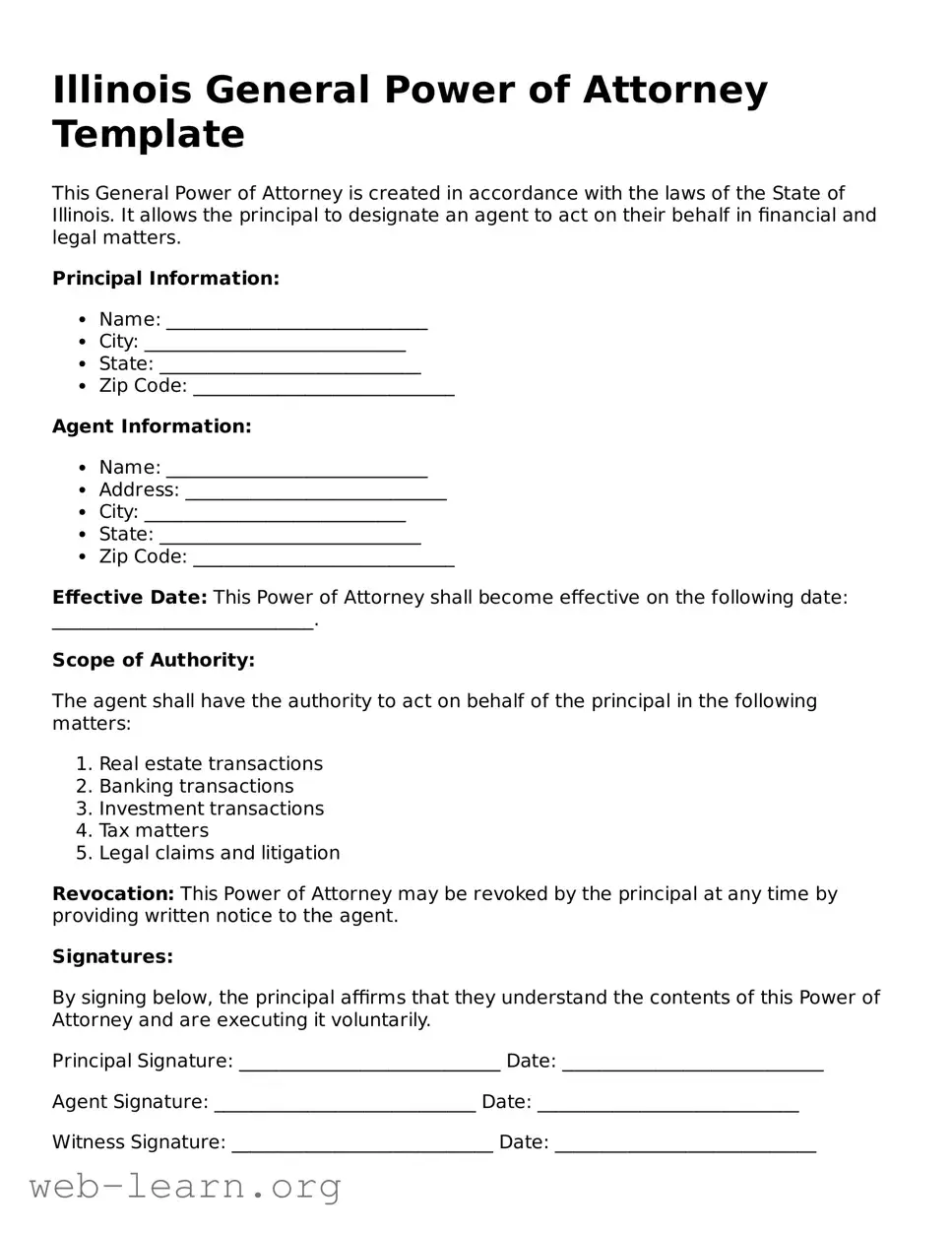
Illinois General Power of Attorney Template
This General Power of Attorney is created in accordance with the laws of the State of Illinois. It allows the principal to designate an agent to act on their behalf in financial and legal matters.
Principal Information:
Agent Information:
Effective Date: This Power of Attorney shall become effective on the following date: ____________________________.
Scope of Authority:
The agent shall have the authority to act on behalf of the principal in the following matters:
Revocation: This Power of Attorney may be revoked by the principal at any time by providing written notice to the agent.
Signatures:
By signing below, the principal affirms that they understand the contents of this Power of Attorney and are executing it voluntarily.
Principal Signature: ____________________________ Date: ____________________________
Agent Signature: ____________________________ Date: ____________________________
Witness Signature: ____________________________ Date: ____________________________
Witness Signature: ____________________________ Date: ____________________________
| Fact Name | Description |
|---|---|
| Definition | The Illinois General Power of Attorney form allows an individual (the principal) to designate another person (the agent) to make decisions on their behalf. |
| Governing Law | This form is governed by the Illinois Power of Attorney Act (755 ILCS 45/1-1 et seq.), which outlines the requirements and powers granted. |
| Durability | The general power of attorney can be durable, meaning it remains effective even if the principal becomes incapacitated, unless specified otherwise. |
| Agent's Authority | The agent can be granted broad authority, including handling financial matters, real estate transactions, and legal affairs, depending on the principal's wishes. |
| Revocation | The principal can revoke the power of attorney at any time, as long as they are mentally competent, by providing written notice to the agent. |
After obtaining the Illinois General Power of Attorney form, you'll need to fill it out carefully. This document allows you to appoint someone to make decisions on your behalf. Follow these steps to complete the form accurately.
Once you have completed the form, keep a copy for your records and provide a copy to your agent. This ensures they have the authority to act on your behalf when needed.
What is a General Power of Attorney in Illinois?
A General Power of Attorney (GPOA) in Illinois is a legal document that allows one person, known as the principal, to grant another person, called the agent or attorney-in-fact, the authority to make decisions on their behalf. This authority can include managing financial matters, handling real estate transactions, and making legal decisions.
Who can be appointed as an agent in a General Power of Attorney?
In Illinois, the agent must be at least 18 years old and capable of understanding the responsibilities involved. The principal can choose anyone they trust, such as a family member, friend, or professional advisor, to serve as their agent.
What powers can be granted through a General Power of Attorney?
The principal can grant a wide range of powers, including:
However, the principal can specify limitations or exclude certain powers in the document.
How is a General Power of Attorney created in Illinois?
To create a GPOA, the principal must complete a form that includes their name, the agent’s name, and the specific powers granted. The document must be signed by the principal in the presence of a notary public. In Illinois, it is also advisable to have a witness sign the document.
Can a General Power of Attorney be revoked?
Yes, a principal can revoke a General Power of Attorney at any time, as long as they are mentally competent. Revocation can be done by creating a new GPOA that explicitly states the previous one is revoked or by providing a written notice to the agent.
What happens if the principal becomes incapacitated?
If the principal becomes incapacitated, the General Power of Attorney remains effective unless it is a "springing" power of attorney, which only takes effect upon the principal's incapacity. It is important for the principal to consider how they want their agent to act in such situations when drafting the document.
Is a General Power of Attorney valid in other states?
A General Power of Attorney created in Illinois may be recognized in other states, but it is advisable to check the specific laws of the other state. Some states have different requirements for powers of attorney, and it may be necessary to create a new document to comply with those laws.
Are there any limitations to the powers granted?
Yes, the principal can limit the powers granted in the General Power of Attorney. They can specify which actions the agent can or cannot take. It is crucial for the principal to be clear about their intentions to ensure the agent acts in accordance with their wishes.
Filling out the Illinois General Power of Attorney form can be a straightforward process, but many individuals make common mistakes that can lead to complications later on. One frequent error is failing to clearly identify the agent. The agent is the person who will act on your behalf, and it’s crucial to provide their full name and address. Omitting this information or providing incomplete details can create confusion and hinder the agent’s ability to make decisions when needed.
Another mistake often seen is not specifying the powers granted to the agent. The form allows you to choose specific powers or grant broad authority. Some individuals either leave this section blank or fail to understand the implications of their choices. It’s important to carefully consider what powers you want to give your agent, as this can affect their ability to manage your affairs effectively.
Additionally, many people overlook the importance of signing and dating the form correctly. The Illinois General Power of Attorney requires your signature and the date to validate the document. If the form is not signed or dated, it may be deemed invalid. This oversight can lead to significant issues, especially in urgent situations when the agent needs to act on your behalf.
Finally, individuals often neglect to have the document witnessed or notarized as required by Illinois law. While some may believe that simply filling out the form is sufficient, the law mandates that the document must be signed in the presence of a witness or a notary public. Failing to meet this requirement can invalidate the power of attorney, leaving your agent without the authority to act.
When creating a General Power of Attorney in Illinois, several other documents may complement this form. These additional documents can help clarify intentions, provide necessary information, or address specific situations. Here’s a list of commonly used forms that often accompany a General Power of Attorney.
Utilizing these documents alongside a General Power of Attorney can provide clarity and ensure that an individual's wishes are honored in various circumstances. It is advisable to consider each document's purpose and how they interact to create a well-rounded plan.
When filling out the Illinois General Power of Attorney form, it’s important to follow certain guidelines to ensure that the document is valid and meets your needs. Here are some key dos and don’ts to keep in mind:
Understanding the Illinois General Power of Attorney form is essential for anyone considering its use. However, many misconceptions surround this important document. Here are ten common misunderstandings:
While a General Power of Attorney often deals with financial decisions, it can also cover health care and other personal matters if specified.
This is not true. A General Power of Attorney remains valid until you revoke it or a court invalidates it, unless it is a "springing" power of attorney that activates upon incapacity.
Your agent must be a competent adult. This means they should be able to understand the responsibilities and make decisions on your behalf.
While notarization is recommended for added validity, it is not strictly required. However, having it notarized can help avoid disputes.
This form can be used in other states, but laws vary. Always check local regulations if you plan to use it outside Illinois.
Your agent must act in your best interest and follow your instructions. They cannot use your assets for personal gain unless you specifically allow it.
You can revoke or change your General Power of Attorney at any time, as long as you are mentally competent.
People of all ages can benefit from having a General Power of Attorney. Unexpected events can happen to anyone, making this document useful for all adults.
This is a common misconception. Without a formal document, your spouse does not have the legal authority to make decisions on your behalf.
A General Power of Attorney is not a will. It allows someone to act on your behalf while you are alive, whereas a will takes effect after your death.
Clearing up these misconceptions can help individuals make informed decisions about their legal documents and ensure their wishes are honored.
Filling out and using the Illinois General Power of Attorney form is an important step in ensuring that your financial and healthcare decisions can be managed by someone you trust. Here are some key takeaways to keep in mind:
By understanding these key points, you can ensure that your General Power of Attorney form serves your needs effectively and provides peace of mind for you and your loved ones.