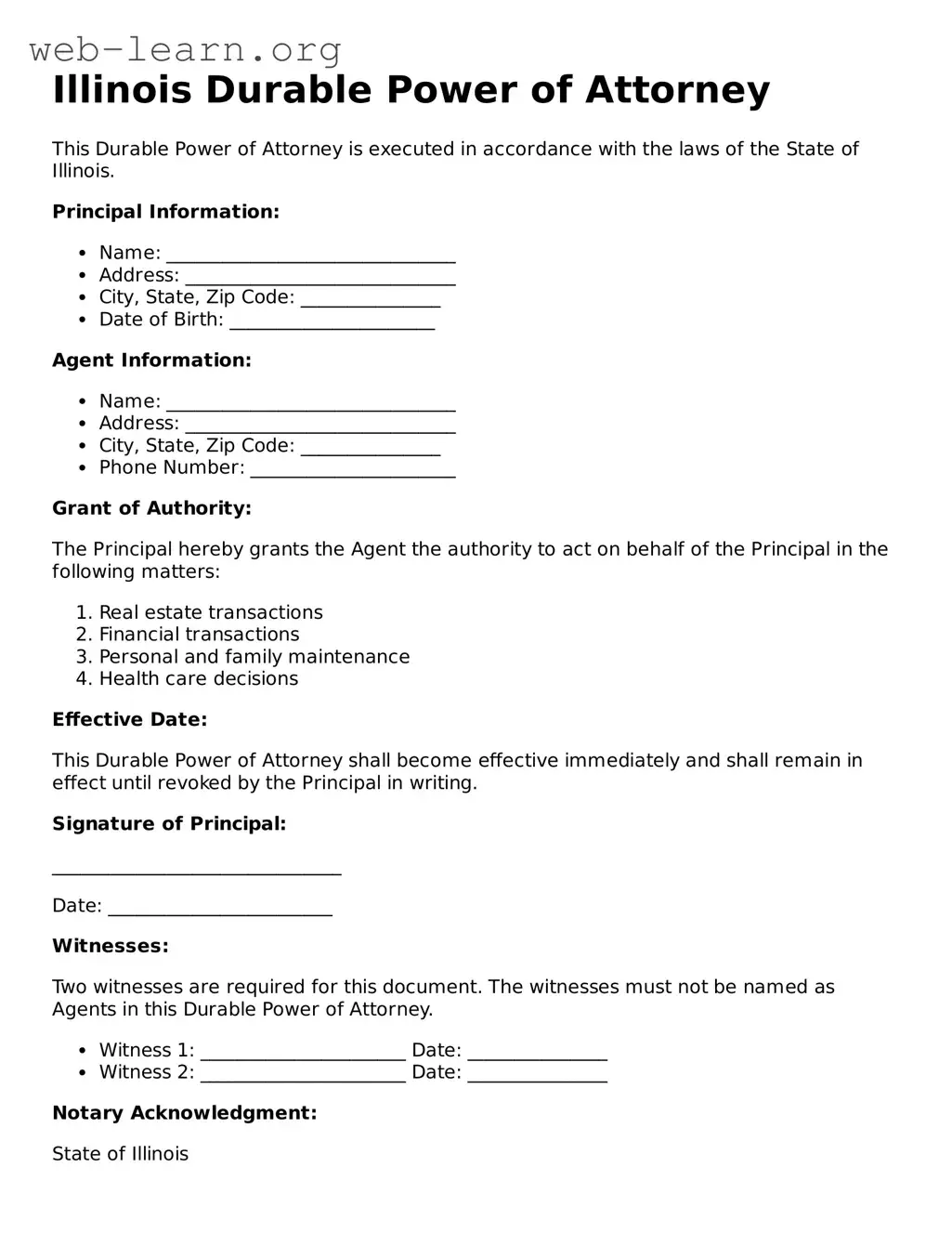
The Illinois Durable Power of Attorney form is a crucial legal document that empowers individuals to designate someone they trust to make decisions on their behalf, particularly in matters related to healthcare and financial affairs. This form remains effective even if the individual becomes incapacitated, ensuring that their wishes are respected and upheld during challenging times. By completing this document, a principal can outline specific powers granted to their agent, allowing for tailored decision-making authority. The form also requires the principal's signature and the acknowledgment of a notary public, which adds a layer of validation to the process. In Illinois, understanding the nuances of this form is essential, as it provides a safety net for individuals who wish to maintain control over their lives, even when they are unable to communicate their preferences directly. Furthermore, it serves to alleviate potential conflicts among family members, providing clear guidelines for caregivers and loved ones during critical moments.
Illinois Durable Power of Attorney
This Durable Power of Attorney is executed in accordance with the laws of the State of Illinois.
Principal Information:
Agent Information:
Grant of Authority:
The Principal hereby grants the Agent the authority to act on behalf of the Principal in the following matters:
Effective Date:
This Durable Power of Attorney shall become effective immediately and shall remain in effect until revoked by the Principal in writing.
Signature of Principal:
_______________________________
Date: ________________________
Witnesses:
Two witnesses are required for this document. The witnesses must not be named as Agents in this Durable Power of Attorney.
Notary Acknowledgment:
State of Illinois
County of ______________________
On this _____ day of ___________, 20____, before me, a Notary Public, personally appeared ______________________, known to me to be the person whose name is subscribed to this instrument, and acknowledged that he/she executed the same.
_______________________________
Notary Public
My Commission Expires: ____________
| Fact Name | Details |
|---|---|
| Definition | The Illinois Durable Power of Attorney form allows an individual to designate someone to make decisions on their behalf if they become incapacitated. |
| Governing Law | The form is governed by the Illinois Power of Attorney Act, 755 ILCS 45/1-1 et seq. |
| Durability | This power of attorney remains effective even if the principal becomes incapacitated. |
| Principal | The person who creates the durable power of attorney is referred to as the principal. |
| Agent | The individual designated to act on behalf of the principal is called the agent or attorney-in-fact. |
| Scope of Authority | The agent can be granted broad or limited powers, depending on the principal's wishes. |
| Signing Requirements | The form must be signed by the principal and witnessed by at least one individual or notarized. |
| Revocation | The principal can revoke the durable power of attorney at any time, as long as they are competent. |
| Use in Healthcare | This form can be combined with a healthcare power of attorney to cover medical decisions. |
Filling out the Illinois Durable Power of Attorney form is an important step in ensuring that your financial and medical decisions can be managed by someone you trust in the event you are unable to make those decisions yourself. Follow these steps carefully to complete the form accurately.
Once the form is filled out and signed, keep it in a safe place. Inform your agent where to find it, as they will need it when the time comes to act on your behalf. It’s also a good idea to review the document periodically to ensure it still reflects your wishes.
What is a Durable Power of Attorney in Illinois?
A Durable Power of Attorney (DPOA) is a legal document that allows you to appoint someone to make decisions on your behalf regarding financial and legal matters. Unlike a standard power of attorney, a DPOA remains effective even if you become incapacitated.
Who can be appointed as an agent?
You can choose any competent adult to serve as your agent. This person could be a family member, friend, or professional, such as an attorney or financial advisor. It is crucial to select someone you trust, as they will have significant authority over your financial matters.
What powers can be granted through a Durable Power of Attorney?
The powers granted can vary widely. Common powers include:
You can customize the document to specify which powers you want to grant.
How do I create a Durable Power of Attorney in Illinois?
To create a DPOA, you need to fill out the appropriate form, which can often be found online or through legal service providers. After completing the form, you must sign it in front of a notary public. In some cases, you may also need witnesses to sign the document.
Can I revoke a Durable Power of Attorney?
Yes, you can revoke a DPOA at any time as long as you are mentally competent. To do this, you should create a written revocation document and notify your agent and any institutions that may have a copy of the original DPOA.
What happens if I do not have a Durable Power of Attorney?
If you do not have a DPOA and become incapacitated, your family may have to go through a court process to obtain guardianship over you. This process can be time-consuming, costly, and may not align with your wishes.
Is a Durable Power of Attorney the same as a living will?
No, a DPOA and a living will serve different purposes. A DPOA deals with financial and legal decisions, while a living will outlines your preferences for medical treatment in case you cannot communicate your wishes. Both documents are important for comprehensive planning.
Filling out the Illinois Durable Power of Attorney form can be straightforward, but many individuals make common mistakes that can lead to complications later. One frequent error is failing to specify the powers granted to the agent. It's crucial to clearly outline what decisions the agent can make on your behalf. Without this clarity, the agent may not have the authority to act in your best interest.
Another mistake is neglecting to date the form. The date is essential for establishing the validity of the document. If the form is undated, it may raise questions about when the powers were intended to take effect, potentially causing delays or disputes.
Many people also overlook the importance of signatures. Both the principal and the agent must sign the document. If either party fails to sign, the form may be deemed invalid. Additionally, having witnesses sign the document is often required, and skipping this step can invalidate the power of attorney.
Choosing the wrong agent is a significant mistake. It’s vital to select someone trustworthy and capable of making decisions in your best interest. Avoid appointing someone who may have conflicts of interest or who may not be available when needed.
Another common error involves not discussing the arrangement with the chosen agent beforehand. Open communication ensures that the agent understands your wishes and is willing to take on the responsibility. Failing to have this conversation can lead to confusion and misaligned expectations.
People often forget to review and update the document as circumstances change. Life events such as marriage, divorce, or the death of a designated agent can affect the validity of the power of attorney. Regularly reviewing the document helps ensure it reflects your current wishes.
Some individuals mistakenly believe that a Durable Power of Attorney is only needed for financial matters. In reality, it can also cover healthcare decisions. Failing to include healthcare powers can lead to complications if medical decisions need to be made.
Another mistake is not ensuring the document complies with state laws. Each state has specific requirements for a Durable Power of Attorney. Ignoring these requirements can lead to the document being considered invalid in Illinois.
People often underestimate the importance of notarization. While notarization may not be required for all powers of attorney, having the document notarized can provide an additional layer of protection and legitimacy.
Lastly, some individuals may not keep the document in a safe but accessible place. It’s important to store the Durable Power of Attorney where trusted individuals can easily find it when necessary. Failing to do so can hinder the agent's ability to act promptly in your best interest.
In the context of estate planning and managing personal affairs, the Illinois Durable Power of Attorney form plays a crucial role. However, it is often accompanied by several other important documents that serve to enhance its effectiveness and ensure comprehensive planning. Below is a list of such documents, each serving a specific purpose.
Each of these documents plays a vital role in ensuring that personal wishes are respected and that individuals are cared for according to their preferences. Together, they create a robust framework for managing health care and financial decisions, thereby providing peace of mind for individuals and their families.
When filling out the Illinois Durable Power of Attorney form, it is essential to approach the task with care and attention. Here are some important dos and don'ts to keep in mind:
When it comes to the Illinois Durable Power of Attorney form, several misconceptions can lead to confusion. Here are six common misunderstandings:
Many people believe this document is limited to financial decisions. In reality, it can also cover healthcare decisions, allowing your agent to make medical choices on your behalf if you become incapacitated.
This form is beneficial for anyone over 18. Accidents or sudden illnesses can happen at any age, making it wise to have this document in place early on.
While many choose family members, your agent can be a trusted friend, a professional, or anyone you believe will act in your best interest.
While it's best to revoke it in writing for clarity, you can also verbally revoke it in certain situations, especially if you have capacity and can communicate your wishes.
This is not true. You can modify or revoke the document at any time as long as you are mentally competent.
Your agent has a fiduciary duty to act in your best interest. They cannot use the authority for personal gain or against your wishes.
When considering the Illinois Durable Power of Attorney form, it’s essential to understand its significance and the steps involved in its completion. Here are some key takeaways to keep in mind:
Understanding these points can help you navigate the process of creating and using a Durable Power of Attorney effectively. Take the time to fill out the form carefully, as it plays a crucial role in your future planning.
Living Will Kansas - This document allows you to choose who will make critical decisions on your behalf.
Power of Attorney Michigan - This form is a way to communicate your wishes clearly, avoiding confusion for your loved ones.
Louisiana Durable Power of Attorney Pdf - This form remains effective even if you become incapacitated.
Oregon Power of Attorney Form - In some states, the form must be notarized or witnessed to be valid.