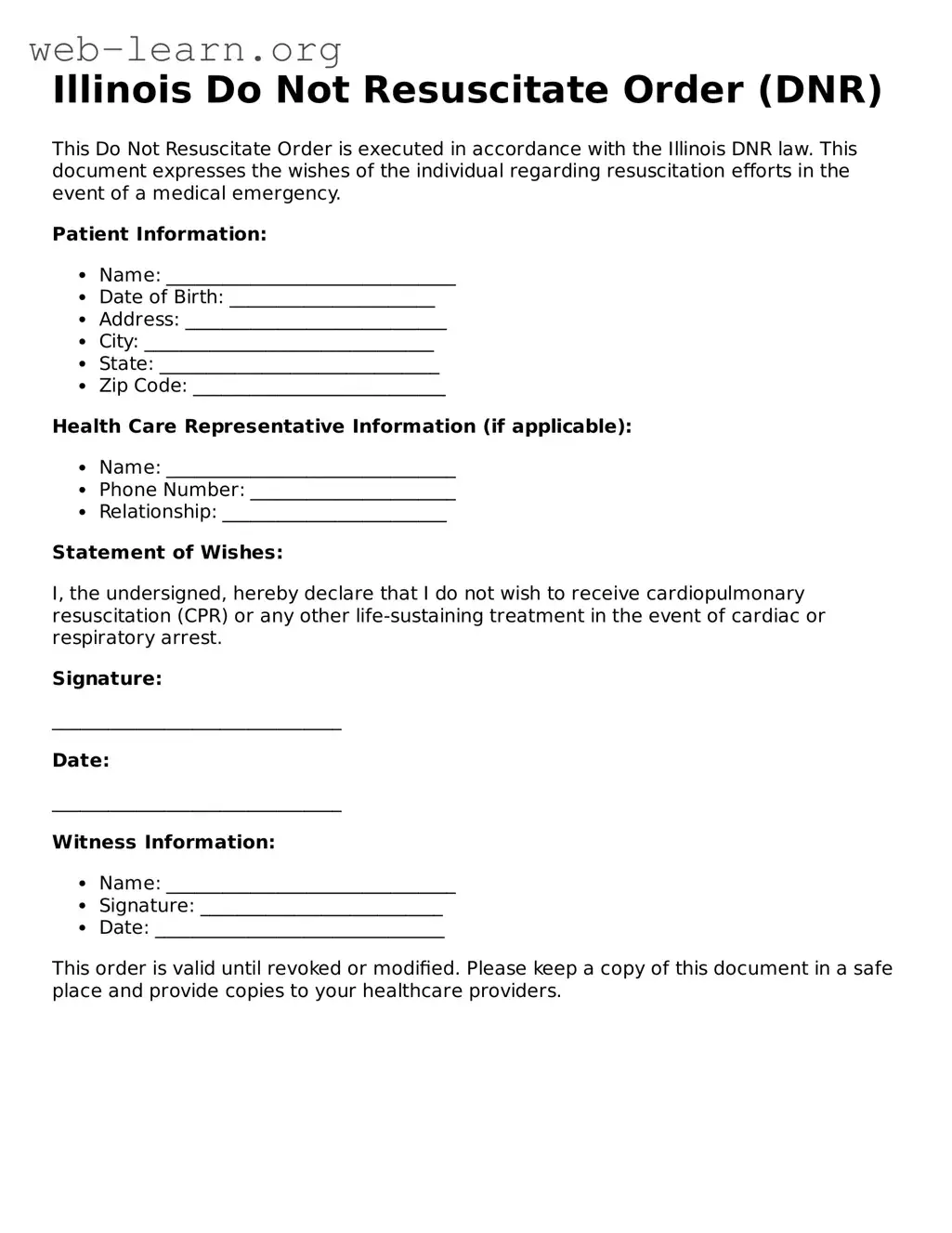
The Illinois Do Not Resuscitate Order (DNR) form serves as a crucial document for individuals who wish to express their preferences regarding medical treatment in emergency situations. This form allows patients to communicate their desire not to receive cardiopulmonary resuscitation (CPR) or other life-sustaining measures if their heart stops or they stop breathing. It is important to understand that the DNR form is not a declaration of death; rather, it is a proactive measure that ensures medical personnel respect the wishes of the patient. The form must be completed and signed by the patient or their legal representative, and it requires the signature of a physician to be valid. Additionally, the DNR form is recognized across various healthcare settings in Illinois, ensuring that the patient's wishes are honored consistently. Understanding the implications of this form can help individuals and their families make informed decisions about end-of-life care, providing peace of mind during challenging times.
Illinois Do Not Resuscitate Order (DNR)
This Do Not Resuscitate Order is executed in accordance with the Illinois DNR law. This document expresses the wishes of the individual regarding resuscitation efforts in the event of a medical emergency.
Patient Information:
Health Care Representative Information (if applicable):
Statement of Wishes:
I, the undersigned, hereby declare that I do not wish to receive cardiopulmonary resuscitation (CPR) or any other life-sustaining treatment in the event of cardiac or respiratory arrest.
Signature:
_______________________________
Date:
_______________________________
Witness Information:
This order is valid until revoked or modified. Please keep a copy of this document in a safe place and provide copies to your healthcare providers.
| Fact Name | Description |
|---|---|
| Purpose | The Illinois Do Not Resuscitate (DNR) Order form allows individuals to express their wishes regarding resuscitation efforts in the event of a medical emergency. |
| Eligibility | Any adult, or a minor with parental consent, can complete the DNR Order form to ensure their healthcare preferences are respected. |
| Governing Law | The DNR Order in Illinois is governed by the Illinois DNR Law, specifically outlined in the Illinois Compiled Statutes, Chapter 410, Act 50. |
| Signature Requirements | The form must be signed by the individual or their authorized representative, and it must also be witnessed by two adults who are not related to the individual. |
Filling out the Illinois Do Not Resuscitate Order form is an important step for those who want to communicate their wishes regarding medical treatment. This document ensures that your preferences are clear and respected in a medical emergency. Below are the steps to help you complete the form accurately.
Once you've filled out the form, keep it in a safe but accessible place. It's important that your loved ones and medical team know where to find it in case of an emergency.
A Do Not Resuscitate Order is a legal document that allows a person to refuse specific life-saving medical interventions, particularly cardiopulmonary resuscitation (CPR), in the event of cardiac arrest or respiratory failure. In Illinois, this order is designed to honor the wishes of individuals who prefer not to undergo aggressive resuscitation efforts.
In Illinois, a DNR Order can be completed by an individual who is at least 18 years old and has the capacity to make medical decisions. Additionally, the form must be signed by a physician, confirming that the individual understands the implications of the order. For minors, a parent or legal guardian can initiate the process.
You can obtain a DNR Order form through various sources:
Once you have the form, it's important to fill it out accurately and discuss it with your healthcare team.
It is crucial to keep your DNR Order in a place where it can be easily accessed by medical personnel. Consider the following options:
By ensuring its visibility, you help ensure that your wishes are respected in an emergency situation.
Yes, you can change or revoke your DNR Order at any time. To do this, simply notify your healthcare provider and complete a new form if necessary. Make sure to inform family members and caregivers about any changes to ensure everyone is aware of your current wishes.
If you do not have a DNR Order in place, medical personnel are required to perform resuscitation efforts if you experience cardiac arrest or respiratory failure. This can include CPR, intubation, and other life-saving measures. If you have specific preferences regarding your medical care, it is advisable to discuss them with your healthcare provider and consider completing a DNR Order.
Filling out the Illinois Do Not Resuscitate Order form is a critical task that requires careful attention. One common mistake people make is not providing the necessary personal information. The form requires details such as the patient’s name, date of birth, and address. Omitting any of this information can lead to confusion and may render the document invalid.
Another frequent error is failing to sign the form. This may seem straightforward, but many individuals overlook this crucial step. Without a signature, the intent of the order is not legally recognized. It is essential to ensure that the form is signed by the patient or their authorized representative to make it effective.
People often misunderstand the purpose of the form, leading to incorrect selections. The Illinois Do Not Resuscitate Order is specific to situations where resuscitation is not desired. Some individuals mistakenly check options that contradict their wishes. It's important to read each section carefully and confirm that the choices reflect the patient’s true desires regarding medical treatment.
Lastly, many forget to distribute copies of the completed form. Once the Illinois Do Not Resuscitate Order is filled out correctly, it should be shared with healthcare providers and family members. This ensures that everyone involved in the patient’s care understands their wishes. Neglecting to do so can result in unwanted medical interventions during critical moments.
The Illinois Do Not Resuscitate Order (DNR) form is a critical document that outlines a patient's wishes regarding resuscitation efforts in the event of a medical emergency. Alongside this form, several other documents are commonly utilized to ensure that an individual's healthcare preferences are clearly communicated and honored. Below is a list of related forms and documents often used in conjunction with the Illinois DNR form.
Each of these documents plays a vital role in ensuring that a person's healthcare wishes are respected and followed. They work together to create a comprehensive plan that addresses various aspects of medical care, particularly in critical situations.
The Do Not Resuscitate (DNR) Order form is an important document that outlines a patient's wishes regarding resuscitation efforts in case of a medical emergency. There are several other documents that share similarities with the DNR Order form. Here are six of them:
When filling out the Illinois Do Not Resuscitate Order form, it is crucial to follow specific guidelines to ensure your wishes are clearly communicated. Here’s a list of things you should and shouldn't do:
By following these guidelines, you can ensure that your Do Not Resuscitate Order accurately reflects your healthcare preferences.
Many people have misunderstandings about the Illinois Do Not Resuscitate (DNR) Order form. Addressing these misconceptions can help individuals make informed decisions about their healthcare preferences. Here are four common misconceptions:
Understanding these points can clarify the purpose and implications of a DNR order, helping individuals navigate their healthcare decisions more effectively.
Filling out and using the Illinois Do Not Resuscitate Order (DNR) form is an important process for individuals who wish to express their preferences regarding resuscitation in medical emergencies. Here are some key takeaways to keep in mind:
How Old Do You Have to Be to Sign a Dnr - Patients should ensure that their DNR order is signed, dated, and witnessed according to state laws.
Is a Dnr an Advance Directive - A DNR order is a way for individuals to maintain control over their medical care at the end of life.