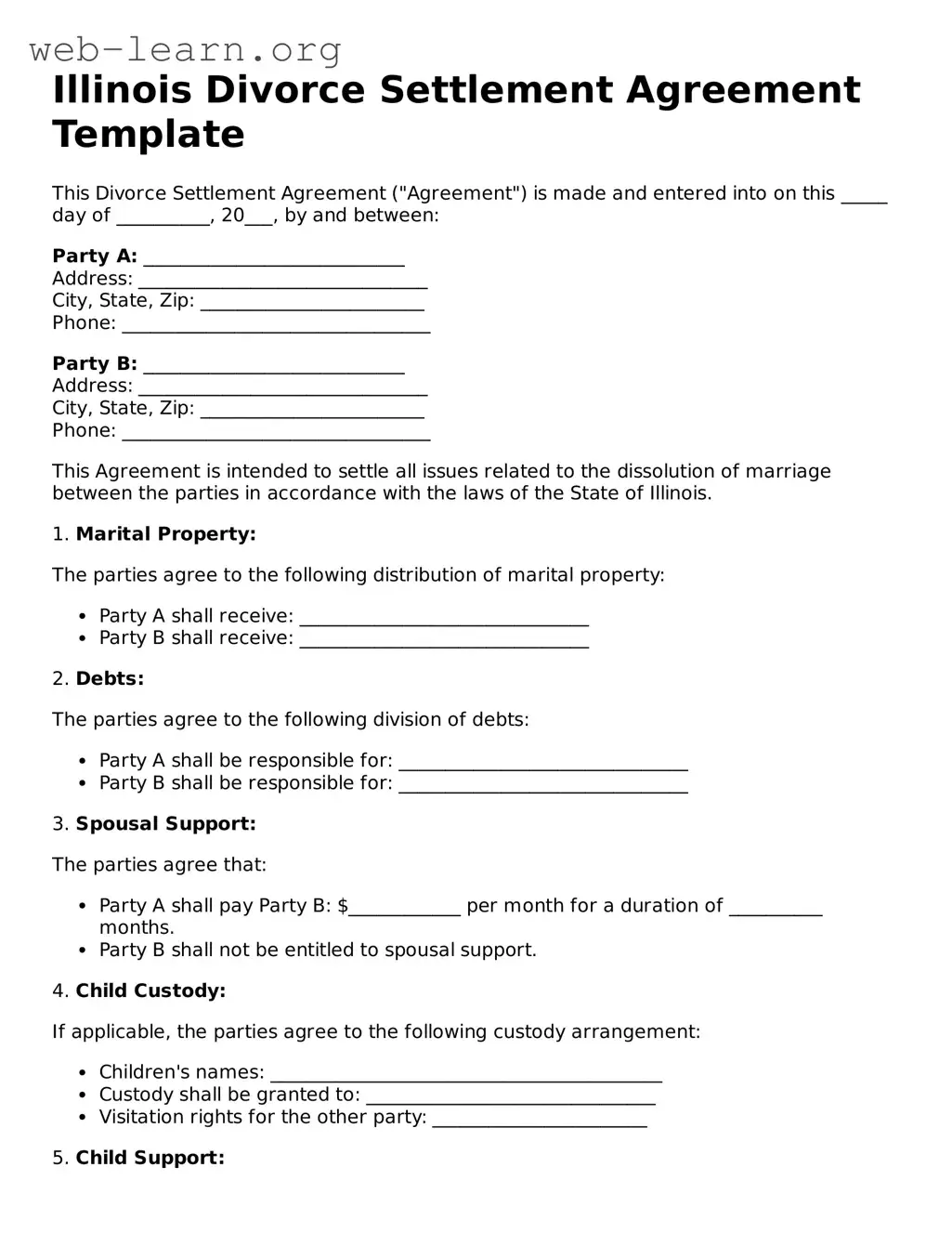
When navigating the complexities of divorce in Illinois, one essential document is the Divorce Settlement Agreement form. This form serves as a comprehensive outline of the terms agreed upon by both parties, addressing critical aspects such as the division of assets and debts, child custody arrangements, and spousal support. It is crucial to ensure that all agreements are clearly articulated to avoid future disputes. The form also includes provisions for child support, detailing the financial responsibilities of each parent. Additionally, it may address health insurance coverage and other relevant considerations for children involved. Completing this form accurately can facilitate a smoother divorce process and provide clarity for both parties moving forward.
Illinois Divorce Settlement Agreement Template
This Divorce Settlement Agreement ("Agreement") is made and entered into on this _____ day of __________, 20___, by and between:
Party A: ____________________________
Address: _______________________________
City, State, Zip: ________________________
Phone: _________________________________
Party B: ____________________________
Address: _______________________________
City, State, Zip: ________________________
Phone: _________________________________
This Agreement is intended to settle all issues related to the dissolution of marriage between the parties in accordance with the laws of the State of Illinois.
1. Marital Property:
The parties agree to the following distribution of marital property:
2. Debts:
The parties agree to the following division of debts:
3. Spousal Support:
The parties agree that:
4. Child Custody:
If applicable, the parties agree to the following custody arrangement:
5. Child Support:
The parties agree that:
6. Miscellaneous:
IN WITNESS WHEREOF, the parties have executed this Divorce Settlement Agreement as of the date first above written.
______________________________
Party A Signature
______________________________
Party B Signature
______________________________
Date
| Fact Name | Description |
|---|---|
| Governing Law | The Illinois Divorce Settlement Agreement form is governed by the Illinois Marriage and Dissolution of Marriage Act. |
| Purpose | This form is used to outline the terms of the divorce settlement between spouses, including asset division, child custody, and support obligations. |
| Required Information | Both parties must provide personal information, including names, addresses, and details about children, if applicable. |
| Asset Division | The agreement should specify how marital property and debts will be divided between the spouses. |
| Child Custody Arrangements | If children are involved, the form must detail custody arrangements, including physical and legal custody and visitation rights. |
| Child Support | The agreement should outline the amount of child support to be paid, along with the payment schedule and duration. |
| Spousal Support | Any spousal support (alimony) obligations should be clearly defined, including the amount and duration of payments. |
| Signatures Required | Both parties must sign the agreement to indicate their acceptance of the terms outlined within. |
| Filing with Court | After signing, the agreement should be filed with the court as part of the divorce proceedings. |
| Modification Clause | The agreement may include a clause that outlines how modifications to the terms can be made in the future, if necessary. |
Once you have the Illinois Divorce Settlement Agreement form in hand, you will need to fill it out carefully. This form will help outline the terms of your divorce, including asset division, spousal support, and child custody arrangements if applicable. Follow these steps to complete the form accurately.
After completing the form, you will need to file it with the appropriate court. Be sure to keep copies for your records and consult with a legal professional if you have any questions about the next steps.
What is a Divorce Settlement Agreement?
A Divorce Settlement Agreement is a legal document that outlines the terms agreed upon by both spouses during a divorce. This agreement typically covers important aspects such as property division, child custody, visitation rights, and spousal support. By clearly defining these terms, the agreement helps to ensure that both parties understand their rights and responsibilities following the divorce.
Why is a Divorce Settlement Agreement important?
This document is crucial because it serves as a binding contract between the divorcing parties. It can help prevent future disputes by providing clarity on how assets and responsibilities will be handled. Additionally, having a well-drafted agreement can expedite the divorce process and make it less contentious.
What should be included in a Divorce Settlement Agreement?
Key components of a Divorce Settlement Agreement typically include:
Each couple’s situation is unique, so the specifics may vary based on individual circumstances.
How is a Divorce Settlement Agreement created?
Creating a Divorce Settlement Agreement typically involves negotiation between the spouses. They may choose to work together directly or with the assistance of attorneys or mediators. Once both parties reach an agreement, the document should be drafted, reviewed, and signed. It is advisable to have legal counsel review the agreement to ensure it complies with state laws and adequately protects each party’s interests.
Can a Divorce Settlement Agreement be modified?
Yes, a Divorce Settlement Agreement can be modified, but only under certain circumstances. If there is a significant change in circumstances, such as a job loss or a change in income, one party may petition the court for a modification. It’s important to note that both parties must agree to the changes, and the court must approve any modifications to ensure they are legally binding.
What happens if one party does not comply with the Divorce Settlement Agreement?
If one party fails to comply with the terms outlined in the agreement, the other party may seek enforcement through the court. This can involve filing a motion to compel compliance, which may lead to legal consequences for the non-compliant party, including fines or modifications to custody and support arrangements.
Is a Divorce Settlement Agreement legally binding?
Yes, once signed by both parties and approved by the court, a Divorce Settlement Agreement is legally binding. This means that both parties are obligated to adhere to the terms set forth in the agreement. Failure to comply can result in legal action, as mentioned earlier.
Do I need a lawyer to create a Divorce Settlement Agreement?
While it is not legally required to have a lawyer to create a Divorce Settlement Agreement, it is highly recommended. An attorney can provide valuable guidance, ensure that your rights are protected, and help navigate any complexities that may arise during the negotiation process. Having legal representation can also help avoid potential pitfalls that could lead to disputes later on.
Filling out the Illinois Divorce Settlement Agreement form can be a complex task, and mistakes can lead to delays or complications in the divorce process. One common error occurs when individuals fail to provide complete information. Omitting details about assets, debts, or income can create confusion and may require additional court hearings to resolve discrepancies.
Another frequent mistake is not being specific about the terms of the settlement. Vague language can lead to misunderstandings between parties. For instance, stating that one party will receive "some" of the marital property does not clarify what that entails. Clear and precise language is essential to avoid future disputes.
Many people also overlook the importance of including all relevant financial information. This includes not only income but also expenses, debts, and any other financial obligations. By failing to disclose all financial aspects, individuals risk having their agreement challenged later on.
Additionally, individuals sometimes neglect to consider tax implications. For example, the division of retirement accounts or the sale of a home can have significant tax consequences. Understanding these factors is crucial to ensure that the settlement is fair and equitable.
Another mistake is not reviewing the agreement thoroughly before submission. Rushing through the form can lead to errors in calculations or typographical mistakes. Taking the time to review the document can help catch these issues before they become problematic.
Some individuals may also forget to include a parenting plan if children are involved. This plan should outline custody arrangements, visitation schedules, and child support details. Without this plan, the court may not have a clear understanding of how parenting responsibilities will be shared.
Moreover, failing to sign the document correctly can be a significant oversight. All parties must sign the agreement, and any missing signatures can delay the finalization of the divorce. Ensuring that all required signatures are present is a critical step in the process.
Lastly, individuals often underestimate the importance of seeking legal advice. While it may seem tempting to fill out the form independently, consulting with a legal professional can provide valuable insights and help avoid common pitfalls. Legal experts can guide individuals through the process, ensuring that their rights and interests are protected.
When navigating a divorce in Illinois, several documents often accompany the Divorce Settlement Agreement. Each of these forms plays a critical role in ensuring that all aspects of the divorce are addressed properly. Below is a list of common documents used in conjunction with the Divorce Settlement Agreement.
These documents are essential in the divorce process, helping to clarify the terms and ensure that both parties are on the same page. Having them prepared and filed correctly can make the divorce process smoother and more efficient.
Filling out the Illinois Divorce Settlement Agreement form requires careful attention to detail. Here are some important dos and don'ts to keep in mind:
When dealing with the Illinois Divorce Settlement Agreement form, several misconceptions can lead to confusion. Here are five common misunderstandings:
Many people believe that if both parties sign the agreement, the court will automatically approve it. In reality, the court reviews the agreement to ensure it is fair and in compliance with state laws.
Some think that a signed agreement is set in stone. However, modifications can be made if both parties agree, and they may need to go back to court to formalize any changes.
People often assume that the Divorce Settlement Agreement form addresses every detail of their divorce. In truth, it primarily focuses on division of assets, debts, and child custody, but additional documents may be needed for other matters.
Some individuals believe they can handle the form without legal help. While it's possible to fill it out independently, having an attorney can ensure that all legal requirements are met and that your rights are protected.
Many think the Divorce Settlement Agreement is only applicable to couples with children. In reality, it is relevant for any couple going through a divorce, regardless of whether children are involved.
When dealing with the Illinois Divorce Settlement Agreement form, understanding its components and implications is crucial. Here are some key takeaways to consider:
Being thorough and clear when filling out the Illinois Divorce Settlement Agreement form can lead to a smoother divorce process and help maintain a cooperative relationship post-divorce.
Marital Settlement Agreement California - Includes a section for the division of retirement accounts.
How Is Property Divided in Divorce - Both parties must agree to the terms for the settlement to be valid.