Homepage Blank Illinois Crt 61 Form
Outline

The Illinois CRT-61 form plays a crucial role in the sales tax process, particularly for businesses engaged in resale transactions. This form acts as a Certificate of Resale, allowing purchasers to buy goods without paying sales tax, provided they are intended for resale. Sellers are tasked with verifying the validity of the purchaser's Illinois account ID or resale number, ensuring compliance with state regulations. The form captures essential information, including the names and addresses of both the seller and purchaser, a description of the property being purchased, and the purchaser’s signature. In some cases, a blanket certificate can be issued, which allows a purchaser to declare that all or a specified percentage of their purchases from a seller are for resale. It's important for sellers to retain these certificates as proof that no tax was due on the sale. Failure to maintain accurate records could lead to complications, including tax liabilities. Therefore, understanding the CRT-61 form and its requirements is vital for both sellers and purchasers operating in Illinois.
Sample - Illinois Crt 61 Form

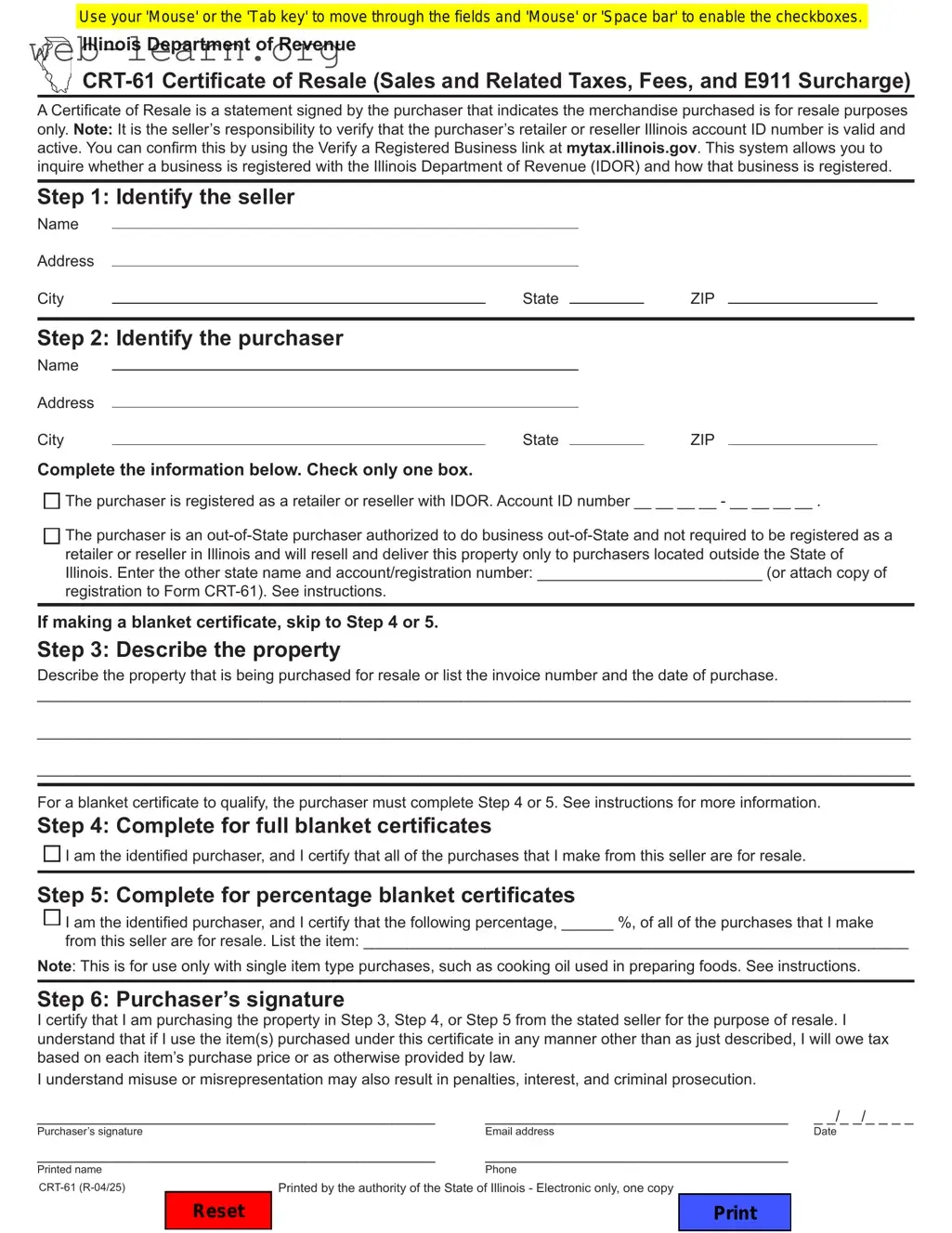
Use your 'Mouse' or the 'Tab key' to move through the fields and 'Mouse' or 'Space bar' to enable the checkboxes.

Illinois Department of Revenue

CRT-61 Certificate of Resale (Sales and Related Taxes, Fees, and E911 Surcharge)

A Certificate of Resale is a statement signed by the purchaser that indicates the merchandise purchased is for resale purposes only. Note: It is the seller’s responsibility to verify that the purchaser’s retailer or reseller Illinois account ID number is valid and active. You can confirm this by using the Verify a Registered Business link at mytax.illinois.gov. This system allows you to inquire whether a business is registered with the Illinois Department of Revenue (IDOR) and how that business is registered.

Step 1: Identify the seller

Name

Address

City


State


ZIP


Step 2: Identify the purchaser

Name

Address

City


State


ZIP


Complete the information below. Check only one box.

The purchaser is registered as a retailer or reseller with IDOR. Account ID number __ __ __ __ - __ __ __ __ .

The purchaser is an out-of-State purchaser authorized to do business out-of-State and not required to be registered as a retailer or reseller in Illinois and will resell and deliver this property only to purchasers located outside the State of Illinois. Enter the other state name and account/registration number: __________________________ (or attach copy of

registration to Form CRT-61). See instructions.

If making a blanket certificate, skip to Step 4 or 5.

Step 3: Describe the property

Describe the property that is being purchased for resale or list the invoice number and the date of purchase.

_____________________________________________________________________________________________________

_____________________________________________________________________________________________________

_____________________________________________________________________________________________________

For a blanket certificate to qualify, the purchaser must complete Step 4 or 5. See instructions for more information.

Step 4: Complete for full blanket certificates

I am the identified purchaser, and I certify that all of the purchases that I make from this seller are for resale.

Step 5: Complete for percentage blanket certificates

I am the identified purchaser, and I certify that the following percentage, ______ %, of all of the purchases that I make

from this seller are for resale. List the item: _______________________________________________________________

Note: This is for use only with single item type purchases, such as cooking oil used in preparing foods. See instructions.

Step 6: Purchaser’s signature

I certify that I am purchasing the property in Step 3, Step 4, or Step 5 from the stated seller for the purpose of resale. I understand that if I use the item(s) purchased under this certificate in any manner other than as just described, I will owe tax based on each item’s purchase price or as otherwise provided by law.

I understand misuse or misrepresentation may also result in penalties, interest, and criminal prosecution.

______________________________________________

___________________________________

_ _/_ _/_ _ _ _

Purchaser’s signature


Email address

Date

______________________________________________

___________________________________


Printed name


Phone


CRT-61 (R-04/25)


Printed by the authority of the State of Illinois - Electronic only, one copy


Reset


Print


Form Information

Fact Name Fact Description
Purpose of Form The Illinois CRT-61 form serves as a Certificate of Resale, which proves that no sales tax is due on property purchased for resale.
Seller's Responsibility It is the seller’s duty to verify the purchaser’s Illinois account ID or resale number for validity and activity.
Retention Requirement Sellers must keep the Certificate of Resale as proof that no tax was due on the sale. This certificate should not be mailed to the Illinois Department of Revenue.
Alternate Documentation Other forms or statements can substitute for the CRT-61, provided they include specific information about the seller, purchaser, and the property being purchased.
Blanket Certificate Usage A blanket certificate of resale can be issued for all purchases from a seller, or specify a percentage of purchases that are for resale.
Governing Law The Illinois CRT-61 form is governed by the Illinois Department of Revenue regulations regarding sales tax exemptions for resale transactions.

Detailed Guide for Filling Out Illinois Crt 61

After completing the Illinois CRT-61 form, the seller should keep it on file as proof that the sale was made tax-free. This form is essential for transactions where no sales tax is due because the property is being purchased for resale. Ensure all information is accurate and complete before submitting it to the seller.

  1. Step 1: Identify the seller
    • Line 1: Write the seller’s name.
    • Line 2: Write the seller’s business address, including city, state, and zip code.
  2. Step 2: Identify the purchaser
    • Line 3: Write the purchaser’s name.
    • Line 4: Write the purchaser’s business address, including city, state, and zip code.
    • Line 5: Check the statement that applies to the purchaser’s business and provide any additional requested information.
  3. Step 3: Describe the property
    • Line 6: Briefly describe the tangible personal property being purchased for resale or list the invoice number and date of purchase.
  4. Step 4: Complete for blanket certificates
    • Line 7: Check the appropriate statement regarding the percentage of purchases for resale and provide any additional requested information.
  5. Step 5: Purchaser’s signature
    • Sign and date the form to certify the purchase for resale.

Obtain Answers on Illinois Crt 61

  1. What is the Illinois CRT-61 form?

    The Illinois CRT-61 form, also known as the Certificate of Resale, is a document that allows purchasers to buy items tax-free when those items are intended for resale. This form is essential for businesses that buy goods to sell them to consumers, as it serves as proof that no sales tax is due on the transaction.

  2. When is a Certificate of Resale required?

    A Certificate of Resale is generally required whenever a sale is made tax-free under the premise that the goods will be resold. If you are a purchaser, you will need to provide this certificate to the seller upon request. This process ensures that the seller has the necessary documentation to validate that no tax is owed on the sale.

  3. Who is responsible for keeping the Certificate of Resale?

    The seller is responsible for retaining the Certificate of Resale. It's crucial for sellers to keep this document on file, as it may be requested by the Illinois Department of Revenue as proof that no sales tax was due on the transaction. Remember, do not mail the certificate to the department; it must be kept by the seller.

  4. Can other forms be used instead of the CRT-61?

    Yes, other forms or statements can serve as proof of a sale made for resale. However, any alternative documentation must include certain key information, such as:

    • The seller's name and address
    • The purchaser's name and address
    • A description of the property being purchased
    • A statement indicating the property is for resale
    • The purchaser's signature and date
    • An Illinois account ID number, resale number, or certification for out-of-state purchasers

    A signed purchase order may also qualify as a Certificate of Resale if it contains all required information.

  5. What is a blanket certificate of resale?

    A blanket certificate of resale allows a purchaser to provide a single certificate to a seller for all purchases made for resale. This can simplify the process for businesses that consistently buy items for resale. The blanket certificate can also specify that only a percentage of the purchases will be for resale. It's important to keep these certificates updated, especially if the percentage changes or at least every three years.

  6. What are the specific steps to fill out the CRT-61 form?

    Filling out the CRT-61 form involves a few straightforward steps:

    1. Step 1: Identify the seller by providing their name and mailing address.
    2. Step 2: Identify the purchaser by filling in their name and mailing address.
    3. Step 3: Describe the property being purchased for resale or list the invoice number and date of purchase.
    4. Step 4: If using a blanket certificate, check the appropriate statement and provide any additional requested information.
    5. Step 5: The purchaser must sign and date the form to validate the information provided.

    Following these steps ensures that the form is completed correctly and meets the requirements set by the Illinois Department of Revenue.

Common mistakes

Filling out the Illinois CRT-61 form can be straightforward, but there are common mistakes that people often make. One frequent error is failing to verify the purchaser's Illinois account ID or resale number. It is the seller's responsibility to ensure this information is valid and active. Not checking can lead to complications later, as the seller must keep the certificate as proof that no tax was due on the sale.

Another mistake involves not providing complete information about the seller and purchaser. Lines 1 through 4 require the names and addresses of both parties. Omitting any details can create confusion and may result in the form being rejected. Ensuring that all information is accurate and complete is crucial for a valid certificate.

People sometimes neglect to describe the property being purchased for resale. Line 6 asks for a brief description or the invoice number and date of purchase. Skipping this step can lead to misunderstandings about what is being sold tax-free, which could cause issues during an audit.

Additionally, some individuals do not update blanket certificates of resale. If the percentage of purchases that are for resale changes, a new certificate should be provided. Keeping these documents current is important, as outdated information may not be accepted during a tax review.

Another common oversight is not signing and dating the form. Step 5 requires the purchaser's signature and the date of signing. Without this, the form is incomplete and may not hold up as valid proof of the resale transaction.

Lastly, people sometimes use incorrect forms or statements in place of the CRT-61 certificate. While other forms can be used, they must contain all required information. Failing to include the necessary details can lead to complications and may result in tax liabilities that could have been avoided.

Documents used along the form

The Illinois CRT-61 form, known as the Certificate of Resale, plays a crucial role in transactions where sales tax is not applicable. However, several other forms and documents are often used in conjunction with the CRT-61 to ensure compliance with tax regulations and to facilitate smooth transactions. Below is a list of these important documents.

  • Purchase Order: This document serves as an official request from the purchaser to the seller, detailing the items being ordered. It can function as a Certificate of Resale if it includes all necessary information, such as the seller's and purchaser's names and addresses, a description of the property, and the purchaser's signature.
  • Illinois Resale Certificate: Similar to the CRT-61, this certificate is used by purchasers to assert that they are buying goods for resale. It must include specific details about the transaction, including the seller's and purchaser's information and a description of the items purchased.
  • Blanket Certificate of Resale: This document allows purchasers to certify that all future purchases from a specific seller will be for resale. It can also specify a percentage of purchases that are for resale, making it a versatile option for ongoing transactions.
  • Sales Tax Exemption Certificate: This form is used by purchasers who qualify for sales tax exemptions, such as non-profit organizations. It provides proof to sellers that the purchaser is exempt from paying sales tax on certain items.
  • Illinois Business Registration: This document proves that a business is registered with the Illinois Department of Revenue. It is essential for sellers to verify that the purchaser is a legitimate business entity before accepting a Certificate of Resale.
  • Tax Compliance Certificate: Issued by the Illinois Department of Revenue, this certificate confirms that a business is compliant with state tax regulations. It can be helpful for sellers to ensure that their purchasers are in good standing.
  • Invoice: An invoice serves as a detailed bill for goods or services provided. It should include essential transaction details and can support the information provided in a Certificate of Resale when needed.

Understanding these forms and documents is essential for both buyers and sellers to navigate the complexities of tax regulations in Illinois. Proper documentation not only ensures compliance but also fosters trust and transparency in business transactions.

Similar forms

  • Illinois CRT-62 Form: Similar to the CRT-61, the CRT-62 is also a certificate of resale but is specifically used for transactions involving certain types of tangible personal property. It requires similar information such as seller and purchaser details and the nature of the property being sold.
  • Illinois CRT-63 Form: This form serves as a blanket certificate of resale, allowing a purchaser to make multiple tax-exempt purchases from the same seller. Like the CRT-61, it requires the seller's and purchaser's names and addresses, along with a description of the property.
  • Illinois Form ST-2: The ST-2 is a general resale certificate used in Illinois. It functions similarly to the CRT-61 by providing proof that a sale is tax-exempt due to resale. It also includes necessary seller and purchaser information.
  • Illinois Form ST-5: This form is used for claiming exemption from sales tax on certain purchases. It shares similarities with the CRT-61 in that it requires detailed information about the purchaser and the items being purchased.
  • Sales Tax Exemption Certificate: This document allows buyers to make tax-exempt purchases. It is akin to the CRT-61 as it verifies that the buyer intends to resell the items and must include similar identifying details.
  • Purchase Order: A signed purchase order can serve as a certificate of resale if it contains all required information. This aligns with the CRT-61 in terms of verifying the buyer's intent to resell.
  • Resale Certificate from Other States: Similar to the CRT-61, these certificates are used in other states to validate tax-exempt purchases. They also require detailed seller and purchaser information.
  • Vendor's Affidavit: This document can serve as proof of tax-exempt status for purchases. It is similar to the CRT-61 in that it confirms the buyer's intent to resell and includes necessary details.
  • Illinois Form ST-1: This is another certificate used for tax-exempt sales. It requires similar information to the CRT-61, including seller and purchaser names and the nature of the purchase.
  • Exemption Certificate for Nonprofit Organizations: This document allows nonprofit entities to make tax-exempt purchases. Like the CRT-61, it necessitates detailed information about the organization and the items being acquired.

Dos and Don'ts

When filling out the Illinois CRT-61 form, there are important do's and don'ts to keep in mind. This ensures compliance and accuracy in the process.

  • Do verify the purchaser's Illinois account ID or resale number is valid before completing the form.
  • Do provide complete and accurate information for both the seller and purchaser.
  • Do describe the property clearly in Step 3 to avoid confusion.
  • Do keep the completed certificate on file as proof of tax-exempt sales.
  • Do use the Verify a Registered Business tool on the Illinois Department of Revenue website.
  • Don't mail the CRT-61 certificate to the Illinois Department of Revenue.
  • Don't forget to sign and date the form; an unsigned form is invalid.
  • Don't use vague descriptions for the property being purchased for resale.
  • Don't assume that a statement of resale is sufficient without supporting evidence.

Misconceptions

Understanding the Illinois CRT-61 form is crucial for both sellers and purchasers. However, several misconceptions can lead to confusion. Here are six common misconceptions:

  • The CRT-61 form must be mailed to the Illinois Department of Revenue. This is incorrect. The seller is required to keep the form for their records and should not send it to the Department of Revenue.
  • Any document can serve as a Certificate of Resale. While other forms or statements can be used, they must include specific information, such as the seller's and purchaser's names and addresses, a description of the property, and the purchaser's signature.
  • A blanket certificate of resale can be used indefinitely. This is a misconception. Blanket certificates should be updated every three years or whenever there is a change in the specified percentage of resale purchases.
  • The seller is responsible for verifying the purchaser's resale status. This is misleading. While the seller should confirm the validity of the purchaser's Illinois account ID or resale number, the ultimate responsibility lies with the purchaser.
  • Purchase orders cannot be used as a Certificate of Resale. This is not true. A purchase order can serve as a Certificate of Resale if it contains all the required information.
  • Only Illinois-based purchasers can use the CRT-61 form. This is incorrect. The form can also be used by purchasers who are registered as out-of-state retailers, provided they meet the necessary requirements.

Key takeaways

Filling out and using the Illinois CRT-61 form involves several important steps and considerations. Here are key takeaways to keep in mind:

  • Responsibility for Verification: The seller must verify that the purchaser’s Illinois account ID or resale number is valid and active. This can be done using the Verify a Registered Business tool on the Illinois Department of Revenue website.
  • Purpose of the Certificate: A Certificate of Resale is necessary to prove that no sales tax is due on transactions made for resale.
  • Retention of Certificate: The seller is required to keep the Certificate of Resale for their records. It should not be mailed to the Illinois Department of Revenue.
  • Alternative Forms: Other forms or statements can be used instead of the CRT-61, provided they include essential information such as names, addresses, and a description of the property.
  • Blanket Certificates: A blanket Certificate of Resale can be issued when all purchases from a seller are for resale. It can also specify a percentage of purchases that will be for resale.
  • Updating Certificates: Blanket certificates should be updated regularly. If the specified percentage of resale purchases changes, a new certificate must be provided. Otherwise, updates should occur at least every three years.
  • Detailed Instructions: Specific lines on the form must be filled out accurately, including identifying both the seller and purchaser, describing the property, and signing the certificate.
  • Supporting Evidence Required: A statement from the purchaser indicating that property will be sold for resale is insufficient without supporting evidence, such as proof of out-of-state registration.
  • Signature Requirement: The purchaser must sign and date the CRT-61 form to validate the transaction.