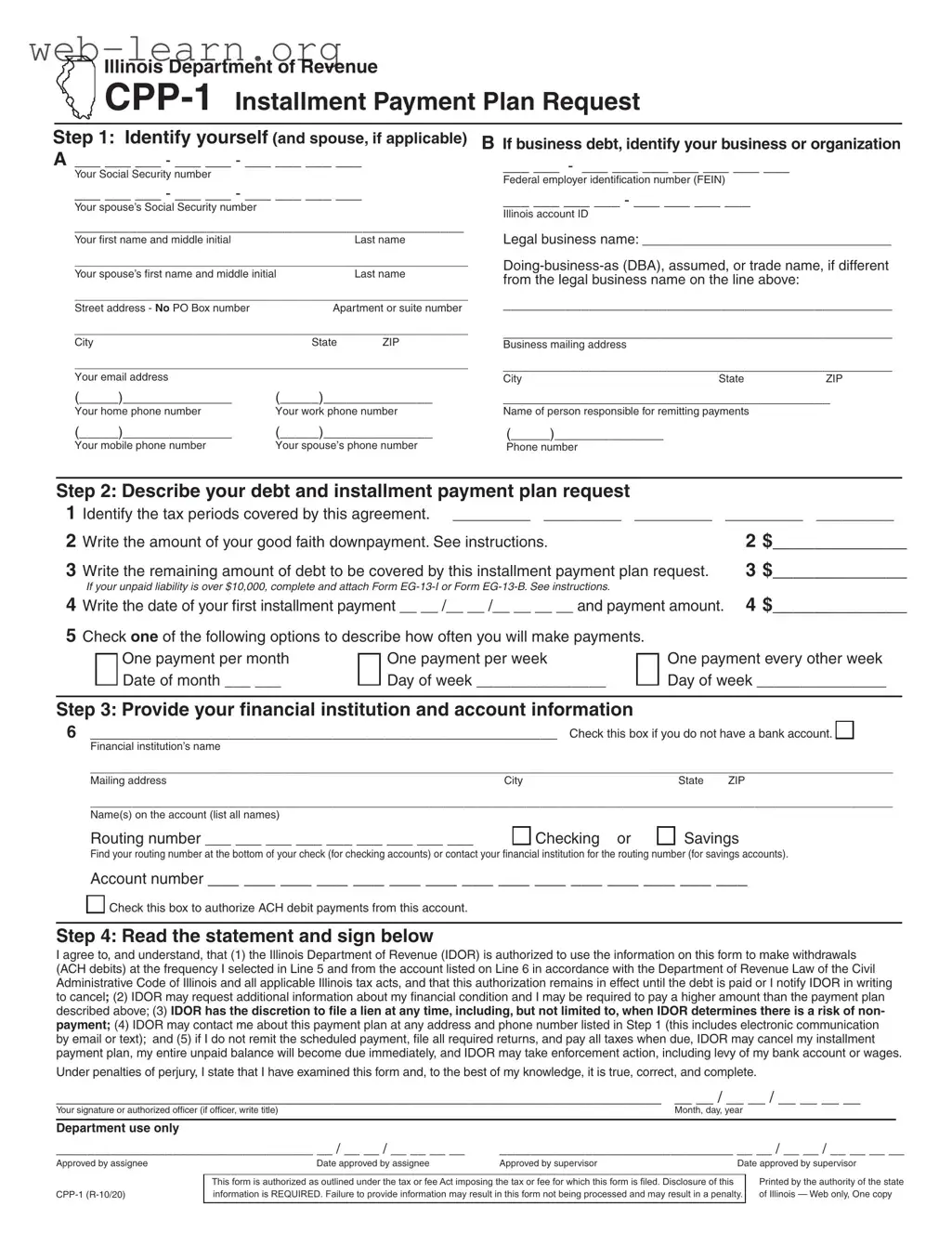
The Illinois CPP-1 form, officially known as the Installment Payment Plan Request, serves as a vital tool for individuals and businesses facing tax delinquencies they cannot pay in full due to financial hardship. This form is designed to help taxpayers propose a structured payment plan to the Illinois Department of Revenue, allowing them to settle their tax debts through manageable installments. Key components of the CPP-1 include personal identification details, such as names and Social Security numbers, as well as information about the debt itself, including the tax periods covered and the total amount owed. Taxpayers must also specify their proposed payment frequency and amount, ensuring that the plan aligns with their financial situation. Additionally, the form requires banking information for automatic withdrawals, streamlining the payment process. By completing and submitting the CPP-1, taxpayers can communicate their intent to resolve their tax obligations while navigating the challenges of financial strain.
Illinois Department of Revenue
Installment Payment Plan Request
_________________________________________________________________
CityStateZIP
_________________________________________________________________
Your email address
BIf business debt, identify your business or organization
___ ___ - ___ ___ ___ ___ ___ ___ ___
Federal employer identification number (FEIN)
___ ___ ___ ___ - ___ ___ ___ ___
Illinois account ID
Legal business name: ________________________________
__________________________________________________
__________________________________________________
Business mailing address
__________________________________________________
City |
State |
ZIP |
(_____)______________ |
(_____)______________ |
__________________________________________ |
Your home phone number |
Your work phone number |
Name of person responsible for remitting payments |
(_____)______________ |
(_____)______________ |
(_____)______________ |
Your mobile phone number |
Your spouse’s phone number |
Phone number |
Step 2: Describe your debt and installment payment plan request
1 |
Identify the tax periods covered by this agreement. _________ _________ _________ |
_________ _________ |
|
2 |
Write the amount of your good faith downpayment. See instructions. |
2 |
$_____________ |
3 |
Write the remaining amount of debt to be covered by this installment payment plan request. |
3 |
$_____________ |
If your unpaid liability is over $10,000, complete and attach Form
4 Write the date of your first installment payment __ __ /__ __ /__ __ __ __ and payment amount. 4 $_____________
5Check one of the following options to describe how often you will make payments.
One payment per month |
|
One payment per week |
Date of month ___ ___ |
|
Day of week _______________ |
One payment every other week Day of week _______________
Step 3: Provide your financial institution and account information
6 ______________________________________________________ Check this box if you do not have a bank account.
Financial institution’s name
____________________________________________________________________________________________________________________
Mailing addressCityState ZIP
____________________________________________________________________________________________________________________
Name(s) on the account (list all names)
Routing number ___ ___ ___ ___ ___ ___ ___ ___ ___
Checking or
Savings
Find your routing number at the bottom of your check (for checking accounts) or contact your financial institution for the routing number (for savings accounts).
Account number ___ ___ ___ ___ ___ ___ ___ ___ ___ ___ ___ ___ ___ ___ ___
Check this box to authorize ACH debit payments from this account.
Step 4: Read the statement and sign below
I agree to, and understand, that (1) the Illinois Department of Revenue (IDOR) is authorized to use the information on this form to make withdrawals (ACH debits) at the frequency I selected in Line 5 and from the account listed on Line 6 in accordance with the Department of Revenue Law of the Civil Administrative Code of Illinois and all applicable Illinois tax acts, and that this authorization remains in effect until the debt is paid or I notify IDOR in writing to cancel; (2) IDOR may request additional information about my financial condition and I may be required to pay a higher amount than the payment plan described above; (3) IDOR has the discretion to file a lien at any time, including, but not limited to, when IDOR determines there is a risk of non- payment; (4) IDOR may contact me about this payment plan at any address and phone number listed in Step 1 (this includes electronic communication by email or text); and (5) if I do not remit the scheduled payment, file all required returns, and pay all taxes when due, IDOR may cancel my installment payment plan, my entire unpaid balance will become due immediately, and IDOR may take enforcement action, including levy of my bank account or wages.
Under penalties of perjury, I state that I have examined this form and, to the best of my knowledge, it is true, correct, and complete.
______________________________________________________________________ |
__ __ / __ __ / __ __ __ __ |
|
||
Your signature or authorized officer (if officer, write title) |
|
|
Month, day, year |
|
|
|
|
|
|
Department use only |
|
|
|
|
_________________________________ __ / __ __ / __ __ __ __ |
______________________________ __ __ / __ __ / __ __ __ __ |
|||
Approved by assignee |
Date approved by assignee |
Approved by supervisor |
Date approved by supervisor |
|
This form is authorized as outlined under the tax or fee Act imposing the tax or fee for which this form is filed. Disclosure of this information is REQUIRED. Failure to provide information may result in this form not being processed and may result in a penalty.
Printed by the authority of the state of Illinois — Web only, One copy
See instructions on next page.

Instructions for Form
General Information
Who should file this form?
You should file Form
What is an installment payment plan?
An installment payment plan is an agreement between you and the Illinois Department of Revenue to pay your tax delinquencies using regularly scheduled payments. Your scheduled payment amount and the length of time that you have to pay is based on your financial condition.
When is this form due?
There is no specific due date. We recommend that you file this form when you receive a bill or notice which you are unable to pay because of a financial hardship. Once you receive the bill or notice, you should complete and return this form within 10 days. Note: Even when you enter into an installment payment plan, you continue to accrue interest and applicable penalties and fees on the delinquent tax you owe.
When will my installment payment plan request be approved?
Approval of your request for an installment payment plan will depend upon the completeness of the information you provide on this form. If additional information is needed to process your request, we will contact you.
If our review finds that you
•can pay in full, then we will require you to do so.
•qualify for an installment payment plan, we will send you a letter of
approval and the conditions of the installment payment plan.
How must I make my installment plan payments?
ACH debit — If you have a checking or savings account, you may be required to make your installment payments using the ACH debit program. It is the recommended form of payment for installment payments. The ACH debit program allows you to have the installment payments automatically withdrawn from a savings or checking account.
Note: If we approve your installment payment plan request, your plan approval letter will describe the requirements for your payments.
How must I make my first payment or extra payments?
To make your first payment or if you would like to make payments IN ADDITION to your regular installment payments, you may use one of the following options.
•MyTax Illinois — This is the Department’s online account management system. You may use MyTax Illinois to make electronic
payments as well as file returns for most taxes. Go TO mytax.illinois.gov.
•“Pay by Phone” — Call
1
•Mail — You may mail your remittance to
INSTALLMENT CONTRACT UNIT ILLINOIS DEPARTMENT OF REVENUE PO BOX 19035
SPRINGFIELD IL
•Credit card (This payment method is only available for Individual Income Tax liability.) — You
may make payments using your Visa, Discover, MasterCard, or American Express. The credit card service provider will assess a convenience fee. Each service provider charges its own rate. The rates can vary daily. The Department of Revenue receives no money from these fees. Please note that this is the only payment option where you will be charged a convenience fee. To make a credit card payment, visit our website at tax.illinois.gov or call 1
Where do I send my completed form?
Please fax your completed form to us at 217
INSTALLMENT CONTRACT UNIT ILLINOIS DEPARTMENT OF REVENUE PO BOX 19035
SPRINGFIELD IL
Where do I get help?
•Visit our website at tax.illinois.gov
•Call our Installment Contract Unit at 217
•Write to
INSTALLMENT CONTRACT UNIT ILLINOIS DEPARTMENT OF REVENUE PO BOX 19035
SPRINGFIELD IL
Step 1: Debtor identification
Line A Complete all lines. If you have a spouse who is also liable, complete the lines about your spouse.
Line B If business debt, complete all lines to identify the business or organization.
Step 2: Describe your debt and installment payment plan request
Line 1 Identify all tax periods (i.e., month, quarter, or year) for which the liability exists. For individual or business income tax liabilities, write the tax year covered by the return.
If you need additional space, write the tax period beside the line provided or list the tax periods on a separate sheet of paper and attach it to this form.
If you have both individual income tax and other tax debt, submit a separate Form
If you are requesting an installment payment plan for more than one type of tax other than individual income tax (i.e., sales, withholding, excise, or business income tax), you may combine the tax types on your Form
Line 2 Write the amount of your good faith down payment (which is due with your completed Form
Line 3 Write the amount of debt to be included in your installment payment plan. If your unpaid liability is over $10,000, complete Form
Information Statement for Individuals, or Form
Line 4 For your regular installment plan payments, write the date payments will begin and the amount of each payment. Please make the payment amount as large as possible to reduce additional interest accrual. Interest accrues on the tax until paid.
Line 5 Check one box to tell us how frequently you will make your installment plan payments as identified on Line 4.
Step 3: Provide your financial institution and account information
Complete all lines about your account. Check the box to authorize the Illinois Department of Revenue to utilize the ACH debit method of payment from this account.
Step 4: Read the statement and sign the form
You (or in the case of a business, the person responsible for remitting payments) must sign the statement. If you do not, processing of your request will be delayed and we may take collection action to collect the unpaid debt.
We will contact you if we do not approve the installment payment plan as you request or if we need additional information from you.
By signing the application, you agree to the following:
(1)the Illinois Department of Revenue (IDOR) is authorized to use the information on this form to make withdrawals (ACH debits) at the frequency you selected in Line 5 and from the account listed on Line 6 in accordance with the Department of Revenue Law of the Civil Administrative Code of Illinois and all applicable Illinois tax acts,
and that this authorization remains in effect until the debt is paid or you notify IDOR in writing to cancel;
(2)IDOR may request additional information about your financial condition and you may be required to pay a higher amount than the payment plan described on this form;
(3)IDOR has the discretion to file a lien at any time, including, but not limited to, when IDOR determines there is a risk of
(4)IDOR may contact you about this payment plan at any address and phone number listed in Step 1 (this includes electronic communication by email or text); and
(5)if you do not remit the scheduled payment, file all required returns, and pay all taxes when due, IDOR may cancel the installment payment plan, the entire unpaid balance will become due immediately, and IDOR may take enforcement action, including levy of your bank account or wages.
| Fact Name | Details |
|---|---|
| Purpose of Form | The Illinois CPP-1 form is used to request an installment payment plan for tax delinquencies due to financial hardship. |
| Governing Law | This form is governed by the Department of Revenue Law of the Civil Administrative Code of Illinois and applicable Illinois tax acts. |
| Submission Recommendations | It is recommended to file the CPP-1 form within 10 days of receiving a bill or notice that cannot be paid in full. |
| Payment Method | Payments are typically made via ACH debit from a checking or savings account, as authorized on the form. |
Filling out the Illinois CPP-1 form is a straightforward process that helps you request an installment payment plan for your tax obligations. Completing this form accurately is essential, as it ensures your request is processed smoothly. Here’s how to fill it out step by step.
After completing the form, make sure to send it to the appropriate address or fax number as indicated. The Illinois Department of Revenue will review your request and get back to you regarding the approval of your installment payment plan.
What is the Illinois CPP-1 form?
The Illinois CPP-1 form, also known as the Installment Payment Plan Request, is a document that allows individuals or businesses with tax delinquencies to request a payment plan. This form is specifically designed for those who are experiencing financial hardship and cannot pay their tax debts in full. By submitting this form, you can propose a structured plan to pay off your tax liabilities over time.
Who should file the CPP-1 form?
If you have outstanding tax debts that you are unable to pay due to financial difficulties, you should consider filing the CPP-1 form. This applies to both individuals and businesses. If your tax liabilities are over $10,000, additional forms may be required.
When should I submit the CPP-1 form?
While there is no specific deadline for submitting the CPP-1 form, it is advisable to do so as soon as you receive a tax bill or notice that you cannot pay. Ideally, you should submit the form within 10 days of receiving the notice to demonstrate your intent to resolve the debt.
How do I determine my down payment amount?
The down payment is the initial amount you propose to pay with your CPP-1 form. It is recommended to make this payment as large as possible to reduce the total interest that will accrue on your unpaid tax balance. The specific amount should be listed in Line 2 of the form.
What happens after I submit the CPP-1 form?
Once your form is submitted, the Illinois Department of Revenue will review the information provided. If they require additional details, they will reach out to you. If your request is approved, you will receive a letter outlining the terms of your installment payment plan. If you can pay the debt in full, you will be required to do so.
How can I make my installment payments?
The preferred method for making installment payments is through ACH debit, where funds are automatically withdrawn from your bank account. You can also make payments using MyTax Illinois, by phone, or by mailing a check. If you choose to pay by credit card, be aware that a convenience fee will apply.
What should I do if I need help with the CPP-1 form?
If you have questions or need assistance while completing the CPP-1 form, you can visit the Illinois Department of Revenue website or contact their Installment Contract Unit. They can provide guidance and answer any specific questions you may have.
What are the consequences of not adhering to the payment plan?
If you fail to make your scheduled payments or do not file required tax returns, the Illinois Department of Revenue may cancel your installment payment plan. This means your entire unpaid balance could become due immediately, and they may take enforcement actions, such as levying your bank account or wages.
Can I change my payment plan after it has been approved?
Once your payment plan is approved, any changes would typically require a new request or additional documentation. It’s important to communicate with the Illinois Department of Revenue if your financial situation changes or if you need to adjust your payment schedule.
Filling out the Illinois Cpp 1 form can be a straightforward process, but many individuals make common mistakes that can delay their application or even lead to its rejection. Understanding these pitfalls can help ensure a smoother experience.
One frequent error is incomplete personal information. Applicants often fail to fill in all required fields, such as their spouse's name or Social Security number if applicable. Omitting this information can lead to processing delays, as the Illinois Department of Revenue may need to reach out for the missing details.
Another mistake involves the incorrect identification of tax periods. When specifying the tax periods covered by the installment payment plan, individuals sometimes write the wrong years or leave out crucial periods. This can complicate the approval process, as it may not be clear which debts are being addressed.
Many people also underestimate the importance of the good faith down payment. Some applicants either forget to include this payment or submit an amount that is too low. A larger down payment can not only reduce interest but also demonstrate a commitment to repaying the debt, which may positively influence approval chances.
Providing inaccurate financial institution details is another common error. Applicants may miswrite their bank account number or routing number, which can hinder the automatic withdrawal process. It is essential to double-check these numbers to ensure they are accurate, as any discrepancies can lead to payment failures.
Additionally, individuals often neglect to sign the form. A missing signature can halt the processing of the application entirely. It is crucial to ensure that the form is signed by the applicant or an authorized officer if applicable.
Lastly, some applicants fail to read the terms and conditions associated with the installment payment plan. Not understanding the implications of missed payments or the potential for additional fees can lead to unexpected complications down the road. Being fully aware of these terms is vital for maintaining compliance and ensuring the plan remains in good standing.
When dealing with tax issues in Illinois, you may encounter several forms and documents that complement the Illinois CPP-1 form. Each of these documents serves a specific purpose in the process of managing your tax liabilities and entering into an installment payment plan. Below is a list of commonly used forms along with a brief description of each.
Understanding these forms and documents can help you navigate your tax obligations more effectively. If you have questions or need assistance, consider reaching out to a tax professional or the Illinois Department of Revenue for guidance.
When filling out the Illinois CPP-1 form, attention to detail is crucial. Here are six important dos and don'ts to ensure your application is processed smoothly.
Submitting a well-completed form will expedite the approval process. Ensure all information is accurate and complete to avoid unnecessary delays.
This form is applicable to both individuals and businesses. If a business has tax delinquencies, it can also use the CPP-1 form to request an installment payment plan.
Approval is not automatic. The Illinois Department of Revenue reviews the information provided. If they determine that you can pay your debt in full, they will require you to do so instead of entering an installment plan.
There is no strict deadline for filing the CPP-1 form. However, it is recommended to submit it within 10 days of receiving a bill or notice that you cannot pay due to financial hardship.
This is incorrect. Payments must be made according to the schedule outlined in the approved plan. Failing to make these payments can lead to the cancellation of the plan and immediate collection actions.
Unfortunately, interest and applicable penalties continue to accrue on the unpaid tax amount even after submitting the form. It’s important to make the largest down payment possible to minimize this.
Providing complete and accurate financial information is essential for processing your request. Incomplete forms can delay approval or result in denial of the installment plan.
Filling out the Illinois CPP-1 form can be a straightforward process if you keep a few key points in mind. Here are some essential takeaways to help guide you through:
By following these key takeaways, you can navigate the process of filling out the Illinois CPP-1 form more effectively. Remember, taking the first step toward managing your tax debt is a positive move.