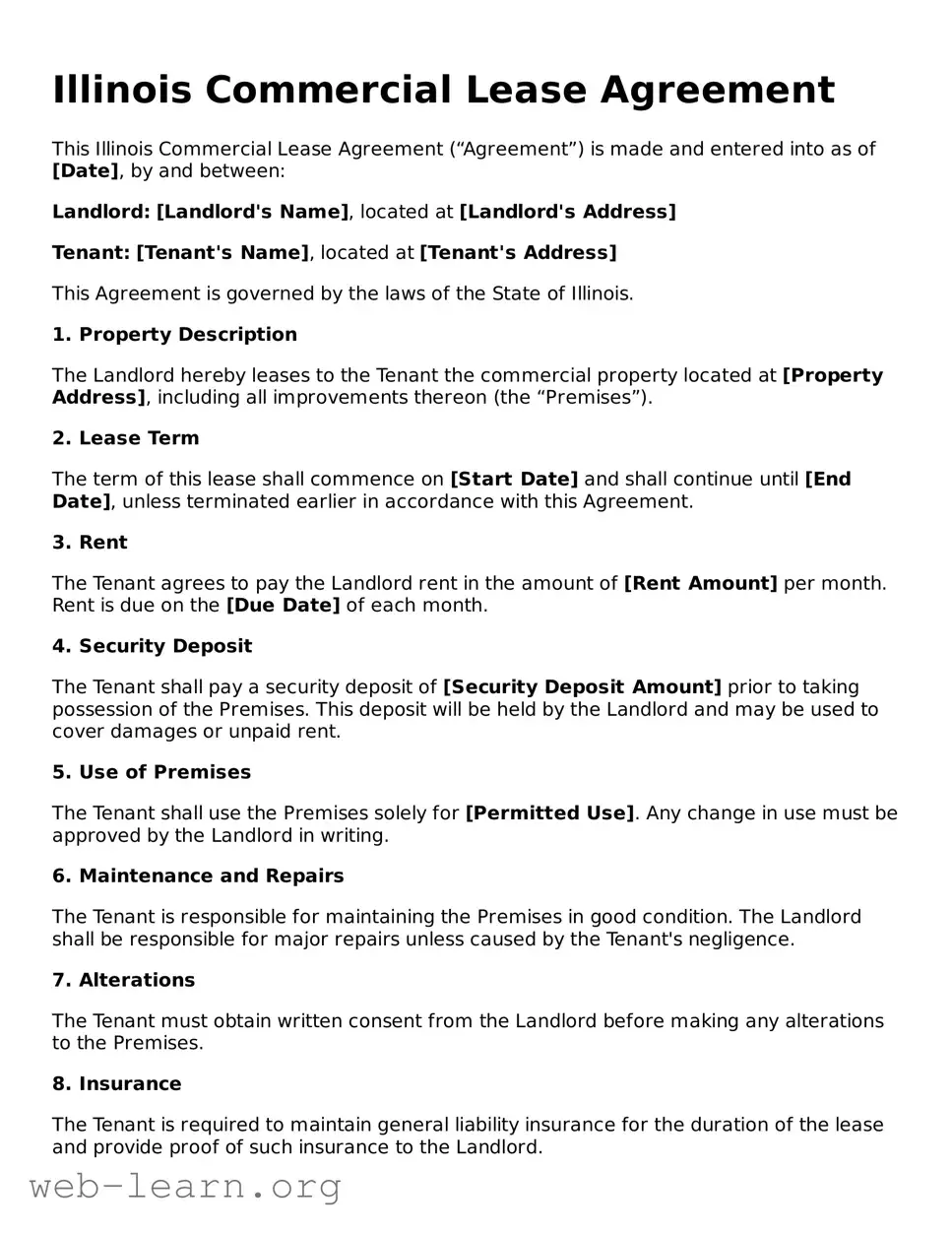
The Illinois Commercial Lease Agreement form serves as a crucial document for landlords and tenants engaged in commercial property transactions. This form outlines the terms and conditions under which a tenant can occupy a commercial space, ensuring both parties understand their rights and obligations. Key components of the agreement include the duration of the lease, the rental amount, and payment schedule. Additionally, it addresses maintenance responsibilities, security deposits, and provisions for lease termination. The document may also include clauses related to property use, insurance requirements, and any restrictions that may apply. Understanding these elements is essential for both landlords and tenants to avoid disputes and ensure a smooth leasing process.
Illinois Commercial Lease Agreement
This Illinois Commercial Lease Agreement (“Agreement”) is made and entered into as of [Date], by and between:
Landlord: [Landlord's Name], located at [Landlord's Address]
Tenant: [Tenant's Name], located at [Tenant's Address]
This Agreement is governed by the laws of the State of Illinois.
1. Property Description
The Landlord hereby leases to the Tenant the commercial property located at [Property Address], including all improvements thereon (the “Premises”).
2. Lease Term
The term of this lease shall commence on [Start Date] and shall continue until [End Date], unless terminated earlier in accordance with this Agreement.
3. Rent
The Tenant agrees to pay the Landlord rent in the amount of [Rent Amount] per month. Rent is due on the [Due Date] of each month.
4. Security Deposit
The Tenant shall pay a security deposit of [Security Deposit Amount] prior to taking possession of the Premises. This deposit will be held by the Landlord and may be used to cover damages or unpaid rent.
5. Use of Premises
The Tenant shall use the Premises solely for [Permitted Use]. Any change in use must be approved by the Landlord in writing.
6. Maintenance and Repairs
The Tenant is responsible for maintaining the Premises in good condition. The Landlord shall be responsible for major repairs unless caused by the Tenant's negligence.
7. Alterations
The Tenant must obtain written consent from the Landlord before making any alterations to the Premises.
8. Insurance
The Tenant is required to maintain general liability insurance for the duration of the lease and provide proof of such insurance to the Landlord.
9. Termination
This Agreement may be terminated by either party with [Notice Period] written notice, or as otherwise permitted by law.
10. Governing Law
This Agreement shall be governed by and construed in accordance with the laws of the State of Illinois.
IN WITNESS WHEREOF, the parties hereto have executed this Agreement as of the date first above written.
Landlord Signature: ____________________________ Date: _______________
Tenant Signature: ____________________________ Date: _______________
| Fact Name | Description |
|---|---|
| Governing Law | The Illinois Commercial Lease Agreement is governed by Illinois state law. |
| Parties Involved | The agreement typically involves a landlord and a tenant, both of whom must be clearly identified. |
| Lease Term | The duration of the lease should be specified, including start and end dates. |
| Rent Payment | Details regarding the amount of rent, payment schedule, and method of payment are included. |
| Maintenance Responsibilities | The agreement outlines the maintenance responsibilities of both the landlord and tenant. |
Filling out the Illinois Commercial Lease Agreement form is an important step in establishing a rental relationship between a landlord and a tenant. This process involves providing specific information about the property, the parties involved, and the terms of the lease. Follow the steps below to complete the form accurately.
Once the form is completed, ensure that both parties retain a copy for their records. This will help avoid misunderstandings and provide a reference for the terms agreed upon.
An Illinois Commercial Lease Agreement is a legally binding contract between a landlord and a tenant for the rental of commercial property in Illinois. This document outlines the terms and conditions of the lease, including the duration, rental amount, and responsibilities of both parties. It is essential for protecting the rights of both landlords and tenants.
Several important terms should be included in an Illinois Commercial Lease Agreement:
To terminate a lease early, a tenant must review the lease agreement for any specific provisions regarding early termination. Often, the tenant may need to provide written notice to the landlord and possibly pay an early termination fee. If the lease does not include an early termination clause, the tenant may need to negotiate with the landlord to reach an agreement.
If a landlord fails to make necessary repairs, the tenant has several options. The tenant should first notify the landlord in writing of the needed repairs. If the landlord does not respond, the tenant may have the right to withhold rent, make the repairs and deduct the cost from future rent, or seek legal remedies. It is crucial for the tenant to document all communications and actions taken regarding the repairs.
Yes, a commercial lease can be modified. Any changes must be agreed upon by both the landlord and tenant and should be documented in writing. It is advisable to include an amendment to the original lease that outlines the changes to ensure clarity and legal enforceability.
Filling out the Illinois Commercial Lease Agreement can be a daunting task, and many people make common mistakes that can lead to complications down the road. One frequent error is failing to clearly define the leased premises. It’s crucial to specify the exact location and boundaries of the property to avoid any misunderstandings. A vague description can lead to disputes about what is actually included in the lease.
Another common pitfall is neglecting to include the lease term. This includes not only the start and end dates but also any options for renewal. Without these details, both parties may have different expectations about how long the lease will last, which can create tension later.
Some individuals overlook the importance of specifying the rent amount and payment terms. It’s not enough to simply state the rent; you must also clarify when it is due, how it should be paid, and any penalties for late payments. This clarity helps prevent financial misunderstandings.
Additionally, people often forget to address maintenance responsibilities. The lease should outline who is responsible for repairs and maintenance of the property. If this is left ambiguous, it can lead to disputes over who is accountable for keeping the premises in good condition.
Another mistake is failing to include clauses related to utilities and services. It’s essential to specify which utilities the tenant is responsible for and how those costs will be handled. This oversight can lead to unexpected expenses for both the landlord and tenant.
Many individuals also skip over the importance of insurance requirements. It’s wise to outline what types of insurance the tenant must carry, as well as any liability coverage that the landlord expects. This protects both parties from potential legal issues.
Another frequent error is not including terms regarding subleasing. If a tenant wants to sublease the property, the lease should state whether this is allowed and under what conditions. Not addressing this can create complications if the tenant wishes to leave the space early.
People sometimes forget to discuss the consequences of defaulting on the lease. Clearly outlining what happens if either party fails to meet their obligations can save time and money in the long run. This includes any penalties or rights to terminate the lease.
Lastly, a common mistake is not having both parties sign and date the lease. A lease is not legally binding until it is signed by all parties involved. Failing to do so can render the agreement unenforceable, leaving both parties vulnerable.
By avoiding these common mistakes, you can ensure that your Illinois Commercial Lease Agreement is clear, comprehensive, and beneficial for both parties. Taking the time to carefully fill out the form can save you from potential headaches in the future.
When entering into a commercial lease in Illinois, several additional forms and documents may be required to ensure a smooth transaction and clear understanding between parties. These documents help clarify responsibilities, outline terms, and protect the interests of both landlords and tenants. Below are some common forms often used alongside the Illinois Commercial Lease Agreement.
Understanding these documents can significantly impact the leasing process. Each serves a distinct purpose, and together they create a comprehensive framework for the commercial lease relationship. Being well-informed can lead to better negotiations and a more successful leasing experience.
Residential Lease Agreement: Similar to a commercial lease, this document outlines the terms and conditions for renting a residential property. It includes details such as rent amount, duration, and responsibilities of both the landlord and tenant.
Rental Agreement: This is a broader term that can refer to both residential and commercial leases. It serves to establish the rental terms and conditions, including payment schedules and property maintenance responsibilities.
Sublease Agreement: This document allows a tenant to lease their rented space to another party. It mirrors the original lease in terms of responsibilities and obligations, ensuring that the landlord's rules are still followed.
Lease Option Agreement: This document provides a tenant the option to purchase the leased property at a later date. It includes terms similar to a commercial lease but adds provisions for the potential sale of the property.
When filling out the Illinois Commercial Lease Agreement form, it’s essential to approach the process with care. Here are some important dos and don’ts to consider:
Understanding the Illinois Commercial Lease Agreement form is crucial for both landlords and tenants. However, several misconceptions can lead to confusion. Here are ten common misconceptions explained:
Many people believe that all commercial leases follow the same format. In reality, each lease can vary significantly based on the specific terms negotiated between the parties involved.
Some think that a lease is set in stone once signed. However, landlords and tenants can negotiate amendments as long as both parties agree.
It’s a common belief that landlords handle all maintenance issues. Depending on the lease terms, tenants may also have responsibilities for certain maintenance tasks.
While many leases do include a security deposit, it is not a universal requirement. Some landlords may choose to waive this fee.
Many assume that the rent amount is fixed. In fact, rent is often negotiable, and tenants can discuss terms with landlords before signing.
People often think commercial leases must last for a year. However, lease terms can be shorter or longer, depending on the agreement between the parties.
Not all commercial leases come with a renewal option. It’s essential to check the specific terms to see if this option is included.
Some believe they can handle lease agreements without legal help. However, having legal representation can provide valuable insights and protect interests.
Many think that verbal agreements hold the same weight as written contracts. In most cases, written agreements are far more enforceable.
It’s a misconception that all commercial leases fall under the same legal framework. Different types of leases may be subject to various local and state laws.
By addressing these misconceptions, both landlords and tenants can navigate the Illinois Commercial Lease Agreement more effectively.
Filling out and using the Illinois Commercial Lease Agreement form requires careful attention to detail. Here are some key takeaways to consider:
By keeping these points in mind, both landlords and tenants can better navigate the complexities of commercial leasing in Illinois.