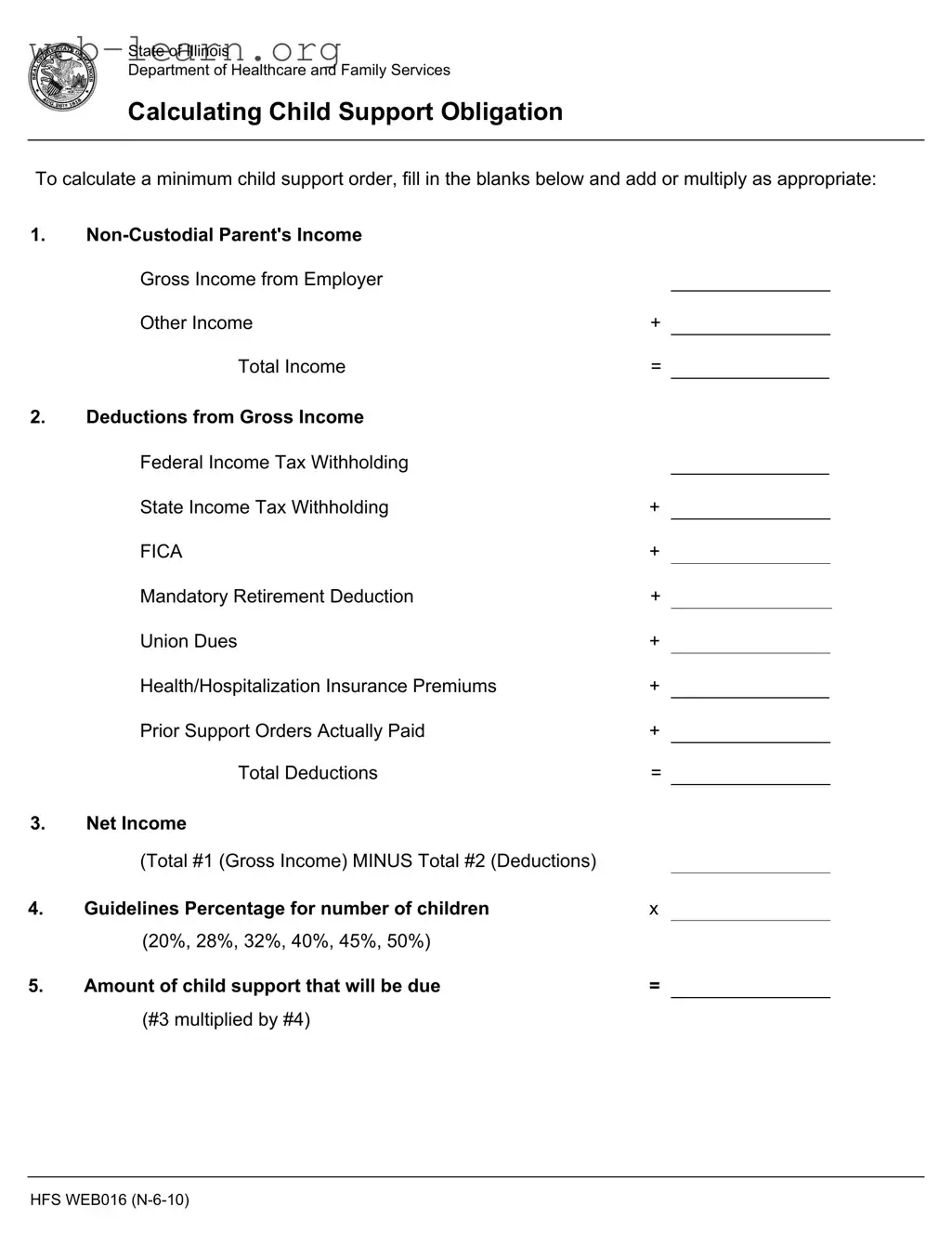
When navigating the complexities of child support in Illinois, the Calculating Support form serves as a vital tool for determining financial obligations. This form is designed to help parents, particularly non-custodial ones, calculate their child support obligations based on their income and necessary deductions. The process begins with the non-custodial parent's gross income, which includes wages from employment and any additional sources of income. From this total, specific deductions must be accounted for, such as federal and state income taxes, FICA contributions, mandatory retirement savings, union dues, and health insurance premiums. The total deductions are subtracted from the gross income to arrive at the net income. This net figure is then multiplied by a percentage that corresponds to the number of children involved—ranging from 20% for one child to 50% for six or more children. By following these steps, parents can arrive at a clear and fair amount of child support that reflects their financial situation and responsibilities.

State of Illinois
Department of Healthcare and Family Services
Calculating Child Support Obligation
To calculate a minimum child support order, fill in the blanks below and add or multiply as appropriate:
1. |
|
|
|
Gross Income from Employer |
|
|
Other Income |
+ |
|
Total Income |
= |
2.Deductions from Gross Income
|
Federal Income Tax Withholding |
|
|
State Income Tax Withholding |
+ |
|
FICA |
+ |
|
Mandatory Retirement Deduction |
+ |
|
Union Dues |
+ |
|
Health/Hospitalization Insurance Premiums |
+ |
|
Prior Support Orders Actually Paid |
+ |
|
Total Deductions |
= |
3. |
Net Income |
|
|
(Total #1 (Gross Income) MINUS Total #2 (Deductions) |
|
4. |
Guidelines Percentage for number of children |
x |
|
(20%, 28%, 32%, 40%, 45%, 50%) |
|
5. |
Amount of child support that will be due |
= |
|
(#3 multiplied by #4) |
|
HFS WEB016
| Fact Name | Details |
|---|---|
| Purpose of the Form | The Illinois Calculating Support form helps determine the minimum child support obligation for non-custodial parents based on their income and deductions. |
| Income Calculation | To calculate total income, the form requires the non-custodial parent's gross income from employment and any other sources of income to be added together. |
| Deductions | The form allows for various deductions from gross income, including federal and state taxes, FICA, and other mandatory expenses, which must be totaled before calculating net income. |
| Governing Law | This form is governed by the Illinois Marriage and Dissolution of Marriage Act, specifically 750 ILCS 5/505, which outlines child support obligations. |
Filling out the Illinois Calculating Support form is a straightforward process that helps determine the child support obligation based on the non-custodial parent's income and deductions. By following these steps, you can accurately complete the form and ensure that all necessary information is included.
After completing the form, review all entries to ensure accuracy. This will help in avoiding any potential issues in the future. Once confirmed, you can submit the form as required by your local child support agency.
What is the purpose of the Illinois Calculating Support form?
The Illinois Calculating Support form is designed to help determine the minimum child support obligation for non-custodial parents. By inputting various income details and deductions, parents can get a clearer picture of their financial responsibilities.
How do I calculate my total income?
To calculate your total income, start with your gross income from your employer. Then, add any other sources of income you may have, such as rental income or bonuses. The sum of these amounts will give you your total income.
What deductions should I consider?
When calculating deductions from your gross income, consider the following:
Add all these deductions together to find your total deductions.
How is net income calculated?
Net income is calculated by taking your total gross income and subtracting your total deductions. This will provide you with the income amount that is subject to child support calculations.
What are the guidelines percentages for child support?
The guidelines percentages for child support in Illinois vary based on the number of children involved. The percentages are as follows:
These percentages are applied to your net income to determine the amount of child support due.
How do I determine the amount of child support due?
To find the amount of child support due, multiply your net income by the appropriate guidelines percentage based on the number of children. This final figure represents your minimum child support obligation.
Is this form mandatory for all child support cases?
While the Illinois Calculating Support form is not legally mandatory for all cases, it serves as a useful tool to guide parents in determining child support obligations. Courts may require a similar calculation during proceedings, so it’s beneficial to be familiar with the process.
When filling out the Illinois Calculating Support form, individuals often make several common mistakes that can affect the accuracy of the child support obligation. One frequent error is failing to include all sources of income. Non-custodial parents may overlook additional income streams such as bonuses, freelance work, or rental income. This omission can lead to an underestimation of total income, which ultimately impacts the child support calculation.
Another mistake involves incorrect deductions from gross income. Some individuals may not account for mandatory deductions, such as FICA or union dues, which can skew the net income figure. It's essential to include all applicable deductions to arrive at an accurate net income amount. Missing even one deduction can result in a significant difference in the final support obligation.
Many people also miscalculate their net income by improperly applying the formula. The calculation requires subtracting total deductions from gross income, but errors in addition or subtraction can lead to incorrect figures. This mistake can occur when individuals rush through the form or do not double-check their calculations.
Additionally, misunderstanding the guidelines percentage for the number of children is another common issue. The percentages vary based on how many children are involved, and selecting the wrong percentage can drastically change the amount of child support owed. It is crucial to ensure that the correct percentage is applied based on the specific circumstances.
Some individuals may also neglect to review the entire form for completeness. Leaving sections blank or providing incomplete information can result in delays or complications in the processing of the child support order. Each section must be filled out thoroughly to avoid potential issues.
Another frequent oversight is not updating the form when circumstances change. If there are changes in income or other relevant factors, the support obligation may need to be recalculated. Failing to submit an updated form can lead to disputes or enforcement actions.
People sometimes misinterpret the instructions provided on the form itself. Clear understanding of the requirements is necessary to complete the form correctly. Misreading instructions can lead to mistakes that could have been avoided with careful attention to detail.
Lastly, individuals may forget to sign and date the form before submission. A lack of signature can result in the form being considered incomplete, delaying the process of establishing or modifying child support. Ensuring that all necessary signatures are included is vital for timely processing.
The Illinois Calculating Support form is a crucial document for determining child support obligations. However, it is often accompanied by several other forms and documents that provide essential information and context. Below is a list of related documents that may be necessary in conjunction with the Calculating Support form.
Gathering these documents is essential for a comprehensive understanding of child support obligations in Illinois. Each document plays a significant role in ensuring that the calculations are fair and reflective of the parents' financial realities.
The Illinois Calculating Support form serves as a tool for determining child support obligations. Several other documents share similarities in purpose and structure. Below is a list of eight such documents, each with a brief explanation of its relation to the Illinois Calculating Support form.
When filling out the Illinois Calculating Support form, consider the following guidelines to ensure accuracy and compliance.
Understanding the Illinois Calculating Support form can be challenging. Here are six common misconceptions that people often have:
By understanding these misconceptions, parents can better navigate the child support process in Illinois.
When using the Illinois Calculating Support form, it is essential to understand the process and requirements involved. Here are key takeaways to consider: