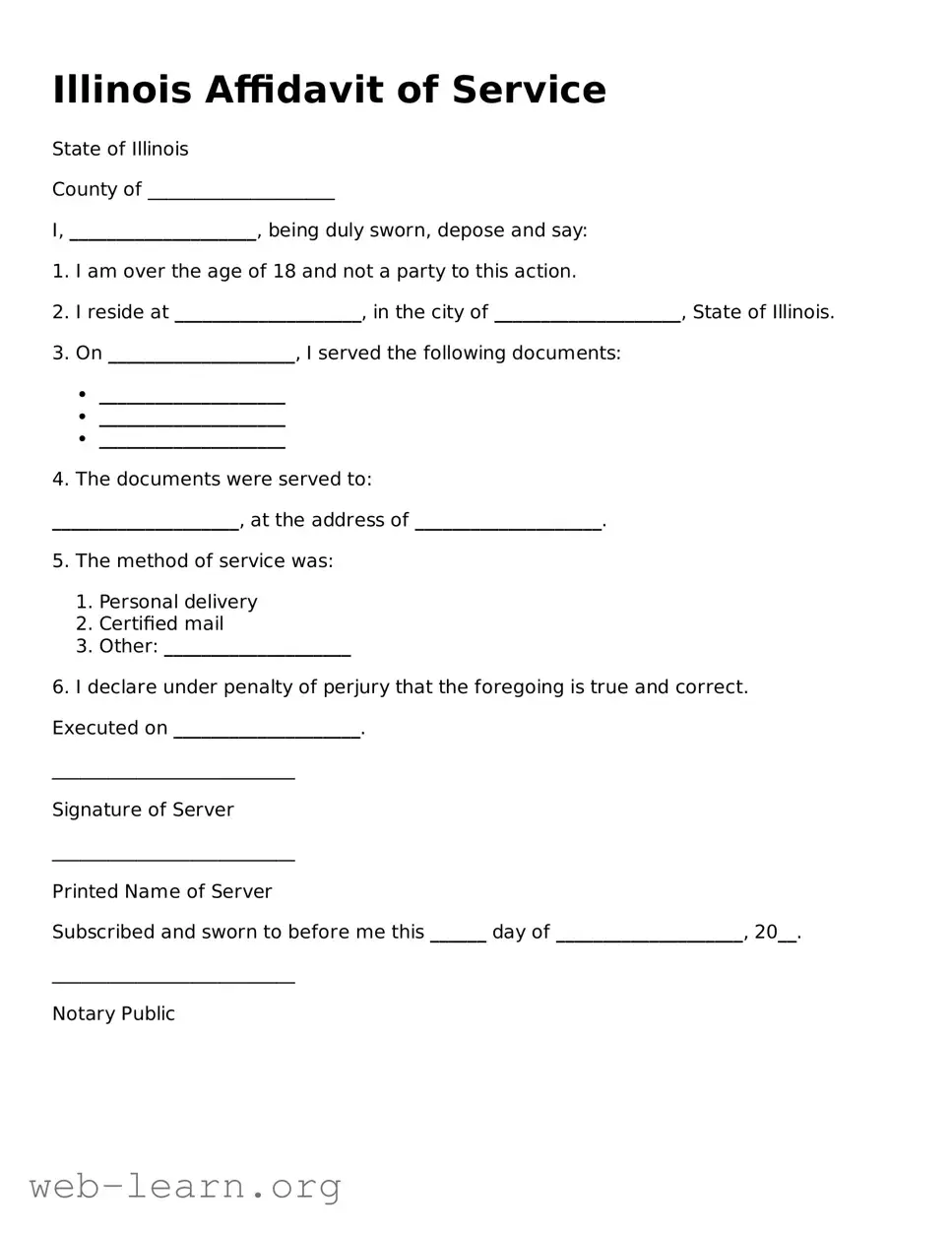
The Illinois Affidavit of Service form plays a crucial role in the legal process by documenting the delivery of legal documents to the relevant parties involved in a case. This form serves as proof that a party has been properly notified, which is essential for ensuring that legal proceedings can move forward without delays. Typically, the affidavit includes details such as the name of the person served, the date and time of service, and the method used for delivery, whether it be personal service, certified mail, or another method. It is important for the individual serving the documents to complete the form accurately and sign it, affirming that the information provided is true. This sworn statement not only helps maintain transparency in legal proceedings but also protects the rights of all parties involved. Understanding the significance and proper use of the Illinois Affidavit of Service form can help individuals navigate the complexities of the legal system more effectively.
Illinois Affidavit of Service
State of Illinois
County of ____________________
I, ____________________, being duly sworn, depose and say:
1. I am over the age of 18 and not a party to this action.
2. I reside at ____________________, in the city of ____________________, State of Illinois.
3. On ____________________, I served the following documents:
4. The documents were served to:
____________________, at the address of ____________________.
5. The method of service was:
6. I declare under penalty of perjury that the foregoing is true and correct.
Executed on ____________________.
__________________________
Signature of Server
__________________________
Printed Name of Server
Subscribed and sworn to before me this ______ day of ____________________, 20__.
__________________________
Notary Public
| Fact Name | Description |
|---|---|
| Purpose | The Illinois Affidavit of Service form is used to confirm that legal documents have been properly served to the intended recipient. |
| Governing Law | This form is governed by the Illinois Code of Civil Procedure, specifically 735 ILCS 5/2-203. |
| Who Can Serve | Any person over the age of 18 who is not a party to the case can serve the documents and complete the affidavit. |
| Filing Requirement | The completed affidavit must be filed with the court to provide proof of service before the case can proceed. |
Once you have gathered all the necessary information, you can begin filling out the Illinois Affidavit of Service form. This form is essential for confirming that legal documents have been properly delivered to the relevant parties. After completing the form, you will need to file it with the appropriate court to ensure that the service of process is officially recognized.
What is the Illinois Affidavit of Service form?
The Illinois Affidavit of Service form is a legal document used to confirm that a specific legal document has been delivered to a party involved in a legal proceeding. This form serves as proof that the recipient has received the documents, which is essential for the court process to proceed smoothly.
Who can serve documents and complete the Affidavit of Service?
Documents can be served by various individuals, including:
It is important that the person serving the documents is impartial and not directly involved in the case.
What information is required on the Affidavit of Service?
The Affidavit of Service must include several key pieces of information:
This information helps establish the validity of the service in court.
Is the Affidavit of Service filed with the court?
Yes, the Affidavit of Service is typically filed with the court after the documents have been served. This filing provides the court with official notice that the service has been completed. It is crucial to file this document in a timely manner to avoid any delays in the legal process.
What happens if the Affidavit of Service is not completed correctly?
If the Affidavit of Service is not filled out properly, it may lead to complications in the legal proceedings. The court might question the validity of the service, which can result in delays or even dismissal of the case. Therefore, it is essential to ensure that all required information is accurate and complete before submission.
Filling out the Illinois Affidavit of Service form is a crucial step in legal proceedings, yet many people make common mistakes that can lead to complications. Understanding these pitfalls can save time and ensure that the process goes smoothly.
One frequent mistake is failing to provide complete information about the recipient. The form requires specific details, including the full name and address of the person being served. Omitting any of this information can result in delays or even the dismissal of a case. Always double-check to ensure that all fields are filled out accurately.
Another common error is neglecting to sign the affidavit. This document must be signed by the person who performed the service. Without a signature, the affidavit lacks validity, which can undermine the entire service process. Remember, a signature not only confirms that service occurred but also attests to the truthfulness of the information provided.
People often confuse the date of service with the date the affidavit is completed. It's essential to clearly indicate the date when the documents were served, as this information is critical for the timeline of the legal proceedings. Misrepresenting the date can lead to confusion and may affect court schedules.
Inaccurate descriptions of the method of service can also create issues. The form requires you to specify how the service was carried out—whether it was by personal delivery, mail, or another method. Failing to accurately describe this can raise questions about the legitimacy of the service, potentially leading to complications in court.
Finally, many individuals overlook the importance of having the affidavit notarized. In Illinois, notarization is often required to validate the affidavit. Skipping this step can render the document ineffective. Always ensure that a notary public witnesses the signing of the affidavit to avoid any problems down the line.
When navigating the legal landscape in Illinois, various forms and documents often accompany the Affidavit of Service. Each serves a specific purpose in ensuring that legal proceedings are conducted fairly and transparently. Below is a list of commonly used documents that may be relevant in conjunction with the Affidavit of Service.
Understanding these documents can facilitate a smoother legal process. Each plays a crucial role in ensuring that all parties are informed and that the proceedings are conducted in accordance with the law.
The Affidavit of Service form is a legal document used to confirm that a particular legal document has been delivered to a party involved in a legal proceeding. Several other documents share similarities with the Affidavit of Service in terms of their purpose and function. Here are six such documents:
When filling out the Illinois Affidavit of Service form, it is essential to ensure accuracy and completeness. Here are five important dos and don'ts to consider:
By following these guidelines, individuals can help ensure that the affidavit is processed smoothly and effectively.
The Illinois Affidavit of Service form is a crucial document in legal proceedings, yet several misconceptions surround it. Here are six common misunderstandings:
Many believe that anyone can complete the Affidavit of Service. In reality, it must be filled out by the person who served the documents, ensuring accurate representation of the service process.
Some think that filing the Affidavit of Service is optional. However, in many legal situations, it is required to prove that the other party was properly notified.
There is a misconception that this affidavit is only relevant for court documents. In fact, it can also be used for other legal notifications, such as summonses or subpoenas.
Some individuals believe that any mistakes on the affidavit are permanent. However, it is possible to amend the affidavit if errors are identified, provided the corrections are made in a timely manner.
Many assume that filing the Affidavit of Service ensures a favorable result in their case. While it is an important step, it does not influence the court’s decision regarding the case itself.
People often confuse the Affidavit of Service with proof of service. While they are related, the affidavit is a sworn statement confirming that service occurred, whereas proof of service may include additional documentation or evidence.
When filling out and using the Illinois Affidavit of Service form, keep the following key points in mind: