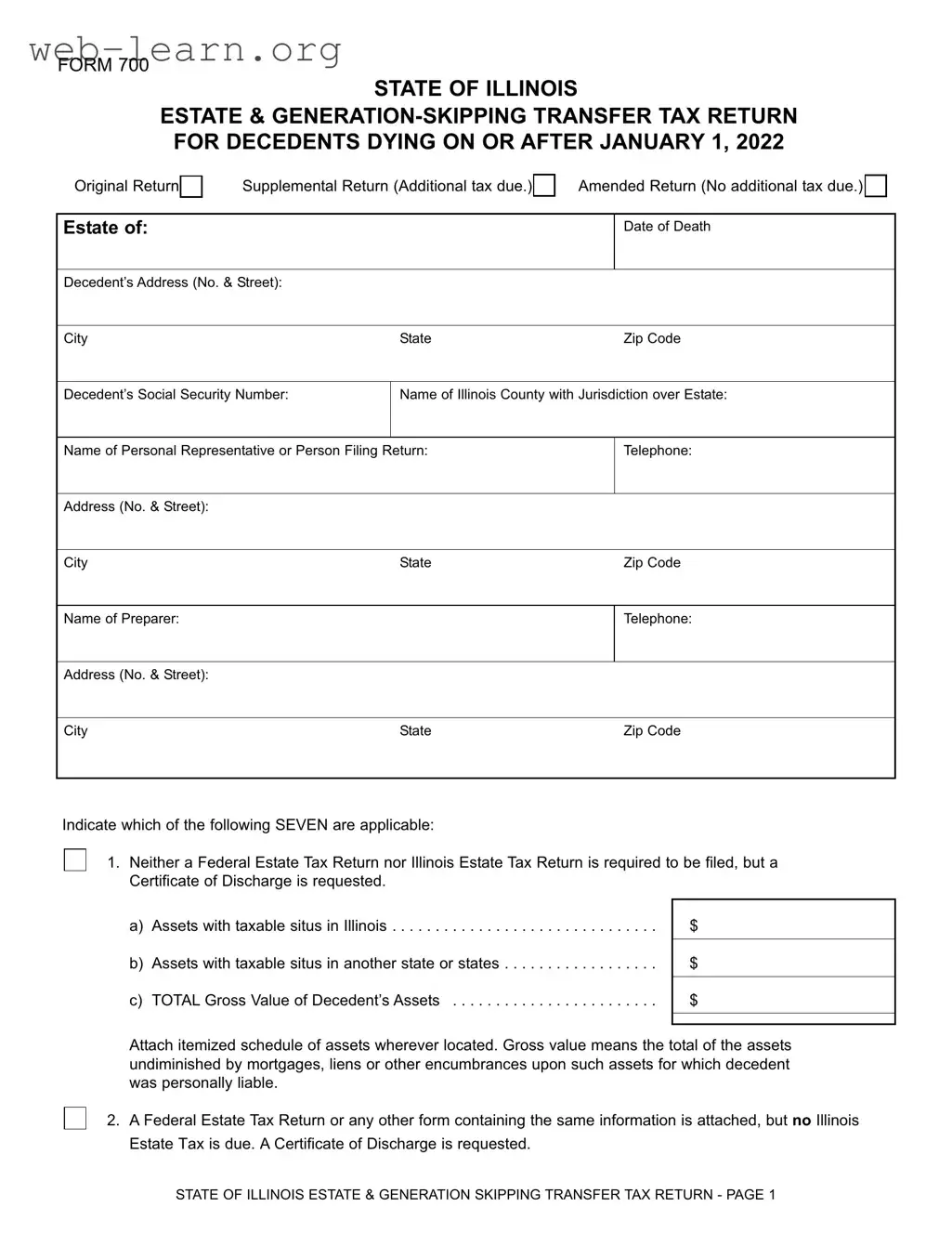
The Illinois Form 700 serves as the Estate and Generation-Skipping Transfer Tax Return for individuals who pass away on or after January 1, 2021. This form is crucial for reporting the gross value of a decedent's estate and determining any applicable estate taxes. It requires essential information such as the decedent’s date of death, address, and Social Security number, along with details about the personal representative handling the estate. The form includes various sections, allowing for original, supplemental, or amended returns, depending on the circumstances. Notably, it also incorporates options for requesting a Certificate of Discharge, making QTIP elections, and filing for extensions. The Illinois estate tax applies to estates exceeding $4 million in gross value, and the form must be filed within nine months of the decedent's death. Additionally, the return includes specific schedules for both resident and non-resident decedents, which help clarify the tax obligations based on the location of the estate's assets. Proper completion of Form 700 is essential for compliance and can significantly impact the estate's financial responsibilities.

FORM 700
STATE OF ILLINOIS
ESTATE &
|
Original Return |
¨ |
|
Supplemental Return (Additional tax due.) |
¨ |
Amended Return (No additional tax due.) |
¨ |
|
|||
|
|
|
|
|
|
|
|
|
|
|
|
|
of: |
|
|
|
|
|
|
|
Date of Death |
||
|
Estate of: |
|
|
|
|
|
|
|
|
|
|
|
|
|
|
|
|
|
|
|
|
|
|
|
Decedent’s Address (No. & Street): |
|
|
|
|
|
|
||||
|
|
|
|
|
|
|
|
|
|
|
|
|
City |
|
State |
|
Zip Code |
||||||
|
|
|
|
|
|
|
|
|
|
|
|
|
Decedent’s Social Security Number: |
Name of Illinois County with Jurisdiction over Estate: |
|||||||||
|
|
|
|
|
|
|
|
|
|
|
|
|
Name of Personal Representative or Person Filing Return: |
|
Telephone: |
||||||||
|
|
|
|
|
|
|
|
|
|
|
|
|
Address (No. & Street): |
|
|
|
|
|
|
|
|||
|
|
|
|
|
|
|
|
|
|
|
|
|
City |
|
State |
|
Zip Code |
||||||
|
|
|
|
|
|
|
|
|
|
|
|
|
Name of Preparer: |
|
|
|
|
Telephone: |
|||||
|
|
|
|
|
|
|
|
|
|
|
|
|
Address (No. & Street): |
|
|
|
|
|
|
|
|||
|
|
|
|
|
|
|
|
|
|
|
|
|
City |
|
State |
|
Zip Code |
||||||
|
|
|
|
|
|
|
|
|
|
|
|
Indicate which of the following SEVEN are applicable:
1. Neither a Federal Estate Tax Return nor Illinois Estate Tax Return is required to be filed, but a Certificate of Discharge is requested.
a) Assets with taxable situs in Illinois . . . . . . . . . . . . . . . . . . . . . . . . . . . . . . .
b) Assets with taxable situs in another state or states . . . . . . . . . . . . . . . . . .
c) TOTAL Gross Value of Decedent’s Assets . . . . . . . . . . . . . . . . . . . . . . . .
$
$
$
Attach itemized schedule of assets wherever located. Gross value means the total of the assets undiminished by mortgages, liens or other encumbrances upon such assets for which decedent was personally liable.
2.A Federal Estate Tax Return or any other form containing the same information is attached, but no Illinois Estate Tax is due. A Certificate of Discharge is requested.
STATE OF ILLINOIS ESTATE & GENERATION SKIPPING TRANSFER TAX RETURN - PAGE 1

3.A Federal Estate Tax Return or any other form containing the same information is attached (whether or not a Federal Estate Tax is due), and an Illinois Estate Tax is due. A Certificate of Discharge is requested. (Complete Recapitulation and Schedule A or B, whichever is applicable.)
4.An Illinois QTIP election is made for this estate.
Amount of Illinois QTIP election . . . . . . . . . . . . . . . . . . . . . . . . . . . . . . . . . . .
(Attach an itemized list of the Illinois QTIP property. If this includes trust property, state the percentage of the trust made subject to the election.)
Social Security Number of surviving spouse ____________________________
5.If a Section 6166 Election to Pay Tax in Installments is being requested, check box, attach an executed Form
Amount of deferred Illinois Estate Tax . . . . . . . . . . . . . . . . . . . . . . . . . . . . . .
$
$
6.This is an Amended or Supplemental Return.
(Complete Recapitulation and Schedule A or B, whichever is applicable, and attach copy of amended Federal Estate Tax Return or other applicable documents.)
Decedent was: |
|
|
||
|
|
|
|
|
|
|
a) |
a resident of Illinois, Year residency established |
a) |
|
|
|||
|
|
|
|
|
|
|
|
|
|
|
|
b) |
a |
b) |
|
|
|||
|
|
|
|
|
|
|
|
|
|
|
|
c) |
an alien, State of residence |
c) |
|
|
|||
|
|
|
|
|
|
|
|
|
|
Due date of this Return:
7. If an extension of time to file is being requested or if due date determined by extension of time to file Federal Estate Tax Return, check box and attach explanation for extension request or a copy of the Federal extension request. If based upon a Federal extension request, file a copy of approved extension request when available. This extension request should be filed within 9 months of date of death.
The undersigned declare, under penalties of perjury, that they have examined this return, including any and all accompanying schedules or attachments, and that they believe the same to be true and correct as to every material matter and further verify that any attached Federal Estate Tax Return and any other applicable Federal tax documents are true and corrected copies of the originals filed with the Internal Revenue Service.
The undersigned further certify that the attached Will (if decedent died testate) is a true and correct copy of the Will of the decedent.
Signature of decedent’s personal representative |
Title |
Date |
Signature of preparer |
Title |
Date |
STATE OF ILLINOIS ESTATE & GENERATION SKIPPING TRANSFER TAX RETURN - PAGE 2

SCHEDULE A – Resident Decedent’s Estate (Instructions on page 5.)
1. Tentative Taxable Estate from Federal Return (Line 3a, Form 706),
or other form containing the same information . . . . . . . . . . . . . . . . . . . . . . . . . . .
2. Illinois QTIP election
(Amount claimed as Illinois QTIP election in this estate or amount from prior estate’s Illinois QTIP election.) . . . . . . . . . . . . . . . . . . . . . . . . . . . . . . . . . . . . . . .
3. Illinois Tentative Taxable Estate
(Line 1 minus Line 2 if the QTIP is elected in this estate; or line 1 plus line 2
if the QTIP was previously elected.) . . . . . . . . . . . . . . . . . . . . . . . . . . . . . . . . . . .
4. Adjusted taxable gifts
(Line 4, Form706, or any other form containing the same information.) . . . . . . . .
5. Illinois Tentative Taxable Estate plus adjusted taxable gifts
(Add Line 3 and Line 4.) . . . . . . . . . . . . . . . . . . . . . . . . . . . . . . . . . . . . . . . . . . . .
6. Full amount computed for Illinois Estate Tax from website calculator before apportionment
(Use Lines 3 & 5 from this Form 700 for the website calculator.) . . . . . . . . . . . . .
7. Gross value of decedent’s estate having taxable situs in Illinois, plus amount added back from prior estate’s Illinois QTIP election . . . . . . . . . . . . . . . .
8. Gross value of decedent’s estate wherever located (Line 1, Form 706),
plus amount added back from prior estate’s Illinois QTIP election . . . . . . . . . . . .
9. Percent of estate having taxable situs in Illinois
(Line 7 divided by Line 8.) . . . . . . . . . . . . . . . . . . . . . . . . . . . . . . . . . . . . . . . . . . .
10. Amount of tax attributable to Illinois
(Line 6 multiplied by Line 9. Also enter on Line 1 in Recapitulation.) . . . . . . . . . .
1.$
2.$
3.$
4.$
5.$
6.$
7.$
8.$
9.%
10.$
With respect to the estate of a deceased resident of this State, all property included in the gross estate of the decedent for Federal Estate Tax purposes shall have a taxable situs in this State for purposes of this Section, excepting real estate and tangible personal property physically situated in another state (including any such property held in trust).
SCHEDULE B –
1. Tentative Taxable Estate from Federal Return (Line 3a, Form 706),
or other form containing the same information . . . . . . . . . . . . . . . . . . . . . . . . . . .
2. Illinois QTIP election
(Amount claimed as Illinois QTIP election in this estate or amount from prior estate’s Illinois QTIP election.) . . . . . . . . . . . . . . . . . . . . . . . . . . . . . . . . . . . . . . .
3. Illinois Tentative Taxable Estate
(Line 1 minus Line 2 if the QTIP is elected in this estate; or line 1 plus line 2 if the QTIP was previously elected) . . . . . . . . . . . . . . . . . . . . . . . . . . . . . . . . . . . . .
4. Adjusted taxable gifts
(Line 4, Form706, or any other form containing the same information.) . . . . . . . .
1.$
2.$
3$
4. $
Continued on Page 4.
STATE OF ILLINOIS ESTATE & GENERATION SKIPPING TRANSFER TAX RETURN - PAGE 3

SCHEDULE B –
5. Illinois Tentative Taxable Estate plus adjusted taxable gifts
(Add Line 3 and Line 4.) . . . . . . . . . . . . . . . . . . . . . . . . . . . . . . . . . . . . . . . . . . . .
6. Full amount computed for Illinois Estate Tax from website calculator before apportionment
(Lines 3 & 5 from this Form 700 and applied to website calculator.) . . . . . . . . . .
7. Gross value of decedent’s estate having taxable situs in Illinois, plus amount added back from prior estate’s Illinois QTIP election . . . . . . . . . . . . . . . .
8. Gross value of decedent’s estate wherever located (Line 1, Form 706),
plus amount added back from prior estate’s Illinois QTIP election . . . . . . . . . . . .
9. Percent of estate having taxable situs in Illinois
(Line 7 divided by Line 8.) . . . . . . . . . . . . . . . . . . . . . . . . . . . . . . . . . . . . . . . . . . .
10. Amount of tax attributable to Illinois
(Line 6 multiplied by Line 9. Also enter on Line 1 in Recapitulation.) . . . . . . . . . .
5.$
6.$
7.$
8.$
9.%
10.$
In the case of a decedent who was a resident of this State at the time of death, all of the transferred property has a tax situs in this State, including any such property held in trust, except real or tangible personal property physically situated in another state.
In the case of a decedent who was not a resident of this State at the time of death, the transferred property having a tax situs in this State, including any such property held in trust, is only the real estate and tangible personal property physically situated in this State.
RECAPITULATION
1. Amount of tax payable to Illinois
(Schedule A Line 10 or Schedule B Line 10.) . . . . . . . . . . . . . . . . . . . . . . . . . . . .
2. Late filing penalty
(5% of tax for each month or portion thereof - maximum penalty 25%.) . . . . . . .
3. Late payment penalty (1/2 of 1% of tax for each month
or portion thereof - maximum penalty 25%.) . . . . . . . . . . . . . . . . . . . . . . . . . . . . .
4. Interest at 10% per annum from 9 months
after death until date of payment . . . . . . . . . . . . . . . . . . . . . . . . . . . . . . . . . . . . . .
5. Total Tax, penalties and interest payable
(Total of Lines 1, 2, 3 and 4.) . . . . . . . . . . . . . . . . . . . . . . . . . . . . . . . . . . . . . . . . .
6. Prior Payment
(Attach explanation.) . . . . . . . . . . . . . . . . . . . . . . . . . . . . . . . . . . . . . . . . . . . . . . .
7. Balance due
(Line 5 minus Line 6.) . . . . . . . . . . . . . . . . . . . . . . . . . . . . . . . . . . . . . . . . . . . . . .
1.$
2.$
3.$
4.$
5.$
6.$
7.$
STATE OF ILLINOIS ESTATE & GENERATION SKIPPING TRANSFER TAX RETURN - PAGE 4

FILING AND PAYMENT INSTRUCTIONS
For decedents dying prior to 2022, see the Returns previously posted on the Attorney General’s website covering the specific year of death.
For persons dying in 2022, the Federal exemption for Federal estate tax purposes is $12,060,000. The exclusion amount for Illinois estate tax purposes is $4,000,000. The exclusion amount operates as a taxable threshold and not as a credit against tax due. If an estate’s gross value exceeds $4 million after inclusion of adjusted taxable gifts, an Illinois Form 700 must be filed, whether or not a federal return is required by the Internal Revenue Service. The estate representative should prepare and submit the Illinois Form 700 with a Federal Form 706, including all schedules, appraisals, wills, trusts, attachments, etc. If an estate is not federally taxable and does not wish to submit a Form 706, the information may be presented in an alternate format as long as all necessary information is included. (See Ill. Admin Code tit. 86, §2000.110.) The Illinois estate tax will be determined using an interrelated calculation for 2022 decedents. The calculator at the Illinois Attorney General’s website (www.illinoisattorneygeneral.gov) may be used for this computation. To determine tax due, insert the amounts from Lines 3 and 5 of Schedule A or B, Form 700. Please note that the Calculator will not perform the computation unless amounts are entered into both fields.
When the tentative taxable estate plus adjusted taxable gifts exceeds $12,060,000 the Illinois Estate Tax Return, Form 700, must include a copy of the Federal Form 706 with all schedules and attachments.
For both resident and nonresident decedents, a preliminary tax prior to apportionment should be calculated assuming all assets are located within Illinois. (Line 6, Schedule A or B, Form 700). The apportioned tax can then be determined by multiplying that figure by the ratio of Illinois assets to total assets.
Illinois QTIP election (Qualified Terminable Interest Property):
For persons dying January 1, 2009 and after, the estate may make a QTIP election for Illinois purposes which is in addition to any Federal QTIP election. The Illinois QTIP must be elected on a timely filed Illinois return by checking the election box (pg. 2, box 4), inserting the dollar amount of the QTIP election, and providing the social security number of the surviving spouse. An itemized list of property included in the Illinois QTIP should be submitted with the return. The Illinois QTIP election will follow Federal statutes and rules for treatment of such elected property passing to the surviving spouse and inclusion for Illinois purposes on any Illinois Estate Tax Return of the surviving spouse, except as to the application of the Illinois Religious Freedom Protection and Civil Union Act to parties of a civil union for Illinois estate tax purposes.
THIS RETURN MUST BE FILED WITH THE ILLINOIS ATTORNEY GENERAL WITHIN NINE (9) MONTHS OF THE DATE OF DEATH. For Cook, DuPage, Lake, and McHenry Counties, file the original of the return with the Office of the Attorney General, Revenue Litigation Bureau, 100 West Randolph Street, 13th Floor, Chicago, Illinois 60601. For all other counties, file the original of the return with the Office of the Attorney General, Revenue Litigation Bureau, 500 South Second Street, Springfield, Illinois 62701.
PAYMENT OF ALL TAXES, INTEREST AND PENALTIES MUST BE MADE PAYABLE TO THE ILLINOIS STATE TREASURER WITH THE “ILLINOIS STATE TREASURER ESTATE TAX PAYMENT FORM” AT THE ADDRESS DESIGNATED THEREIN.
ALL PAYMENTS MUST BE MAILED TO OR DEPOSITED WITH THE STATE TREASURER IN ORDER TO BE CREDITED WITH TIMELY PAYMENT.
Printed by authority of the State of Illinois. (Revised: 07/22)
STATE OF ILLINOIS ESTATE & GENERATION SKIPPING TRANSFER TAX RETURN - PAGE 5
| Fact Name | Details |
|---|---|
| Purpose | The Illinois 700 form is used for filing the Estate and Generation-Skipping Transfer Tax Return for decedents who died on or after January 1, 2021. |
| Filing Deadline | This return must be filed within nine months of the decedent's date of death. |
| Exemption Amount | The exclusion amount for Illinois estate tax purposes is $4,000,000, which operates as a taxable threshold. |
| Governing Law | The Illinois Estate Tax is governed by the Illinois Compiled Statutes, specifically 35 ILCS 200/1-1 et seq. |
| QTIP Election | Estates may make an Illinois QTIP election, which is in addition to any Federal QTIP election, starting from January 1, 2009. |
| Payment Instructions | All taxes, interest, and penalties must be paid to the Illinois State Treasurer using the designated payment form. |
Filling out the Illinois 700 form is an important step in managing the estate of a deceased individual. This form is essential for reporting the estate and generation-skipping transfer tax obligations to the state. Follow these steps to ensure that you complete the form accurately and efficiently.
Once you have filled out the Illinois 700 form, ensure that all necessary attachments are included before submission. This will help facilitate the processing of the estate tax return. If you have any questions or need further assistance, consider consulting a professional familiar with estate matters.
The Illinois Form 700 is the Estate and Generation-Skipping Transfer Tax Return. It is required for estates of decedents who passed away on or after January 1, 2021, and whose gross estate value exceeds $4 million. This form is used to report the estate's value and calculate any taxes owed to the state of Illinois.
If the total gross value of a decedent's estate exceeds $4 million, a Form 700 must be filed. This applies regardless of whether a Federal Estate Tax Return is required. Additionally, the estate representative must file this form within nine months of the decedent's date of death.
The form requires various details, including:
The Form 700 must be filed within nine months of the date of death. If an extension is needed, it should be requested within this timeframe. If based on a Federal extension request, a copy of the approved extension must be filed when available.
If the estate is not federally taxable, the representative can still file Form 700. They may present the required information in an alternate format, as long as all necessary details are included. This allows for flexibility in how the information is submitted.
The Illinois QTIP (Qualified Terminable Interest Property) election allows the estate to elect certain property for tax purposes. This election can be made in addition to any Federal QTIP election. To make this election, the estate representative must check the appropriate box on Form 700 and provide an itemized list of the property included.
For decedents in Cook, DuPage, Lake, and McHenry Counties, file the original return with the Office of the Attorney General, Revenue Litigation Bureau, in Chicago. For all other counties, the return should be filed with the Office of the Attorney General in Springfield. All payments related to the estate tax must be made payable to the Illinois State Treasurer.
Filling out the Illinois 700 form can be a complex process, and mistakes can lead to delays or even penalties. One common error occurs when individuals fail to accurately report the decedent's gross assets. It's essential to include the total gross value of all assets without deducting any mortgages or liens. This total should reflect all property, regardless of its location. Neglecting to provide a complete and itemized schedule of these assets can complicate the process and may result in additional scrutiny from the state.
Another frequent mistake is misidentifying the type of return being filed. The Illinois 700 form has specific categories: original, supplemental, and amended. Choosing the wrong type can cause confusion and may lead to improper processing of the return. For instance, if a supplemental return is filed when an original return is required, it can result in unnecessary delays in tax processing and possible penalties for late filing.
People also often overlook the importance of including the correct Social Security number of the decedent and any surviving spouse. This information is critical for identification purposes and helps ensure that the return is linked correctly to the individuals involved. Missing or incorrect Social Security numbers can lead to significant processing delays and complications in tax assessments.
Lastly, failing to meet the filing deadline is a common pitfall. The Illinois 700 form must be filed within nine months of the date of death. If an extension is needed, it is crucial to request it properly and submit the necessary documentation. Missing this deadline can result in penalties and interest on any taxes owed, which can add up quickly. It's essential to stay organized and aware of all deadlines to avoid these costly mistakes.
The Illinois Form 700 serves as the Estate and Generation-Skipping Transfer Tax Return for individuals who have passed away on or after January 1, 2021. When filing this form, several other documents may be necessary to ensure compliance with state regulations. Below is a list of commonly used forms that accompany the Illinois Form 700, along with brief descriptions of each.
Understanding the relationship between the Illinois Form 700 and these accompanying documents is essential for effective estate management. Ensuring that all necessary forms are completed accurately can facilitate a smoother process during a challenging time.
The Illinois Form 700 is related to several other documents that deal with estate and transfer taxes. Here are four documents that share similarities with the Illinois Form 700:
When filling out the Illinois Form 700, it is crucial to adhere to specific guidelines to ensure accuracy and compliance. Below is a list of dos and don'ts to consider:
Understanding the Illinois 700 form is essential for navigating estate tax requirements. However, several misconceptions often arise. Here are six common misunderstandings: