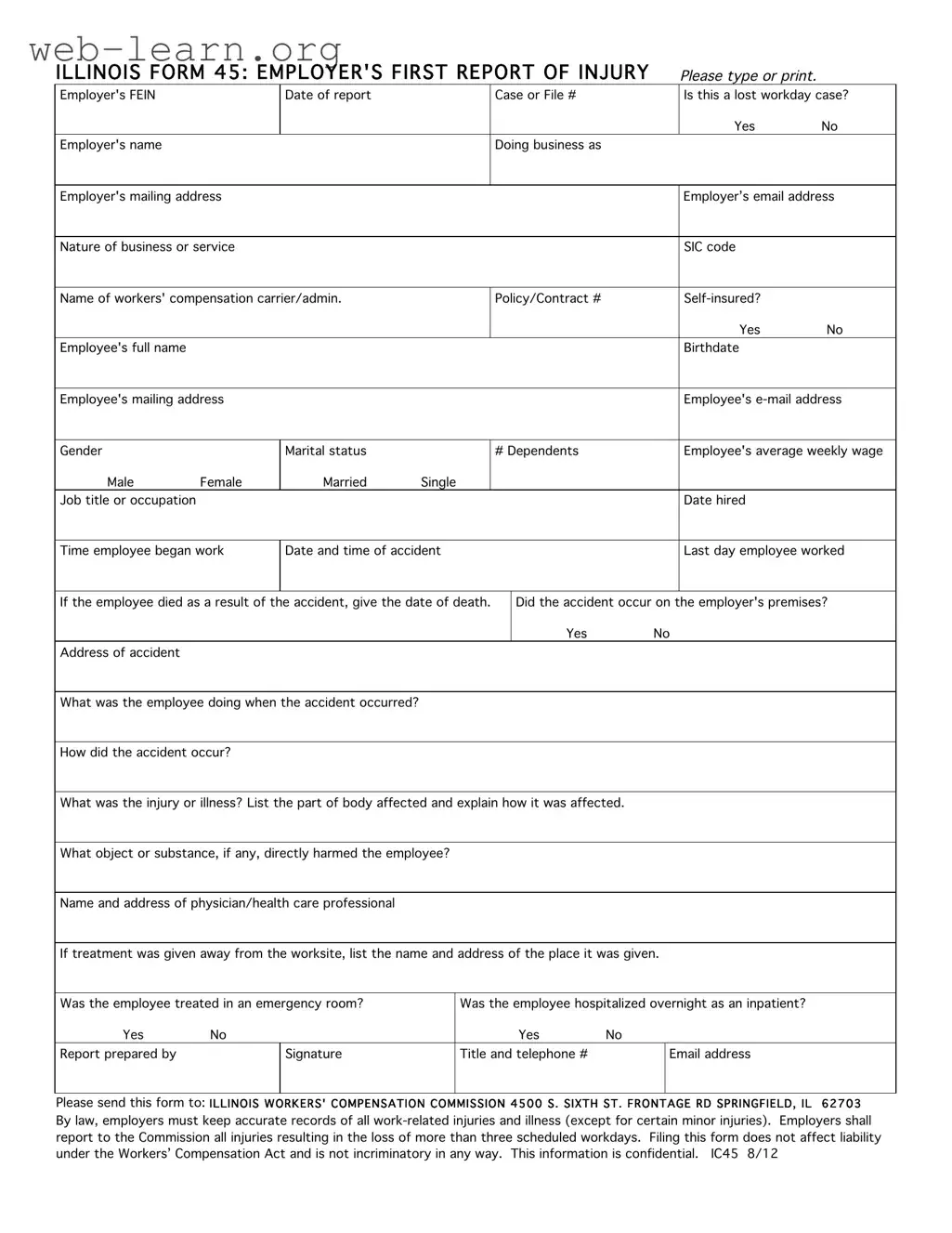
The Illinois Form 45, officially known as the Employer's First Report of Injury, serves a crucial role in documenting workplace injuries and illnesses. This form is required for employers to report any incidents that result in significant consequences for their employees, particularly those leading to the loss of more than three scheduled workdays. It collects essential details such as the employer's information, including the Federal Employer Identification Number (FEIN), the nature of the business, and the workers' compensation carrier. Additionally, it requires specific information about the injured employee, such as their name, Social Security number, birthdate, and job title. The form also prompts employers to describe the accident, detailing what the employee was doing at the time, the nature of the injury or illness, and any relevant medical treatment received. Employers must also indicate whether the accident occurred on their premises and provide the address of the incident. This comprehensive documentation not only aids in the processing of claims but also ensures compliance with state laws regarding workplace safety and injury reporting. Confidentiality is maintained throughout the process, as the information submitted is protected under the law. By understanding the significance of the Illinois Form 45, employers can better navigate the complexities of workers' compensation and ensure their responsibilities are met promptly and accurately.

ILLINOIS FORM 45: EMPLOYER'S FIRST REPORT OF INJURY |
|
|
Please type or print. |
|
|||||||||
Employer's FEIN |
|
Date of report |
|
|
|
|
Case or File # |
|
|
|
Is this a lost workday case? |
||
|
|
|
|
|
|
|
|
|
|
|
|
Yes |
No |
Employer's name |
|
|
|
|
|
|
Doing business as |
|
|
|
|
|
|
|
|
|
|
|
|
|
|
|
|
|
|
||
Employer's mailing address |
|
|
|
|
|
|
|
|
|
|
Employer’s email address |
||
|
|
|
|
|
|
|
|
|
|
|
|
|
|
Nature of business or service |
|
|
|
|
|
|
|
|
|
|
SIC code |
|
|
|
|
|
|
|
|
|
|
|
|
|
|
||
Name of workers' compensation carrier/admin. |
|
|
|
|
Policy/Contract # |
|
|
|
|
||||
|
|
|
|
|
|
|
|
|
|
|
|
Yes |
No |
Employee's full name |
|
|
|
|
|
|
|
|
|
|
|
Birthdate |
|
|
|
|
|
|
|
|
|
|
|
|
|
||
Employee's mailing address |
|
|
|
|
|
|
|
|
|
|
Employee's |
||
|
|
|
|
|
|
|
|
|
|
|
|
|
|
Gender |
|
Marital status |
|
|
|
|
# Dependents |
|
|
|
Employee's average weekly wage |
||
Male |
Female |
Married |
Single |
|
|
|
|
|
|
|
|
|
|
Job title or occupation |
|
|
|
|
|
|
|
|
|
|
|
Date hired |
|
|
|
|
|
|
|
|
|
|
|
|
|||
Time employee began work |
Date and time of accident |
|
|
|
|
|
|
|
Last day employee worked |
||||
|
|
|
|
|
|
|
|||||||
If the employee died as a result of the accident, give the date of death. |
|
Did the accident occur on the employer's premises? |
|||||||||||
|
|
|
|
|
|
|
|
Yes |
|
No |
|
||
Address of accident |
|
|
|
|
|
|
|
|
|
|
|
|
|
|
|
|
|
|
|
|
|
|
|
|
|
||
What was the employee doing when the accident occurred? |
|
|
|
|
|
|
|
|
|
|
|
||
|
|
|
|
|
|
|
|
|
|
|
|
|
|
How did the accident occur? |
|
|
|
|
|
|
|
|
|
|
|
|
|
|
|
|
|
|
|
||||||||
What was the injury or illness? List the part of body affected and explain how it was affected. |
|
|
|
|
|||||||||
|
|
|
|
|
|
|
|
|
|
|
|||
What object or substance, if any, directly harmed the employee? |
|
|
|
|
|
|
|
|
|
||||
|
|
|
|
|
|
|
|
|
|
|
|
||
Name and address of physician/health care professional |
|
|
|
|
|
|
|
|
|
|
|
||
|
|
|
|
||||||||||
If treatment was given away from the worksite, list the name and address of the place it was given. |
|
||||||||||||
|
|
|
|
|
|
||||||||
Was the employee treated in an emergency room? |
|
|
Was the employee hospitalized overnight as an inpatient? |
|
|||||||||
Yes |
No |
|
|
|
|
|
|
Yes |
No |
|
|
|
|
Report prepared by |
|
Signature |
|
|
Title and telephone # |
|
|
Email address |
|
||||
|
|
|
|
|
|||||||||
Please send this form to: ILLINOIS WORKERS' COMPENSATION COMMISSION 4500 S. SIXTH ST. FRONTAGE RD SPRINGFIELD, IL |
62703 |
||||||||||||
By law, employers must keep accurate records of all
| Fact Name | Description |
|---|---|
| Purpose | The Illinois Form 45 serves as the Employer's First Report of Injury, documenting work-related injuries or illnesses. |
| Governing Law | This form is governed by the Illinois Workers' Compensation Act, which mandates reporting of certain workplace injuries. |
| Mandatory Reporting | Employers are required to report injuries that result in the loss of more than three scheduled workdays. |
| Confidentiality | The information provided on the form is confidential and is protected under Illinois law. |
| Submission Address | Completed forms must be sent to the Illinois Workers' Compensation Commission at 701 S. Second Street, Springfield, IL 62704. |
| Employee Information | The form requires detailed employee information, including name, address, Social Security number, and average weekly wage. |
| Accident Details | Employers must provide specific details about the accident, including the date, time, and nature of the injury or illness. |
Completing the Illinois 45 form is essential for reporting workplace injuries. Follow these steps carefully to ensure all necessary information is accurately submitted.
What is the Illinois Form 45?
The Illinois Form 45, also known as the Employer's First Report of Injury, is a document that employers must complete when an employee suffers a work-related injury or illness. This form serves as an official report to the Illinois Workers' Compensation Commission, ensuring that necessary information about the incident is documented and submitted in a timely manner.
When should the Illinois Form 45 be filed?
Employers are required to file the Illinois Form 45 for any work-related injury that results in the loss of more than three scheduled workdays. This means that if an employee is unable to work for more than three days due to the injury, the form must be submitted to the Commission.
What information is required on the form?
The form requires detailed information about both the employer and the injured employee. Key details include:
Accurate and complete information is crucial for the processing of the report.
Is there a specific format for completing the form?
Yes, the Illinois Form 45 should be typed or printed clearly to ensure that all information is legible. Employers should take care to fill out each section completely and accurately, as missing information can delay the processing of the report.
What happens after the form is submitted?
Once the Illinois Form 45 is submitted to the Workers' Compensation Commission, it becomes part of the official record regarding the injury. This information is confidential and is used to assess the claim and ensure compliance with workers' compensation laws.
Can the filing of this form affect liability?
No, filing the Illinois Form 45 does not affect the employer's liability under the Workers' Compensation Act. The form is simply a reporting tool and is not considered an admission of fault or liability.
What if the employee dies as a result of the accident?
If the employee dies due to a work-related injury, the form must still be completed. Employers should provide the date of death on the form and ensure that all other relevant information is included. This helps in processing any claims related to the employee's death.
Where should the form be sent?
The completed Illinois Form 45 should be sent to the Illinois Workers' Compensation Commission at the following address:
701 S. Second Street
Springfield, IL 62704
What if the employer is self-insured?
If the employer is self-insured, this should be indicated on the form. Self-insured employers have different reporting requirements and must ensure they are compliant with all applicable laws and regulations regarding workers' compensation.
Completing the Illinois Form 45 can be a straightforward process, but many individuals make common mistakes that can lead to delays or complications in workers' compensation claims. One frequent error is failing to provide accurate information regarding the employer's details. This includes the Employer's Federal Employer Identification Number (FEIN) and the name of the business. If these details are incorrect or incomplete, it can result in confusion and potentially hinder the processing of the claim.
Another mistake often encountered involves the employee's information. It's crucial to ensure that the employee's full name, Social Security number, and birthdate are entered correctly. A simple typographical error can lead to significant issues down the line, including problems with benefits or delays in claim processing. Double-checking these details can save time and frustration.
Many also overlook the importance of accurately describing the accident and the resulting injury. The section asking for specifics about what the employee was doing at the time of the accident and how it occurred is vital. Insufficient or vague descriptions can lead to misunderstandings about the nature of the claim. Clear and detailed explanations help ensure that the claim is assessed correctly and promptly.
Lastly, individuals often neglect to provide complete information about medical treatment. If the employee received treatment away from the worksite, it’s essential to list the name and address of the healthcare provider. Additionally, indicating whether the employee was treated in an emergency room or hospitalized overnight is crucial. Omitting this information can complicate the claim process and may lead to unnecessary delays in receiving benefits.
The Illinois Form 45, known as the Employer's First Report of Injury, is a crucial document for reporting work-related injuries. Alongside this form, several other documents may be required to ensure comprehensive reporting and compliance with state regulations. Below is a list of additional forms and documents often used in conjunction with the Illinois Form 45.
Using these forms together with the Illinois Form 45 helps ensure that all necessary information is documented and reported accurately. This comprehensive approach aids in the efficient processing of workers' compensation claims, benefiting both the employer and the injured employee.
The Illinois Form 45, known as the Employer's First Report of Injury, serves a critical role in documenting workplace injuries. Several other forms share similarities with this document, particularly in their purpose and content. Here’s a look at six documents that are comparable to the Illinois 45 form:
Understanding these documents can help employers and employees navigate the complexities of workplace injury reporting and ensure compliance with necessary regulations.
When filling out the Illinois Form 45, it's essential to follow guidelines to ensure accuracy and compliance. Here’s a list of things to do and avoid:
By adhering to these guidelines, you can help ensure a smooth reporting process for workplace injuries.
Understanding the Illinois Form 45 is crucial for employers navigating the workers' compensation process. However, several misconceptions can lead to confusion. Here are four common misunderstandings:
This form must be completed for any work-related injury that results in the loss of more than three scheduled workdays. Even minor injuries can require documentation, so it’s important to report accurately.
Employers often fear that submitting the Illinois Form 45 will imply they are accepting responsibility for the injury. In reality, filing this form is simply a requirement and does not affect liability under the Workers' Compensation Act.
Many believe that the details shared in the Illinois Form 45 are public. However, this information is confidential and is only used for administrative purposes by the Workers' Compensation Commission.
While timely reporting is essential, the Illinois Form 45 specifically applies to injuries that result in lost workdays. Employers should focus on the circumstances surrounding the injury and ensure that they meet the reporting requirements.
Here are some key takeaways about filling out and using the Illinois Form 45: