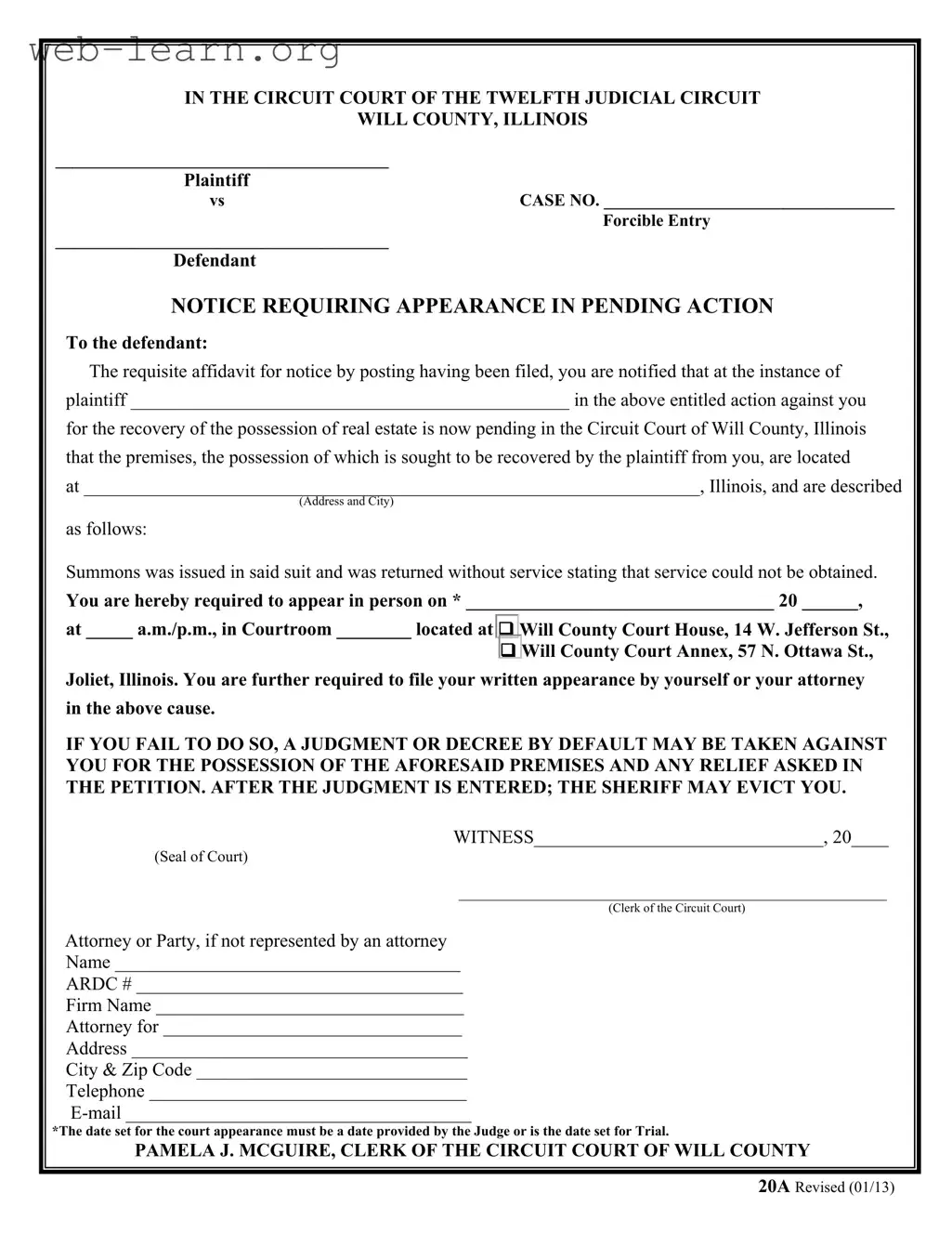
The Illinois 20A form plays a crucial role in the legal process surrounding eviction cases. It serves as a formal notice requiring the defendant to appear in court regarding a forcible entry action initiated by the plaintiff. This form is utilized when a plaintiff seeks to recover possession of real estate, and it outlines essential details such as the case number, the parties involved, and the specific location of the property in question. Additionally, the form indicates that a summons has been issued but returned without service, highlighting the importance of the defendant's appearance. The notice specifies the date, time, and location for the court appearance, emphasizing that failing to respond could result in a judgment against the defendant, potentially leading to eviction. The presence of the court seal and the clerk's signature further validate the document, underscoring its significance in the legal proceedings.

IN THE CIRCUIT COURT OF THE TWELFTH JUDICIAL CIRCUIT
WILL COUNTY, ILLINOIS
_______________________________________
Plaintiff
vs |
CASE NO. __________________________________ |
|
Forcible Entry |
_______________________________________ |
|
Defendant |
|
NOTICE REQUIRING APPEARANCE IN PENDING ACTION
To the defendant:
The requisite affidavit for notice by posting having been filed, you are notified that at the instance of plaintiff _______________________________________________ in the above entitled action against you
for the recovery of the possession of real estate is now pending in the Circuit Court of Will County, Illinois that the premises, the possession of which is sought to be recovered by the plaintiff from you, are located
at __________________________________________________________________, Illinois, and are described
(Address and City)
as follows:
Summons was issued in said suit and was returned without service stating that service could not be obtained.
You are hereby required to appear in person on * _________________________________ 20 ______,
at _____ a.m./p.m., in Courtroom ________ located atWill County Court House, 14 W. Jefferson St.,
Will County Court Annex, 57 N. Ottawa St.,
Joliet, Illinois. You are further required to file your written appearance by yourself or your attorney
in the above cause.
IF YOU FAIL TO DO SO, A JUDGMENT OR DECREE BY DEFAULT MAY BE TAKEN AGAINST YOU FOR THE POSSESSION OF THE AFORESAID PREMISES AND ANY RELIEF ASKED IN THE PETITION. AFTER THE JUDGMENT IS ENTERED; THE SHERIFF MAY EVICT YOU.
WITNESS_______________________________, 20____
(Seal of Court)
_______________________________________________________
(Clerk of the Circuit Court)
Attorney or Party, if not represented by an attorney
Name _____________________________________
ARDC # ___________________________________
Firm Name _________________________________
Attorney for ________________________________
Address ____________________________________
City & Zip Code _____________________________
Telephone __________________________________
*The date set for the court appearance must be a date provided by the Judge or is the date set for Trial.
PAMELA J. MCGUIRE, CLERK OF THE CIRCUIT COURT OF WILL COUNTY
20A Revised (01/13)
| Fact Name | Details |
|---|---|
| Purpose of the 20A Form | The Illinois 20A form is used to notify a defendant of a pending forcible entry action, which typically involves the recovery of possession of real estate. |
| Governing Law | This form is governed by the Illinois Code of Civil Procedure, specifically under 735 ILCS 5/9-107, which outlines procedures for eviction and forcible entry actions. |
| Required Appearance | Defendants must appear in person on a specified date and time, as indicated on the form. Failure to do so may result in a default judgment against them. |
| Service of Notice | The form indicates that a requisite affidavit for notice by posting has been filed, meaning the defendant was unable to be served personally. |
| Consequences of Non-Appearance | If the defendant fails to appear, the court may issue a judgment for possession, allowing the sheriff to proceed with eviction. |
Filling out the Illinois 20A form is an important step in responding to a legal notice regarding a forcible entry case. This form requires specific information about the parties involved and the court appearance details. Completing it accurately ensures that you meet your legal obligations and can properly address the situation at hand.
After completing the form, it is crucial to file it with the court and ensure that it is served to the defendant. This action will help move the case forward and address the matter of possession as required by law.
What is the Illinois 20A form?
The Illinois 20A form is a legal document used in the Circuit Court of Will County, Illinois. It serves as a notice requiring a defendant to appear in court for a pending action, typically related to the recovery of possession of real estate. The form informs the defendant of the case details, including the court date and location.
Who uses the Illinois 20A form?
This form is primarily used by plaintiffs in forcible entry actions against defendants who have allegedly failed to vacate a property. The plaintiff must file this notice with the court to ensure that the defendant is properly informed of the legal proceedings against them.
What information is included in the Illinois 20A form?
The form includes several key pieces of information:
What happens if a defendant fails to appear in court?
If a defendant does not appear in court as required by the Illinois 20A form, a judgment or decree by default may be entered against them. This means the court may grant the plaintiff the possession of the property without further input from the defendant. Following this judgment, the sheriff may proceed with eviction actions.
How is the Illinois 20A form served to the defendant?
The Illinois 20A form is typically served by posting, which means that the notice is affixed to the property in question. This method is used when personal service cannot be obtained, ensuring that the defendant is still made aware of the legal action against them.
What should a defendant do upon receiving the Illinois 20A form?
Upon receiving the Illinois 20A form, the defendant should take immediate action. They must appear in court on the specified date and time, either in person or through an attorney. Additionally, they should file a written appearance with the court to formally acknowledge the proceedings.
Can a defendant contest the action after receiving the Illinois 20A form?
Yes, a defendant has the right to contest the action. By appearing in court and filing the necessary documents, the defendant can present their case and argue against the plaintiff’s claims. It is crucial to take this step to avoid default judgment.
Where can I obtain the Illinois 20A form?
The Illinois 20A form can be obtained from the Circuit Court of Will County or through their official website. It is advisable to ensure that you are using the most current version of the form, as legal documents are subject to updates.
When completing the Illinois 20A form, individuals often make several common mistakes that can lead to complications in their legal proceedings. One frequent error is failing to provide accurate information about the defendant. It is essential to ensure that the name and address of the defendant are correct. Even a small typo can delay the process and may result in the case being dismissed.
Another mistake is neglecting to fill in the case number. This number is crucial for the court to track the case and associate it with the correct file. Omitting this information can cause confusion and may hinder the progress of the case.
Many people also forget to include the correct date for the court appearance. The date must be specified clearly, as it is set by the judge or designated for trial. Leaving this section blank or entering an incorrect date can lead to missed court appearances and unfavorable outcomes.
In addition, individuals sometimes fail to sign the form. A signature is necessary to validate the document and confirm that the information provided is accurate. Without a signature, the form may be considered incomplete and may not be processed by the court.
Another common oversight involves not providing a proper address for the premises in question. The address should be detailed and complete, including the city and state. Incomplete or vague addresses can result in confusion and may delay the proceedings.
People often overlook the requirement to file a written appearance. It is important to either appear in person or have an attorney file this document on your behalf. Failing to do so can lead to a default judgment against the defendant, which may result in eviction.
Some individuals also forget to include their contact information, such as a telephone number and email address. Providing this information is essential for the court and other parties to reach you if needed. Without it, communication can be significantly hampered.
Additionally, errors in the attorney's information, such as the ARDC number or firm name, can lead to complications. This information must be accurate to ensure that the attorney is properly recognized by the court.
Lastly, individuals sometimes do not review the entire form before submission. It is critical to double-check all entries for accuracy and completeness. Taking the time to review can prevent many of the issues mentioned and help ensure that the process runs smoothly.
The Illinois 20A form is a crucial document used in eviction proceedings. It notifies the defendant of their required court appearance and the potential consequences of failing to respond. Alongside this form, several other documents are commonly used in the eviction process. Here’s a brief overview of those documents.
Understanding these documents can help both plaintiffs and defendants navigate the eviction process more effectively. Each plays a vital role in ensuring that the legal proceedings are conducted fairly and in accordance with the law.
The Illinois 20A form serves a specific purpose in legal proceedings, particularly in eviction cases. Several other documents share similarities with the 20A form in terms of function and structure. Here’s a list of those documents:
When filling out the Illinois 20A form, there are several important dos and don'ts to keep in mind. Following these guidelines can help ensure that your submission is complete and accurate.
Many people have misunderstandings about the Illinois 20A form. Here are five common misconceptions:
Understanding these misconceptions can help you navigate the legal process more effectively. Always consider reaching out for guidance if you have questions.
When dealing with the Illinois 20A form, it’s crucial to understand its purpose and the implications of filling it out correctly. Here are some key takeaways: