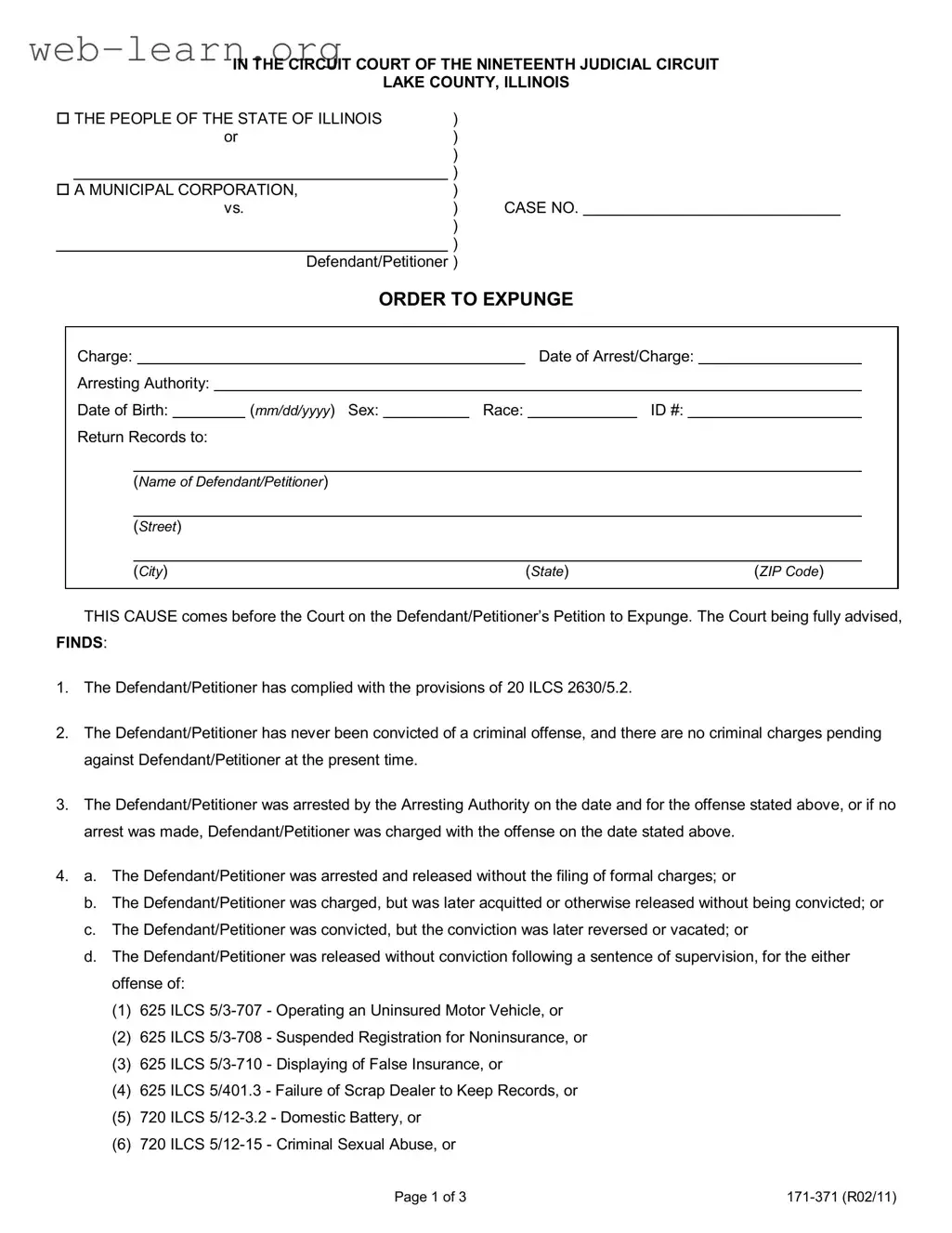
The Illinois 171 371 form plays a crucial role in the legal process of expunging criminal records. This form is used in the Nineteenth Judicial Circuit Court of Lake County, Illinois, and is essential for individuals seeking to clear their names after an arrest or charge that did not result in a conviction. It requires the petitioner to provide specific details, such as the case number, arrest date, and the nature of the charges. The form includes a series of findings that the court must verify, ensuring that the petitioner meets the necessary criteria for expungement. These criteria include having no convictions, being compliant with the relevant state laws, and having fulfilled any conditions of supervision or probation. The court's order, if granted, mandates the destruction or return of all records related to the arrest, effectively allowing the individual to move forward without the burden of a criminal record. Understanding the nuances of this form is vital for anyone looking to navigate the expungement process successfully.
IN THE CIRCUIT COURT OF THE NINETEENTH JUDICIAL CIRCUIT
LAKE COUNTY, ILLINOIS
THE PEOPLE OF THE STATE OF ILLINOIS |
) |
|
|
|
or |
) |
|
|
|
) |
|
|
|
) |
|
A MUNICIPAL CORPORATION, |
) |
|
|
|
vs. |
) |
CASE NO. |
|
|
) |
|
|
|
) |
|
Defendant/Petitioner )
ORDER TO EXPUNGE
Charge: |
|
|
|
|
|
|
Date of Arrest/Charge: |
|
|||
Arresting Authority: |
|
|
|
|
|
|
|
|
|
||
Date of Birth: |
|
|
(mm/dd/yyyy) Sex: |
|
Race: |
|
|
ID #: |
|
||
Return Records to: |
|
|
|
|
|
|
|
|
|
||
(Name of Defendant/Petitioner)
(Street)
(City) |
(State) |
(ZIP Code) |
THIS CAUSE comes before the Court on the Defendant/Petitioner’s Petition to Expunge. The Court being fully advised,
FINDS:
1.The Defendant/Petitioner has complied with the provisions of 20 ILCS 2630/5.2.
2.The Defendant/Petitioner has never been convicted of a criminal offense, and there are no criminal charges pending against Defendant/Petitioner at the present time.
3.The Defendant/Petitioner was arrested by the Arresting Authority on the date and for the offense stated above, or if no arrest was made, Defendant/Petitioner was charged with the offense on the date stated above.
4.a. The Defendant/Petitioner was arrested and released without the filing of formal charges; or
b.The Defendant/Petitioner was charged, but was later acquitted or otherwise released without being convicted; or
c.The Defendant/Petitioner was convicted, but the conviction was later reversed or vacated; or
d.The Defendant/Petitioner was released without conviction following a sentence of supervision, for the either offense of:
(1)625 ILCS
(2)625 ILCS
(3)625 ILCS
(4)625 ILCS 5/401.3 - Failure of Scrap Dealer to Keep Records, or
(5)720 ILCS
(6)720 ILCS
Page 1 of 3 |
(7) 720 ILCS
and it has been FIVE years since the successful discharge and dismissal from supervision; or
5.The Defendant/Petitioner was released without conviction following a sentence of supervision for an offense which is not set forth above, and it has been TWO years since the successful discharge and dismissal from supervision, or
6.The Defendant/Petitioner was released without conviction following a sentence of probation under:
a.720 ILCS 550/10 - Section 10 of the Cannabis Control Act, or
b.720 ILCS 570/410 - Section 410 of the Illinois Controlled Substances Act, or
c.720 ILCS
d.20 ILCS
e.20 ILCS
f.Section 10 of the Steroid Control Act (repealed); or
g.720 ILCS 646/70 - Section 70 of the Methamphetamine Control and Community Protection Act; and it has been FIVE years since the successful termination of probation.
7.In the case sought to be expunged, the Defendant/Petitioner was not granted court supervision for (1) driving under the influence; (2) reckless driving; or (3) any sexual offense committed against a minor under 18 years of age as a result of this arrest.
8.The Defendant/Petitioner has paid all costs and fees for the filing of this Petition, or has been granted a fee waiver by the Court.
9.The Circuit Clerk has served notice on the Arresting Authority, the Department of the State Police, the State’s
Attorney and the Chief Legal Officer of the unit of local government affecting the arrest and
a.neither of said agencies has filed an objection to the Petition to Expunge within 60 days from the date of service; or
b.following the filing of an objection, this Court, having heard evidence in the matter, finds that the records should be expunged.
IT IS THEREFORE ORDERED as follows:
That the Petition to Expunge the Defendant/Petitioner’s arrest record is GRANTED, and that the official records be EXPUNGED as follows:
1.All records relating to arrest or charges, or both, shall be physically destroyed or return to the petitioner, and the petitioner’s name must be obliterated from any official index or public record, or both. Nothing in this Act shall require the physical destruction of the circuit court file, but such records relating to arrests or charges, or both, ordered expunged, shall be impounded. Said records shall be expunged by the arresting agency, the Department, and any other agency as ordered by the court, within 60 days of the date of service of this order, unless a motion to vacate, modify, or reconsider the order is filed. In response to an inquiry for expunged records, the Circuit Clerk
Page 2 of 3 |

of the Court, the Department, or the agency receiving such inquiry, shall reply as it does in response to inquiries when no records ever existed.
2.The records of the Circuit Court Clerk shall be impounded until further order of the court upon good cause shown and the name of the petitioner obliterated on the official index required to be kept by the circuit court clerk under Section 16 of the Clerks of Courts Act, but the order shall not affect any index issued by the circuit court clerk before the entry of the order.
3.Nothing in this Order shall prevent the Department of State Police from maintaining all records of any person who is admitted to probation upon terms and conditions and who fulfills those terms and conditions pursuant to Section 10 of the Cannabis Control Act, Section 410 of the Illinois Controlled Substances Act, Section 70 of the Methamphetamine Control and Community Protection Act, Section
4.The Clerk of the Circuit Court shall provide copies of this order to the petitioner, to the Department of State Police (in the form and manner prescribed), to the State's Attorney or prosecutor charged with the duty of prosecuting the offense, to the arresting agency, to the chief legal officer of the unit of local government effecting the arrest, and to such other criminal justice agencies as may be ordered by the court.
5.Further, the Department may charge the petitioner a fee equivalent to the cost of processing any order before expunging the records. Notwithstanding any provision of the Clerks of Courts Act to the contrary, the Circuit Court Clerk may also charge a fee equivalent to the cost associated with the expungement of the records.
6.This order becomes a final and appealable order 30 days after service of the order on the petitioner and all parties entitled to notice of the petition.
IT IS SO ORDERED.
Dated this |
|
day of |
|
, 20___ |
ENTER:
Judge
Prepared by: |
|
|
|
|
|||
Name: |
|
Telephone: |
|
||||
Attorney for: |
|
ADRC: |
|
||||
Address: |
|
City/State/Zip: |
|
||||
Page 3 of 3 |
| Fact Name | Description |
|---|---|
| Governing Law | The Illinois 171 371 form is governed by 20 ILCS 2630/5.2, which outlines the expungement process for certain criminal records. |
| Purpose | This form is used to petition the court for the expungement of an arrest record or criminal charges that did not result in a conviction. |
| Eligibility Criteria | To qualify for expungement, the petitioner must have never been convicted of a criminal offense and must not have any pending charges. |
| Timeframes | For certain offenses, a waiting period of five years is required after the successful completion of supervision, while others require only two years. |
| Fee Waivers | The petitioner may be granted a fee waiver by the court, which allows them to file the petition without paying associated costs. |
| Notification Requirement | The Circuit Clerk must notify relevant agencies about the petition. If no objections are filed within 60 days, the expungement can proceed. |
| Finality of Order | The order for expungement becomes final and appealable 30 days after it is served on the petitioner and all parties involved. |
Filling out the Illinois 171 371 form requires careful attention to detail. This form is used in the expungement process, which allows individuals to clear their criminal records under certain conditions. Follow the steps below to complete the form accurately.
After completing the form, ensure all information is accurate before submitting it to the court. The next steps involve filing the form with the appropriate court and possibly attending a hearing, depending on the specific circumstances of the case.
What is the purpose of the Illinois 171 371 form?
The Illinois 171 371 form is used to petition the court for the expungement of an arrest record. Expungement allows individuals to have their criminal records sealed or destroyed, effectively erasing the record from public view. This can be crucial for those who wish to move forward without the stigma of an arrest affecting their employment opportunities, housing applications, or personal reputation.
Who is eligible to file the Illinois 171 371 form?
Eligibility for filing the Illinois 171 371 form generally includes individuals who:
Specific criteria apply depending on the nature of the arrest and the outcome of any related charges. It is essential to review these requirements carefully before filing.
What happens after the form is submitted?
Once the Illinois 171 371 form is submitted, the court will review the petition. The Circuit Clerk must notify relevant authorities, including the arresting agency and the Department of State Police. If no objections are filed within 60 days, the court is likely to grant the expungement. If an objection is raised, a hearing will be held to determine whether the records should be expunged.
What are the potential costs associated with filing this form?
Filing the Illinois 171 371 form may involve certain fees. The Circuit Court Clerk can charge fees related to the processing of the expungement order. Additionally, the Department of State Police may impose a fee for processing the records. However, individuals may be eligible for a fee waiver if they demonstrate financial hardship. It is advisable to check with the court for the most current fee structure and waiver options.
Filling out the Illinois 171 371 form can be a straightforward process, but many individuals make common mistakes that can delay or derail their petition to expunge their criminal records. One frequent error is neglecting to provide complete personal information. This includes missing details like the date of birth or the full name of the defendant or petitioner. Incomplete information can lead to confusion and may result in the rejection of the form.
Another mistake often encountered is failing to accurately describe the circumstances surrounding the arrest or charge. It is essential to clearly state whether the individual was arrested, charged, acquitted, or had their conviction reversed. Misrepresenting these facts can create significant issues down the line, including potential legal repercussions.
Many people also overlook the importance of checking the eligibility requirements for expungement. The form specifies certain conditions that must be met, such as the time elapsed since the completion of supervision or probation. Ignoring these stipulations can result in a wasted effort, as the petition may be denied outright.
Additionally, some individuals forget to include proof of payment for any required fees. While some may qualify for a fee waiver, the absence of documentation can lead to delays. It’s crucial to ensure that all financial obligations are met and documented before submitting the form.
Another common issue is not providing sufficient notice to the necessary parties. The form requires that notice be served to the arresting authority, the Department of State Police, and other relevant entities. Failure to do so can result in objections or complications during the review process.
Inaccurate or unclear signatures can also pose problems. Each signature must be legible and match the name provided on the form. A mismatch can raise questions about the authenticity of the petition and lead to further scrutiny from the court.
Furthermore, some individuals mistakenly believe that submitting the form electronically is an option. However, the Illinois 171 371 form typically requires physical submission. Ignoring this requirement can lead to unnecessary delays in processing the petition.
Another oversight is not keeping copies of submitted documents. It’s essential to retain a copy of the completed form and any supporting documents for personal records. This can be invaluable if there are questions or issues that arise later in the process.
Lastly, individuals sometimes fail to follow up on the status of their petition. After submission, it is wise to check in with the court to ensure that the petition is being processed. Proactive communication can help address any potential issues before they become significant problems.
By avoiding these common mistakes, individuals can enhance their chances of successfully expunging their criminal records through the Illinois 171 371 form. Careful attention to detail and adherence to the outlined requirements are key to a smoother process.
The Illinois 171 371 form is a crucial document used in the expungement process, allowing individuals to clear their criminal records under certain conditions. However, this form is often accompanied by several other important documents that play a vital role in the expungement process. Understanding these documents can help ensure that the expungement petition is complete and properly filed.
Familiarity with these documents is essential for anyone seeking to navigate the expungement process in Illinois. Each document serves a specific purpose and contributes to the overall goal of clearing an individual's criminal record. Ensuring that all forms are completed accurately and submitted on time can significantly impact the success of the expungement petition.
When filling out the Illinois 171 371 form, there are several important considerations to keep in mind. Below is a list of things you should and shouldn't do to ensure a smooth process.
Following these guidelines can help facilitate the expungement process and avoid unnecessary delays.
Here are seven common misconceptions about the Illinois 171 371 form, along with clarifications to help you understand its purpose and requirements.
This is incorrect. The form can be used by individuals who have had charges that were dismissed, acquitted, or vacated, even if they had previous encounters with the law.
While expungement removes records from public view, it does not erase the fact that an arrest occurred. The records are still maintained but are not accessible to the public.
Not all records are eligible. Certain offenses, such as driving under the influence or sexual offenses against minors, cannot be expunged.
The process requires court approval. The court must review the petition and determine if the expungement meets legal criteria.
Fees may apply for filing the petition, and the petitioner may be responsible for these costs unless a fee waiver is granted.
While expungement seals records from public access, it can be challenged by law enforcement agencies if there are grounds to do so within a specific timeframe.
This form is specific to Illinois. Individuals seeking expungement in other states must follow that state's specific procedures and requirements.
When dealing with the Illinois 171 371 form, understanding its purpose and requirements is crucial for a successful expungement process. Here are some key takeaways to keep in mind:
Understanding these elements can help you navigate the expungement process more effectively. It is essential to ensure that all information is accurate and that you meet the necessary criteria to avoid delays.