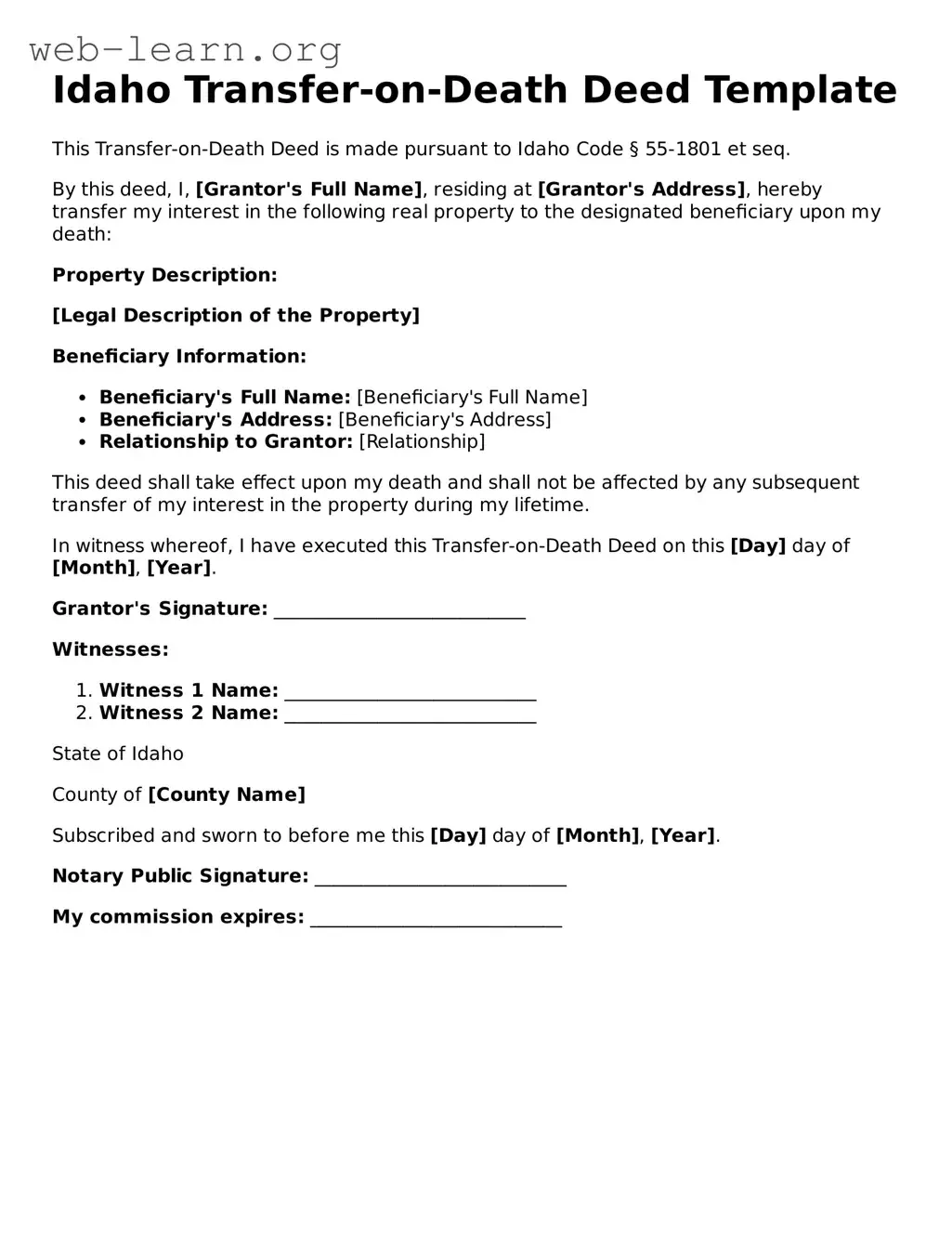
The Idaho Transfer-on-Death Deed form offers a straightforward way for property owners to transfer their real estate to designated beneficiaries upon their death, without the need for probate. This legal tool allows individuals to maintain control over their property during their lifetime while ensuring a seamless transition to heirs. The form requires essential information, including the names of the property owner(s), the beneficiaries, and a legal description of the property. By completing and recording this deed, property owners can avoid the complexities and costs associated with probate proceedings. It is important to note that the transfer only occurs upon the death of the owner, allowing for flexibility and peace of mind. Additionally, the deed can be revoked or altered during the owner’s lifetime, providing further control over the estate planning process. Understanding the nuances of the Idaho Transfer-on-Death Deed can empower property owners to make informed decisions about their assets and legacy.
Idaho Transfer-on-Death Deed Template
This Transfer-on-Death Deed is made pursuant to Idaho Code § 55-1801 et seq.
By this deed, I, [Grantor's Full Name], residing at [Grantor's Address], hereby transfer my interest in the following real property to the designated beneficiary upon my death:
Property Description:
[Legal Description of the Property]
Beneficiary Information:
This deed shall take effect upon my death and shall not be affected by any subsequent transfer of my interest in the property during my lifetime.
In witness whereof, I have executed this Transfer-on-Death Deed on this [Day] day of [Month], [Year].
Grantor's Signature: ___________________________
Witnesses:
State of Idaho
County of [County Name]
Subscribed and sworn to before me this [Day] day of [Month], [Year].
Notary Public Signature: ___________________________
My commission expires: ___________________________
| Fact Name | Description |
|---|---|
| Purpose | The Idaho Transfer-on-Death Deed allows property owners to transfer real estate to beneficiaries upon their death without going through probate. |
| Governing Law | The deed is governed by Idaho Code § 15-2-401 through § 15-2-415. |
| Eligibility | Any individual who owns real property in Idaho can create a Transfer-on-Death Deed. |
| Revocation | The deed can be revoked at any time by the property owner through a subsequent deed or a written revocation. |
| Beneficiary Designation | Property owners can designate one or more beneficiaries, and they can also specify alternate beneficiaries. |
| Filing Requirements | The deed must be recorded with the county recorder in the county where the property is located to be effective. |
| Tax Implications | Transfer-on-Death Deeds do not affect the property owner's tax liability during their lifetime. |
After obtaining the Idaho Transfer-on-Death Deed form, it is essential to fill it out accurately. Completing the form correctly ensures that the property will transfer as intended upon the owner's passing. Follow these steps to fill out the form.
What is a Transfer-on-Death (TOD) Deed?
A Transfer-on-Death Deed allows you to transfer real estate to a beneficiary upon your death, without going through probate. This means that your property can go directly to the person you choose, simplifying the process for your loved ones.
Who can use a TOD Deed in Idaho?
Any property owner in Idaho can use a TOD Deed. This includes individuals who own real estate solely or as a joint tenant. However, it’s important to ensure that the deed complies with Idaho laws.
How do I create a TOD Deed?
To create a TOD Deed, you need to fill out the form with your information, the beneficiary’s information, and a legal description of the property. Once completed, you must sign the deed in front of a notary public and then record it with the county recorder’s office.
Can I change the beneficiary after I create a TOD Deed?
Yes, you can change the beneficiary at any time. To do this, you must create a new TOD Deed that names the new beneficiary and record it. The previous deed will be revoked once the new one is recorded.
What happens if the beneficiary dies before me?
If the beneficiary you named in the TOD Deed passes away before you, the deed will not transfer the property to them. Instead, the property will go to the beneficiary’s heirs, unless you name an alternate beneficiary in the deed.
Is a TOD Deed revocable?
Yes, a TOD Deed is revocable. You can revoke it at any time while you are alive. This can be done by recording a revocation form with the county recorder’s office or by creating a new TOD Deed.
Do I need to notify the beneficiary when I create a TOD Deed?
While it is not legally required to notify the beneficiary, it is a good idea. Discussing your plans with them can help avoid confusion or disputes later on.
Are there any tax implications with a TOD Deed?
Generally, there are no immediate tax implications when you create a TOD Deed. However, when the property is transferred upon your death, the beneficiary may be subject to estate taxes depending on the total value of your estate.
Can I use a TOD Deed for all types of property?
A TOD Deed can be used for most types of real estate, including residential homes and vacant land. However, it cannot be used for personal property like vehicles or bank accounts.
What if I have multiple properties?
If you own multiple properties, you can create a separate TOD Deed for each one. Each deed will need to be filled out and recorded individually, specifying the beneficiaries for each property.
Filling out a Transfer-on-Death Deed (TODD) form in Idaho can be a straightforward process, but mistakes can lead to significant complications. One common error is failing to provide accurate property descriptions. The deed must clearly identify the property being transferred. Vague descriptions or incorrect parcel numbers can create confusion and may invalidate the deed.
Another frequent mistake involves not including all necessary signatures. Both the property owner and a witness must sign the deed for it to be valid. Omitting a signature can result in the deed being challenged or deemed ineffective, which can frustrate the intended transfer of property.
People often overlook the importance of notarization. In Idaho, a TODD must be notarized to be legally binding. Failing to have the deed notarized can lead to issues in probate court, potentially delaying the transfer process or even nullifying the deed.
Additionally, some individuals mistakenly believe that a TODD automatically takes effect upon signing. In reality, the deed must be recorded with the county recorder's office. Neglecting this step means that the deed may not be recognized, leaving the property subject to probate.
Another common error is not considering the implications of joint ownership. If property is jointly owned, it’s crucial to understand how a TODD interacts with existing ownership rights. Misunderstanding these relationships can lead to unintended consequences for heirs and beneficiaries.
People sometimes fail to update the deed after significant life changes, such as marriage or divorce. If the property owner changes their marital status or has children, it’s essential to revisit the TODD to ensure it reflects current intentions. Ignoring these changes can complicate matters for heirs.
Finally, many individuals do not seek legal advice when completing the form. Consulting with a legal expert can help clarify any uncertainties and ensure that the deed meets all legal requirements. Skipping this step might save time initially but can lead to costly mistakes in the long run.
The Idaho Transfer-on-Death Deed is a useful tool for individuals looking to pass their property to beneficiaries without the need for probate. However, several other documents may accompany this deed to ensure a smooth transfer of property and address any related legal matters. Below is a list of important forms and documents that often work in conjunction with the Transfer-on-Death Deed.
Having these documents prepared and organized can greatly simplify the process of transferring property and ensure that all legal requirements are met. Understanding each document's role can empower individuals to make informed decisions regarding their estate planning.
The Transfer-on-Death Deed (TODD) is a unique estate planning tool that allows individuals to transfer property to beneficiaries upon their death without going through probate. Several other documents serve similar purposes in estate planning and property transfer. Below is a list of ten documents that share similarities with the Transfer-on-Death Deed:
When filling out the Idaho Transfer-on-Death Deed form, it's essential to approach the task with care and attention. Here are four important dos and don'ts to consider:
By following these guidelines, you can navigate the process more smoothly and ensure that your intentions are clearly communicated in your Transfer-on-Death Deed.
Understanding the Idaho Transfer-on-Death Deed form can be tricky, and several misconceptions can lead to confusion. Here are seven common myths surrounding this important legal document:
Understanding these misconceptions can help individuals make informed decisions about their estate planning. A Transfer-on-Death Deed can be a powerful tool when used correctly, so it’s important to have accurate information.
Filling out and using the Idaho Transfer-on-Death Deed form can be an important step in estate planning. Below are key takeaways that can help individuals understand the process and implications.
Problems With Transfer on Death Deeds in Virginia - It enables property owners to retain full control during their lifetime while designating heirs.
Transfer on Death Deed Connecticut - Many find that a Transfer-on-Death Deed provides the peace of mind that comes from knowing their wishes will be honored.