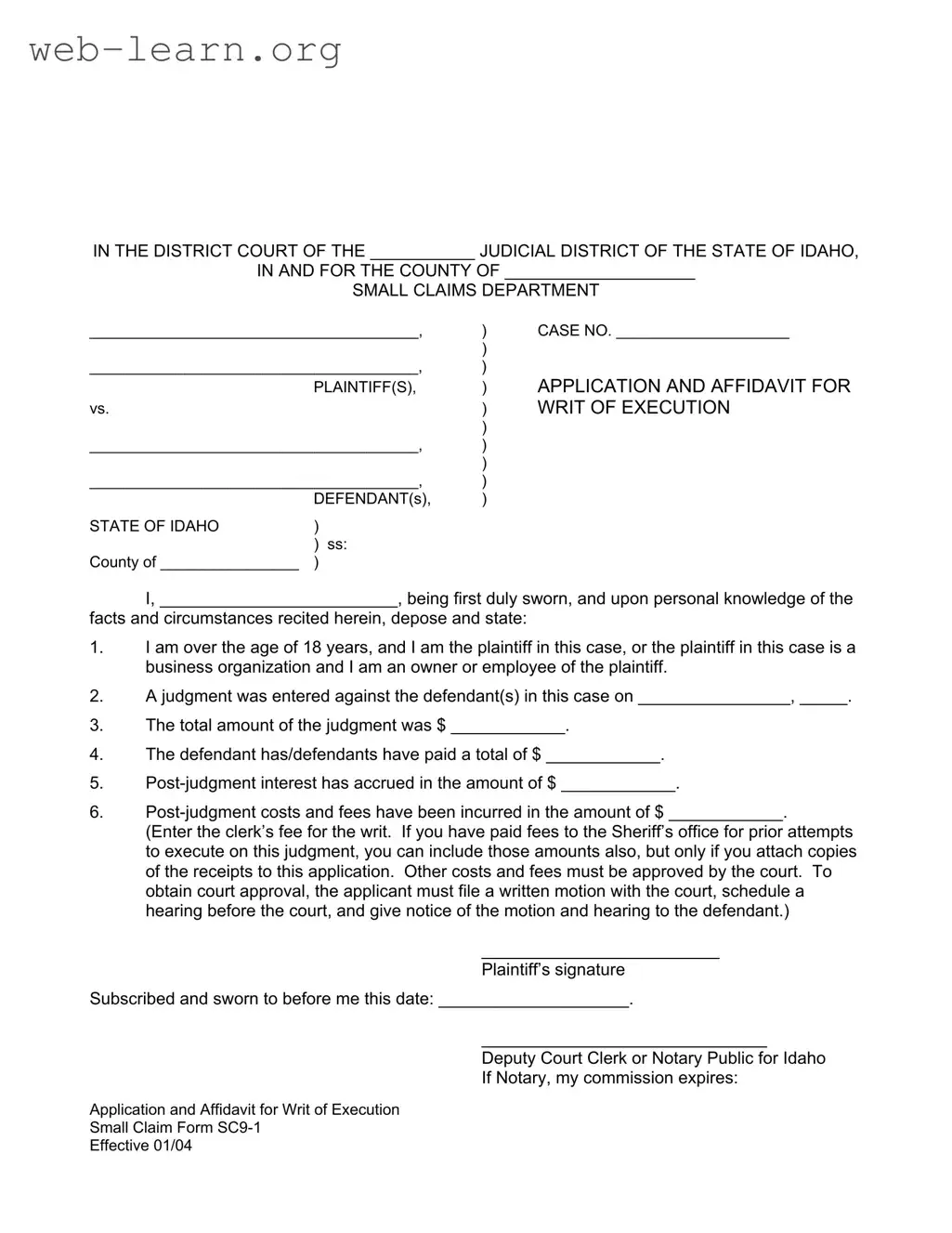
The Idaho SC 9 1 form is an essential document for individuals or businesses looking to enforce a judgment in small claims court. This form is used to apply for a writ of execution, allowing the plaintiff to collect on a judgment that has already been entered against a defendant. Key components of the form include the case number, details about the plaintiff and defendant, and a declaration of the judgment amount, any payments made by the defendant, and accrued post-judgment interest and costs. The plaintiff must confirm their identity and relationship to the case, affirming they are over 18 years old and have personal knowledge of the facts presented. Additionally, if there are any costs related to the execution process, such as fees paid to the sheriff, these must be documented and submitted for court approval. This form must be signed and sworn before a notary or deputy court clerk, ensuring its validity. Understanding the SC 9 1 form is crucial for anyone navigating the small claims process in Idaho, as it serves as a vital tool for enforcing legal rights and obtaining owed amounts.
IN THE DISTRICT COURT OF THE ___________ JUDICIAL DISTRICT OF THE STATE OF IDAHO,
IN AND FOR THE COUNTY OF ____________________
SMALL CLAIMS DEPARTMENT
______________________________________, |
) |
CASE NO. ____________________ |
|
|
|
) |
|
______________________________________, |
) |
|
|
|
PLAINTIFF(S), |
) |
APPLICATION AND AFFIDAVIT FOR |
vs. |
|
) |
WRIT OF EXECUTION |
|
|
) |
|
______________________________________, |
) |
|
|
|
|
) |
|
______________________________________, |
) |
|
|
|
DEFENDANT(s), |
) |
|
STATE OF IDAHO |
) |
|
|
)ss:
County of ________________ )
I, _________________________, being first duly sworn, and upon personal knowledge of the
facts and circumstances recited herein, depose and state:
1.I am over the age of 18 years, and I am the plaintiff in this case, or the plaintiff in this case is a business organization and I am an owner or employee of the plaintiff.
2.A judgment was entered against the defendant(s) in this case on ________________, _____.
3.The total amount of the judgment was $ ____________.
4.The defendant has/defendants have paid a total of $ ____________.
5.
6.
(Enter the clerk’s fee for the writ. If you have paid fees to the Sheriff’s office for prior attempts to execute on this judgment, you can include those amounts also, but only if you attach copies of the receipts to this application. Other costs and fees must be approved by the court. To obtain court approval, the applicant must file a written motion with the court, schedule a hearing before the court, and give notice of the motion and hearing to the defendant.)
_________________________
Plaintiff’s signature Subscribed and sworn to before me this date: ____________________.
______________________________
Deputy Court Clerk or Notary Public for Idaho If Notary, my commission expires:
Application and Affidavit for Writ of Execution
Small Claim Form
Effective 01/04
| Fact Name | Description |
|---|---|
| Governing Law | The Idaho Small Claims Act governs the use of the SC 9 1 form. |
| Purpose | This form is used to apply for a writ of execution following a judgment in a small claims case. |
| Eligibility | The applicant must be over the age of 18 or represent a business organization as an owner or employee. |
| Judgment Requirement | A valid judgment must have been entered against the defendant(s) before filing this application. |
| Payment Tracking | The form requires disclosure of any payments made by the defendant(s) towards the judgment amount. |
| Interest Accrual | Post-judgment interest must be calculated and included in the application. |
| Cost Documentation | Any post-judgment costs and fees must be documented and may require court approval. |
| Signature Requirement | The application must be signed by the plaintiff and notarized to be valid. |
Completing the Idaho SC 9 1 form is a straightforward process. This form is essential for initiating a writ of execution in small claims cases. After gathering the necessary information, follow the steps below to ensure the form is filled out correctly.
What is the Idaho SC 9 1 form?
The Idaho SC 9 1 form is an Application and Affidavit for Writ of Execution. It is used in small claims court when a plaintiff seeks to enforce a judgment against a defendant who has not paid. This form allows the plaintiff to request the court's assistance in collecting the amount owed as per the judgment.
Who can use the SC 9 1 form?
This form can be utilized by individuals or businesses that have obtained a judgment in small claims court. The plaintiff must be at least 18 years old, or if the plaintiff is a business, the individual completing the form must be an owner or employee of that business.
What information is required on the form?
When filling out the SC 9 1 form, you will need to provide:
What happens after I submit the SC 9 1 form?
Once the form is submitted, the court will review your application. If approved, the court will issue a writ of execution, allowing you to take further steps to collect the judgment, such as garnishing wages or seizing property.
Can I include additional costs and fees?
Yes, you may include additional costs and fees, such as the clerk's fee for the writ. However, any other costs must be approved by the court. To obtain this approval, you must file a written motion and schedule a hearing.
What if the defendant has made partial payments?
If the defendant has made any payments towards the judgment, you must indicate the total amount paid on the form. This information is crucial for calculating the remaining balance owed.
Is there a deadline for submitting the SC 9 1 form?
While there is no specific deadline for submitting the SC 9 1 form, it is important to act promptly after a judgment is entered. Delays may hinder your ability to collect the owed amount, especially if the defendant's financial situation changes.
Filling out the Idaho SC 9 1 form can be straightforward, but many people make common mistakes that can delay their application. One frequent error is leaving the case number blank. The case number is essential for the court to identify the specific case associated with the application. Without it, the form may be rejected or cause confusion.
Another common mistake is incorrect or incomplete information regarding the parties involved. Applicants often fail to provide full names or accurate addresses for both the plaintiff and the defendant. This information is crucial for legal notifications and must be precise to avoid complications later in the process.
Many individuals overlook the requirement to specify the date when the judgment was entered. This date is important for calculating any post-judgment interest. If this section is left blank or filled out incorrectly, it can lead to issues with the amount owed and hinder the execution process.
Additionally, applicants sometimes miscalculate the total amount of the judgment or the payments made by the defendant. Errors in these figures can create discrepancies that complicate the case. It is vital to double-check all calculations before submitting the form to ensure accuracy.
Another mistake involves the post-judgment interest and costs. Some people forget to include these amounts or do not provide the necessary documentation for any additional fees. The court requires proof for certain costs, so attaching the appropriate receipts is essential for a smooth application process.
Additionally, failing to sign the application can lead to immediate rejection. A signature is required to validate the affidavit. Without it, the court will not process the application, and the plaintiff will need to start over.
Lastly, applicants sometimes neglect to check the expiration date of their notary's commission. If the notary's commission has expired, the signature may not be valid. Ensuring that the notary is currently commissioned can prevent unnecessary delays and complications.
The Idaho SC 9 1 form is essential for plaintiffs seeking a writ of execution after obtaining a judgment in small claims court. However, several other forms and documents often accompany this application to ensure the process runs smoothly. Below are some commonly used documents that may be necessary.
Utilizing these forms correctly can significantly affect the outcome of the collection process. Ensure that all documents are completed accurately and submitted in a timely manner to avoid delays in enforcement of the judgment.
The Idaho SC 9 1 form, which is an Application and Affidavit for Writ of Execution, shares similarities with several other legal documents used in small claims and civil procedures. Below is a list of eight such documents, highlighting their similarities:
When filling out the Idaho SC 9 1 form, there are important dos and don'ts to keep in mind. This will help ensure your application is processed smoothly and efficiently.
Following these guidelines will help you avoid common pitfalls and improve your chances of a successful application.
Understanding the Idaho SC 9 1 form can be crucial for anyone involved in small claims court. However, there are several misconceptions that can lead to confusion. Here are nine common myths about the form, along with clarifications to help you navigate the process more effectively.
This form can be used by both individuals and business organizations. If a business is the plaintiff, an owner or employee can complete the form on its behalf.
A judgment must be entered against the defendant before you can use this form. It serves as a request to enforce that judgment.
It's essential to indicate any payments made by the defendant. This information helps calculate the remaining balance owed.
You must calculate and enter the amount of post-judgment interest accrued separately. It's not automatically added to your judgment amount.
Only certain costs and fees can be included, and some require court approval. Make sure to follow the proper procedures to avoid complications.
The SC 9 1 form must be sworn to before a notary public or a deputy court clerk. This adds a layer of legitimacy to your application.
There are time limits on when you can apply for a writ of execution. Familiarize yourself with these deadlines to ensure your application is timely.
Notifying the defendant is a critical step. They must be informed about the motion and hearing to ensure due process is followed.
While this form is essential for obtaining a writ of execution, you may need additional documents depending on your specific situation and the court's requirements.
By addressing these misconceptions, you can better prepare yourself for the small claims process in Idaho. Always consider seeking guidance if you're unsure about any steps involved.
When filling out the Idaho SC 9 1 form, it is essential to understand the following key points: