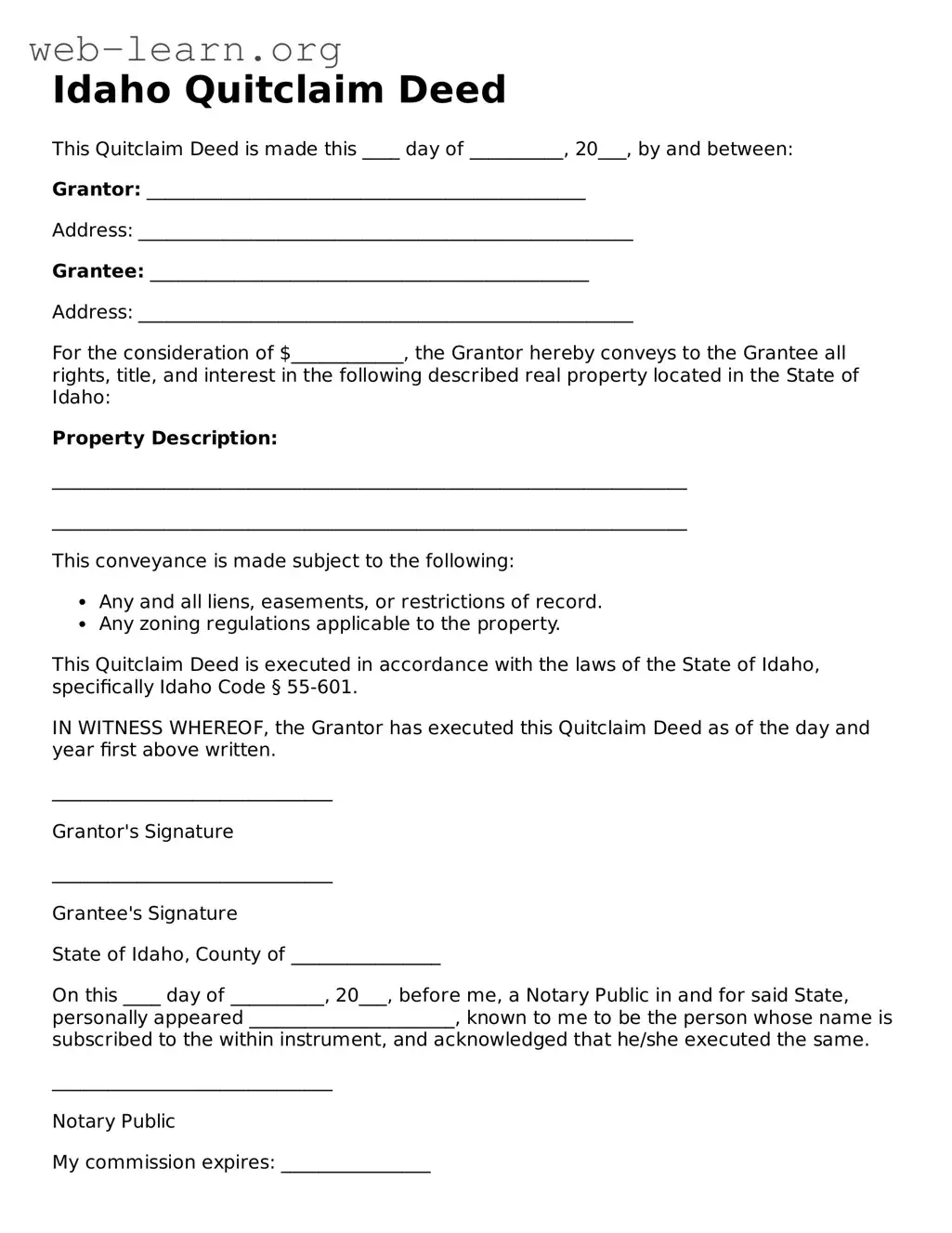
The Idaho Quitclaim Deed form serves as a vital tool in the realm of property transfer, enabling individuals to convey ownership rights without making any guarantees about the title's validity. This form is particularly useful in situations where the granter may not have complete knowledge of the property’s history or when the transfer occurs between family members or acquaintances. By utilizing a quitclaim deed, the granter relinquishes any claim they may have to the property, allowing the grantee to assume ownership. It is important to note that this type of deed does not provide the same level of protection as a warranty deed, which assures the grantee of a clear title. Instead, the quitclaim deed merely transfers whatever interest the granter possesses, if any. Completing this form requires careful attention to detail, including the correct identification of the parties involved and a clear description of the property being transferred. Additionally, proper execution, including signatures and notarization, is essential to ensure the deed is legally binding. Understanding the nuances of the Idaho Quitclaim Deed form can empower individuals to navigate property transactions more effectively, fostering trust and clarity in the process.
Idaho Quitclaim Deed
This Quitclaim Deed is made this ____ day of __________, 20___, by and between:
Grantor: _______________________________________________
Address: _____________________________________________________
Grantee: _______________________________________________
Address: _____________________________________________________
For the consideration of $____________, the Grantor hereby conveys to the Grantee all rights, title, and interest in the following described real property located in the State of Idaho:
Property Description:
____________________________________________________________________
____________________________________________________________________
This conveyance is made subject to the following:
This Quitclaim Deed is executed in accordance with the laws of the State of Idaho, specifically Idaho Code § 55-601.
IN WITNESS WHEREOF, the Grantor has executed this Quitclaim Deed as of the day and year first above written.
______________________________
Grantor's Signature
______________________________
Grantee's Signature
State of Idaho, County of ________________
On this ____ day of __________, 20___, before me, a Notary Public in and for said State, personally appeared ______________________, known to me to be the person whose name is subscribed to the within instrument, and acknowledged that he/she executed the same.
______________________________
Notary Public
My commission expires: ________________
| Fact Name | Description |
|---|---|
| Definition | An Idaho Quitclaim Deed transfers ownership of property without guaranteeing clear title. |
| Governing Law | The Idaho Quitclaim Deed is governed by Idaho Code § 55-601 et seq. |
| Purpose | It is commonly used to transfer property between family members or to clear up title issues. |
| Requirements | The form must include the names of the grantor and grantee, a legal description of the property, and the date of transfer. |
| Signature | The grantor must sign the deed in front of a notary public for it to be valid. |
| Recording | To protect the interests of the grantee, the deed should be recorded with the county recorder's office. |
| Limitations | The quitclaim deed does not offer any warranties; the grantor is not liable for title defects. |
Once you have the Idaho Quitclaim Deed form, you will need to fill it out carefully to ensure all necessary information is included. After completing the form, it will need to be signed and notarized before being filed with the appropriate county office.
What is a Quitclaim Deed in Idaho?
A Quitclaim Deed is a legal document used to transfer ownership of real estate in Idaho. This type of deed allows the current owner, known as the grantor, to transfer their interest in a property to another party, known as the grantee. Unlike other types of deeds, a Quitclaim Deed does not guarantee that the grantor holds clear title to the property. Instead, it simply conveys whatever interest the grantor has, if any.
When should I use a Quitclaim Deed?
There are several situations where a Quitclaim Deed may be appropriate:
How do I complete a Quitclaim Deed in Idaho?
Completing a Quitclaim Deed involves several steps:
Are there any fees associated with filing a Quitclaim Deed?
Yes, there are typically fees involved when filing a Quitclaim Deed in Idaho. These may include:
It’s advisable to check with your local county recorder’s office for the exact fees and requirements.
Filling out the Idaho Quitclaim Deed form can be straightforward, but mistakes often occur. One common error is not including all required information. Ensure that both the grantor and grantee's names are clearly stated. Missing even one name can lead to delays or complications in the transfer process.
Another mistake is failing to provide a legal description of the property. This description is essential for identifying the exact location and boundaries of the property being transferred. Without it, the deed may not be valid.
Many people forget to sign the document. Both the grantor and any witnesses must sign the Quitclaim Deed for it to be legally binding. Neglecting this step can render the deed ineffective.
Incorrectly dating the document is another frequent issue. The date on the Quitclaim Deed should reflect the day it is signed. An inaccurate date can lead to confusion about when the transfer took place.
Some individuals overlook the need for notarization. In Idaho, a Quitclaim Deed must be notarized to be valid. Skipping this step can result in the deed being rejected by the county recorder's office.
Additionally, people sometimes use outdated forms. Always ensure that you are using the most current version of the Quitclaim Deed form. Using an old form can lead to errors and complications.
Finally, not checking for typos can be a costly mistake. Simple errors in spelling names or addresses can create problems down the line. Always double-check your work before submitting the form.
When completing a real estate transaction in Idaho, several documents may accompany the Quitclaim Deed form. Each of these forms serves a specific purpose in the transfer of property rights and ensuring legal compliance. Below is a list of commonly used documents that may be required or beneficial in conjunction with the Quitclaim Deed.
Understanding these documents can facilitate a smoother property transfer process. Each plays a vital role in ensuring that all parties are informed and protected during the transaction.
A Quitclaim Deed is a legal document used to transfer ownership of property. While it serves a specific purpose, several other documents share similarities in function or intent. Here’s a list of nine documents that are similar to a Quitclaim Deed:
Each of these documents plays a role in property transactions, whether through transferring ownership or establishing rights. Understanding their similarities and differences can help in navigating property law effectively.
When filling out the Idaho Quitclaim Deed form, it's important to follow certain guidelines to ensure the process goes smoothly. Here’s a list of what you should and shouldn’t do:
By adhering to these guidelines, you can help ensure that your Quitclaim Deed is completed accurately and effectively.
The Idaho Quitclaim Deed form is often misunderstood. Below are seven common misconceptions about this legal document.
Understanding these misconceptions can help individuals make informed decisions when dealing with property transfers in Idaho.
When dealing with property transfers in Idaho, understanding the Quitclaim Deed form is essential. Here are key takeaways to consider:
Understanding these points can help ensure a smooth property transfer process in Idaho.
Quick Deed Process - A Quitclaim Deed does not protect against future claims on the property.
New York Quitclaim Deed - A Quitclaim Deed is a straightforward way to manage property interests.
Arkansas Quit Claim Deed - This form can help avoid lengthy probate processes.
Quitclaim Deed Georgia Cost - This document is a straightforward way to transfer property rights.