Homepage Attorney-Approved Power of Attorney Template Attorney-Approved Power of Attorney Document for the State of Idaho
Outline

The Idaho Power of Attorney form is a crucial legal document that allows individuals to appoint someone they trust to make decisions on their behalf, particularly in financial or healthcare matters. This form serves to empower an agent, often referred to as an attorney-in-fact, to act in the best interest of the principal, who is the person granting the authority. It can be tailored to fit specific needs, whether for a limited time or for ongoing use, and can cover various types of decisions, from managing bank accounts to making medical decisions during incapacitation. Understanding the nuances of this form is essential, as it includes important details such as the scope of authority granted, the duration of the powers, and any conditions or limitations that may apply. Additionally, it is vital to consider the implications of choosing a trustworthy agent, as this person will have significant control over personal and financial matters. By exploring the Idaho Power of Attorney form, individuals can ensure they are prepared for unforeseen circumstances and that their wishes will be respected when they are unable to communicate them directly.

Sample - Idaho Power of Attorney Form

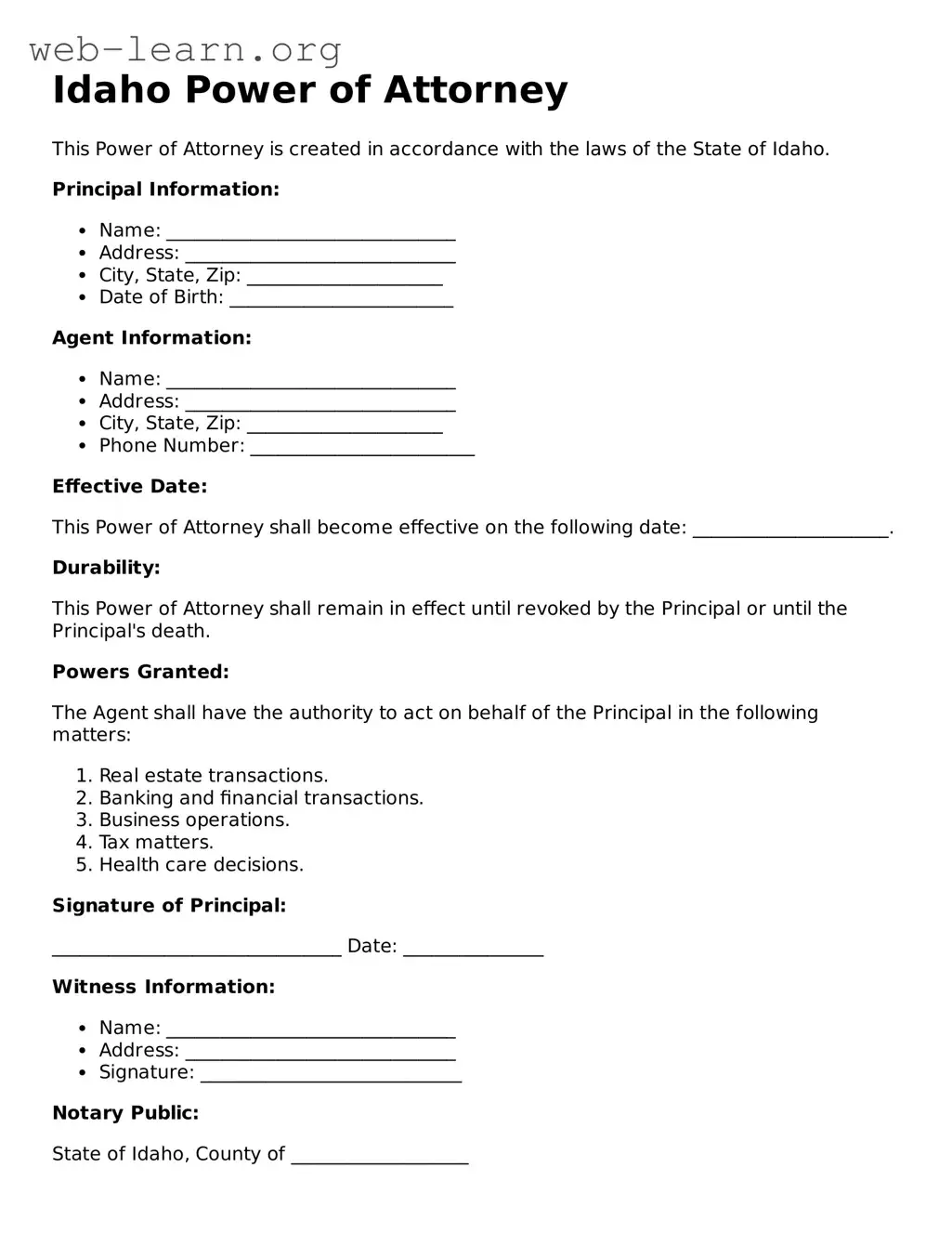
Idaho Power of Attorney

This Power of Attorney is created in accordance with the laws of the State of Idaho.

Principal Information:

  • Name: _______________________________
  • Address: _____________________________
  • City, State, Zip: _____________________
  • Date of Birth: ________________________

Agent Information:

  • Name: _______________________________
  • Address: _____________________________
  • City, State, Zip: _____________________
  • Phone Number: ________________________

Effective Date:

This Power of Attorney shall become effective on the following date: _____________________.

Durability:

This Power of Attorney shall remain in effect until revoked by the Principal or until the Principal's death.

Powers Granted:

The Agent shall have the authority to act on behalf of the Principal in the following matters:

  1. Real estate transactions.
  2. Banking and financial transactions.
  3. Business operations.
  4. Tax matters.
  5. Health care decisions.

Signature of Principal:

_______________________________ Date: _______________

Witness Information:

  • Name: _______________________________
  • Address: _____________________________
  • Signature: ____________________________

Notary Public:

State of Idaho, County of ___________________

Subscribed and sworn to before me this _____ day of __________, 20__.

_______________________________

Notary Public for the State of Idaho

My commission expires: ________________

File Characteristics

Fact Name Details
Purpose The Idaho Power of Attorney form allows you to designate someone to make decisions on your behalf, such as financial or medical choices.
Governing Law This form is governed by Idaho Code Title 15, Chapter 12, which outlines the rules for powers of attorney in the state.
Types of Authority You can grant general authority or specific authority, depending on your needs. Specific authority can be limited to certain tasks.
Revocation You can revoke the power of attorney at any time, as long as you are mentally competent. A written notice is recommended.

Detailed Guide for Filling Out Idaho Power of Attorney

Filling out the Idaho Power of Attorney form is an important step in designating someone to make decisions on your behalf. Once completed, the form should be signed and notarized to ensure its validity. Here are the steps to guide you through the process of filling out the form.

  1. Obtain the Idaho Power of Attorney form. This can typically be found online or at a local legal office.
  2. Begin by entering your full name and address in the designated section. Ensure that this information is accurate.
  3. Next, provide the name and address of the person you are appointing as your agent. This person will have the authority to act on your behalf.
  4. Clearly specify the powers you wish to grant your agent. This may include financial decisions, health care decisions, or other specific authorities.
  5. Indicate the duration of the Power of Attorney. You may choose to make it effective immediately, or specify a start date and an expiration date.
  6. Review the form for any errors or omissions. It’s essential that all information is complete and correct.
  7. Sign the form in the presence of a notary public. This step is crucial for the form’s legal standing.
  8. Have the notary public sign and seal the document, confirming that they witnessed your signature.
  9. Make copies of the completed form for your records and for the agent, if necessary.

Obtain Answers on Idaho Power of Attorney

  1. What is a Power of Attorney in Idaho?

    A Power of Attorney (POA) in Idaho is a legal document that allows one person, known as the principal, to appoint another person, known as the agent or attorney-in-fact, to make decisions on their behalf. This authority can cover a range of matters, including financial decisions, medical care, and property management.

  2. What types of Power of Attorney are available in Idaho?

    Idaho recognizes several types of Power of Attorney, including:

    • General Power of Attorney: Grants broad powers to the agent to act on behalf of the principal.
    • Durable Power of Attorney: Remains effective even if the principal becomes incapacitated.
    • Limited Power of Attorney: Restricts the agent's authority to specific tasks or time frames.
    • Medical Power of Attorney: Specifically allows the agent to make healthcare decisions for the principal.
  3. How do I create a Power of Attorney in Idaho?

    To create a Power of Attorney in Idaho, follow these steps:

    1. Choose the type of Power of Attorney that fits your needs.
    2. Complete the appropriate form, ensuring all necessary details are included.
    3. Sign the document in the presence of a notary public.
    4. Provide copies to your agent and any relevant institutions or individuals.
  4. Can I revoke a Power of Attorney in Idaho?

    Yes, a Power of Attorney can be revoked at any time as long as the principal is mentally competent. To revoke, the principal should create a written revocation document, sign it, and notify the agent and any institutions that have a copy of the original Power of Attorney.

  5. What happens if I do not have a Power of Attorney?

    If you do not have a Power of Attorney and become incapacitated, your family may need to go through a legal process to appoint a guardian or conservator to manage your affairs. This process can be time-consuming and costly, highlighting the importance of having a POA in place.

  6. Is a Power of Attorney valid in other states?

    A Power of Attorney created in Idaho is generally valid in other states, but it is advisable to check the specific laws of the state where it will be used. Some states may have different requirements for POA documents, and it may be beneficial to consult with a legal professional if you plan to use it outside Idaho.

Common mistakes

Filling out the Idaho Power of Attorney form can be straightforward, but many people make common mistakes that can lead to complications. One frequent error is failing to specify the powers granted. It is crucial to clearly outline what authority is being given to the agent. Without this clarity, the agent may not have the necessary power to act on behalf of the principal.

Another mistake is neglecting to date the document. A date is essential for establishing when the Power of Attorney becomes effective. Without a date, there may be confusion about the validity of the form, which can lead to disputes or delays in executing the principal's wishes.

Many individuals forget to sign the form. A signature is required to make the document legally binding. If the principal does not sign, the Power of Attorney is not valid, and the agent cannot act on their behalf.

Additionally, people often overlook the need for witnesses or notarization. Idaho law requires certain Powers of Attorney to be witnessed or notarized. Failing to meet these requirements can render the document invalid.

Another common mistake is not informing the agent about their responsibilities. It is vital for the principal to communicate clearly with the agent about their expectations and the scope of authority. This communication helps prevent misunderstandings and ensures that the agent acts in the principal's best interest.

In some cases, individuals use outdated forms. Laws and requirements can change, so it is important to use the most current version of the Power of Attorney form. Using an outdated form may lead to legal issues down the line.

People sometimes forget to revoke previous Powers of Attorney. If a principal has granted authority to another agent in the past, they must formally revoke that authority before establishing a new Power of Attorney. Failing to do so can create confusion about which agent has the authority to act.

Another mistake is not considering the choice of agent carefully. Selecting someone who is not trustworthy or capable can lead to problems. It is essential to choose an agent who will act responsibly and in the principal's best interests.

Finally, some individuals fail to keep copies of the completed form. It is important to provide copies to the agent and any institutions that may need to recognize the Power of Attorney. Without copies, there may be challenges in executing the principal's wishes when needed.

Documents used along the form

A Power of Attorney (POA) is a vital legal document that allows one person to act on behalf of another in financial or medical matters. In Idaho, as in many states, several other forms and documents often accompany a Power of Attorney to ensure that the principal's wishes are clearly articulated and legally binding. Below is a list of common documents that may be used alongside the Idaho Power of Attorney form.

  • Advance Healthcare Directive: This document outlines a person's preferences for medical treatment and end-of-life care. It can include specific instructions about medical procedures and designate someone to make healthcare decisions if the individual becomes unable to communicate.
  • Living Will: A living will is a specific type of advance directive that details what medical interventions a person does or does not want in the event of a terminal illness or irreversible condition.
  • Durable Power of Attorney: This is a specific type of POA that remains effective even if the principal becomes incapacitated. It is essential for long-term planning and ensures that financial decisions can be made on behalf of the principal when they are unable to do so themselves.
  • Financial Power of Attorney: This document grants someone the authority to manage financial matters, such as paying bills, managing investments, and handling property transactions, on behalf of the principal.
  • Trust Documents: If a person has established a trust, the trust documents outline how the trust operates, who the beneficiaries are, and the powers of the trustee. This can work in conjunction with a POA for comprehensive estate planning.
  • HIPAA Authorization: This form allows designated individuals to access a person's medical records and health information. It is crucial for ensuring that healthcare agents can make informed decisions based on the principal's medical history.
  • Will: A will outlines how a person's assets should be distributed after their death. While it does not directly relate to a POA, it is an essential component of overall estate planning.
  • Guardianship Documents: If a person anticipates needing a guardian for minor children or for themselves in the future, these documents outline the process for appointing a guardian and the responsibilities involved.
  • Property Deeds: If real estate is involved, property deeds may need to be updated or transferred to reflect the authority granted under a POA, ensuring that the designated agent can manage or sell property as needed.

These documents collectively help in creating a comprehensive legal framework that protects the interests of individuals, especially in situations where they may be unable to make decisions for themselves. By understanding and utilizing these forms, individuals can ensure their wishes are respected and their affairs are managed effectively.

Similar forms

The Power of Attorney form shares similarities with several other legal documents. Here is a list of ten documents that have comparable functions or purposes:

  • Living Will: Like a Power of Attorney, a Living Will allows individuals to express their wishes regarding medical treatment in case they become unable to communicate. It focuses specifically on healthcare decisions.
  • Healthcare Proxy: This document designates someone to make healthcare decisions on behalf of an individual. Similar to a Power of Attorney, it grants authority to act in specific situations.
  • Durable Power of Attorney: This is a type of Power of Attorney that remains effective even if the person becomes incapacitated. It ensures that decisions can still be made when needed.
  • Financial Power of Attorney: This document specifically grants authority to manage financial matters. It is a focused version of a general Power of Attorney.
  • Trust Agreement: A Trust Agreement allows a person to place their assets in a trust for management by another party. Both documents involve delegating authority over assets.
  • Will: A Will outlines how a person's assets will be distributed after their death. While it does not grant authority during life, it serves to manage affairs similarly.
  • Guardian Appointment: This document names a guardian for a minor or incapacitated adult. It shares the purpose of protecting an individual's interests, similar to a Power of Attorney.
  • Business Authorization Letter: This letter allows someone to act on behalf of a business. It is similar in that it grants authority to make decisions for another party.
  • Release of Information Form: This form allows a designated person to access private information. Like a Power of Attorney, it involves sharing authority over personal matters.
  • Affidavit: An Affidavit is a sworn statement used in legal matters. While it does not grant authority, it can support decisions made under a Power of Attorney.

Dos and Don'ts

When filling out the Idaho Power of Attorney form, it's important to approach the process carefully. Here are some key do's and don'ts to keep in mind:

  • Do ensure that you clearly identify the person you are appointing as your agent.
  • Do specify the powers you want to grant your agent in detail.
  • Don't rush through the form; take your time to read and understand each section.
  • Don't forget to sign the form in front of a notary public, as this is often a requirement for validity.

Following these guidelines can help ensure that your Power of Attorney is executed properly and serves your needs effectively.

Misconceptions

When it comes to the Idaho Power of Attorney form, several misconceptions can lead to confusion. Understanding these common misunderstandings can help individuals make informed decisions about their legal needs.

  • All Power of Attorney forms are the same. Many people believe that all Power of Attorney forms function identically. In reality, these forms can vary significantly by state and purpose. Idaho has specific requirements that must be met for a Power of Attorney to be valid.
  • A Power of Attorney is only for financial matters. While many use a Power of Attorney for financial decisions, it can also be used for healthcare decisions. In Idaho, you can designate someone to make medical choices on your behalf if you are unable to do so.
  • Once a Power of Attorney is signed, it cannot be revoked. This is a common myth. In Idaho, you can revoke a Power of Attorney at any time as long as you are mentally competent. This revocation should be documented in writing.
  • The agent must be a lawyer. Some individuals think that only a lawyer can serve as an agent under a Power of Attorney. However, in Idaho, anyone who is at least 18 years old and competent can be designated as an agent.
  • A Power of Attorney is permanent. Many people assume that a Power of Attorney remains in effect indefinitely. In Idaho, a Power of Attorney can be set up to be durable or non-durable, meaning it can be limited to a specific time or event.
  • Signing a Power of Attorney means giving up control. This misconception can deter individuals from creating a Power of Attorney. In fact, the principal retains control and can specify what powers the agent has, ensuring that their wishes are respected.

Understanding these misconceptions can empower individuals in Idaho to make better choices regarding their Power of Attorney needs. Always consider consulting a legal professional for personalized advice.

Key takeaways

When dealing with the Idaho Power of Attorney form, it's essential to understand the implications and requirements involved. Here are some key takeaways to keep in mind:

  • Understand the Purpose: The Power of Attorney allows you to designate someone to make decisions on your behalf, whether for financial, medical, or legal matters.
  • Choose Your Agent Wisely: Select a trustworthy individual as your agent. This person will have significant authority over your affairs, so their integrity and reliability are crucial.
  • Be Specific: Clearly outline the powers you are granting. You can limit your agent’s authority to specific tasks or give them broad powers, depending on your needs.
  • Sign and Notarize: For the document to be valid, it must be signed in front of a notary public. This step is crucial in ensuring that your Power of Attorney is legally recognized.

Taking these steps seriously can help ensure that your wishes are honored and that your affairs are managed according to your preferences.