The Idaho Power of Attorney for a Child form serves as a vital legal document, empowering a designated adult to make important decisions on behalf of a child when the parent or legal guardian is unavailable. This form is particularly useful in situations where parents may need to travel, attend to personal matters, or face unforeseen circumstances that prevent them from caring for their child. By appointing a trusted individual, parents can ensure that their child's needs are met and that important decisions regarding education, medical care, and general welfare are handled appropriately. The form outlines the specific powers granted to the agent, which can include the ability to enroll the child in school, consent to medical treatment, and make day-to-day decisions. It is essential for parents to understand the duration of the authority granted, as well as any limitations they may wish to impose. Moreover, the document requires signatures from both the parent and the appointed agent, often necessitating notarization to enhance its legal standing. Overall, this form offers peace of mind, ensuring that children are cared for in their parents' absence while maintaining clear lines of authority and responsibility.
Idaho Power of Attorney for a Child
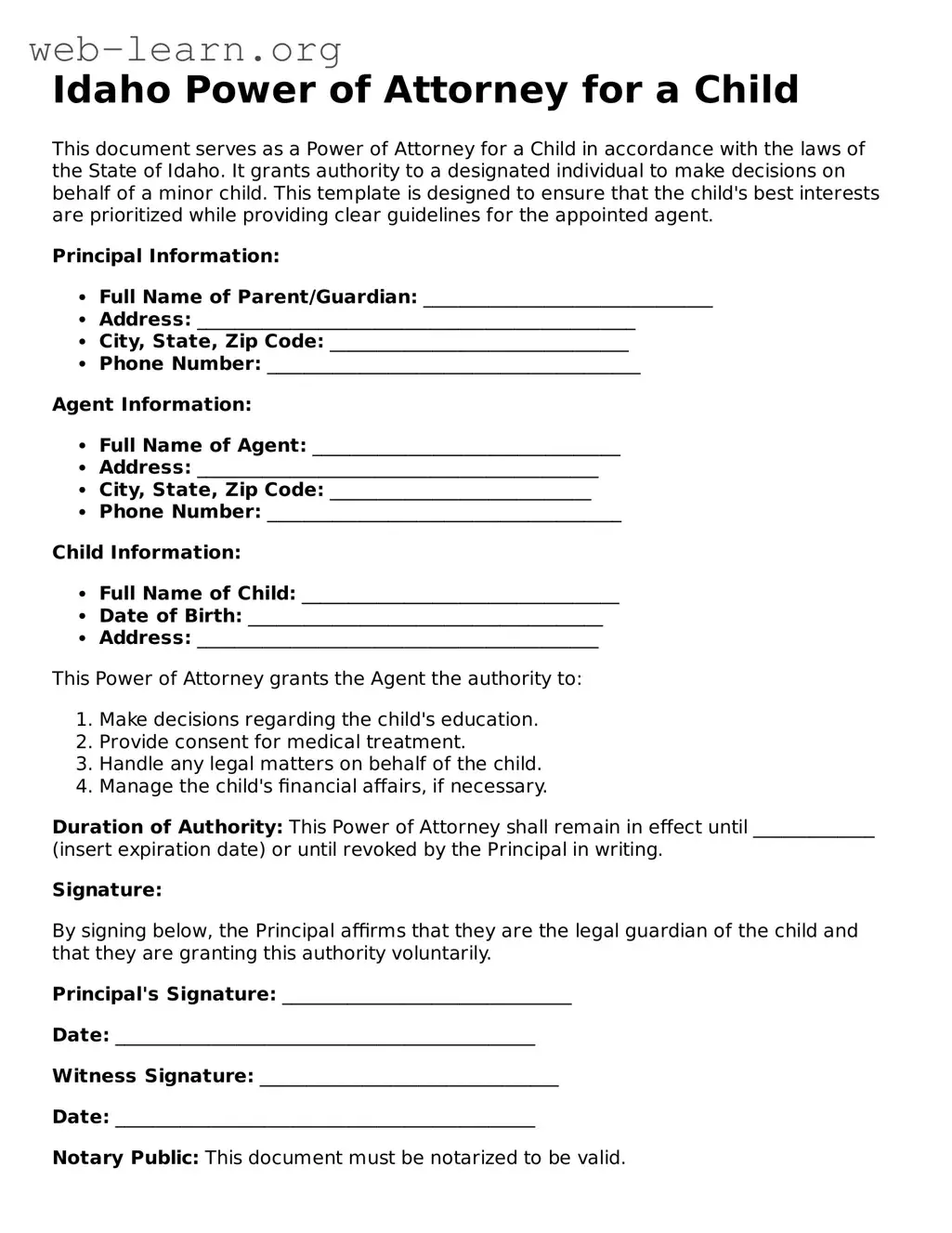
This document serves as a Power of Attorney for a Child in accordance with the laws of the State of Idaho. It grants authority to a designated individual to make decisions on behalf of a minor child. This template is designed to ensure that the child's best interests are prioritized while providing clear guidelines for the appointed agent.
Principal Information:
Agent Information:
Child Information:
This Power of Attorney grants the Agent the authority to:
Duration of Authority: This Power of Attorney shall remain in effect until _____________ (insert expiration date) or until revoked by the Principal in writing.
Signature:
By signing below, the Principal affirms that they are the legal guardian of the child and that they are granting this authority voluntarily.
Principal's Signature: _______________________________
Date: _____________________________________________
Witness Signature: ________________________________
Date: _____________________________________________
Notary Public: This document must be notarized to be valid.
| Fact Name | Description |
|---|---|
| Purpose | The Idaho Power of Attorney for a Child form allows a parent or guardian to grant temporary authority to another adult to make decisions for their child. |
| Legal Basis | This form is governed by Idaho Code § 15-5-501 through § 15-5-503. |
| Duration | The authority granted can be set for a specific period or until revoked by the parent or guardian. |
| Who Can Be an Agent | The person designated as an agent must be at least 18 years old and capable of making decisions in the best interest of the child. |
| Scope of Authority | The agent can make decisions regarding health care, education, and general welfare, depending on what the parent specifies. |
| Revocation | The parent or guardian can revoke the Power of Attorney at any time, which must be done in writing. |
| Notarization | While notarization is not required, it is highly recommended to ensure the document's validity. |
| Emergency Situations | This form can be particularly useful in emergencies, allowing for immediate decision-making when parents are unavailable. |
| Limitations | The Power of Attorney does not allow the agent to make decisions that permanently affect the child's legal status, such as adoption. |
| Availability | The Idaho Power of Attorney for a Child form is available online and can be filled out and printed for use. |
Once you have the Idaho Power of Attorney for a Child form in hand, you can start filling it out. Be sure to have all necessary information ready, such as names, addresses, and any relevant details about the child and the designated agent. This will make the process smoother.
After completing the form, ensure that both you and the agent keep copies for your records. It’s also wise to inform the child about who will be responsible for their care in your absence.
What is a Power of Attorney for a Child in Idaho?
A Power of Attorney for a Child in Idaho allows a parent or legal guardian to designate another person to make decisions on behalf of their child. This can include decisions about education, healthcare, and general welfare. The form ensures that the appointed person has the authority to act in the best interest of the child when the parent or guardian is unavailable.
Who can be appointed as an agent?
Any responsible adult can be appointed as an agent. This may include relatives, family friends, or trusted individuals. It is essential to choose someone who is reliable and capable of making decisions that align with the child's best interests.
How long is the Power of Attorney valid?
The Power of Attorney for a Child is generally valid until the specified date in the document or until it is revoked by the parent or guardian. If no date is specified, it may remain in effect until the child reaches the age of majority, which is 18 years old in Idaho.
Do I need to have the form notarized?
Yes, the Power of Attorney for a Child form must be notarized to be legally binding. This step helps to ensure that the document is authentic and that the signatures are valid.
Can I revoke the Power of Attorney once it is established?
Yes, you can revoke the Power of Attorney at any time. To do this, you should provide written notice to the agent and any relevant parties. It is advisable to also complete a revocation form to ensure clarity and avoid confusion.
What decisions can the agent make on behalf of the child?
The agent can make various decisions regarding the child's education, healthcare, and general welfare. However, the specific powers granted should be clearly outlined in the Power of Attorney document. Parents should consider what decisions they are comfortable allowing the agent to make.
Is there a specific form I must use for Idaho?
While there is no state-mandated form, it is recommended to use a form that complies with Idaho laws. Many legal resources provide templates that can be customized to fit your needs. Ensure that the form includes all necessary details and is properly executed.
What happens if I do not have a Power of Attorney for my child?
If you do not have a Power of Attorney, it may be challenging for someone else to make important decisions for your child in your absence. Without this document, authorities may require additional legal processes to appoint someone to act on your behalf, which can be time-consuming and stressful.
Where can I find assistance in completing the form?
Assistance can be found through various resources, including legal aid organizations, family law attorneys, and online legal services. Many of these resources can provide guidance and answer any questions you may have about the process.
Filling out the Idaho Power of Attorney for a Child form can be a straightforward process, but mistakes can lead to complications. One common error is failing to provide complete information. When names, addresses, or contact details are missing, it can create confusion and may delay the authority granted.
Another frequent mistake is not specifying the duration of the power of attorney. Without a clear start and end date, the arrangement may be open-ended, which can lead to misunderstandings about when the authority is active.
Some individuals neglect to identify the child clearly. Including the child’s full name, date of birth, and any relevant identification numbers is crucial. This information ensures that the authority applies specifically to the intended child and not to others.
People often overlook the importance of signatures. Both the parent or guardian granting the power and the designated agent must sign the form. Failing to obtain all necessary signatures can render the document invalid.
Another mistake involves not having the document notarized. In Idaho, a power of attorney for a child typically requires notarization to be legally binding. Skipping this step can lead to challenges in enforcing the authority granted.
Additionally, some individuals do not consider the limitations of the power of attorney. Clearly outlining what decisions the agent can make is essential. Without these details, the agent may assume they have broader authority than intended.
People may also forget to update the form when circumstances change. Life events such as divorce, relocation, or the child reaching adulthood can necessitate a revision of the power of attorney. Keeping the document current is vital to ensure it reflects the current situation.
Finally, some individuals fail to communicate with the designated agent. Discussing the responsibilities and expectations with the person taking on this role is essential. This conversation can prevent misunderstandings and ensure that the agent is prepared to act in the child’s best interests.
When considering the Idaho Power of Attorney for a Child form, it is important to understand that several other documents may be necessary to ensure comprehensive legal authority and protection for the child. Below is a list of commonly used forms and documents that may accompany this power of attorney.
Having these documents prepared and organized can help facilitate smoother transitions and ensure that the child’s needs are met in various situations. It is advisable to consult with a legal professional to ensure all necessary documents are properly completed and aligned with current laws.
When filling out the Idaho Power of Attorney for a Child form, it is crucial to follow specific guidelines to ensure the document is valid and effective. Here are four things you should and shouldn't do:
When it comes to the Idaho Power of Attorney for a Child form, several misconceptions can lead to confusion for parents and guardians. Understanding the facts can help ensure that children receive the proper care and support they need. Here are seven common misconceptions:
Many believe that a Power of Attorney for a Child is only necessary in emergencies. However, this document can be useful for various situations, such as temporary travel, medical care, or educational needs.
Some parents worry that signing this form means they are relinquishing their parental rights. In reality, the Power of Attorney allows a designated person to act on behalf of the parent while retaining full parental rights.
While notarization can add an extra layer of authenticity, it is not always required for the Power of Attorney for a Child in Idaho. The form must be signed and dated, but specific requirements may vary.
Some people think that once a Power of Attorney is established, it cannot be changed or revoked. In fact, parents can revoke or modify the document at any time, as long as they follow the proper legal procedures.
Another misconception is that only one individual can be named in the Power of Attorney. Parents can designate multiple individuals to share responsibilities, providing flexibility in caregiving.
Many assume that only legal guardians can utilize this form. However, any parent can grant temporary authority to another trusted adult, regardless of their legal status.
Some believe that the Idaho Power of Attorney for a Child is only valid within the state. However, many states recognize similar documents, although it is wise to check local laws when traveling or relocating.
By addressing these misconceptions, parents can make informed decisions about the care and well-being of their children, ensuring they have the necessary support when needed.
When filling out and using the Idaho Power of Attorney for a Child form, there are several important points to keep in mind. Understanding these can ensure that the process goes smoothly and that the needs of the child are prioritized.
By keeping these key takeaways in mind, individuals can effectively navigate the process of using the Idaho Power of Attorney for a Child form, ensuring that the best interests of the child are always prioritized.
How to Get a Power of Attorney in Indiana - Can be tailored to fit specific needs or situations regarding the child.
How to Get Power of Attorney in Arkansas - It can help provide clarity in situations where immediate decisions are required for the child's well-being.
Power of Attorney Illinois Cost - This form can empower caregivers to act swiftly in emergencies, ensuring your child's safety.
Temporary Poa for Child - It is important to ensure that the agent understands their responsibilities.