When starting a business in Idaho, one of the essential documents you'll need is the Operating Agreement form. This form serves as a foundational blueprint for how your business will operate and outlines the roles and responsibilities of its members. It covers key aspects such as ownership percentages, decision-making processes, and profit distribution. By clearly defining these elements, the Operating Agreement helps prevent misunderstandings and disputes among members. Additionally, it can address management structures, voting rights, and procedures for adding or removing members, ensuring that everyone is on the same page. Having a well-crafted Operating Agreement is not just a legal formality; it’s a vital tool for fostering a collaborative and transparent business environment. Whether you’re forming a single-member LLC or a multi-member partnership, understanding and completing this form accurately can set the stage for your business’s success.
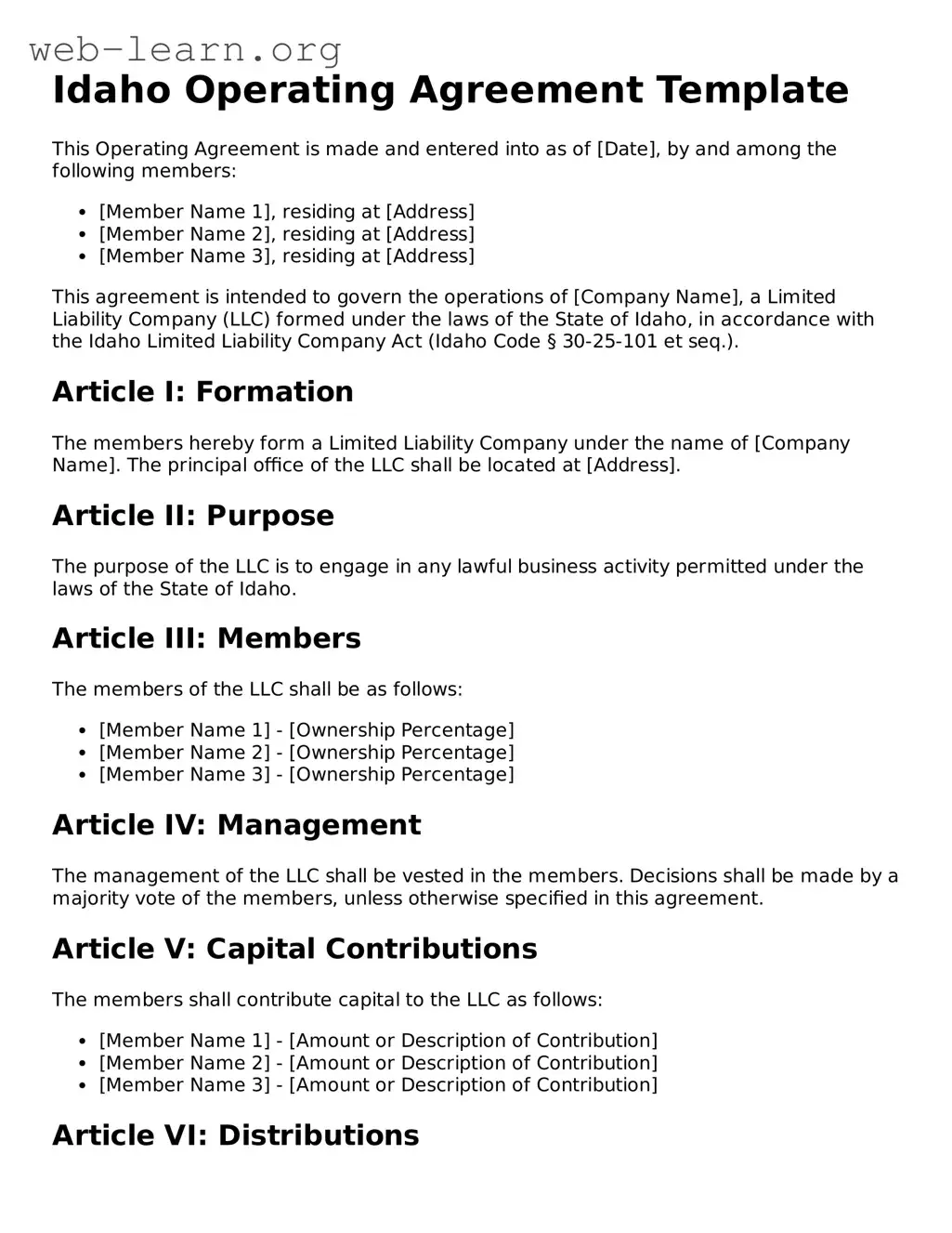
Idaho Operating Agreement Template
This Operating Agreement is made and entered into as of [Date], by and among the following members:
This agreement is intended to govern the operations of [Company Name], a Limited Liability Company (LLC) formed under the laws of the State of Idaho, in accordance with the Idaho Limited Liability Company Act (Idaho Code § 30-25-101 et seq.).
Article I: Formation
The members hereby form a Limited Liability Company under the name of [Company Name]. The principal office of the LLC shall be located at [Address].
Article II: Purpose
The purpose of the LLC is to engage in any lawful business activity permitted under the laws of the State of Idaho.
Article III: Members
The members of the LLC shall be as follows:
Article IV: Management
The management of the LLC shall be vested in the members. Decisions shall be made by a majority vote of the members, unless otherwise specified in this agreement.
Article V: Capital Contributions
The members shall contribute capital to the LLC as follows:
Article VI: Distributions
Distributions of profits and losses shall be allocated to the members in proportion to their respective ownership percentages, unless otherwise agreed upon in writing.
Article VII: Indemnification
The LLC shall indemnify any member or manager against any and all expenses and liabilities incurred in connection with the LLC, to the fullest extent permitted by Idaho law.
Article VIII: Amendments
This Operating Agreement may be amended only by a written agreement signed by all members.
Article IX: Governing Law
This agreement shall be governed by and construed in accordance with the laws of the State of Idaho.
IN WITNESS WHEREOF, the members have executed this Operating Agreement as of the date first above written.
______________________________
[Member Name 1]
______________________________
[Member Name 2]
______________________________
[Member Name 3]
| Fact Name | Details |
|---|---|
| Definition | The Idaho Operating Agreement is a document that outlines the management structure and operating procedures of a limited liability company (LLC). |
| Governing Law | The agreement is governed by the Idaho Limited Liability Company Act. |
| Purpose | It serves to clarify the rights and responsibilities of members and managers within the LLC. |
| Flexibility | The agreement allows for flexibility in management and operational structures, accommodating various business needs. |
| Member Contributions | It specifies the contributions of each member, including cash, property, and services. |
| Profit Distribution | The document outlines how profits and losses will be distributed among members. |
| Amendments | It includes provisions for how the agreement can be amended in the future. |
| Legal Protection | The operating agreement provides legal protection for members by establishing clear terms and conditions. |
Filling out the Idaho Operating Agreement form requires careful attention to detail. This document is essential for outlining the management structure and operational procedures of your business. Once you have completed the form, you will be able to move forward with establishing your business in Idaho.
What is an Idaho Operating Agreement?
An Idaho Operating Agreement is a legal document that outlines the management structure and operating procedures of a Limited Liability Company (LLC) formed in Idaho. It serves as a foundational document that specifies the rights, responsibilities, and obligations of the members of the LLC. This agreement is crucial for ensuring that all members are on the same page regarding how the business will operate.
Is an Operating Agreement required in Idaho?
While Idaho law does not mandate that LLCs have an Operating Agreement, it is highly recommended. Without this document, the LLC will be governed by the default rules set forth by state law, which may not align with the members' intentions. Having a tailored Operating Agreement can help prevent misunderstandings and disputes among members.
What should be included in an Idaho Operating Agreement?
An effective Operating Agreement should cover several key areas:
These elements help ensure clarity and provide a roadmap for how the LLC will function.
Can I change the Operating Agreement after it has been created?
Yes, an Operating Agreement can be amended. The process for making changes should be outlined within the agreement itself. Typically, a certain percentage of members must agree to the amendments. Keeping the Operating Agreement updated is important, especially as the business evolves or as members’ circumstances change.
How does an Operating Agreement protect members?
An Operating Agreement provides legal protection to the members of an LLC by clearly defining their roles and responsibilities. It helps to limit personal liability, as it establishes that the LLC is a separate legal entity. In the event of disputes or legal issues, having a well-drafted Operating Agreement can serve as evidence of the agreed-upon terms, thereby protecting members’ interests.
Where can I obtain an Idaho Operating Agreement form?
Idaho Operating Agreement forms can be found online through various legal document services or templates. However, it is advisable to consult with a legal professional to ensure that the agreement is tailored to your specific needs and complies with Idaho laws. Customizing the agreement can help address the unique aspects of your LLC and provide better protection for its members.
Filling out the Idaho Operating Agreement form can be a straightforward process, but several common mistakes can lead to complications. One frequent error is failing to include all members' names. Each member's full name should be listed to ensure clarity and legal recognition. Omitting a member can create disputes later regarding ownership and decision-making.
Another common mistake is not specifying the percentage of ownership for each member. This detail is crucial for determining profit distribution and voting rights. If ownership percentages are left blank or are inaccurately stated, it can lead to misunderstandings among members.
People often overlook the importance of detailing the management structure. The agreement should clearly outline whether the business will be managed by members or designated managers. Without this information, the management process can become ambiguous, leading to confusion and potential conflicts.
Many individuals neglect to include provisions for member meetings. Stating how often meetings will occur and the procedures for calling them can prevent future disagreements. If these details are absent, members may struggle to establish a consistent communication framework.
Another mistake is failing to address the process for adding or removing members. The agreement should outline how new members can join or how existing members can exit the business. Without this, the business may face challenges in adapting to changes in membership.
Some people do not specify the duration of the agreement. It is essential to indicate whether the agreement is for a fixed term or indefinite. An unclear duration can lead to disputes over the agreement's validity over time.
Inadequate attention to dispute resolution mechanisms is also a common error. The agreement should include a process for resolving conflicts among members. Without a clear resolution process, disputes may escalate, potentially harming the business.
Another mistake involves not considering the tax implications of the operating agreement. Members should understand how the agreement affects their tax responsibilities. Failing to address this can lead to unexpected tax liabilities.
People often forget to review the agreement periodically. An operating agreement should evolve as the business grows. Neglecting to update the agreement can result in outdated provisions that no longer reflect the business's current operations.
Lastly, many individuals skip the step of having the agreement reviewed by a legal professional. While it may seem unnecessary, expert review can help identify potential issues and ensure compliance with state laws. Ignoring this step can lead to serious legal complications down the line.
When establishing a business in Idaho, the Operating Agreement is a vital document for outlining the management structure and operational procedures of a Limited Liability Company (LLC). However, several other forms and documents are often used in conjunction with the Operating Agreement to ensure comprehensive legal compliance and clarity in business operations. Below is a list of five commonly used documents.
Incorporating these documents alongside the Idaho Operating Agreement will help ensure that your LLC operates smoothly and remains compliant with state regulations. Each document plays a distinct role in the governance and management of the business, contributing to its overall success.
When filling out the Idaho Operating Agreement form, it's essential to approach the process with care. Here’s a list of things you should and shouldn’t do to ensure everything is completed correctly.
By following these guidelines, you can help ensure that your Operating Agreement is completed accurately and effectively. This document is crucial for the smooth operation of your business, so take the time to do it right.
When dealing with the Idaho Operating Agreement form, several misconceptions can lead to confusion. Understanding these misconceptions is essential for anyone looking to establish or manage a business in Idaho.
This is not true. Even small businesses and single-member LLCs benefit from having an Operating Agreement. It outlines the structure and management of the business, which can help prevent disputes in the future.
In Idaho, the Operating Agreement is a private document. It is not filed with the state, meaning its contents are not accessible to the public. This allows members to maintain confidentiality regarding their business operations.
This is incorrect. The Idaho Operating Agreement does not need to be filed with any state agency. It is an internal document that governs the LLC's operations and can be kept on file with the business's records.
While it is advisable for all members to sign the Operating Agreement, it is not a legal requirement for validity. An unsigned agreement can still be enforceable if it can be demonstrated that all parties have agreed to its terms.
Filling out and using the Idaho Operating Agreement form is an important step for business owners in establishing their limited liability company (LLC). Here are six key takeaways to consider:
By paying attention to these key points, business owners can create a comprehensive Operating Agreement that serves as a foundation for their LLC's operations.
Operating Agreement Llc California Template - It may specify how decisions are documented and communicated.
How to File Operating Agreement Llc - The Operating Agreement may outline financial contributions of each member.